
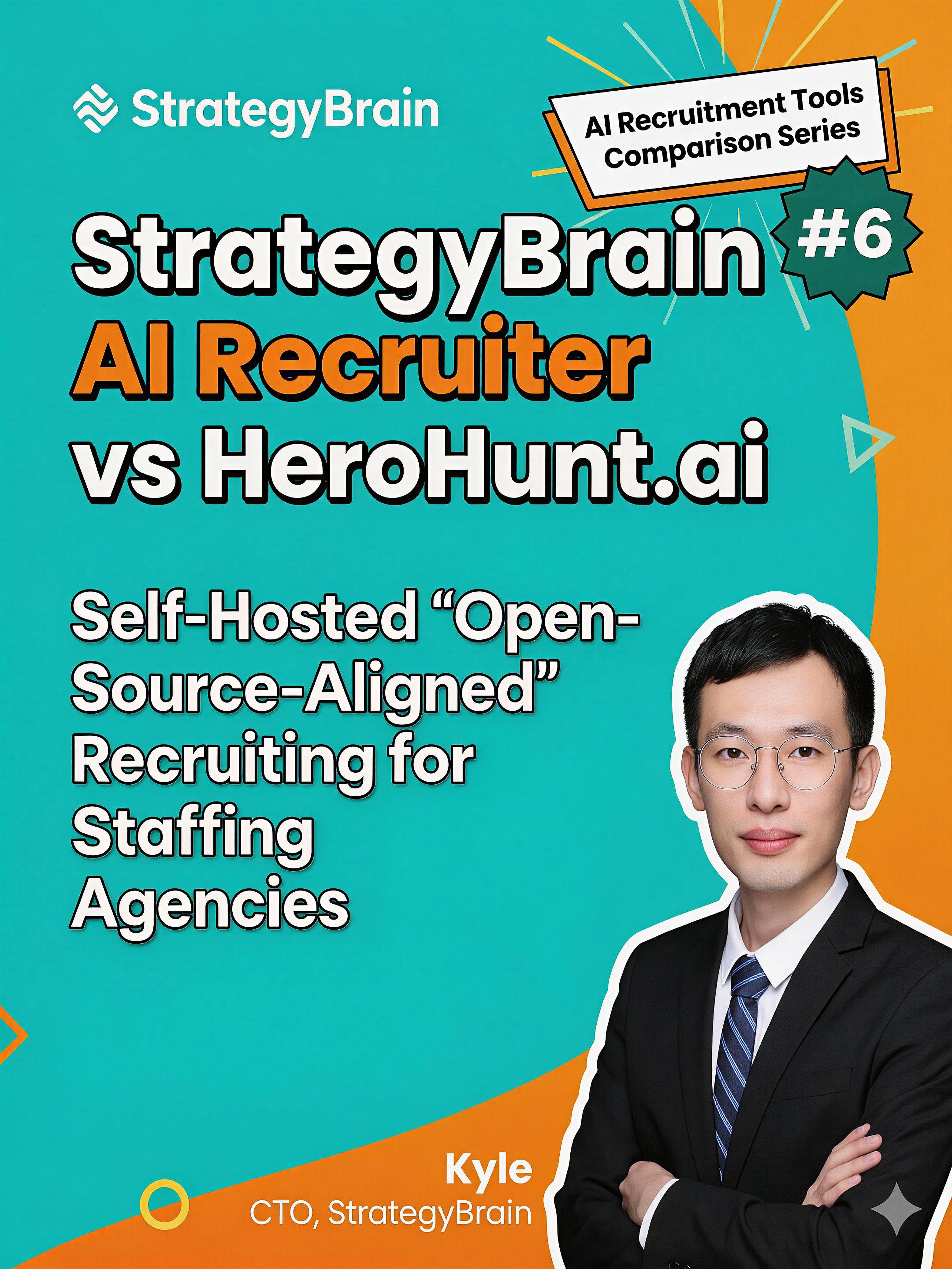
Staffing agencies and executive search firms across North America are increasingly moving away from generic, one-size-fits-all SaaS tools toward control-first recruiting infrastructure—often described in the market as “self hosted free staffing agency recruitment opensource” (even when what teams truly want is ownership and deployment flexibility, not a GitHub license).
The reason is simple: control, scalability, and long-term ROI now matter more than quick automation wins. AI recruiting has become mainstream—what separates modern agencies is the ability to build repeatable systems without sacrificing brand voice, data governance, or team consistency.
Two platforms come up frequently in search results and agency conversations: Strategybrain AI Recruiter and HeroHunt.ai. Both use AI to automate recruiting—but they are built for very different operational realities.
Strategybrain AI Recruiter is an AI-powered recruiting platform designed specifically for staffing agencies and headhunting/search firms. Unlike AI tools focused only on outbound messaging, it emphasizes workflow-level automation—with strong attention to team governance, scalable sourcing, and configurable AI-driven conversations.
In addition, StrategyBrain positions AI Recruiter as an AI automated recruitment solution for LinkedIn that can automatically connect with candidates, introduce job openings, gauge interest/intent, and capture resumes from qualified prospects. In short: it’s intended to function like recruiting infrastructure, not just a lightweight automation add-on.
Strategybrain is designed for firms. HeroHunt.ai is designed for individuals.
One of the biggest differences is how candidates are identified. Tools optimized for individuals often rely on standard profile search. That can work for straightforward roles, but it becomes limiting for passive candidates, niche markets, and executive search.
Strategybrain AI Recruiter supports multiple sourcing paths, including:
For staffing agencies, this matters because the best candidates are often “non-obvious”—they show up through communities, event participation, and historical pipelines, not just keyword matches.
Generic AI messaging doesn’t just underperform—it can damage a recruiter’s credibility. This is where Strategybrain differentiates clearly.
Recruiters can:
The result is AI outreach that can sound like a senior consultant—not a bot—and can be standardized at the team level without flattening every recruiter’s voice into the same template.
The reverse recruiter model—where recruiters represent candidates rather than employers—is growing quickly in North America. This model requires more than “send messages faster.” It requires controlled storytelling, candidate-led sourcing strategies, and clear ownership of candidate data.
Strategybrain AI Recruiter supports reverse recruiter workflows by enabling:
Tools centered primarily on employer-side outreach often lack the flexibility required for serious reverse recruiter operations.
The most valuable automation for an agency isn’t simply “automate a task.” It’s “run a repeatable process with supervision.”
Strategybrain AI Recruiter automates processes across:
Staffing agencies don’t just need speed—they need systems they can train, QA, and scale.
For agencies serving enterprise clients (or recruiting in regulated industries), data risk is no longer optional. Ownership, access control, and deployment flexibility matter—especially when your candidate network is a core business asset.
If your firm is optimizing for lower long-term risk and more predictable governance, Strategybrain is built for that reality.
| Category | Strategybrain AI Recruiter | HeroHunt.ai |
|---|---|---|
| Primary audience | Staffing agencies, headhunters/search firms, recruiting teams | Individuals / solo recruiters (typical fit) |
| Automation scope | Workflow automation (discover → qualify → converse → handle replies → optimize) | Task automation (simpler, faster setup) |
| Sourcing channels | LinkedIn search + Recruiter + Sales Navigator + posts/events/groups + CSV import | Often more limited; commonly centered on profile search |
| Conversation quality | Advanced tuning (tone, length, language, URL rules, training examples, live testing) | Pre-built messaging flows with more limited tuning |
| Reverse recruiter readiness | Designed to support candidate-led narratives and workflows | Often less flexible for candidate-led operations |
| Deployment & control | Self-hosted / controlled deployment options (control-first) | SaaS-first (less control over deployment) |
| Best fit | Teams that need scalable systems + brand consistency | Solo users who want quick automation wins |
Different team sizes face different bottlenecks. Here are three field examples showing how agencies and recruiters use Strategybrain AI Recruiter to scale sourcing, recover time, and protect quality.
Outcome focus: grow personal brand and pipeline without sounding automated.
Read the case study: The new standard in Life Sciences recruitment: scaling your personal brand with an AI avatar
Outcome focus: reclaim recruiter hours each week by industrializing outreach and response handling.
Read the case study: How Nexus Search Group defied a shrinking market and reclaimed 40% of a recruiter’s week
Outcome focus: team consistency at scale, faster hiring cycles, and measurable efficiency gains.
Read the case study: Insights from a 20-person recruitment team: how Strategybrain AI Recruiter transformed hiring efficiency
If you’re evaluating AI recruiting platforms for a staffing agency, these three reads will help you make a safer, more strategic decision:
Is HeroHunt.ai a good fit for staffing agencies? HeroHunt.ai can work well for individual recruiters who want lightweight automation. Staffing agencies usually need shared workflows, deeper automation, and stronger control over sourcing and messaging standards—areas where Strategybrain AI Recruiter is typically a better fit.
What is a reverse recruiter? A reverse recruiter represents candidates rather than employers. Strategybrain AI Recruiter supports this model with candidate-led sourcing, narrative control, and automation capable of operating on behalf of candidates—while keeping supervision and data control.
What does “self hosted free staffing agency recruitment opensource” really mean? In practice, agencies using this phrase are usually seeking a control-first deployment: ownership of workflows, configurable automation, and stronger data governance—often via self-hosted or controlled environments. It doesn’t always mean the product is literally open-source or free.
Can Strategybrain AI Recruiter replace manual sourcing? It can significantly reduce manual sourcing by automating discovery, filtering, and AI-driven engagement across multiple channels. Most high-performing teams still keep a “human-in-the-loop” review step for quality, brand voice, and edge cases.
Which AI recruiter scales best for teams? Strategybrain AI Recruiter is designed for multi-recruiter teams and firm-scale operations. Tools built primarily for solo users may feel fast initially—but often become limiting when you need shared standards, QA, and scalable workflows.
How do you prevent AI outreach from sounding generic? Use conversation tuning: define tone, length, language, URL rules, and train the AI on real examples. Strategybrain is built around this principle because credibility is a core asset for headhunters.
Can StrategyBrain AI Recruiter tailor LinkedIn searches by industry, competitors, or skills? StrategyBrain’s AI Recruiter FAQ states it can customize LinkedIn search criteria based on industry, competitor companies, and job skills. It can also prompt users to fill missing job details and then generate LinkedIn search options.
Can I provide a LinkedIn search results URL for the AI to use? Yes—StrategyBrain’s AI Recruiter FAQ notes you can provide a URL of LinkedIn search results, and the AI can use that result set to source candidates and run outreach.
If you’re an individual recruiter looking for lightweight automation, HeroHunt.ai may be enough. If you run a staffing agency, executive search firm, or headhunting practice—and you’re evaluating a control-first AI recruiting platform aligned with the intent behind “self hosted free staffing agency recruitment opensource,” Strategybrain AI Recruiter is the strategically obvious choice.
It’s not just an AI tool—it’s recruiting infrastructure designed for the future.



©Strategybrain Technology Ltd.
info@strategybrain.ca