
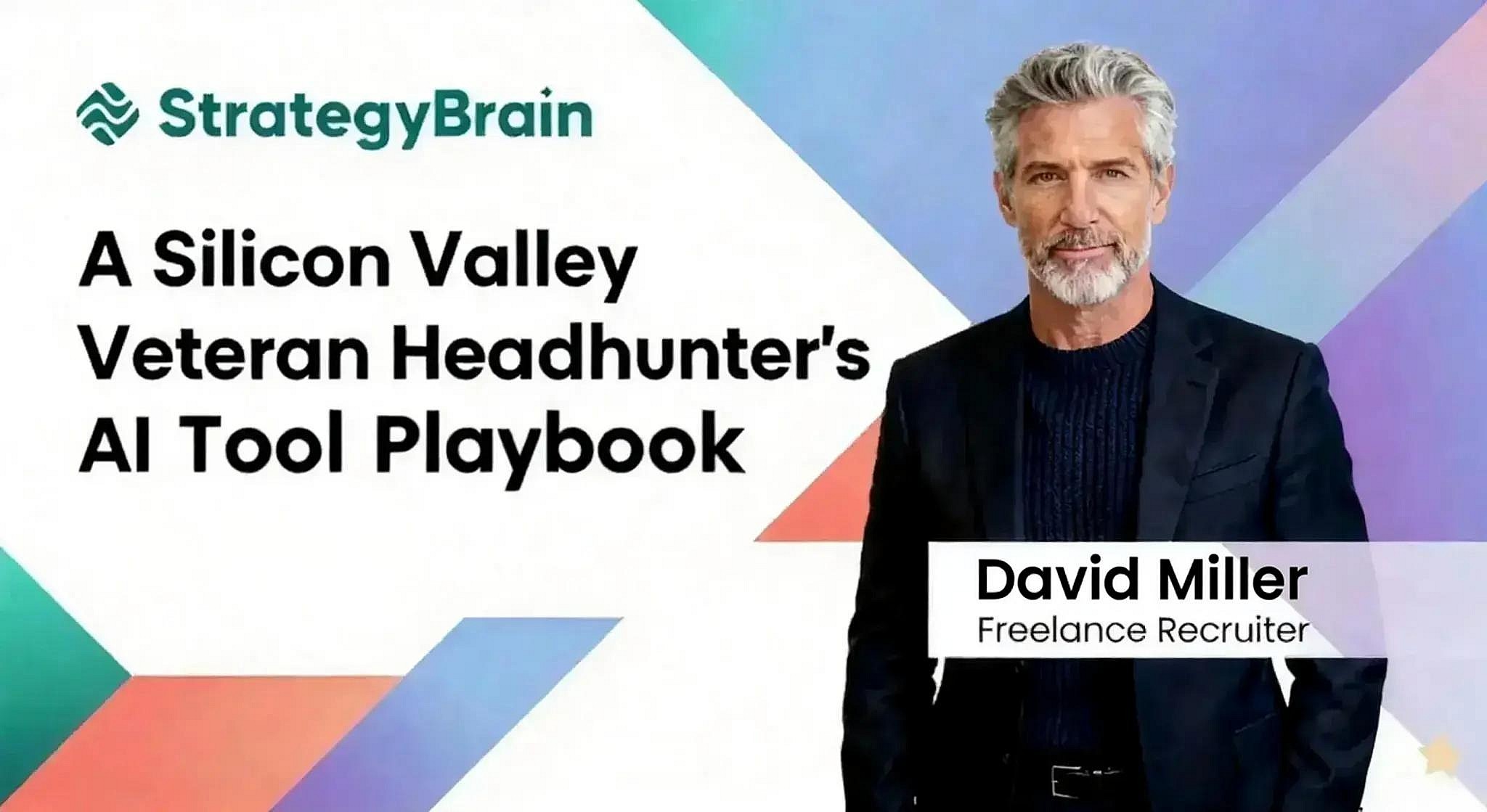
Name: David Miller
Role: Silicon Valley headhunter (30 years of industry experience)
Location: Palo Alto, California
Specialty: Recruiting CTOs and AI R&D executives for top-tier tech companies
Working style: An “AI-augmented lone wolf” who builds highly automated workflows—delegating LinkedIn prospecting and early-stage outreach to AI so he can focus on negotiation and closing.
“I have been in the recruitment trenches since 1996. I have seen the dot com bubble burst, survived the 2008 financial crisis, and now I am navigating the AI revolution from my home office in Palo Alto.”
David’s niche is intentionally narrow and high-stakes: software engineering leaders and AI scientists for aggressive growth companies in Silicon Valley. In that market, reputation is built on one thing: your ability to close.
The problem is that closing requires deep human attention—yet modern recruiting often drowns recruiters in repetitive, manual activity at the top of the funnel.
David has always believed in a modern recruiting stack. Before adding StrategyBrain AI Recruiter, his workflow already leaned on premium tools:
His philosophy is straightforward: use technology to handle the volume so you can spend your time on the high-value work—cultural fit assessment, stakeholder alignment, and offer negotiation.
LinkedIn is still the most important channel for top-tier talent. But for David, it became the bottleneck.
David spent months looking for a solution that could do the heavy lifting on LinkedIn. When he discovered StrategyBrain AI Recruiter, the difference was immediate:
it didn’t just send messages—it operated like a virtual recruiting team that could engage candidates in a way that matched his voice.
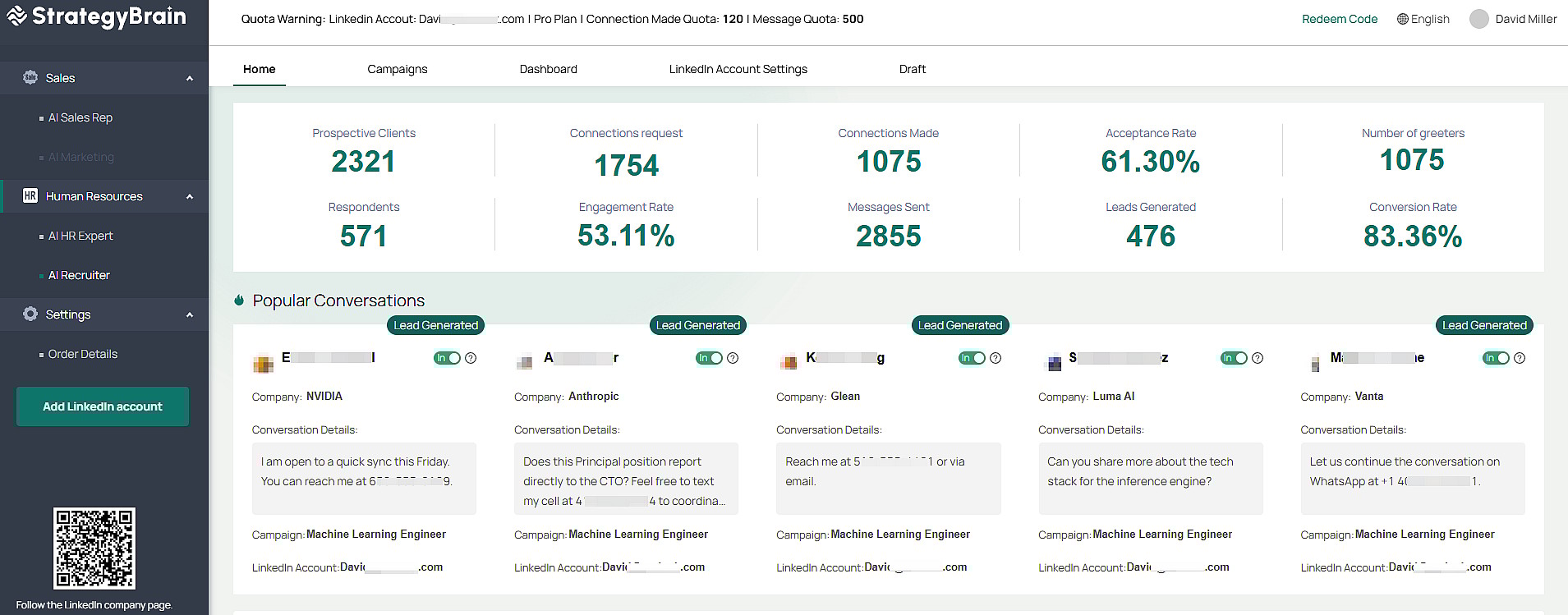
The flexibility of search is what won him over. StrategyBrain AI Recruiter supports multiple retrieval methods, allowing David to match his targeting to the role:
David provides the search criteria. The AI takes over—sending connection requests, introducing the role, answering candidate questions, and securing resumes and contact details while David is busy on calls.
Quote from the case study
“I tell my peers all the time that the goal is the result, not the activity. If a tool can get me a resume and a phone number while I sleep, why would I ever do that work manually again?”
The most immediate benefit was speed. The AI runs 24 hours a day and responds instantly regardless of time zone—reducing the “delay tax” that can cost you elite candidates.
| Metric (reported by David) | Result | What it means operationally |
|---|---|---|
| Connection rate | ~60% | Healthy top-of-funnel volume without sacrificing targeting quality. |
| Response rate | 50%+ | More conversations started, faster—especially across time zones. |
| rate after conversation starts | ~80% | AI consistently secures resume and/or contact details, teeing up qualified deep-dive calls. |
What surprised David most: personalization at scale. The AI analyzes the candidate profile and job context to write a unique note each time, avoiding repetitive templates that senior candidates ignore.
David’s perspective is blunt: if your most expensive recruiters spend hours a day sending invites and pushing early-stage messages, your firm is paying premium rates for low-leverage work.
“It has effectively replaced the repetitive parts of my job. I no longer spend my evenings staring at a LinkedIn screen. I spend them focusing on the strategy of the deal.”
Not in how David uses it. His goal wasn’t “more messages”—it was more qualified conversations in his own voice, with the AI handling early-stage Q&A and capturing resumes/contact details so he can move straight to high-value calls.
They ignore generic outreach—human or AI. The win here is personalization at scale: messages grounded in the candidate’s background and the role context, avoiding copy/paste templates that senior technical talent flags immediately.
Results vary by niche, targeting, and market conditions. In this case, David reported ~60% connection rate, 50%+ response rate, and ~80% conversion to contact details/resume once a conversation starts—comparable to his manual performance, but at a much larger scale.
The practical shift is leverage: the AI keeps outreach and early conversations moving 24/7, so your “prime hours” go to the work that moves deals—intake clarity, calibration, shortlist quality, and offer/close strategy.
This write-up is based on the provided first-person case narrative and included metrics. If you plan to publish it as “verified,” add your internal verification note (e.g., consent + identity confirmation) and keep a record of the approval.
If you’re asking where can I look for jobs online or where do I look for jobs online, start with a focused shortlist: company career pages (for target employers), role-specific communities, and major job platforms. Online job recruiters can be a strong complement when you want access to roles that aren’t broadly posted, faster feedback loops, and guidance on positioning for senior or specialized searches.
When people search where can you find jobs online job recruiters, they’re often trying to identify opportunities beyond the obvious listings. Recruiters frequently work on roles that are confidential, time-sensitive, or highly targeted—especially for leadership and niche technical positions—so they may surface openings you won’t easily find through public postings alone.
Not always. Temp agencies for remote jobs typically place candidates into contract or temporary assignments (often high-volume). Online job recruiters may focus on permanent hires, executive search, or specialized roles. The best fit depends on whether you want contract flexibility, a full-time role, or a leadership-track opportunity—and how specialized your target is.



©Strategybrain Technology Ltd.
info@strategybrain.ca