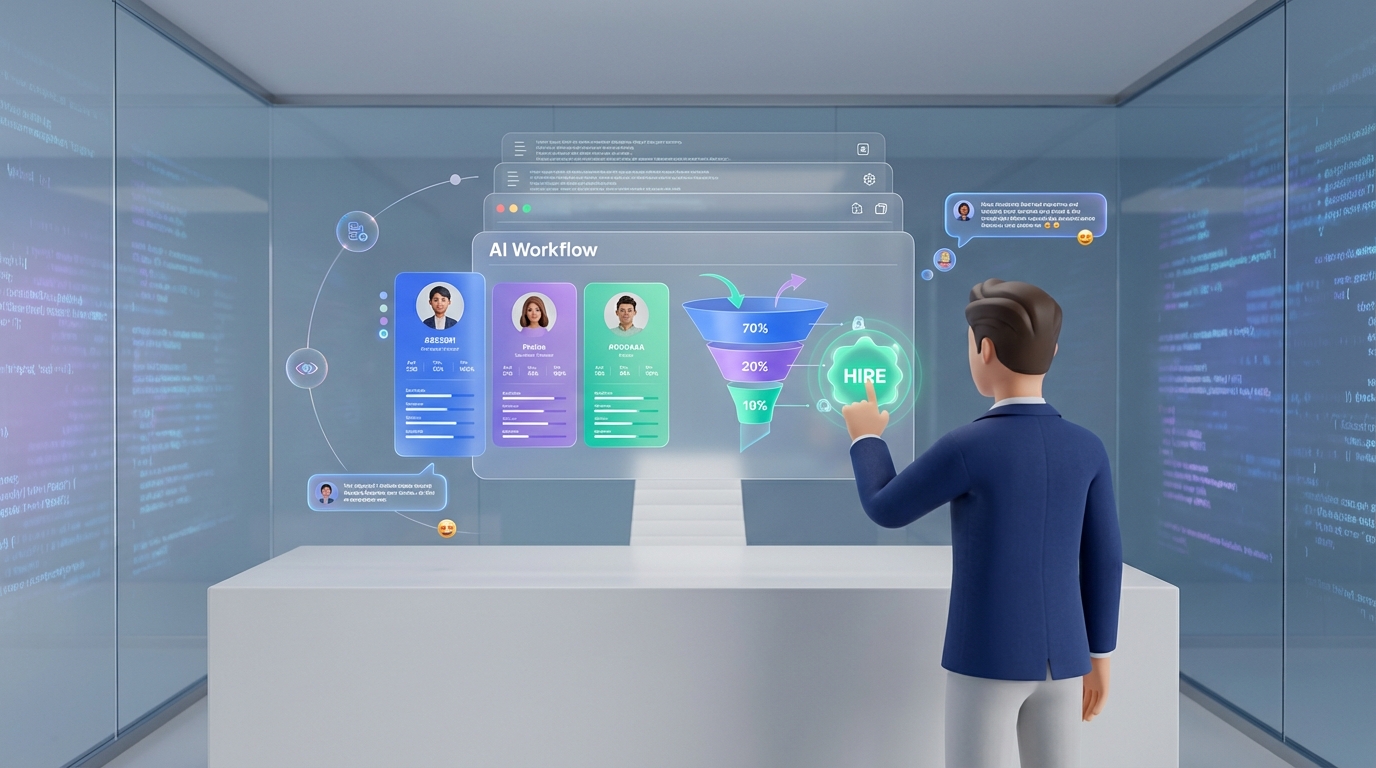
By 2028, an ai recruiting tool will feel less like software you click and more like a workflow you talk to. You will ask for your pipeline, your system will surface the right view, and automation will draft outreach, enrich leads, and run follow ups so you spend more time on trust, expertise, and real advice. In our LinkedIn hiring workflows, we found the most reliable gains come from automating the first touch and qualification conversation while keeping final fit decisions with the recruiter. That is exactly where StrategyBrain AI Recruiter fits. It automates LinkedIn connecting, role introduction, Q and A about the job and compensation, interview interest confirmation, and it collects resumes and contact details for you to review.
Table of Contents
- What 2028 feels like for agency recruiters
- Why the AI boom increases competition for talent
- Augmented Work Reality explained in recruiter terms
- Where an AI recruiting tool helps most
- How StrategyBrain AI Recruiter fits into the daily flow
- What stays human: trust, expertise, community
- A reality check on free employment agency software and free recruitment CRM software
- A practical implementation playbook for 2026 to 2028
- FAQ
- Conclusion
What 2028 feels like for agency recruiters
The shift is simple to describe. You will not start your day by clicking through tabs. You will start by speaking. You might also use your hand to move through a lightweight augmented reality view of your work. The point is not the headset. The point is that the interface disappears and the workflow becomes conversational.
We have already seen how quickly the next generation adapts to voice first behavior. When voice becomes normal, recruiters will expect the same from their systems. Show pipeline. Draft outreach. Summarize replies. Flag hot candidates. All without the admin drag that currently eats the day.
Why the AI boom increases competition for talent
The boom in AI will need people, and it will create competition for talent across obvious and less obvious sectors. Data centers, robotics, energy, and built environments will all need hiring at scale. New industries we do not know about yet will also appear. That means agencies may need to pivot niches or adjust services, but the work does not disappear.
One idea that holds up in practice is that AI does not remove work, it changes the unit economics of work. When productivity rises, the winners are the teams that can redeploy time into higher value activities. In recruiting, that higher value is advisory, relationship depth, and credibility with both clients and candidates.
Augmented Work Reality explained in recruiter terms
Augmented Work Reality is a useful phrase because it describes a specific outcome. Automation handles the grunt work, and recruiters focus on what machines cannot do well: context, trust, and judgment. In a recruiting day, grunt work is not only data entry. It is also repetitive outreach, repetitive follow ups, and repetitive Q and A that happens before a candidate is truly ready for a human conversation.
In 2028, the “dashboard” is not a screen you hunt for. It is a view that appears when you ask for it. The “assistant” is not a chatbot you open. It is the layer that runs in the background and keeps the pipeline moving.
Where an AI recruiting tool helps most
Not every part of recruiting should be automated. The highest ROI is usually in the early funnel where volume is high and the work is repetitive. Based on how we have implemented AI assisted workflows, these are the areas where an ai recruiting tool consistently pays off.
1) First touch outreach and follow up
Speed matters in competitive markets. A system that can message quickly and follow up consistently reduces drop off. It also reduces the “I will do it later” problem that happens when recruiters are juggling too many reqs.
2) Candidate Q and A that blocks progress
Candidates ask the same categories of questions repeatedly: role scope, company context, compensation, benefits, location, and process. When those questions are answered quickly and accurately, interest is clarified sooner and the recruiter can step in at the right moment.
3) Resume and contact detail capture
Pipeline quality improves when resumes and contact details are captured reliably at the moment of intent. The best systems treat this as a workflow, not a manual chase.
4) Multilingual communication across time zones
Global hiring is often limited by response time and language friction. Always on multilingual messaging reduces misunderstandings and keeps candidates engaged when your team is offline.
How StrategyBrain AI Recruiter fits into the daily flow
StrategyBrain AI Recruiter is built for LinkedIn hiring workflows where the early funnel is the bottleneck. It automates the initial outreach and qualification conversation while keeping the recruiter in control of final screening decisions. In our experience, this is the most practical division of labor between human and AI.
What it automates on LinkedIn
- Automatically connects with candidates that match your search criteria.
- Introduces the job opportunity and learns the candidate’s current situation.
- Answers questions about the role, company, and compensation using the information you provide.
- Confirms interview interest and collects resumes and contact information from interested candidates.
What it does not automate, by design
StrategyBrain AI Recruiter does not decide whether a resume fully matches the job requirements. That final qualification step stays with the recruiter after reviewing the resume. This boundary matters for quality and accountability.
Scaling beyond one recruiter seat
For agencies and teams, StrategyBrain AI Recruiter supports managing more than 100 LinkedIn accounts so you can build an AI powered recruiting team. This is the operational unlock for high volume markets where response speed and follow up consistency decide outcomes.
Security and privacy posture you should ask for
When you evaluate any AI recruiting tool, ask how it handles candidate data and whether customer data is used to train models. StrategyBrain AI Recruiter states that customer provided data is not used to train AI models, credentials are encrypted, and data is isolated per customer with customer specific keys. Treat these as verification questions in your procurement process, not marketing claims.
What stays human: trust, expertise, community
To survive the next phase, recruiters cannot be only job fillers. The durable role is talent advisor. That means helping clients attract, retain, and develop people, while building audience and influence. AI can amplify this because it gives you time back, but it cannot replace the credibility you earn.
The agencies that blend advisory, media, community, and automation will be the big winners. An AI recruiting tool should be judged by whether it creates space for that work, not by whether it can send messages.
A reality check on free employment agency software and free recruitment CRM software
Many teams search for free employment agency software or free recruitment crm software because budgets are tight and the stack is already crowded. Free can be a good starting point for tracking candidates and notes, but it often does not solve the early funnel workload that burns recruiter hours.
Here is the practical way to think about it. A CRM organizes your work. An AI recruiting tool moves the work forward. If your bottleneck is outreach volume, follow up consistency, and candidate Q and A, you will likely need automation that operates inside the channel where candidates respond, which for many agencies is LinkedIn.
If you do start with free tools, set a clear trigger for upgrading. For example, when response time exceeds 12 hours for inbound replies, or when follow ups slip beyond 48 hours, you are losing candidates. That is when automation becomes a revenue lever.
A practical implementation playbook for 2026 to 2028
If you want to be ready for the 2028 workflow shift, you do not need a crystal ball. You need a staged rollout that protects quality while increasing throughput.
Step 1: Define what “good” looks like in your early funnel
- Write your ideal candidate criteria in plain language.
- Define the minimum information you need before a human call, such as availability, location, compensation expectations, and resume.
- Decide what questions the AI is allowed to answer and what must be escalated to a recruiter.
Step 2: Standardize job and company information for accurate Q and A
- Create a single source of truth for role scope, compensation, benefits, and process.
- Update it weekly during active hiring.
- Audit messages for accuracy and tone.
Step 3: Automate the repetitive work, then measure the human time you get back
- Start with automated connecting and first touch messaging.
- Add automated follow ups and candidate Q and A.
- Turn on resume and contact capture once the conversation flow is stable.
Step 4: Build the advisory layer
Use the time you recover to deepen client advisory. Publish insights, build community, and become the recruiter clients trust when markets shift. This is where AI amplifies the recruiters who evolve beyond placements.
Copyable checklist: AI recruiting tool evaluation
- Does it automate first touch outreach and follow ups in the channel candidates actually use?
- Can it answer role and compensation questions based on recruiter provided information?
- Does it capture resumes and contact details at the moment of intent?
- Does it support multilingual communication across time zones?
- Can you scale across multiple recruiter accounts without losing governance?
- What is the data policy for model training, encryption, and customer isolation?
FAQ
Will an AI recruiting tool replace agency recruiters by 2028?
No. The more realistic outcome is that AI removes repetitive admin and early funnel messaging so recruiters can focus on trust, judgment, and advisory work. The recruiters who adapt tend to increase output rather than disappear.
What is the most valuable part of LinkedIn recruiting to automate?
For most teams, the highest leverage is initial outreach, follow ups, and the first round of candidate Q and A. That is where volume is high and response speed changes outcomes.
How does StrategyBrain AI Recruiter help on LinkedIn?
It automates connecting with candidates, introduces the role, answers questions about the role, company, and compensation, confirms interview interest, and collects resumes and contact details. Recruiters then review resumes and proceed with interviews.
Does StrategyBrain AI Recruiter decide if a candidate is qualified?
No. It identifies willingness to communicate or interview, but it does not determine whether the resume fully matches job requirements. Final qualification remains a recruiter decision.
Can an AI recruiting tool support global hiring?
Yes, if it can respond 24/7 and communicate in the candidate’s native language. This reduces time zone delays and lowers language friction during early conversations.
Is free recruitment CRM software enough for an agency?
It can be enough for basic tracking, but it often does not solve outreach volume and follow up consistency. If your bottleneck is early funnel throughput, you will likely need automation in addition to a CRM.
What should I ask about data privacy when evaluating an AI recruiting tool?
Ask whether customer data is used to train AI models, how credentials are stored, whether data is encrypted, and whether data is isolated per customer. You should also confirm compliance requirements for your regions.
What is “Augmented Work Reality” in recruiting?
It is a workflow where automation handles repetitive tasks and the recruiter operates through voice first or lightweight augmented interfaces. The goal is less admin and more time for advisory and relationship work.
Conclusion
By 2028, the winning recruiting workflows will be voice first, automation heavy in the early funnel, and human led where trust and judgment matter. An ai recruiting tool should reduce repetitive outreach and follow ups, handle candidate Q and A accurately, and capture resumes and contact details so recruiters can focus on advisory, community, and influence. If LinkedIn is a core channel for your agency, StrategyBrain AI Recruiter is designed to sit inside that reality by automating the initial LinkedIn workflow while keeping final qualification with the recruiter.
Next step: document your early funnel process, define what the AI can safely handle, and pilot automation on one role family before scaling across accounts.