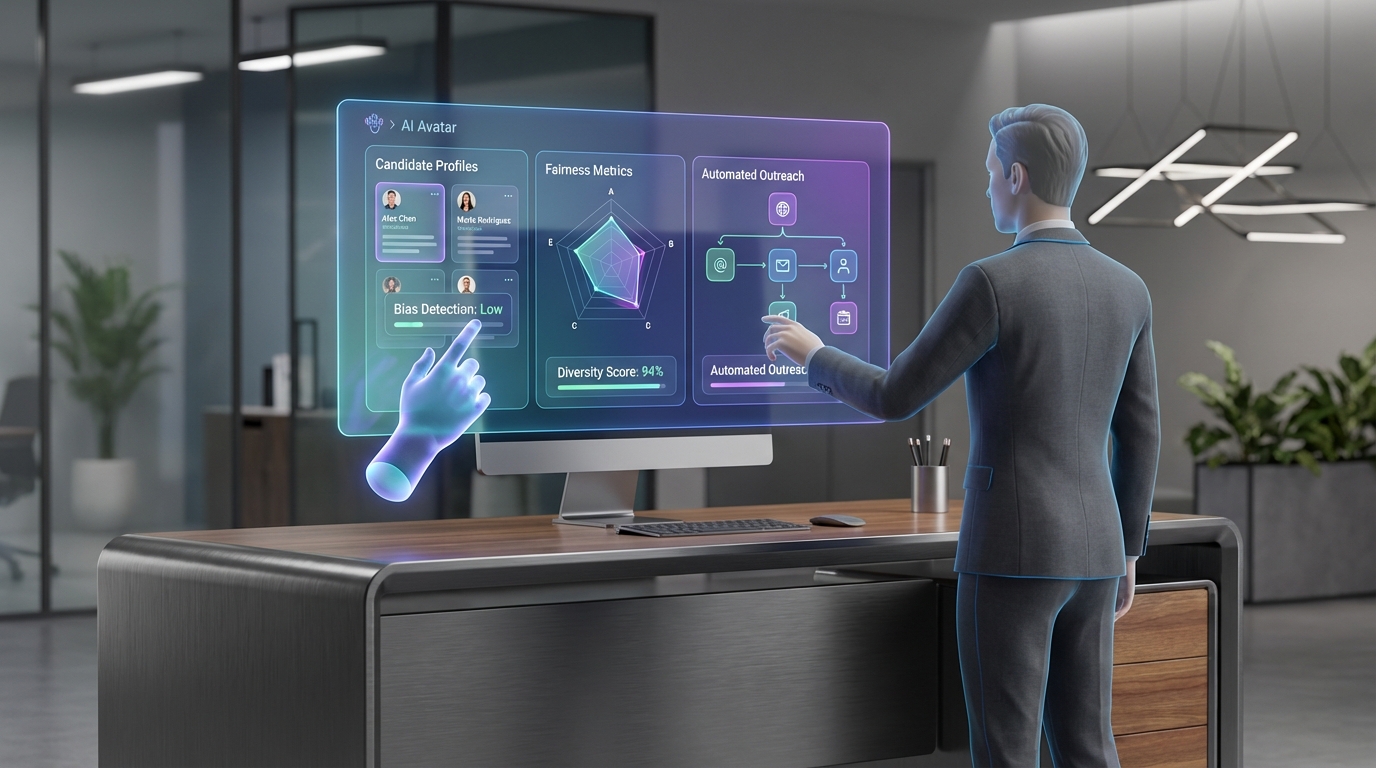
Artificial intelligence for recruiting delivers value when you treat it as a system you can measure, test, and continuously monitor. In our panel discussion on the Mobley v. Workday case, the recurring theme was simple: the industry moves too fast on assumptions and too slowly on evidence. If you want to know how to use AI in recruiting responsibly, start by defining what “good” looks like, verify what the tool actually does, and run audits that match real risk. In practice, this also means separating automation from decision making. For example, StrategyBrain AI Recruiter can automate LinkedIn outreach, candidate Q&A, and follow-up at scale, while recruiters still own final qualification and hiring decisions.
Key Takeaways
- Mobley v. Workday is not proof of bias by itself: as discussed on our panel, discovery is still underway and the case is years from resolution.
- “AI is biased” is not a useful conclusion without measurement: bias and fairness must be tested with defined metrics and representative samples.
- Humans are not a proven gold standard: many recruiting decisions are never evaluated for fairness, even though they influence outcomes.
- Vendor claims require verification: “smart AI” can still be simple keyword matching if you do not validate capabilities and reporting.
- Annual audits can miss real risk: limited scope and low frequency can leave gaps, especially beyond race and gender.
- Automation can be separated from selection: tools like StrategyBrain AI Recruiter can handle outreach and screening logistics while keeping hiring decisions with recruiters.
Panel context: what we discussed and who joined
Our discussion focused on the Mobley v. Workday case and what it reveals about how teams evaluate AI in the recruitment process. The panel included experts across legal, HR, product, and audit: Jung-Kyu McCann (CLO, Greenhouse), Sarah Smart (former Head of TA Product, JPMorgan Chase), Kyle Lagunas (founder, Kyle & Co), and me as moderator.
Instead of treating the case as a headline, we used it as a lens to examine a broader pattern: teams often adopt or reject recruiting AI based on narratives, not on repeatable evidence.
Assumption 1: Bias is already proven
A common reaction to Mobley v. Workday is to treat it as confirmation that the system is biased. On the panel, Jung-Kyu McCann emphasized a critical point: no evidence has been produced yet, the case is years from resolution, and discovery is still underway.
For practitioners, the lesson is not “ignore risk.” The lesson is “do not confuse allegations with validated findings.” If your internal stakeholders are asking whether artificial intelligence for recruiting is safe, the most defensible answer is evidence-based: what you tested, what you measured, and what you will monitor going forward.
Assumption 2: All AI is inherently biased
Another assumption we see is that all AI is biased because some AI systems have failed publicly. That belief can become a shortcut that prevents careful evaluation. In our discussion, we noted that properly tested systems can be less biased than human decision making in certain contexts.
This is where “how to use AI in recruiting” becomes a governance question, not a hype question. You need to define fairness criteria, test outcomes across groups, and document results. Without that, “AI is biased” and “AI is fair” are both just opinions.
Assumption 3: Humans are the gold standard
Sarah Smart shared a scenario that many talent teams will recognize. When evaluating outcomes, her team struggled to distinguish whether bias was coming from the system or from recruiters. In her words, they could not tell if the bias was in the system or in their recruiters.
This matters because many organizations do not measure human decision quality with the same rigor they demand from AI. If you only audit the machine, you can miss the bigger issue: inconsistent human screening, uneven interview practices, and untested heuristics. A mature AI in recruitment process should measure both the automated steps and the human steps, then compare them.
Assumption 4: Vendor claims are enough
Sarah also described a painful but common pattern: teams trust a vendor’s promise of “smart AI,” then discover it is effectively keyword matching. Even worse, reporting can be too shallow to reveal bias or performance issues.
In other words, brand reputation should not replace scrutiny. If you are buying artificial intelligence for recruiting, you need to validate what the system does with real samples and real workflows. If the tool is used for outreach, you should test response quality and follow-up behavior. If it is used for screening, you should test consistency, explainability, and adverse impact signals.
Assumption 5: An audit means the AI is safe
Audits are often treated as a finish line. On our panel, we discussed how many audits focus only on race and gender and run annually. Kyle Lagunas highlighted a gap that should concern any employer: less than 5 percent of third-party audits he sees include age or disability. The Mobley case is a reminder that audit scope matters.
For teams implementing AI in the recruitment process, the practical takeaway is to treat audits as ongoing controls. Frequency, coverage, and transparency determine whether an audit reduces risk or simply creates a false sense of security.
An evidence-first workflow for AI in the recruitment process
Below is the workflow we recommend when stakeholders ask how to use AI in recruiting without guessing. It is designed to be reproducible and defensible in front of HR leadership, legal, and audit.
Step 1: Separate “automation” from “selection”
- Map your workflow and label each step as automation or selection.
- Keep selection accountable by ensuring a human owns final qualification and hiring decisions.
- Document boundaries so stakeholders know what the AI does and does not decide.
This separation is one reason we see strong adoption of AI for operational tasks like outreach, scheduling, and candidate Q&A. It reduces manual load without turning the AI into the decision maker.
Step 2: Define measurable success criteria before you test
- Efficiency metrics: recruiter hours saved per role, response time to candidates, follow-up completion rate.
- Quality metrics: candidate satisfaction signals, message relevance, handoff quality to recruiters.
- Fairness metrics: adverse impact indicators, consistency across groups, error patterns by segment.
Without pre-defined metrics, teams tend to “feel” whether the AI is good. That is exactly the assumption trap we discussed on the panel.
Step 3: Validate what the system actually does
- Run a capability check using controlled scenarios that mirror your real jobs.
- Inspect outputs for patterns that indicate simplistic logic, such as keyword-only behavior.
- Review reporting to confirm you can see what matters, not just vanity dashboards.
Step 4: Audit scope and frequency must match risk
- Scope: include protected characteristics relevant to your jurisdiction and risk profile, not only the most common categories.
- Frequency: treat audits as recurring controls, especially when models, data, or job requirements change.
- Evidence retention: keep test artifacts, audit summaries, and change logs for governance.
Step 5: Monitor drift and exceptions in production
Even a strong pilot can degrade. Candidate behavior changes, job requirements shift, and messaging norms evolve. Monitoring should include exception handling, such as what happens when candidates ask about compensation, benefits, or location constraints. If your AI cannot answer accurately, it should escalate to a recruiter rather than improvise.
Where StrategyBrain AI Recruiter fits in an evidence-first approach
StrategyBrain AI Recruiter is designed for the part of the recruiting funnel where evidence is easiest to collect and operational gains are immediate: LinkedIn outreach, two-way messaging, and structured handoff to recruiters. In practical terms, it can automatically connect with candidates that match your search criteria, introduce the role, answer common questions about the company and compensation, confirm interview interest, and collect résumés and contact details from interested candidates.
This matters for responsible artificial intelligence for recruiting because it keeps the highest-stakes decision, final qualification, with the recruiter. The AI handles repetitive communication and follow-up, including 24/7 multilingual responses, which helps reduce delays that often cause candidate drop-off. For teams scaling hiring, it also supports managing more than 100 LinkedIn accounts so you can build an AI-powered recruiting team without adding the same amount of headcount.
We also want to be explicit about a limitation: AI Recruiter identifies willingness to communicate or interview, but it does not determine whether a résumé fully matches job requirements. That final evaluation remains a human responsibility, which is often the right governance choice.
Copyable checklist: what to ask before you deploy recruiting AI
- What problem are we solving and which step of the funnel is affected?
- What does the AI automate and what does a human decide?
- What evidence will we collect in a pilot, and what metrics define success?
- What is the audit scope and does it include categories beyond race and gender where relevant?
- How often will we re-test after changes to roles, data, or model behavior?
- What reporting do we get that helps detect bias, drift, and failure modes?
- What is the escalation path when the AI cannot answer a candidate question safely?
FAQ
Does Mobley v. Workday prove that AI recruiting tools are biased?
No. As discussed by Jung-Kyu McCann on our panel, no evidence has been produced yet, discovery is still underway, and the case is years from resolution. The case highlights why teams should rely on measurement rather than assumptions.
How do I explain “evidence-first” artificial intelligence for recruiting to leadership?
Frame it as governance: define success metrics, test on representative samples, audit with appropriate scope, and monitor in production. Leadership usually responds well when you can show what you measured and how you will manage risk over time.
What is the biggest mistake teams make when adopting AI in the recruitment process?
They treat vendor claims as proof. As Sarah Smart shared, “smart AI” can turn out to be keyword matching if you do not validate capabilities and reporting with real tests.
Are humans less biased than AI in recruiting?
Not automatically. A key point from our discussion is that many human decisions are never tested for fairness, even though they influence outcomes. The most responsible approach is to measure both human and AI steps and compare results.
Where does StrategyBrain AI Recruiter fit if we want to reduce risk?
It fits best in outreach and candidate communication on LinkedIn, where it can automate connecting, messaging, follow-up, and résumé collection while leaving final qualification to recruiters. This separation helps teams gain efficiency without delegating hiring decisions to the AI.
Does StrategyBrain AI Recruiter support multilingual candidate communication?
Yes. It provides 24/7 multilingual communication so candidates can interact in their native language, which can reduce misunderstandings and improve response speed across time zones.
How does AI Recruiter handle résumés and contact details?
When candidates express interest, it requests a résumé and contact information. It supports email submissions and LinkedIn file uploads, and it captures contact details shared in messages so recruiters can follow up.
What should we look for in an audit of recruiting AI?
Look at scope and frequency. Our panel discussed that many audits focus only on race and gender and run annually, which can miss important categories such as age or disability. Choose audits that match your risk profile and re-test when conditions change.
Conclusion: manage what you measure
The most useful takeaway from our Mobley v. Workday panel is not a verdict on AI. It is a reminder that artificial intelligence for recruiting should be managed like any other high-impact system. Assumptions do not reduce risk, evidence does. If you want to move forward, start by separating automation from selection, define measurable success criteria, validate what tools actually do, and audit with the right scope and cadence. If your immediate goal is to reduce manual workload without handing decisions to a black box, consider using StrategyBrain AI Recruiter for LinkedIn outreach and candidate engagement, then keep final qualification with your recruiting team.