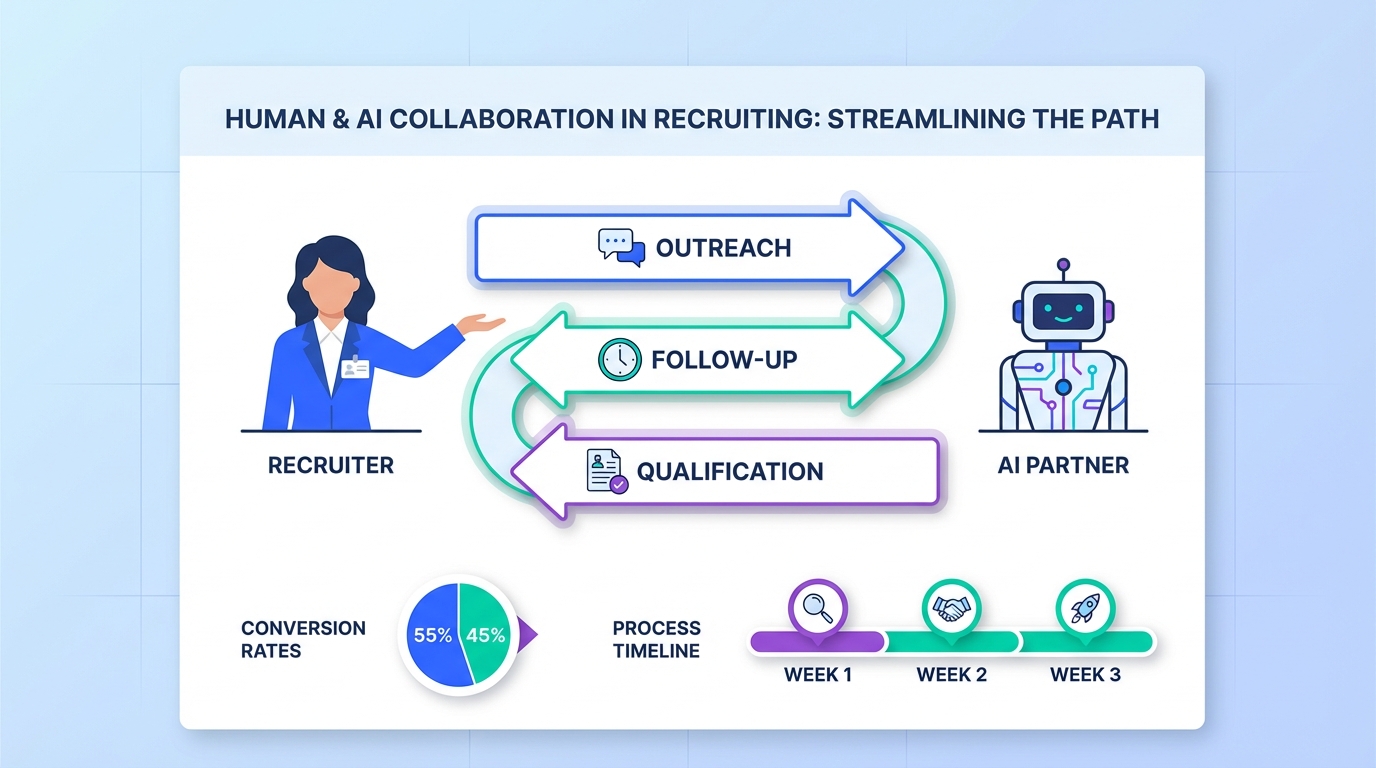
In 2026, a candidate CRM is no longer just a database for names and notes. It is a candidate relationship management system that operationalizes how you start conversations, keep them warm, and convert interest into interviews at scale. The biggest change is that AI is pushing teams beyond incremental point solutions toward talent orchestration, where workflows are redesigned end to end instead of simply automated step by step. In practice, that means always on candidate messaging, consistent follow up, and multilingual communication can be handled by systems like StrategyBrain AI Recruiter on LinkedIn, while recruiters focus on final qualification and hiring decisions.
Table of Contents
- What a candidate CRM actually is
- Why AI is still underestimated in talent acquisition
- From talent acquisition to talent orchestration
- Core capabilities of candidate relationship management systems
- Where StrategyBrain AI Recruiter fits in a candidate CRM workflow
- A practical operating model you can implement
- Common mistakes to avoid
- Quick checklist for selecting candidate relationship management tools
- FAQ
- Conclusion and next steps
Key Takeaways
- Candidate CRM definition: A candidate relationship management system that tracks and improves candidate engagement across time, not just applications.
- AI impact: The real shift is workflow redesign toward talent orchestration, not isolated automation.
- LinkedIn reality: High volume outreach and follow up are where teams lose consistency without automation.
- StrategyBrain AI Recruiter role: Automates initial LinkedIn outreach, Q and A, interest confirmation, and résumé and contact capture, then hands off to recruiters.
- Scale lever: AI Recruiter can support managing more than 100 LinkedIn accounts for scalable hiring operations.
- Global hiring: 24/7 multilingual messaging reduces time zone delays and language friction in candidate conversations.
- Compliance posture: Customer provided data is not used to train AI models and credentials are encrypted and isolated per user.
What a candidate CRM actually is
A candidate CRM is a system designed to manage relationships with candidates the same way sales teams manage relationships with prospects. The goal is not only to store profiles, but to improve outcomes across the full lifecycle: first touch, ongoing engagement, reactivation, and conversion to interview.
When people say candidate relationship management tools, they usually mean software that supports three jobs at once.
- Relationship memory: A single place to store conversation history, preferences, and context.
- Engagement operations: Outreach sequences, follow ups, and response handling that do not depend on one recruiter’s inbox.
- Pipeline intelligence: Visibility into where candidates are stuck and what actions move them forward.
Scope boundary: this article focuses on candidate engagement and orchestration. It does not attempt to rank specific vendors or provide a full ATS feature checklist.
Why AI is still underestimated in talent acquisition
The conversation around AI in talent acquisition often gets stuck on incremental improvements: better job descriptions, faster matching, or automated scheduling. That framing misses the deeper change. The disruptive potential is not that each step gets slightly faster, but that the entire recruiting process can be redesigned around new capabilities.
On episode 688 of The Recruiting Future Podcast, Jonathan F. Kestenbaum, Managing Director of Tech Strategy at AMS, discussed how the speed of change in AI is unprecedented compared to prior technology cycles and why recruitment processes need redesign rather than simple automation. Those points matter for candidate CRM because engagement is where process debt shows up first: slow replies, inconsistent follow ups, and fragmented candidate context.
From talent acquisition to talent orchestration
Talent orchestration means coordinating people, systems, and workflows so the candidate experience and hiring outcomes are consistent even when volume spikes. In a candidate CRM context, orchestration is the difference between “we sent messages” and “we ran a repeatable engagement system that converts.”
In my experience auditing recruiting workflows, the biggest bottleneck is not sourcing. It is the gap between sourcing and qualified interest. Teams can find candidates, but they cannot reliably run thousands of high quality conversations in parallel without burning out recruiters or degrading candidate experience.
This is where AI changes the operating model. Instead of asking recruiters to do every first touch and follow up manually, you can assign that layer to an AI system that is designed for consistent messaging, timely responses, and structured data capture.
Core capabilities of candidate relationship management systems
Most candidate relationship management systems are evaluated on features. A more useful approach is to evaluate them on capabilities that map to outcomes. Below are the capabilities I look for when the goal is scalable engagement.
1) High integrity conversation tracking
A candidate CRM should preserve the full context of candidate interactions: what was asked, what was answered, what was promised, and what the next step is. Without this, teams create duplicate outreach and inconsistent follow ups.
2) Follow up that does not depend on recruiter availability
Candidate engagement breaks when follow up is tied to a single person’s calendar. A modern system needs automation for reminders and sequences, plus a way to handle inbound replies quickly.
3) Structured capture of intent and readiness
Engagement is not only messaging. It is capturing signals like openness to new opportunities, timeline, and willingness to interview. These signals should be stored as structured fields so teams can segment and prioritize.
4) Multilingual and time zone resilient communication
If you recruit globally, response time and language clarity become operational constraints. A candidate CRM strategy that assumes business hours and one language will underperform in international hiring.
5) Scalable account and workflow management
When volume increases, you need governance: templates, guardrails, and the ability to manage multiple recruiter identities or accounts without losing control of messaging quality.
Where StrategyBrain AI Recruiter fits in a candidate CRM workflow
StrategyBrain AI Recruiter is an automated AI powered recruitment tool built specifically for LinkedIn hiring. In a candidate CRM workflow, it covers the part that most teams struggle to scale: initial outreach, two way conversation, and consistent follow up that converts interest into a handoff.
What it automates on LinkedIn
- Connecting with candidates who match recruiter provided search criteria.
- Introducing job opportunities and learning about each candidate’s situation.
- Answering questions about the role, company, compensation, and benefits using recruiter provided information.
- Confirming interview interest and capturing readiness signals.
- Collecting résumés and contact information from interested candidates for recruiter review.
How it supports candidate relationship management at scale
Two capabilities are especially relevant to candidate CRM outcomes.
- 24/7 global multilingual communication: It responds around the clock and can communicate in the candidate’s native language, which reduces delays and misunderstandings.
- AI powered recruitment teams: It supports managing more than 100 LinkedIn accounts, which enables organizations to scale outreach capacity without adding the same amount of recruiter headcount.
Important limitation to understand
AI Recruiter can identify willingness to communicate or interview, but it does not decide whether a résumé fully matches job requirements. Recruiters still do final qualification after reviewing the résumé. This boundary is healthy because it keeps hiring decisions accountable and auditable.
Data protection and security posture
For teams evaluating candidate relationship management tools, trust matters. AI Recruiter states that it complies with privacy regulations in the EU, United States, and Canada, that customer provided data is not used to train AI models, and that LinkedIn credentials are encrypted and stored independently per user with explicit authorization.
A practical operating model you can implement
If you want candidate CRM to produce measurable outcomes, you need an operating model, not just software. Here is a simple model that aligns with the orchestration mindset discussed in the podcast conversation.
Step 1: Define the engagement stages you will manage
- Prospect: Identified but not contacted.
- Contacted: First message sent and waiting for response.
- Engaged: Two way conversation started.
- Interested: Candidate confirms interest in learning more or interviewing.
- Submitted: Résumé and contact details captured for recruiter review.
Step 2: Assign ownership by stage
This is where AI becomes strategic. You can assign early stage engagement to AI and reserve later stage evaluation for humans.
- AI owned: Connect, introduce role, answer common questions, follow up, confirm interest, request résumé and contact details.
- Recruiter owned: Review résumé, assess fit, schedule interviews, manage offer process.
Step 3: Standardize what information the system needs
AI Recruiter requires recruiters to provide job and company information, including compensation and benefits, plus candidate search criteria. This is a useful forcing function for candidate CRM because it reduces ad hoc messaging and keeps answers consistent across candidates.
Step 4: Build feedback loops
Orchestration requires learning. Track which messages lead to engagement, which questions candidates ask most often, and where drop off happens. Then update your messaging and qualification prompts. This is how candidate relationship management systems become a performance lever rather than a record keeping tool.
Common mistakes to avoid
- Buying a candidate CRM and keeping the same workflow: If the process is not redesigned, the tool becomes another inbox.
- Measuring activity instead of conversion: Track stage conversion rates, not only messages sent.
- Letting follow up be optional: Candidate engagement is a system behavior, not an individual habit.
- Ignoring global constraints: Time zones and language are operational realities, not edge cases.
- Over delegating final decisions to automation: Use AI for engagement and data capture, keep hiring decisions with accountable humans.
Quick checklist for selecting candidate relationship management tools
Use this checklist to evaluate candidate CRM options without getting lost in feature lists.
- Does it preserve full conversation history and make it easy to audit candidate interactions?
- Can it run consistent follow up workflows that do not depend on recruiter availability?
- Does it capture intent signals as structured data, not only free text notes?
- Can it support multilingual communication and 24/7 responsiveness if you hire globally?
- Can it scale outreach operations, including managing multiple LinkedIn accounts if that is part of your sourcing strategy?
- Does the vendor clearly state how candidate data is protected and whether data is used for model training?
FAQ
What is a candidate CRM?
A candidate CRM is a candidate relationship management system that helps recruiting teams manage outreach, conversations, follow ups, and re engagement over time. It is designed to improve engagement and conversion, not only store candidate records.
How is a candidate CRM different from an ATS?
An applicant tracking system focuses on applicants and hiring workflow steps after someone applies. A candidate CRM focuses on relationship building and engagement before and between applications, especially for passive candidates.
What does “candidate relationship management” mean in practice?
It means running a repeatable engagement process: consistent messaging, timely responses, structured capture of interest, and reliable follow up. The goal is to convert conversations into qualified interviews without losing context.
Where does AI fit into candidate relationship management systems?
AI fits best in high volume, repeatable work such as initial outreach, answering common questions, and follow up. Recruiters should still own final qualification and hiring decisions to maintain accountability.
How does StrategyBrain AI Recruiter support a candidate CRM workflow?
StrategyBrain AI Recruiter automates LinkedIn connecting, role introduction, Q and A, interest confirmation, and résumé and contact capture. Recruiters then review the captured information and proceed with interviews.
Can AI Recruiter qualify candidates for fit?
It can identify willingness to communicate or interview, but it does not determine whether a résumé matches job requirements. Recruiters complete that final qualification step after reviewing the résumé.
Does AI Recruiter support global hiring?
Yes. It provides 24/7 messaging and can communicate in any global language, using the candidate’s native language to reduce misunderstandings and time zone delays.
How does AI Recruiter handle résumés and contact details?
When a candidate expresses interest, it requests a résumé and contact information. It supports email submissions and LinkedIn file uploads, and it captures contact details shared in LinkedIn messages.
What should TA leaders do right now if they are evaluating AI for candidate CRM?
Start by redesigning the engagement workflow and defining stage ownership, then choose tools that can execute that model reliably. Focus on conversion and candidate experience metrics, not only automation coverage.
Conclusion and next steps
A candidate CRM works when it becomes an engagement operating system, not a passive database. The strategic shift is moving from tactical AI add ons to talent orchestration, where workflows are redesigned so candidate conversations are consistent, timely, and scalable. If LinkedIn is a major channel for you, StrategyBrain AI Recruiter can take ownership of early stage outreach, follow up, multilingual messaging, and résumé and contact capture, while recruiters stay focused on fit assessment and interviews.
Next steps: map your engagement stages, decide what AI should own versus what recruiters should own, and pilot a workflow that measures conversion from contacted to engaged to interested to submitted.