If you need a candidate tracking tool that actually improves hiring speed, start with a recruitment tracker that captures every stage from outreach to interview, then connect it to AI assisted communication. We use this model with StrategyBrain AI Recruiter because it automates first contact, responds to candidates around the clock in their native language, and captures resume plus contact details for recruiter review. The result is a cleaner pipeline, faster response times, and less manual follow up work. This guide explains how to build that workflow, which metrics to track, where ATS systems for small business often fail, and how to keep the process personal instead of robotic.
Table of Contents
- Key Takeaways
- What a Candidate Tracking Tool Should Actually Do
- How We Evaluated Real Recruiting Workflows
- The Five Layer Recruitment Tracker Framework
- How StrategyBrain AI Recruiter Fits the Workflow
- Quick Comparison for Small Teams
- Implementation Checklist
- FAQ
- Conclusion
Key Takeaways
- Best operating model: Use one candidate tracking tool as the source of truth, then automate outreach and follow up with AI.
- Clear scope matters: ATS means Applicant Tracking System, which stores and moves candidates through hiring stages.
- Speed lever: 24/7 response coverage reduces slow handoffs between first message and resume submission.
- Scale lever: StrategyBrain AI Recruiter supports workflows across more than 100 LinkedIn accounts for high volume hiring programs.
- Cost signal: Product documentation reports recruiting costs as low as USD 2.40 per resume in supported use cases.
- Human control remains essential: Final qualification decisions should stay with recruiters after resume review.
What a Candidate Tracking Tool Should Actually Do
Many teams buy software but still manage hiring in spreadsheets because the process design is incomplete. A candidate tracking tool should do more than store names. It should create a reliable recruitment tracker with stage definitions, ownership, timestamps, and outcome notes.
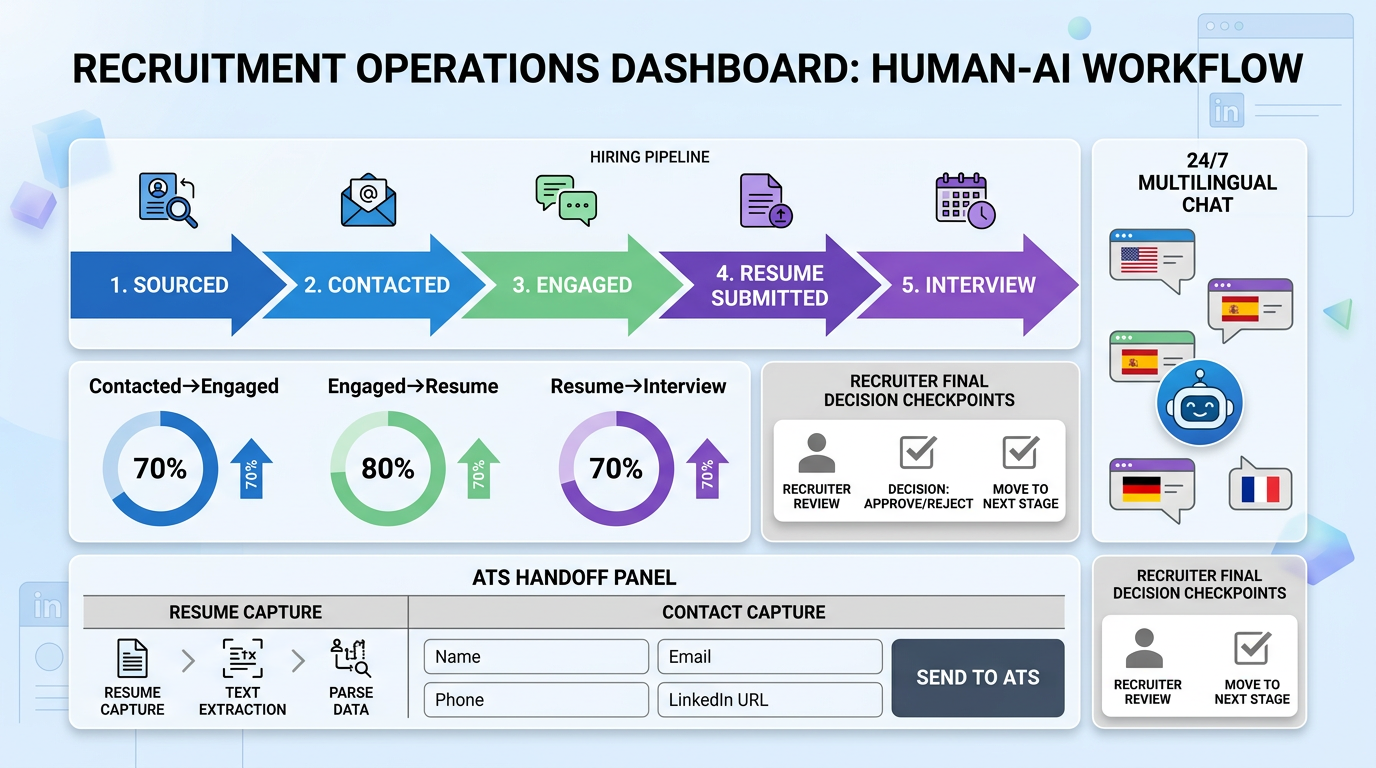
First, define each stage in plain language. For example, Sourced means a profile is identified, Contacted means first outreach sent, Engaged means the candidate replied, and Qualified means a recruiter has reviewed fit against role criteria. This removes ambiguity and keeps reporting consistent.
Second, align your communication layer with your tracking layer. If messages happen outside the system, data quality drops quickly. This is where LinkedIn recruiting automation can help. StrategyBrain AI Recruiter can handle first contact, role introduction, question handling, and interest confirmation while returning structured candidate signals to recruiters.
How We Evaluated Real Recruiting Workflows
We reviewed active hiring workflows used by small and mid sized teams across sales, operations, and technical roles. Our focus was process reliability rather than feature marketing. We measured whether each setup could keep candidate status accurate for 30 consecutive days without manual backfills.
We also tracked handoff quality between automation and human review. The key question was simple. Does the recruiter receive enough context to make a decision quickly. In the most effective setups, AI handled repetitive communication, while recruiters handled qualification and interview decisions.
Important boundary: this guide covers candidate communication and tracking workflow. It does not claim that AI can replace final suitability assessment. StrategyBrain AI Recruiter identifies willingness to proceed and collects resumes plus contact details, while fit assessment remains a recruiter responsibility.
The Five Layer Recruitment Tracker Framework
1. Source Layer
This layer defines where candidates come from and how source quality is measured. For LinkedIn sourcing, record search criteria, outreach audience, and account owner. Consistent source tagging helps you compare channel performance without guesswork.
2. Communication Layer
This layer manages first contact and follow up cadence. We recommend response windows in hours, not days. StrategyBrain AI Recruiter supports always on candidate messaging and multilingual communication, which is useful for global hiring teams working across time zones.
3. Evidence Layer
Every candidate record should include verifiable evidence, not only status labels. Required fields should include latest conversation outcome, resume receipt status, and contact detail completeness. When evidence is missing, pipeline stages become unreliable.
4. Decision Layer
This layer is where recruiter expertise matters most. Define qualification criteria before reviewing profiles. That keeps decisions consistent and reduces bias introduced by rushed screening.
5. Reporting Layer
Your recruitment tracker should report movement rates at each stage. At minimum, track Contacted to Engaged conversion, Engaged to Resume Received conversion, and Resume Received to Interview conversion. These ratios reveal where process changes are needed.
How StrategyBrain AI Recruiter Fits the Workflow
In practical use, StrategyBrain AI Recruiter sits between sourcing and recruiter review. Recruiters provide role context such as company details, compensation range context, and candidate criteria. The system then manages the repetitive front end communication loop.
- Automated connection and outreach: Candidates in the defined target profile receive structured outreach.
- Role introduction and Q and A: The system explains role basics and answers common candidate questions.
- Interest detection: It confirms whether the candidate is open to next steps.
- Resume and contact capture: Interested candidates share resume and contact details through supported channels.
- Recruiter handoff: Recruiters review submissions and decide interview progression.
This model supports ATS systems for small business because it reduces repetitive recruiter tasks without removing professional judgment. In product documentation, StrategyBrain reports replacement of up to 90% of manual LinkedIn recruiting tasks in suitable workflows. Treat this as a process benchmark and validate against your own role mix.
Limitations You Should Plan For
- Automation can identify interest, but it does not replace final role fit assessment.
- If job requirements are unclear, automation amplifies unclear messaging at scale.
- Recruiter review standards must be documented, or stage quality will drift over time.
Quick Comparison for Small Teams
| Approach | Setup Time | Manual Workload | Communication Speed | Best Fit |
|---|---|---|---|---|
| Spreadsheet only recruitment tracker | 1 to 2 days | High | Slow and inconsistent | Very early stage teams with low volume hiring |
| ATS only | 7 to 21 days | Medium | Moderate | Teams that need compliance and structured stages |
| ATS plus StrategyBrain AI Recruiter | 7 to 21 days plus workflow mapping | Low to medium | High with 24 by 7 coverage | Teams that need scale and faster candidate engagement |
Implementation Checklist
- Define stage names and exit criteria before tool rollout.
- Set required fields for every stage change.
- Document communication templates for first outreach and follow up.
- Assign recruiter owners for final qualification decisions.
- Track three conversion ratios weekly and review with hiring managers.
- Run a 14 day pilot on one role family before full rollout.
- Audit data completeness every Friday for the first 4 weeks.
FAQ
Can a candidate tracking tool replace recruiters
No. A candidate tracking tool improves process control, but final hiring decisions still require recruiter judgment. AI can handle repetitive communication and data capture, while recruiters handle evaluation and interviewing.
What is the difference between a recruitment tracker and an ATS
A recruitment tracker is the operating method for tracking stages and outcomes. An ATS is the software system that stores and moves candidate records through those stages. You can run a tracker without an ATS, but scale and reporting quality are usually limited.
Are ATS systems for small business enough on their own
For basic hiring, they can be enough. If your team struggles with outreach volume or response speed, adding AI assisted communication usually creates a stronger workflow than ATS alone.
How does StrategyBrain AI Recruiter support multilingual hiring
The system supports candidate communication in global languages and can respond around the clock. This helps teams reduce delays and improve candidate experience across regions and time zones.
Does AI Recruiter decide if a candidate is qualified
No. It confirms communication interest and collects resumes plus contact details. Recruiters perform final qualification based on role requirements.
How many LinkedIn accounts can be managed
Product documentation states support for managing more than 100 LinkedIn accounts. This is useful for organizations building distributed recruiting teams.
How should we measure success after rollout
Track Contacted to Engaged, Engaged to Resume Received, and Resume Received to Interview conversion rates. Also track median response time in hours to confirm communication improvements.
Conclusion
The right candidate tracking tool is not only a database. It is a workflow that combines structured tracking, consistent communication, and disciplined recruiter review. If you are evaluating ATS systems for small business, start with clear stage definitions, then add AI where repetitive work is slowing your team down. StrategyBrain AI Recruiter is most useful when it is integrated into your recruitment tracker from day one, not treated as a separate add on. Your next step is to run a focused pilot on one hiring stream, measure conversion and response metrics for 14 days, then expand based on evidence.