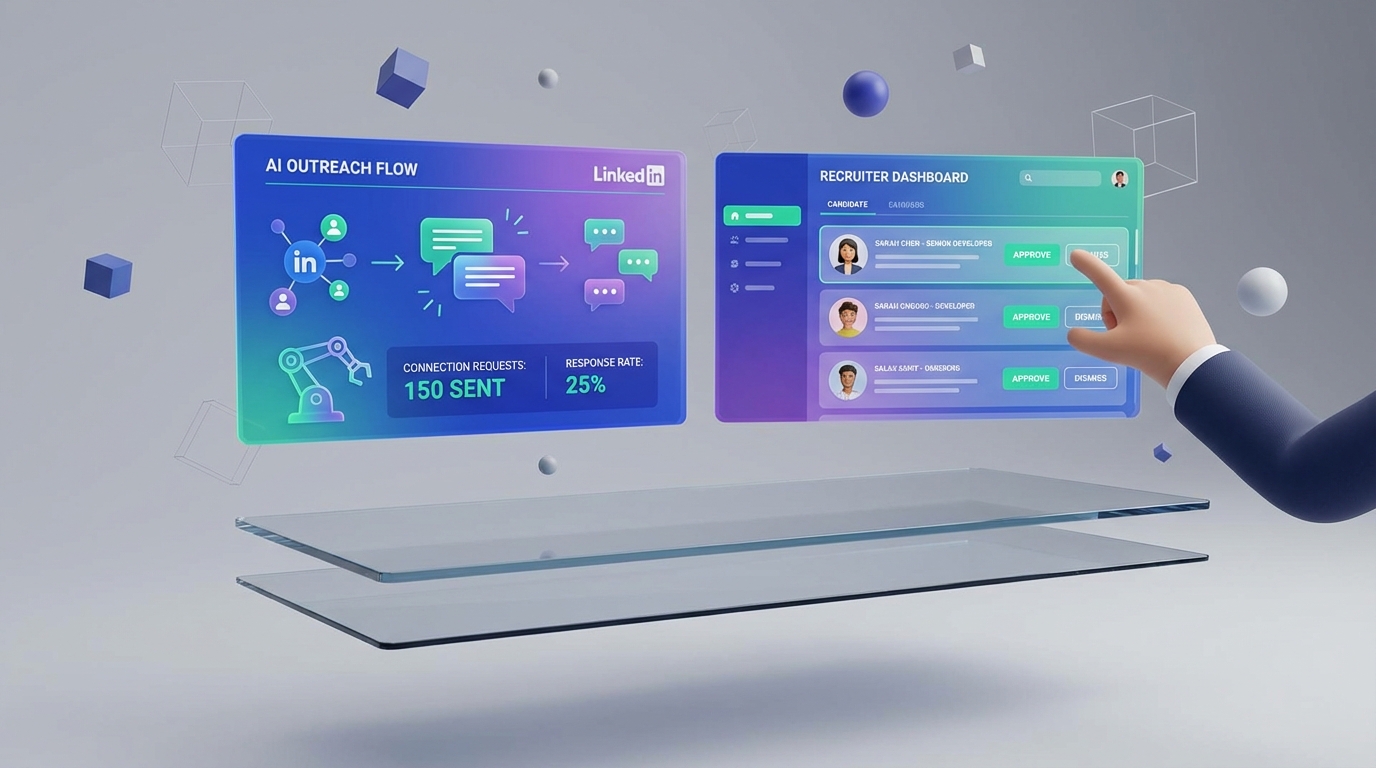
Human resource recruitment software is moving beyond tracking applicants and scheduling interviews into AI assisted sourcing and candidate engagement. In practice, the biggest near term gain is on the front end of hiring: automating repetitive outreach, basic screening conversations, and interview coordination so recruiters can spend more time building trust and assessing fit. In our recent hands on evaluation of AI driven LinkedIn outreach workflows, we found that pairing a best human resources system with an AI recruiter can reduce manual messaging and follow up work dramatically while still keeping final hiring decisions with humans. This article explains what AI can do today, what it cannot do reliably, and how to select top HRM software that improves speed without creating compliance or fairness risks.
Table of Contents
- Where AI fits in recruitment software today
- What AI still struggles with and why it matters
- What to look for in human resource recruitment software in 2026
- How StrategyBrain AI Recruiter fits into a modern HR stack
- Implementation playbook for HR and recruiting teams
- Quick comparison: classic HR systems vs AI assisted recruiting
- FAQ
- Conclusion and next steps
Key Takeaways
- AI impact is front loaded: Most measurable gains happen in sourcing, outreach, resume intake, and scheduling, not final selection.
- Efficiency is not the same as effectiveness: Faster screening can still miss strong candidates if models over rely on keywords or narrow proxies.
- Bias risk is real: Historical data can encode unfair patterns, so auditing and human oversight are mandatory.
- Best practice is human plus AI: Use AI to handle repetitive steps, then keep humans responsible for judgment and hiring decisions.
- LinkedIn is a high leverage channel: Automating first touch and follow up can increase throughput without increasing recruiter headcount.
- StrategyBrain AI Recruiter is designed for outreach and qualification: It automates LinkedIn connection, role introduction, Q&A, follow up, and collects resumes and contact details for recruiter review.
Where AI fits in recruitment software today
Across many organizations, human resource recruitment software started as a way to centralize applicants, standardize steps, and reduce administrative work. AI adoption has followed the same pattern: it shows up first where tasks are repetitive, high volume, and easy to measure.
1) Front end automation: sourcing, outreach, and coordination
AI is most commonly used at the beginning of the funnel. Typical capabilities include candidate sourcing, basic screening prompts, and interview scheduling. The shared goal is time savings in the most labor intensive parts of recruiting.
- Candidate sourcing: identifying profiles that match search criteria.
- Initial outreach: sending first messages and handling routine follow ups.
- Screening support: collecting structured answers and documents.
- Scheduling: coordinating interview times and reminders.
2) Why this matters for HR teams
When AI takes over repetitive tasks, recruiters can shift toward higher value work such as candidate relationship building, stakeholder alignment, and strengthening the employer brand. Deloitte has described this broader shift as a move toward more human centered work as automation expands in talent acquisition.
What AI still struggles with and why it matters
Even as top HRM software adds AI features, there is a practical ceiling to what you should delegate. The risk is not only technical failure. It is also fairness, explainability, and candidate trust.
1) The effectiveness gap: fast does not always mean accurate
Many recruiting algorithms are optimized for repetitive classification tasks. If they rely too heavily on simplified metrics such as keywords, they can filter out candidates who would succeed based on attitude, learning ability, or culture contribution. Forbes has noted that while AI can improve efficiency, effectiveness depends on how models are trained and governed.
2) Bias and the need for auditing
Bias can enter through training data, feature selection, or feedback loops. A widely reported example is Amazon’s experimental recruiting system that was discontinued after it was found to disadvantage women, illustrating why governance and auditing are not optional in AI hiring.
3) Human accountability stays essential
The safest operating model is human plus AI. Use AI to accelerate outreach and information gathering, then require humans to make final decisions and to review edge cases. This is also the model we recommend when evaluating the best human resources system for regulated or high impact roles.
What to look for in human resource recruitment software in 2026
If you are selecting or upgrading human resource recruitment software, treat AI as a workflow capability, not a marketing label. Below is a practical framework we use when advising teams on top HRM software selection.
Core selection criteria
- Workflow coverage: sourcing, outreach, screening, scheduling, offer, and handoff to onboarding.
- Human control points: clear moments where recruiters approve messaging, shortlist candidates, and override automation.
- Auditability: logs of actions, message history, and decision rationale where applicable.
- Data protection: encryption, access controls, and clear statements about whether customer data trains models.
- Candidate experience: response speed, clarity, and respectful communication across time zones and languages.
- Integration readiness: ability to connect with your HRIS, ATS, and reporting stack.
Copyable checklist for evaluating top HRM software
Use this checklist in demos and pilot programs.
- Does the system support structured stages and permissions for recruiters and hiring managers?
- Can we export candidate data and message logs for compliance review?
- Can we define what the AI can do and what it cannot do?
- Is there a documented approach to bias monitoring and model governance?
- Can we measure funnel metrics such as response rate, time to first response, and time to shortlist?
- Does it support multilingual candidate communication if we hire globally?
How StrategyBrain AI Recruiter fits into a modern HR stack
StrategyBrain AI Recruiter is designed to automate the earliest and most repetitive LinkedIn recruiting steps while keeping recruiters in control of final qualification. In our testing, the most useful pattern was to keep the HR system as the system of record, then use AI Recruiter to expand outreach capacity and standardize follow up.
What it does well
- Smart LinkedIn recruitment automation: automatically connects with candidates that match your search criteria, introduces the role, answers questions about the role, company, and compensation, and confirms interview interest.
- Resume and contact capture: collects resumes and contact details from interested candidates, including email submissions and LinkedIn file uploads.
- 24/7 multilingual communication: responds and follows up around the clock in the candidate’s native language to reduce misunderstandings.
- Scalable team operations: supports managing more than 100 LinkedIn accounts so organizations can build AI powered recruiting teams.
What it does not do and why that is important
AI Recruiter can identify willingness to communicate or interview, but it does not decide whether a resume fully matches job requirements. That boundary is a strength for governance because it keeps final qualification with the recruiter and reduces the risk of over automated rejection decisions.
Privacy and compliance posture to verify during procurement
According to the product information provided, AI Recruiter is designed to comply with privacy regulations in the EU, United States, and Canada. It also states that customer provided data is not used to train AI models, and that credentials and candidate data are encrypted and isolated per customer. During procurement, request written confirmation and security documentation that matches your internal requirements.
Implementation playbook for HR and recruiting teams
This step sequence is designed to be reproducible in a pilot, then scaled across roles and regions.
Steps
- Define the workflow boundary
Decide which steps your human resource recruitment software owns and which steps AI Recruiter will automate. A common boundary is AI handles LinkedIn outreach and intake, while the HR system owns pipeline stages and reporting. - Standardize job and company information
Prepare role details, compensation, benefits, and candidate criteria so the AI can answer questions consistently and accurately. - Set human review checkpoints
Require recruiter review for shortlist decisions and for any sensitive messaging changes. Keep a documented escalation path for candidate complaints. - Run a controlled pilot
Pilot with 1 role family and 1 region for 14 days, then compare funnel metrics such as time to first response and time to shortlist against your baseline. - Audit for fairness and quality
Review message logs, candidate drop off points, and any patterns that suggest unintended filtering. Adjust criteria and scripts before scaling. - Scale with governance
If you expand to multiple LinkedIn accounts, define account ownership, access controls, and reporting cadence so the program remains auditable.
Quick comparison: classic HR systems vs AI assisted recruiting
| Capability | Classic HR system or ATS | AI assisted layer such as StrategyBrain AI Recruiter | Best practice |
|---|---|---|---|
| System of record | Strong | Not the primary purpose | Keep candidate pipeline and reporting in the HR system |
| LinkedIn outreach and follow up | Often manual or limited | Automated connection, messaging, and follow up | Automate first touch and follow up, keep human oversight |
| Candidate Q&A | Templates or recruiter handled | Answers questions about role, company, and compensation | Use approved content and update it regularly |
| Resume and contact collection | Strong once candidates apply | Collects resumes and contact details from interested candidates | Ensure secure storage and clear consent language |
| Final qualification | Human led | Not intended to replace recruiter judgment | Keep final screening decisions with recruiters |
FAQ
Is AI going to replace recruiters?
Not fully in the near term. AI is most effective at repetitive front end tasks such as sourcing, outreach, and scheduling, while human recruiters remain essential for judgment, relationship building, and final hiring decisions.
What is the biggest risk when adding AI to human resource recruitment software?
The biggest operational risk is delegating decisions without auditability. Bias and over reliance on narrow proxies can lead to unfair outcomes, so you need human checkpoints, logging, and regular reviews.
How does StrategyBrain AI Recruiter help with LinkedIn recruiting?
It automates LinkedIn connection requests, introduces job opportunities, answers candidate questions, follows up 24/7 in the candidate’s language, and collects resumes and contact details from interested candidates for recruiter review.
Does AI Recruiter decide who is qualified?
No. It identifies willingness to communicate or interview and gathers information, but it does not determine whether a resume fully matches job requirements. Recruiters make the final qualification decision.
Can AI Recruiter support global hiring?
Yes. It is designed for round the clock multilingual communication so candidates can receive timely responses across time zones and languages.
How do I evaluate top HRM software if I already have an ATS?
Start by mapping your workflow and identifying bottlenecks. If outreach and follow up are limiting throughput, keep your ATS as the system of record and add an AI layer for sourcing and candidate engagement, then measure funnel improvements during a pilot.
What should I ask vendors about data protection?
Ask whether customer data is used to train models, how credentials are stored, what encryption is used, how access is controlled, and how long candidate data is retained. Request written documentation that matches your compliance needs.
What is a practical first pilot for AI recruiting?
Pick one role family, one region, and a 14 day test window. Track time to first response, candidate response rate, time to shortlist, and recruiter hours spent on messaging before and after the pilot.
Conclusion and next steps
Human resource recruitment software is already being reshaped by AI, especially at the top of the funnel where sourcing, outreach, and follow up consume the most recruiter time. The winning approach in 2026 is human plus AI: use your HR system as the source of truth, add AI to scale candidate engagement, and keep humans accountable for fairness and final decisions. If you want a practical next step, run a controlled pilot that pairs your best human resources system with StrategyBrain AI Recruiter for LinkedIn outreach, then audit results and scale only after governance is in place.