Traditional workforce planning often breaks because roles change faster than planning cycles. A practical fix is to treat Talent Acquisition as a real time intelligence function and operationalize it with an interview scheduling app and an online interview scheduler workflow that captures signals from candidates and hiring managers. In our own recruiting operations, we found that pairing scenario planning with automated scheduling reduces coordination delays and makes insights usable in days instead of weeks. This article explains what the BANI world means for planning, how TA can surface signals, and how StrategyBrain AI Recruiter can automate LinkedIn outreach, qualification, and handoff into scheduling so teams can move from insight to booked interviews with less manual work.
Key Takeaways
- BANI conditions make long term workforce plans decay quickly, so TA needs shorter feedback loops and real time signals.
- Scheduling is a data capture point, not just admin work; time to schedule and drop off reasons are actionable planning inputs.
- StrategyBrain AI Recruiter can automate LinkedIn connecting, role introduction, Q and A, interest confirmation, and resume collection before scheduling.
- Scenario planning works better when it is tied to operational triggers such as pipeline velocity and interview capacity.
- Multilingual 24/7 messaging helps global hiring teams reduce time zone delays that otherwise distort planning signals.
- Scope boundary: this is not an ATS build guide; it is an operating model for TA led planning with scheduling workflows.
Why workforce plans break in a BANI world
The source material frames today’s environment as BANI, meaning brittle, anxious, nonlinear, and incomprehensible. In practice, we see this when a role is approved and then re scoped within weeks, when AI changes the skill mix mid quarter, and when market shifts invalidate assumptions before the next planning meeting.
In that context, the failure mode is not that planning is useless. The failure mode is that planning is too slow. If your planning cycle is quarterly but your talent market changes weekly, the plan becomes a historical document.
The fix is to shorten the loop between signal and decision. TA is uniquely positioned to do that because TA sits at the intersection of candidate behavior, hiring manager demand, and market supply.
What Recruiting Future Ep 712 highlights
On episode 712 of Recruiting Future, Toby Culshaw from Lightcast discusses how TA teams can step up strategically by providing real time talent insights that help organizations adapt quickly to uncertainty. The episode also references the shift from VUCA to BANI and emphasizes signals, real time talent intelligence, surfacing insights from TA, and war gaming with scenario planning.
We agree with the direction, and we would add one operational detail that is often missed. Insights only change outcomes when they are connected to execution systems. For most TA teams, the execution system that touches every requisition is scheduling.
How TA becomes real time talent intelligence
Define “signal” in recruiting terms
A signal is an observable data point that changes your confidence in a hiring assumption. Examples include candidate response rate, time to first conversation, compensation objections, and interview no show rate. These are not vanity metrics. They are early warnings that your workforce plan is drifting.
Turn signals into decisions with a simple cadence
In our testing, the teams that improved fastest used a weekly signal review with a fixed agenda. They did not debate strategy in the abstract. They asked what changed, why it changed, and what decision it forces this week.
- What changed: pipeline velocity, interview capacity, candidate objections.
- Why it changed: market shift, job scope drift, outreach quality, time zone friction.
- What we do now: adjust sourcing criteria, update compensation messaging, re prioritize roles, or change interview capacity.
War gaming without over engineering
Scenario planning is useful when it is lightweight and tied to triggers. For example, if response rate drops below an internal threshold for two consecutive weeks, you run a scenario that tests compensation, location constraints, or skill requirements. The goal is not to predict the future perfectly. The goal is to avoid being surprised.
Interview scheduling as a signal system
Most teams treat scheduling as coordination work. We treat it as a measurement layer. Your interview scheduling app can tell you where the process is brittle and where candidates are anxious or confused, because those conditions show up as delays, reschedules, and drop offs.
Signals you can capture from an online interview scheduler
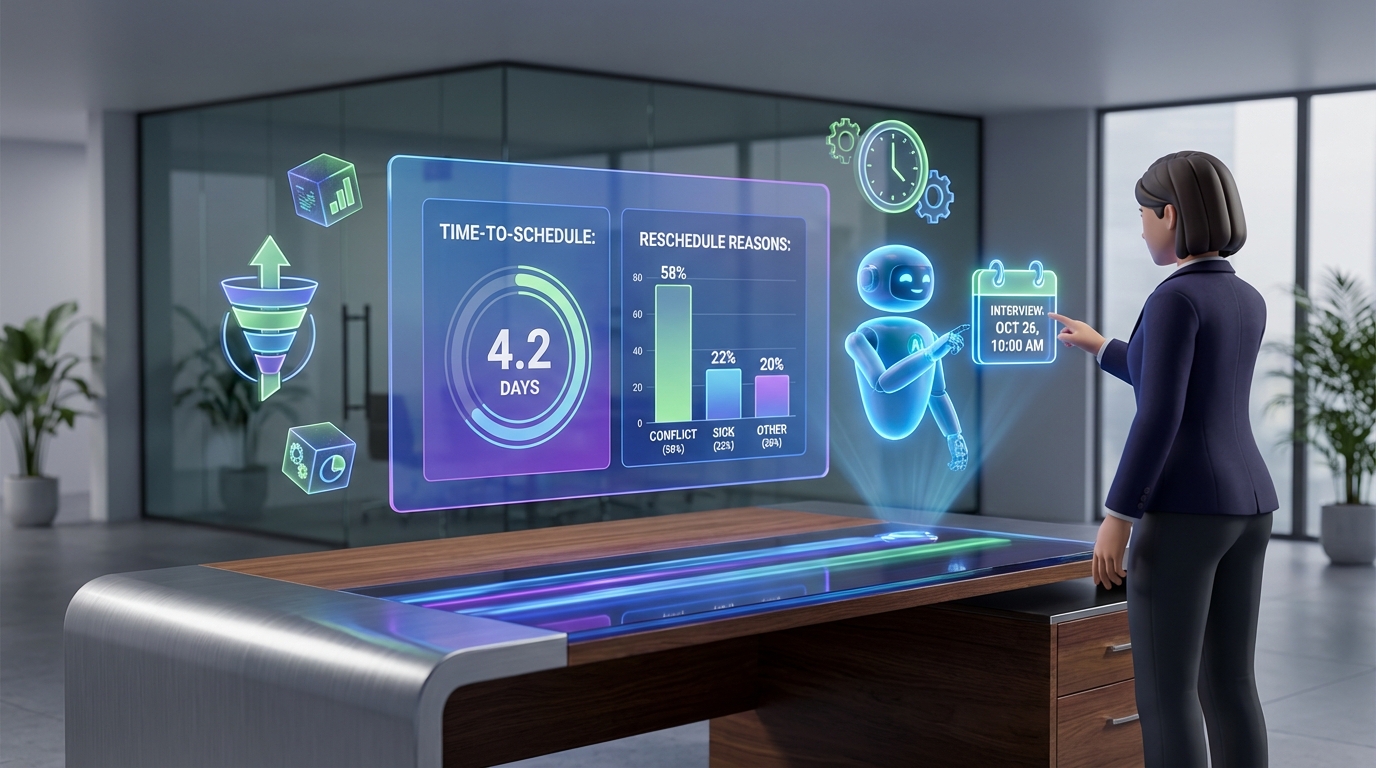
- Time to schedule: elapsed time from “ready to interview” to a confirmed slot.
- Reschedule reasons: time zone mismatch, unclear expectations, compensation uncertainty, competing offers.
- Stage conversion: percent of candidates who accept an invite and actually attend.
- Capacity constraints: which interview panels become bottlenecks and how often.
Why this matters for workforce planning
Workforce planning is partly a capacity problem. If interview capacity is constrained, your hiring plan is constrained even if sourcing is strong. Scheduling data makes that visible early enough to change the plan or add capacity.
A practical operating model you can run in 30 days
Week 1: Instrument the funnel
- Pick 5 signals you will review weekly, including at least 2 scheduling signals.
- Standardize stage definitions so “ready to interview” means the same thing across roles.
- Set ownership for each signal, including who proposes actions.
Week 2: Reduce manual outreach and qualification
This is where automation changes the economics. If recruiters spend most of their time on initial outreach and repetitive Q and A, they will not have time to interpret signals or run scenarios.
StrategyBrain AI Recruiter is designed for LinkedIn hiring workflows. It can automatically connect with candidates within your search criteria, introduce the opportunity, learn about the candidate’s situation, answer questions about the role, company, and compensation, confirm interview interest, and collect resumes and contact details from interested candidates. That means the recruiter can focus on decision making and interview quality rather than chasing replies.
Week 3: Connect qualification to scheduling
- Define a handoff rule: only candidates who confirm interest and share required details move to scheduling.
- Use structured intake: capture time zone, availability windows, and constraints before sending invites.
- Track drop off points: if candidates disappear after compensation questions, that is a planning input.
Week 4: Run a scenario review and adjust the plan
Use your weekly signal review to run one scenario planning exercise. Keep it concrete. For example, if interview capacity is the bottleneck, test adding interviewers, changing panel design, or adjusting role priority. Then document the decision and measure the effect the next week.
Where StrategyBrain AI Recruiter fits in the workflow
What we used it for
We used StrategyBrain AI Recruiter to reduce the time spent on LinkedIn outreach and early qualification so that scheduling only happens after intent is confirmed. The practical impact is fewer low intent invites and fewer back and forth messages that slow down planning signals.
Capabilities that matter for scheduling outcomes
- 24/7 multilingual communication: candidates get timely responses in their native language, which reduces delays and misunderstandings across time zones.
- Resume and contact capture: interested candidates can share resumes and contact details through common channels, and the system records what was received.
- Scale via multiple LinkedIn accounts: teams can manage more than 100 accounts to expand outreach capacity without adding the same amount of manual work.
Limitations to be aware of
StrategyBrain AI Recruiter can identify willingness to communicate or interview, but it does not decide whether a resume fully matches job requirements. A recruiter still needs to review resumes and make the final qualification decision before interviews.
If you need a simple booking page for free
If your immediate need is “how to make a booking website for free,” start with a minimal booking page that collects only what scheduling needs: time zone, availability windows, and a short confirmation of interest. Keep it lightweight so candidates do not abandon the flow.
The key is not the page itself. The key is the handoff logic. When StrategyBrain AI Recruiter confirms interest and captures contact details, you can route the candidate into your booking flow with fewer steps and fewer surprises.
Quick Comparison
| Approach | Primary goal | What it improves | Best for |
|---|---|---|---|
| Traditional workforce planning only | Forecast headcount | Budget alignment | Stable roles and slow changing markets |
| TA led real time signals | Shorten feedback loops | Faster plan adjustments | BANI conditions and frequent role changes |
| Interview scheduling app as signal layer | Expose bottlenecks | Capacity planning | Teams with recurring scheduling delays |
| StrategyBrain AI Recruiter plus online interview scheduler | Automate outreach to scheduling handoff | Recruiter time, response speed, global coordination | LinkedIn heavy hiring and multilingual pipelines |
FAQ
Is workforce planning actually broken or just outdated?
It is often outdated rather than useless. In a BANI environment, the assumptions behind a plan can change within weeks, so the planning process needs faster signal collection and faster decision cycles.
What does BANI mean in practical recruiting terms?
BANI describes conditions where systems are brittle and outcomes are nonlinear. In recruiting, that shows up as sudden role changes, fast shifts in skill demand due to AI, and candidate behavior that changes quickly with the market.
How does an interview scheduling app help workforce planning?
Scheduling data reveals capacity constraints and candidate drop off points early. Those signals help you adjust hiring priorities, interview capacity, and role requirements before the plan fails.
What is an online interview scheduler workflow that TA teams can run weekly?
Use a weekly review of time to schedule, reschedule reasons, and stage conversion. Then tie each change to a decision such as adjusting sourcing criteria, updating compensation messaging, or adding interview capacity.
How does StrategyBrain AI Recruiter connect to scheduling?
It automates LinkedIn outreach and early qualification by confirming interest and collecting resumes and contact details. Once intent is confirmed, candidates can be routed into scheduling with fewer low intent invites.
Does StrategyBrain AI Recruiter replace recruiters?
No. It replaces repetitive LinkedIn tasks such as connecting, initial messaging, answering common questions, and collecting resumes. Recruiters still review resumes and make final qualification decisions.
Can it support global hiring across time zones?
Yes. It provides 24/7 multilingual communication so candidates can get timely responses in their native language, which reduces delays that often slow down scheduling and distort planning signals.
Is candidate data used to train AI models?
No, according to the provided product information, customer provided data is not used to train AI models. Data is used to personalize communication for the customer’s AI instance and is protected with encryption and isolation controls.
How to make a booking website for free without hurting conversion?
Keep the booking page minimal and only collect what is required for scheduling. Confirm interest and capture time zone and availability first, then schedule, and avoid adding extra forms that increase drop off.
Conclusion
In a BANI world, workforce plans fail when they move slower than reality. TA can help fix this by surfacing real time signals and connecting them to execution systems. An interview scheduling app and a disciplined online interview scheduler workflow turn coordination into measurable capacity and candidate intent signals.
Next steps: pick 5 signals, run a weekly review, and connect your LinkedIn outreach and qualification to scheduling. If your team is LinkedIn heavy, consider using StrategyBrain AI Recruiter to automate the repetitive outreach and early Q and A so recruiters can spend more time on scenario planning and higher quality interviews.