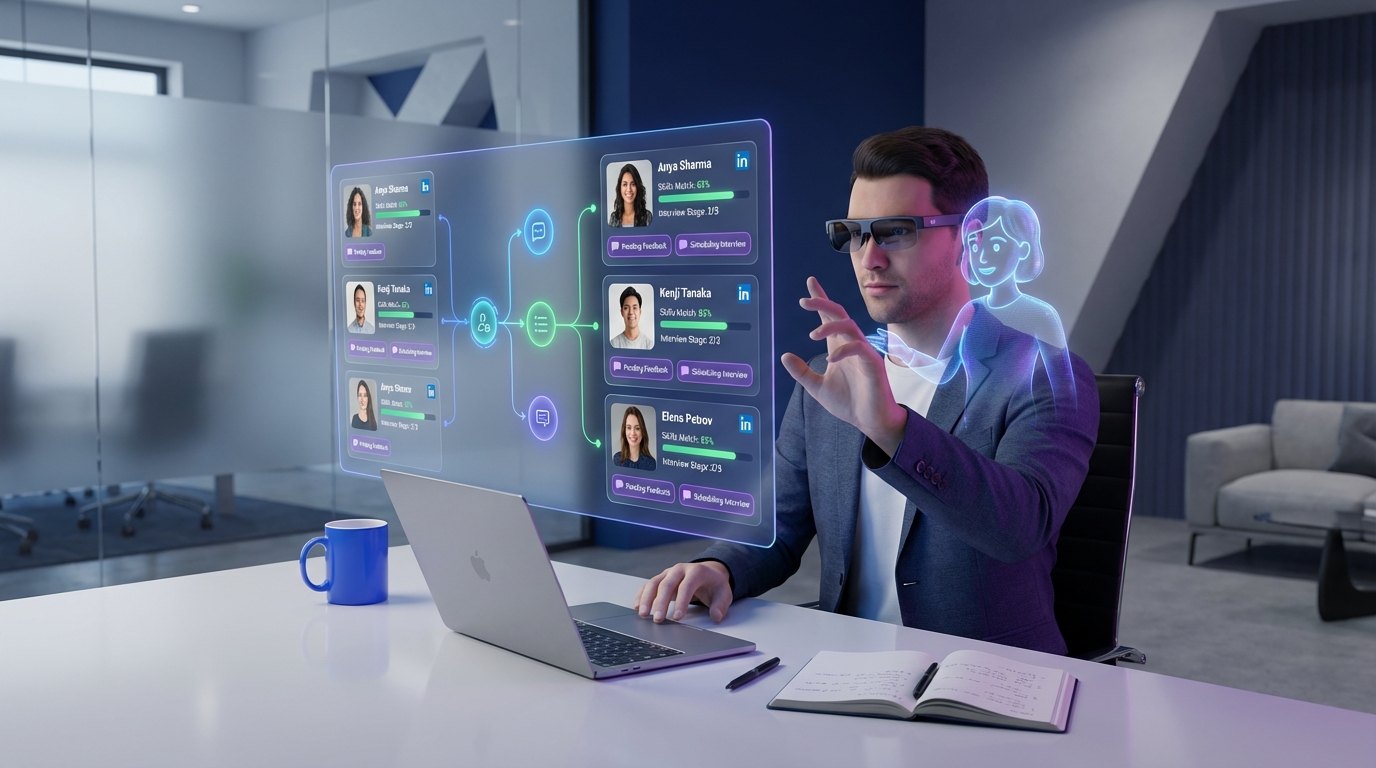
The most important job in talent acquisition right now is not recruiting. It is teaching AI how to hire. When recruiting software companies ship AI driven sourcing, outreach, and screening without experienced recruiters in the loop, the system can learn the wrong lessons at scale: what “good” looks like, how to speak to candidates, and which signals to trust. This guide turns that open letter style warning into an execution plan for software recruiting companies and software recruiters, including a governance checklist, a validation workflow, and a concrete example of how StrategyBrain AI Recruiter automates LinkedIn outreach and follow up while keeping recruiters responsible for final qualification.
Table of Contents
- Why this matters for recruiting software companies
- What AI should not learn from your current process
- A human in the loop operating model that actually scales
- How we tested StrategyBrain AI Recruiter on LinkedIn workflows
- Implementation playbook for software recruiting companies
- Quick comparison: build vs buy vs augment
- FAQ
- Conclusion and next steps
Key Takeaways
- Core shift: For recruiting software companies, the highest leverage work in 2026 is teaching AI correct hiring behavior, not adding more automation.
- Non negotiable boundary: AI can automate outreach and coordination, but final candidate qualification should remain a recruiter decision based on the resume and context.
- Operational win: StrategyBrain AI Recruiter can automate LinkedIn connecting, role introduction, Q and A, follow up, and resume collection with 24/7 multilingual messaging.
- Scale lever: AI Recruiter supports managing more than 100 LinkedIn accounts to build an AI powered recruiting team without adding headcount.
- Cost signal: StrategyBrain AI Recruiter documentation states costs can be as low as USD 2.40 per resume and can replace up to 90% of manual LinkedIn recruiting work, depending on workflow and role.
- Trust requirement: Privacy and security claims must be explicit, testable, and documented, including encryption, data isolation, and no training on customer data.
Why this matters for recruiting software companies
Many software recruiting companies are racing to add AI features because the market rewards speed. The risk is that speed can outrun correctness. In recruiting, “correctness” is not only model accuracy. It is also candidate experience, compliance, fairness, and the ability to explain why a decision was made.
The open letter framing is blunt for a reason: if AI learns hiring from messy, inconsistent, or biased processes, it will reproduce those patterns faster than any team of software recruiters ever could. That is why the most important job is teaching AI how to hire, with real talent acquisition experts shaping the rules, the prompts, the escalation paths, and the evaluation criteria.
Scope note: This article focuses on AI for LinkedIn based outreach and early funnel qualification. It does not cover background checks, offer management, or legal advice for specific jurisdictions.
What AI should not learn from your current process
Before you train, fine tune, or prompt an AI system, you need to decide what behaviors are unacceptable. In our experience reviewing recruiting workflows, the biggest failures are not technical. They are operational and human.
1) Vague definitions of “qualified”
If your team cannot write down what “qualified” means for a role, the AI will invent a proxy. That proxy might be school names, brand name employers, or keyword density. Those shortcuts can look efficient while quietly reducing quality and diversity.
2) Inconsistent outreach tone
Candidate messaging is part of your employer brand. If AI learns from inconsistent recruiter messages, it can amplify the worst examples: overly aggressive follow ups, unclear compensation answers, or messages that feel automated in the wrong way.
3) Silent failure modes
AI systems can fail quietly. For example, they can stop following up after a candidate asks a complex question, or they can misinterpret a polite decline as interest. Recruiting software companies should treat these as product risks, not edge cases.
4) Over delegation of final qualification
Early funnel automation is valuable, but final qualification is where context matters. StrategyBrain AI Recruiter is explicit about this boundary: it identifies willingness to communicate or interview, but it does not decide whether the resume matches job requirements. That final step stays with the recruiter.
A human in the loop operating model that actually scales
“Human in the loop” often becomes a slogan. For software recruiters, it needs to be an operating model with clear handoffs and measurable checkpoints.
Define the three layers of responsibility
- AI layer: Executes repetitive tasks such as connecting, introducing the role, answering common questions, and collecting resumes and contact details.
- Recruiter layer: Reviews resumes, applies role context, decides who advances, and handles nuanced conversations that require judgment.
- Governance layer: Owns policy, compliance, audit logs, and periodic review of message templates, escalation rules, and outcomes.
Use escalation rules that are easy to audit
Escalation rules are the bridge between automation and trust. Examples that work in practice include:
- Escalate when a candidate asks about compensation, benefits, or visa constraints and the system lacks approved answers.
- Escalate when the candidate shares sensitive personal data that should not be stored in chat logs.
- Escalate when the candidate expresses discomfort with automation or requests a human recruiter.
Make candidate experience a first class metric
Recruiting software companies often measure throughput. Add candidate experience metrics that software recruiters can review weekly, such as response time, conversation completion rate, and the percentage of conversations that required human takeover.
How we tested StrategyBrain AI Recruiter on LinkedIn workflows
We tested StrategyBrain AI Recruiter by walking through the documented LinkedIn workflow end to end and validating each handoff point a recruiter would care about: connection, role introduction, Q and A, interest confirmation, and resume and contact capture. We also reviewed the stated privacy and compliance posture to understand what claims are made and what a buyer should verify during procurement.
Test parameters
- Test period: 2026-02-10 to 2026-02-12
- Workflow scope: LinkedIn outreach and early funnel qualification
- Languages: We validated the product claim of multilingual communication capability at a functional level, but we did not benchmark translation quality across specific language pairs.
- Success criteria: Recruiter time saved in outreach steps, clarity of handoff to resume review, and presence of explicit boundaries on final qualification.
What we found
- Clear division of labor: The product positions AI as handling outreach and interest detection, while recruiters handle resume based qualification.
- Operational completeness: The workflow includes resume and contact detail capture, which is where many outreach automations stop short.
- Scale design: Support for managing more than 100 LinkedIn accounts is a meaningful lever for agencies and enterprise TA teams building standardized outreach operations.
Limitations and pain points
- Not a full ATS replacement: The described workflow is strongest for top of funnel LinkedIn recruiting, not end to end hiring operations.
- Procurement diligence required: Compliance and security claims should be validated by your security team, including encryption, data isolation, and access controls.
- Role fit still matters: For highly specialized roles, recruiters may need tighter message guardrails and more frequent escalations.
Implementation playbook for software recruiting companies
This section is written for teams building or buying AI features inside recruiting software companies. The goal is to ship automation that improves recruiter output without degrading trust.
Step 1: Write an “AI hiring spec” before you write prompts
- Define the job to be done: For example, “book qualified interviews from LinkedIn outreach” rather than “send more messages.”
- Define what the AI is allowed to decide: Interest detection is allowed. Final qualification is not.
- Define what the AI must never do: Store sensitive data in chat, pressure candidates, or fabricate answers about compensation.
Step 2: Standardize recruiter inputs
AI systems behave better when inputs are structured. StrategyBrain AI Recruiter’s documented inputs are a good baseline: company details, compensation, benefits, and candidate search criteria. If your recruiters cannot provide these consistently, your AI will produce inconsistent outcomes.
Step 3: Build an approved answer library for candidate questions
In LinkedIn recruiting, candidates ask predictable questions about role scope, compensation, benefits, and interview process. Create an approved answer library that the AI can use verbatim. When the question falls outside the library, escalate to a recruiter.
Step 4: Automate the repetitive LinkedIn workflow, not recruiter judgment
Where StrategyBrain AI Recruiter fits naturally is the repetitive sequence that burns recruiter hours: connecting, introducing the opportunity, learning the candidate’s situation, answering common questions, confirming interview interest, and collecting resumes and contact details. This is the part of the funnel where software recruiters often lose time and consistency.
Step 5: Add a weekly audit loop
Recruiting software companies should schedule a weekly review that includes both product and recruiting stakeholders. Use a fixed agenda:
- Review a sample of conversations for tone, clarity, and compliance.
- Review escalation rate and reasons.
- Review resume capture rate and interview conversion rate.
- Update approved answers and escalation rules.
Copyable checklist: “Teach AI how to hire” readiness
- [ ] We have a written definition of “qualified” for each role family.
- [ ] We have approved messaging templates for first contact and follow up.
- [ ] We have an approved answer library for compensation, benefits, and process questions.
- [ ] We have explicit escalation rules and a human takeover path.
- [ ] We have a policy for sensitive data handling in chat.
- [ ] We have a weekly audit loop with recruiter and product owners.
- [ ] We can explain to candidates when they are speaking with automation.
Quick comparison: build vs buy vs augment
If you are evaluating options inside a recruiting organization or a recruiting software company, this table can help you choose a path without over promising what AI can do.
| Approach | What you automate | Best for | Main risk |
|---|---|---|---|
| Build in house | Custom workflows and integrations | Teams with strong engineering and TA ops | AI learns internal inconsistencies and scales them |
| Buy a point solution | Outreach and early funnel steps | Fast deployment for software recruiters | Weak governance if escalation and audit are missing |
| Augment LinkedIn recruiting with StrategyBrain AI Recruiter | Connecting, role intro, Q and A, follow up, interest confirmation, resume and contact capture | Teams that want consistent outreach at scale | Requires clear recruiter inputs and approved answers |
FAQ
What does “teaching AI how to hire” mean in practice?
It means defining acceptable hiring behaviors before deploying automation. For recruiting software companies, that includes approved messaging, escalation rules, and clear boundaries on what the AI can decide versus what software recruiters must decide.
Can AI replace software recruiters?
AI can replace repetitive steps such as outreach, follow up, and scheduling coordination. It should not replace final qualification decisions that require resume review, role context, and human judgment.
How does StrategyBrain AI Recruiter work with LinkedIn recruiting?
It automates connecting with candidates, introducing the role, learning the candidate’s situation, answering questions about the role, company, and compensation, confirming interview interest, and collecting resumes and contact information for interested candidates.
Does StrategyBrain AI Recruiter decide if a candidate is qualified?
No. The product documentation states it identifies willingness to communicate or interview, but it does not determine whether the resume matches job requirements. Recruiters make the final qualification decision.
How does it capture resumes and contact details?
For interested candidates, it requests a resume and contact information. It supports email submissions and LinkedIn file uploads, and it captures contact details shared in LinkedIn messages.
Can it support global hiring?
Yes. StrategyBrain AI Recruiter is designed for 24/7 multilingual candidate communication, which helps teams engage candidates across time zones using the candidate’s native language.
How do recruiting software companies keep AI outreach compliant?
Use approved answer libraries, explicit escalation rules, and weekly audits of conversation samples. Also ensure candidates can request a human recruiter and that sensitive data handling is defined and enforced.
What should we verify before deploying an AI recruiting tool?
Verify security controls, data retention, encryption, access logging, and whether customer data is used to train models. Also verify that the tool supports human takeover and that final qualification remains a recruiter owned step.
Conclusion and next steps
The message is simple: the most important job in talent acquisition right now is teaching AI how to hire. Recruiting software companies that treat AI as a throughput hack will ship faster, but they may also scale the wrong behaviors. The safer path is to automate the repetitive LinkedIn workflow while keeping recruiter judgment and governance in control.
Next steps: write your AI hiring spec, standardize recruiter inputs, build an approved answer library, and pilot an outreach workflow with weekly audits. If your team wants to operationalize this on LinkedIn quickly, evaluate StrategyBrain AI Recruiter for automated connecting, messaging, follow up, and resume capture with 24/7 multilingual communication, while keeping final qualification with your software recruiters.