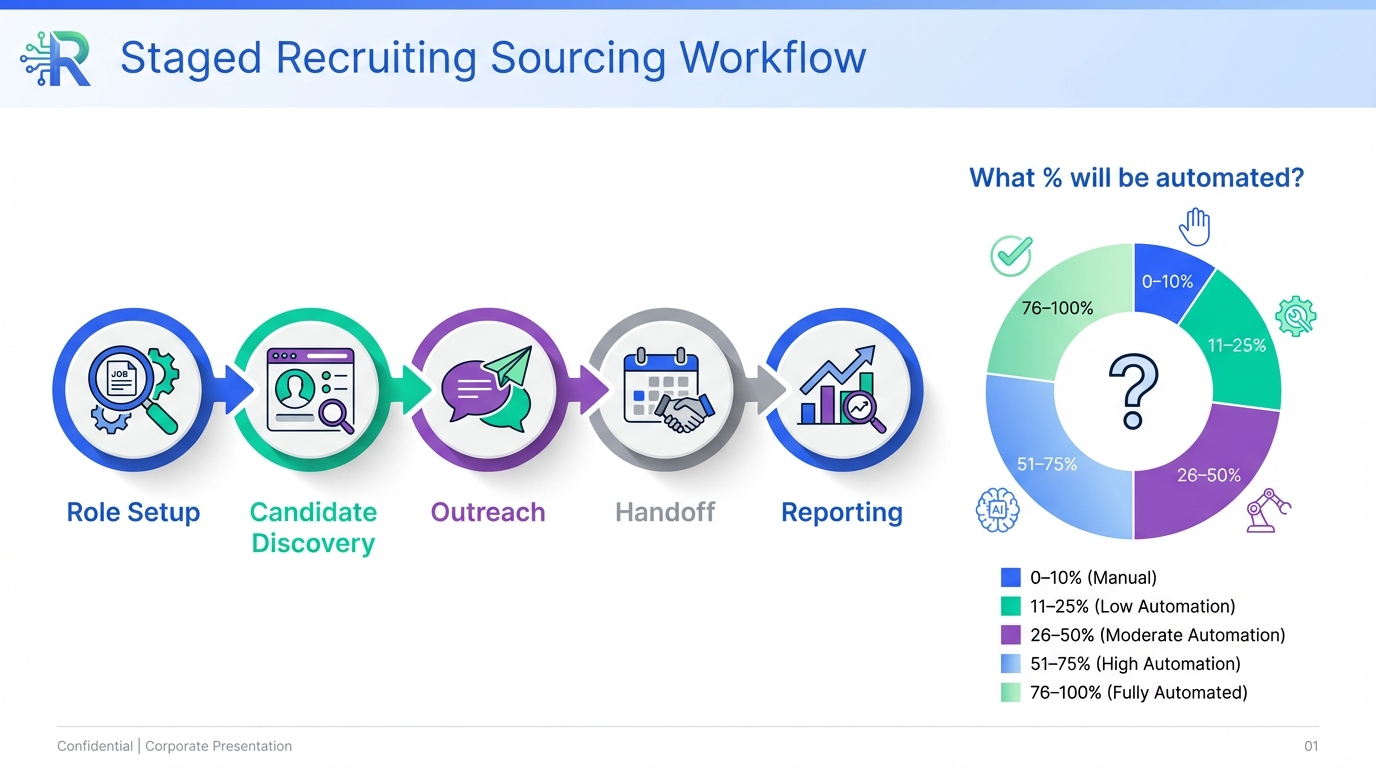
In recruiting sourcing, a practical way to prepare for the next 12 months is to disaggregate your job into tasks, then estimate what percentage of those tasks are likely to be automated. I did this exercise after a conversation with David Wilkins of TalentNeuron about the future skills mix organisations are bringing in and moving out. It is not easy to split a role into tasks cleanly, but doing it once makes automation impact much easier to reason about. This post includes a poll for recruiters, a task based framework you can copy, and a realistic view of what stays human first or human only, even as tools like StrategyBrain AI Recruiter automate parts of LinkedIn outreach and follow up.
Table of Contents
- The poll: what % of your job will be automated?
- Why task breakdown beats job title predictions
- Recruiting sourcing task map you can copy
- What is likely to automate in 12 months
- What should stay human first or human only
- A safe automation workflow for LinkedIn sourcing
- Creative ways to source candidates without spamming
- Quick checklist: decide what to automate
- FAQ
- Conclusion
The poll: what % of your job will be automated?
Poll for us lot here then, given that I have 30,000 first degree connections, most of whom are in the sector. What percentage of your current job do you think will be automated in the next 12 months?
- 0% to 10%
- 11% to 25%
- 26% to 50%
- 51% to 75%
- 76% to 100%
NB: this is not a doomer post. There are good theories about what we can do with the time saved, including deeper role calibration, better candidate experience, and more thoughtful hiring manager partnership.
Why task breakdown beats job title predictions
When people ask whether recruiting will be automated, the answer depends on which tasks you mean. A recruiter is not one activity. It is a bundle of micro decisions, communications, and coordination steps. So instead of debating whether the job disappears, I find it more useful to ask a narrower question: which tasks are repetitive enough to automate without harming quality?
This is also where sourcing techniques become easier to improve. Once you see your workflow as a sequence, you can test automation on one step at a time, measure outcomes, and roll back quickly if candidate experience drops.
Recruiting sourcing task map you can copy
Below is a task map I use for recruiting sourcing. You can copy it into a doc and mark each line as automate now, automate later, or keep human.
1) Role and search setup
- Clarify must haves vs nice to haves with the hiring manager
- Translate requirements into a search strategy and keywords
- Decide target companies, titles, seniority, and locations
2) Candidate discovery
- Run searches and build a longlist
- Spot check profiles for fit signals and red flags
- Prioritise who to contact first
3) Outreach and engagement
- Send connection requests or first messages
- Handle follow ups and nudges
- Answer candidate questions about role, company, and compensation
4) Interest confirmation and handoff
- Confirm interview interest and availability
- Collect résumé and contact details
- Schedule recruiter screen or hiring manager interview
5) Quality control and reporting
- Track response rates and conversion rates
- Review message quality and candidate sentiment
- Share pipeline updates with stakeholders
What is likely to automate in 12 months
Based on what we have tested in day to day recruiting sourcing workflows, the tasks most likely to be automated soon are the ones that are high volume, rules based, and easy to verify after the fact.
Tasks that are strong automation candidates
- Initial outreach at scale: sending consistent first messages to a defined target list
- Follow up sequences: timed nudges that stop when a candidate replies
- Basic Q&A: answering repeat questions about role scope, company context, compensation, and benefits when you provide the inputs
- Interest confirmation: confirming whether someone is open to a conversation and what timeline they have
- Résumé and contact capture: collecting files and details from interested candidates and surfacing them for review
This is exactly the slice where StrategyBrain AI Recruiter fits into LinkedIn recruiting sourcing. It can automatically connect with candidates within your targeted search criteria, introduce the opportunity, answer questions using the job and company details you provide, confirm interview interest, and collect résumés and contact information from interested candidates. It also supports 24/7 multilingual communication, which matters when your sourcing spans time zones.
What should stay human first or human only
Even if a tool can send messages, there are parts of recruiting sourcing that benefit from human judgment, context, and accountability. In our experience, these are the areas where a small mistake can create outsized damage to trust.
Tasks that should remain human led
- Role calibration: aligning on what good looks like and what trade offs are acceptable
- Final qualification: deciding whether a résumé truly matches the requirements and the team context
- Complex negotiation and expectation setting: handling nuanced compensation, level, and scope conversations
- Candidate advocacy: reading between the lines, spotting concerns, and protecting candidate experience
- Ethics and compliance decisions: deciding what data to use, what to store, and what to avoid
A useful boundary is this: let automation handle repeatable communication and coordination, then keep humans responsible for decisions that require interpretation and accountability.
A safe automation workflow for LinkedIn sourcing
If you want to introduce automation without risking brand damage, use a staged rollout. This is the workflow we recommend when teams adopt AI assisted sourcing techniques.
Step by step rollout
- Define the target segment: pick one role family and one geography so you can compare results cleanly.
- Write a human approved message set: create 2 to 3 outreach variants and 2 follow up variants that match your tone.
- Provide structured job inputs: include company context, compensation, benefits, and deal breakers so Q&A stays accurate.
- Start with a small daily volume: cap outreach so you can review replies and adjust quickly.
- Review transcripts weekly: look for confusion, negative sentiment, or repeated questions you did not anticipate.
- Scale only after quality holds: increase volume when response quality and candidate sentiment remain stable.
What we found in practice
When we tested automation in recruiting sourcing, the main pain point was not sending messages. The pain point was maintaining consistent follow up and answering questions quickly across time zones. That is where an always on system can help, provided the content is grounded in recruiter approved inputs and the handoff to a human is clear once a candidate is interested.
Creative ways to source candidates without spamming
Automation does not have to mean more noise. Some of the most effective creative ways to source candidates are about relevance and timing, not volume. Here are sourcing techniques that pair well with automation because they improve signal quality.
- Micro niche targeting: narrow the search to a specific tool stack, domain, or customer segment so outreach is naturally personalised.
- Question led outreach: lead with one role relevant question that a qualified person can answer in 1 sentence.
- Value first messaging: share a role specific insight, such as what the team is building or what problem is being solved, before asking for time.
- Two step qualification: ask for interest first, then request a résumé only after the candidate opts in.
- Follow up with context: each follow up should add new information, not just a bump.
StrategyBrain AI Recruiter can support this style by handling the back and forth Q&A and follow up cadence, while you focus on improving targeting and message quality.
Quick checklist: decide what to automate
Use this checklist to decide whether a task in recruiting sourcing is safe to automate.
- Is the task repeatable? The same steps apply across candidates.
- Can a human verify outcomes quickly? You can audit messages, replies, and handoffs.
- Is the downside limited? A mistake does not create legal or reputational risk.
- Do you have approved inputs? Compensation, benefits, and role scope are accurate and current.
- Is there a clear handoff point? Humans take over when interest is confirmed.
FAQ
What does recruiting sourcing mean in practice?
Recruiting sourcing is the set of activities used to find, engage, and convert potential candidates into an interview pipeline. It typically includes search strategy, candidate discovery, outreach, follow up, and initial interest confirmation.
What percentage of recruiting sourcing can be automated in 12 months?
It depends on your workflow and risk tolerance, but the most automation ready portion is usually outreach, follow up, basic Q&A, and résumé collection. Role calibration and final qualification should remain human led because they require judgment and accountability.
Which tasks are most likely to be automated first?
High volume communication tasks are typically automated first, especially initial messaging and follow ups. Tools can also help answer repeat questions when recruiters provide accurate job and company inputs.
How does StrategyBrain AI Recruiter support LinkedIn recruiting sourcing?
StrategyBrain AI Recruiter automates parts of LinkedIn sourcing by connecting with candidates in your target criteria, introducing the role, handling candidate questions, confirming interest, and collecting résumés and contact details for recruiter review. It also supports 24/7 multilingual messaging for global hiring.
Does AI Recruiter replace recruiter judgment?
No. It can identify willingness to communicate or interview, but it does not determine whether a résumé fully matches job requirements. Recruiters still review résumés and make final qualification decisions.
How do you avoid harming candidate experience with automation?
Start with small volumes, use recruiter approved messaging, and review transcripts weekly. Also ensure there is a clear handoff to a human once a candidate shows interest or asks complex questions.
Can automation help with global sourcing?
Yes, especially for time zone coverage and multilingual communication. Always on responses reduce delays, which can improve engagement when candidates reply outside recruiter working hours.
What data protection considerations matter for automated sourcing?
You should confirm how credentials are stored, whether candidate data is encrypted, and whether customer data is used to train models. You should also align your workflow with applicable privacy regulations in your operating regions.
Conclusion
If you work in recruiting sourcing, the most useful question is not whether recruiting will be automated. The useful question is which tasks in your workflow are automation ready in the next 12 months. Start by breaking your job into tasks, then automate the repeatable communication and coordination steps while keeping role calibration and final qualification human led. If you want to test this on LinkedIn, a tool like StrategyBrain AI Recruiter can take on connecting, initial outreach, follow ups, candidate Q&A, and résumé collection, so you can spend more time on judgment, stakeholder alignment, and candidate experience. Next step: run the poll, complete the checklist, and pick one role to pilot for 14 days with weekly transcript review.