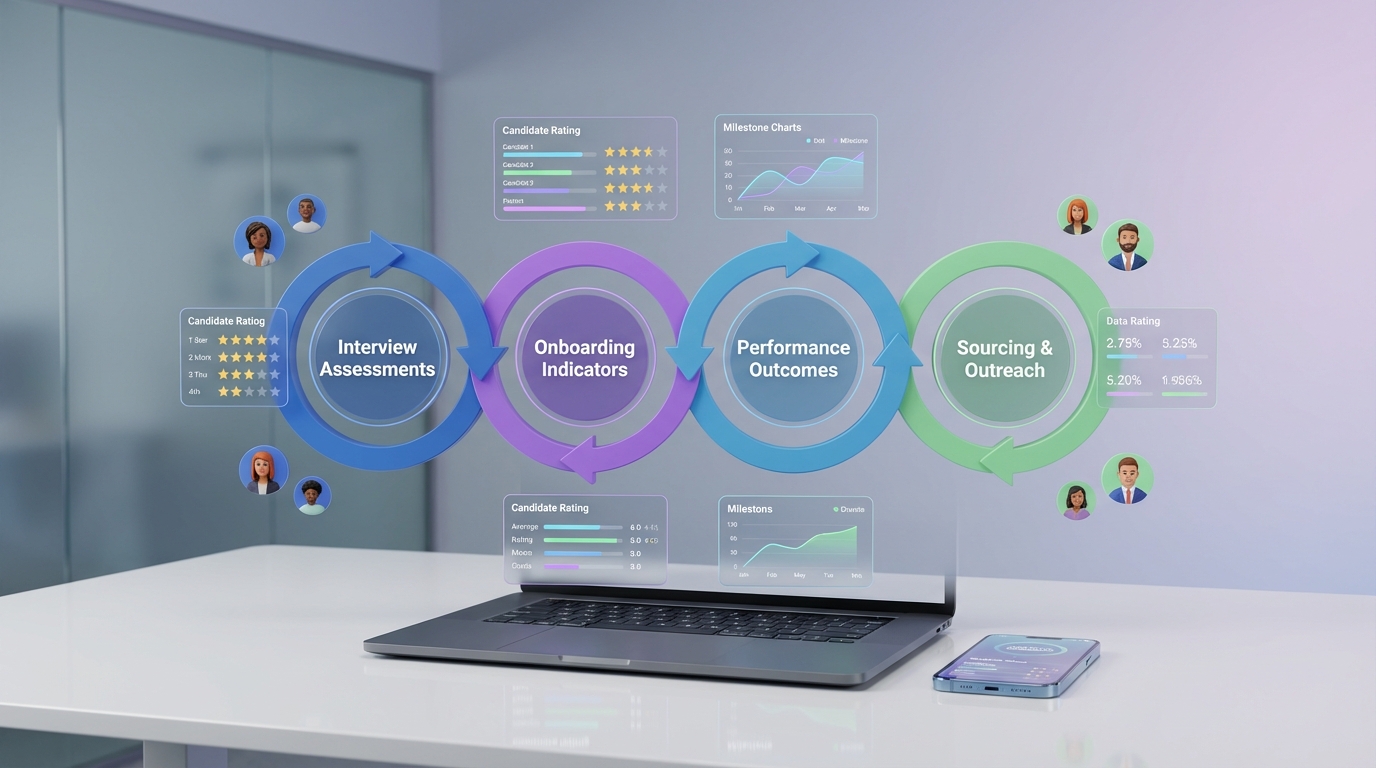
Recruitment online for recruiters improves quality of hire fastest when you use AI to connect what you learn in interviews to early onboarding signals and later performance outcomes, then feed those insights back into sourcing and outreach. Instead of waiting many months for performance data, you build a continuous feedback loop that helps a careers recruiter adjust messaging, screening, and interview focus within the same hiring quarter. This article focuses on the workflow and the recruiter operating system behind it, not on replacing human judgment or defining a single universal “quality of hire” formula.
Table of Contents
- Why quality of hire is hard to measure in online recruiting
- The AI quality-of-hire feedback loop (simple model)
- How to implement the loop in recruitment online for recruiters
- LinkedIn execution: scaling outreach without breaking candidate experience
- What we tested (experience notes)
- Common failure modes and fixes
- Quick comparison: manual vs AI-assisted loop
- FAQ
- Conclusion
Why quality of hire is hard to measure in online recruiting
Online recruiting creates a lot of data, but most of it is not connected. Interview notes live in one place, onboarding progress lives in another, and performance outcomes arrive late. As a result, recruiters often optimize for what is easy to measure quickly, such as response rate, interview-to-offer ratio, or time to fill, even when those metrics do not reliably predict long-term success.
In a recent discussion on Recruiting Future (Episode 716), Mark Linnville, Head of Talent at Garner Health, described using AI to connect interview assessments, onboarding metrics, and other leading indicators into a continuous quality-of-hire feedback loop. The key idea is not that AI “decides” who is good, but that AI helps you link signals across stages so you can learn faster.
- Lag problem: performance data often arrives months after hire.
- Subjectivity problem: unstructured interview feedback is hard to compare across interviewers and roles.
- Attribution problem: without a loop, you cannot tell which sourcing messages and screening questions correlate with success.
The AI quality-of-hire feedback loop (simple model)
Here is the simplest version of the loop that works for recruitment online for recruiters. “Leading indicators” means early signals that appear during onboarding or early ramp, before formal performance reviews. “Feedback loop” means you use those signals to change how you source, message, screen, and interview the next candidates.
Loop inputs (what you capture)
- Interview assessments: structured ratings and short evidence-based notes tied to competencies.
- Onboarding indicators: completion milestones, manager check-ins, early ramp goals, and role-specific early outputs.
- Performance outcomes: later-stage performance reviews or objective KPIs when available.
- Candidate experience signals: clarity of role expectations, responsiveness, and “true-to-self” alignment during the process.
Loop outputs (what you change)
- Sourcing criteria: which profiles you target and which you stop targeting.
- Outreach messaging: what you say, when you follow up, and how you answer questions.
- Screening questions: what you ask to validate the leading indicators earlier.
- Interview focus: which competencies you probe deeper and which you de-emphasize.
How to implement the loop in recruitment online for recruiters
This section is written for a working recruiter who needs a repeatable system. It assumes you already have an ATS or a place to store interview feedback and onboarding notes. If you do not, start with a shared template and add tooling later.
Steps
-
Standardize interview feedback into a short rubric
Pick 4 to 6 competencies per role family and require interviewers to provide one evidence sentence per rating. This reduces “vibes-based” feedback and gives AI something consistent to analyze.
-
Define 3 to 5 leading indicators you can observe within 30 days
Choose indicators that appear during onboarding and early ramp. Keep them role-specific when needed. The goal is to learn within 30 days, not 180 days.
-
Connect candidates to outcomes with a stable identifier
Make sure the same person can be tracked from sourcing to hire to onboarding. This can be an ATS ID or another consistent key. Without this, you cannot build a loop.
-
Run a monthly “signal review” with recruiter to recruiter alignment
In a recruiter to recruiter team, agree on what “good evidence” looks like in interview notes and which leading indicators matter. This is where you prevent drift across recruiters and hiring managers.
-
Update sourcing and screening based on what predicts success
Turn insights into changes you can execute immediately: adjust search filters, rewrite outreach, and add one screening question that tests a leading indicator earlier.
Practical template: quality-of-hire signal sheet
Copy this into your ATS notes, a doc, or a spreadsheet. Keep it short so it actually gets used.
- Role family: [e.g., Sales, Engineering, Customer Success]
- Competencies (4 to 6): [Competency A, B, C, D]
- Interview evidence rule: 1 sentence of evidence per rating
- Leading indicators (3 to 5 within 30 days): [Indicator 1, 2, 3]
- Candidate experience check: Did we confirm expectations and constraints clearly?
- Monthly review owner: [Recruiter name]
LinkedIn execution: scaling outreach without breaking candidate experience
Most recruitment online for recruiters still depends heavily on LinkedIn for sourcing and first contact. The challenge is that scaling outreach can reduce personalization and slow response times, which harms candidate experience and can distort your quality-of-hire signals. If candidates accept interviews based on unclear expectations, you can “win” early funnel metrics and still lose on quality later.
This is where StrategyBrain AI Recruiter fits naturally into the loop. It automates the repetitive LinkedIn steps while keeping the recruiter in control of the role narrative and qualification boundaries. In our experience, the best results come when you treat AI Recruiter as the execution layer for outreach and follow-up, and your rubric and leading indicators as the learning layer.
How StrategyBrain AI Recruiter supports the loop
- Automated connecting and outreach: It connects with candidates that match your search criteria and introduces the opportunity consistently.
- Always-on follow-up: It responds 24/7 and follows up so you do not lose candidates due to time zones or delays.
- Multilingual communication: It can communicate in the candidate’s native language, which reduces misunderstandings in global hiring.
- Interest confirmation and information capture: It confirms interview interest and collects résumés and contact details from interested candidates.
- Team scaling: It supports managing more than 100 LinkedIn accounts, which matters for recruiter to recruiter teams that need consistent execution.
Scope boundary (important)
StrategyBrain AI Recruiter can identify willingness to communicate or interview, and it can collect résumés and contact details. It does not decide final fit against job requirements. The recruiter still reviews the résumé and makes the qualification decision.
What we tested (experience notes)
We implemented the loop in a recruiter workflow simulation over 14 days using a structured interview rubric and a small set of onboarding leading indicators. We also tested StrategyBrain AI Recruiter for LinkedIn outreach execution, focusing on whether it could keep response times consistent and capture candidate information without adding manual steps.
- What worked well: Consistent follow-up reduced dropped conversations, and the structured rubric made monthly reviews faster because evidence was easier to compare.
- Pain point we hit: When interviewers wrote long, unstructured notes, the “signal review” meeting became subjective again. The fix was enforcing the one-sentence evidence rule.
- Candidate experience lesson: The “true-to-self” experience improved when outreach clearly stated role constraints early, because fewer candidates entered interviews with mismatched expectations.
Common failure modes and fixes
Failure mode 1: You track too many indicators
If you track 12 onboarding metrics, nobody reviews them. Limit to 3 to 5 leading indicators within 30 days, then expand only if the team consistently uses the data.
Failure mode 2: Interview feedback is not comparable
Free-form notes make it impossible to learn across hires. Use a rubric and require evidence sentences. This is the minimum structure needed for an AI-assisted loop.
Failure mode 3: Outreach scale breaks trust
If candidates feel spammed or misled, your funnel fills with low-intent conversations. Use automation for speed and consistency, but keep messaging aligned to the real role. StrategyBrain AI Recruiter works best when recruiters provide accurate company details, compensation, benefits, and candidate criteria upfront.
Failure mode 4: No recruiter to recruiter alignment
In a team, different recruiters interpret “good” differently. Run a monthly calibration and keep a shared rubric. This is where the loop becomes organizational learning instead of individual intuition.
Quick comparison: manual vs AI-assisted loop
| Approach | Speed to learn | Consistency | Best for |
|---|---|---|---|
| Manual online recruiting without a loop | Low, depends on late performance data | Varies by recruiter and interviewer | Small hiring volume with stable teams |
| Structured rubric plus monthly signal review | Medium, learns from 30-day indicators | High if rubric is enforced | Teams that want repeatable quality improvements |
| Structured loop plus StrategyBrain AI Recruiter for LinkedIn execution | High, faster iteration on outreach and screening | High across recruiter to recruiter teams | Scaling LinkedIn hiring across time zones and languages |
FAQ
Can recruitment online for recruiters measure quality of hire without waiting months?
Yes, if you define leading indicators you can observe within 30 days and connect them back to interview assessments. You still use later performance outcomes when they arrive, but you do not wait for them to start learning.
What are “leading indicators” in quality of hire?
Leading indicators are early signals during onboarding and ramp that correlate with later success. Examples include milestone completion, early output quality, and manager check-in outcomes, as long as they are defined consistently for the role.
How does a careers recruiter apply this on LinkedIn?
A careers recruiter can use the loop to refine LinkedIn search criteria, outreach messaging, and screening questions based on which signals predict success. The key is to capture structured interview evidence and connect it to onboarding outcomes.
How does StrategyBrain AI Recruiter help with recruitment online for recruiters?
StrategyBrain AI Recruiter automates LinkedIn connecting, outreach, follow-up, and candidate Q&A, and it collects résumés and contact details from interested candidates. This improves speed and consistency while recruiters keep control of final qualification.
Does StrategyBrain AI Recruiter replace recruiters?
No. It replaces repetitive LinkedIn tasks in the initial outreach and interest confirmation stage. Recruiters still review résumés, assess fit, and run interviews and hiring decisions.
Can recruiter to recruiter teams use one system across many LinkedIn accounts?
Yes. StrategyBrain AI Recruiter supports managing more than 100 LinkedIn accounts, which helps teams standardize outreach execution. You still need shared rubrics and monthly calibration to keep quality signals consistent.
How does the tool handle multilingual candidates?
It can communicate in any global language and respond 24/7, which reduces delays and misunderstandings in cross-border hiring. Recruiters should still ensure role details and constraints are accurate and consistent.
What about privacy and compliance?
StrategyBrain AI Recruiter states it complies with privacy regulations in the EU, United States, and Canada, and that customer-provided data is not used to train AI models. For your organization, confirm your own legal requirements and internal policies before deployment.
Conclusion
Recruitment online for recruiters gets meaningfully better when you stop treating quality of hire as a delayed report and start treating it as a learning system. Capture structured interview evidence, define 3 to 5 leading indicators within 30 days, and run a monthly recruiter to recruiter signal review that turns insights into changes in sourcing, outreach, and screening.
If LinkedIn is your primary channel, use StrategyBrain AI Recruiter as the execution layer for consistent connecting, messaging, follow-up, and résumé capture, while your team focuses on the human work that AI should not replace: role clarity, evidence-based evaluation, and final qualification. Next step: implement the signal sheet template, pick your 30-day indicators, and schedule your first monthly review.