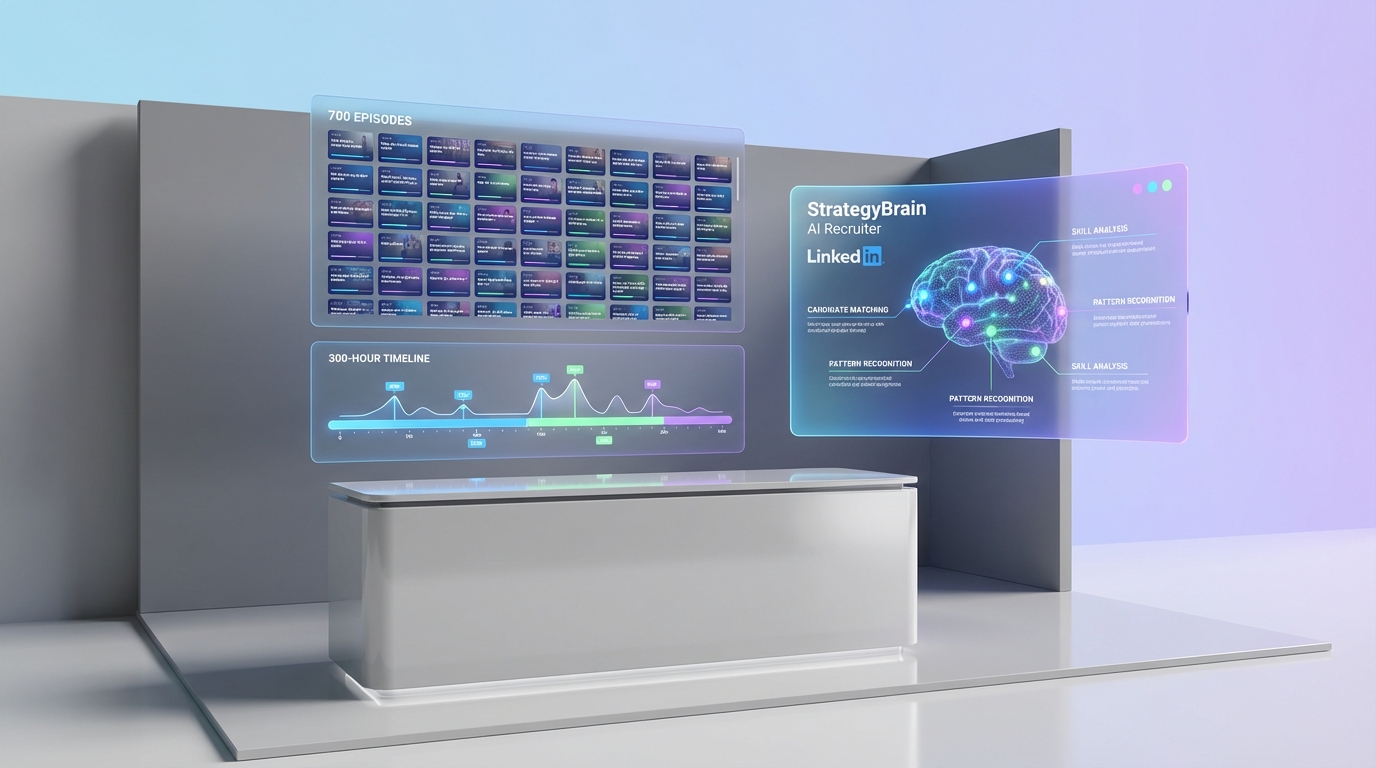
An ai recruiting tool is most valuable when it helps you make better decisions, not just send more messages. For the 10th birthday of my podcast, Recruiting Future, we used AI to do deep research across 700 episodes and 300 hours of conversation. The analysis revealed repeating patterns in how Talent Acquisition talks about the future and adopts technology. In this post, I explain the patterns we saw, why they matter, and how to turn them into execution using StrategyBrain AI Recruiter, including LinkedIn outreach automation, 24/7 multilingual candidate communication, and scalable recruiting teams across multiple LinkedIn accounts.
Why an AI recruiting tool mindset is useful for research
When people hear “AI recruiting tool,” they often think of the front office of recruiting: sourcing, outreach, screening, scheduling. That is real value, but there is another layer that matters just as much: using AI to detect patterns in what we say, what we repeat, and what we avoid.
In Talent Acquisition, we tend to cycle through the same debates every few years. We rename problems, we repackage solutions, and we underestimate the operational work required to adopt new technology. AI is good at spotting those cycles because it can read and summarize at a scale no human can sustain.
That is why I approached this birthday project like a research exercise. The goal was not to produce a novelty summary. The goal was to identify repeatable patterns that can help us predict what is next and, more importantly, decide what to do now.
What we analyzed and what we did not
We used AI to review the full archive of 700 episodes and 300 hours of conversation from Recruiting Future. The output was a set of themes and recurring structures in how guests describe the future of work, the future of recruiting, and the adoption of new tools.
What this article covers:
- How repeating patterns show up in Talent Acquisition conversations
- How to translate those patterns into a practical operating plan
- How StrategyBrain AI Recruiter can help execute the plan on LinkedIn
What this article does not cover:
- Episode by episode findings, quotes, or private notes
- A claim that AI can replace recruiter judgment or final qualification
- A ranking of the best recruitment apps or a directory of freeware recruitment software
That last point matters. People often ask for “best recruitment apps” lists. Those can be useful, but they are not the same as understanding adoption patterns. Here, the focus is on decision quality and execution discipline.
The repeating patterns we found
The AI analysis highlighted repeating patterns in how we talk about the future and how we adopt technology. I am deliberately describing these as patterns rather than predictions. Patterns are actionable because they show up again and again.
Pattern 1: We overestimate the tool and underestimate the operating model
In many conversations, the technology sounds like the hard part. In practice, the hard part is the operating model: who owns the workflow, what “good” looks like, how exceptions are handled, and how performance is measured.
This is where an ai recruiting tool can either help or hurt. If it is deployed as a bolt on, it creates more fragmentation. If it is deployed as a workflow owner, it reduces fragmentation.
Pattern 2: Adoption follows trust, not hype
Across a decade of discussions, the same dynamic appears. Teams adopt technology when they trust the outcomes, trust the data handling, and trust that the tool will not create reputational risk with candidates.
That is why security and privacy practices are not “legal details.” They are adoption accelerators. For example, StrategyBrain AI Recruiter is designed so customer provided data is not used to train AI models, and candidate information is encrypted and isolated per customer environment. Those choices are not marketing. They are what makes scale possible without losing control.
Pattern 3: The future arrives in the inbox
Many “future of recruiting” narratives focus on platforms and systems. Yet the day to day reality is messaging. Candidate experience is often decided in the inbox: response time, clarity, follow up, and whether questions are answered accurately.
This is one reason LinkedIn remains central. It is not only a database. It is a conversation channel. An ai recruiting tool that can manage outreach and follow up consistently can change outcomes without changing your entire tech stack.
Pattern 4: Global hiring exposes language and time zone friction
When teams expand internationally, they discover a simple constraint: candidates reply when your recruiters are asleep, and they ask questions in their native language. If your process cannot respond, you lose momentum.
StrategyBrain AI Recruiter addresses this with 24/7 multilingual communication that responds in the candidate’s native language. In practice, this reduces misunderstandings and keeps conversations moving across time zones.
Pattern 5: Scale requires systems, not heroics
One of the most consistent themes in Talent Acquisition is the reliance on individual effort. That works until it does not. When hiring demand spikes, heroics break first.
A system approach means you can scale output without scaling headcount at the same rate. StrategyBrain AI Recruiter supports managing more than 100 LinkedIn accounts, which enables an AI powered recruiting team model. The point is not to spam. The point is to create controlled, measurable capacity.
How to apply these patterns to your hiring strategy
Patterns are only useful if they change what you do next. Here is a practical way to apply them, whether you are evaluating an ai recruiting tool, comparing best recruitment apps, or trying to decide if freeware recruitment software is enough for your needs.
1) Define what the tool owns
Be explicit about the boundary. For StrategyBrain AI Recruiter, the ownership is the initial LinkedIn outreach and qualification conversation: connecting, introducing the role, answering questions, confirming interest, and collecting résumés and contact details from interested candidates.
Also be explicit about what it does not own. AI Recruiter does not decide final fit against job requirements. Recruiters still review résumés and make the hiring decision.
2) Design for trust and compliance
Adoption is faster when stakeholders can answer basic questions clearly: What data is stored, how is it protected, and is it used to train models. If you cannot answer those questions, you will struggle to scale.
In our experience, the fastest way to build trust is to document the workflow and the data handling in plain language, then review it with HR, legal, and security before rollout.
3) Measure the inbox, not just the funnel
Funnels are lagging indicators. Inbox metrics are leading indicators. Track response time, follow up completion, and the percentage of conversations that reach a clear outcome: not interested, interested, or needs human follow up.
When you evaluate best recruitment apps, ask whether they improve these leading indicators. Many tools report pipeline stages but do not improve the actual conversation quality.
4) Plan for global coverage
If you hire across regions, build coverage into the system. A human only model requires shift coverage. An AI assisted model can provide 24/7 responsiveness, with recruiters stepping in when a candidate is ready for an interview.
5) Scale with guardrails
Scaling outreach without guardrails creates risk. Scaling with guardrails creates capacity. Guardrails include message policies, role specific FAQs, escalation rules, and monitoring for edge cases.
StrategyBrain AI Recruiter supports multi account management so teams can scale outreach capacity while keeping control over what is sent and how candidates are handled.
Where StrategyBrain AI Recruiter fits in
There is a reason I am emphasizing execution. Many organizations already have an ATS, a CRM, and a stack of tools that look like “best recruitment apps” on paper. The bottleneck is often the repetitive work on LinkedIn: connecting, introducing roles, answering questions, following up, and collecting résumés.
StrategyBrain AI Recruiter is built specifically for LinkedIn hiring. It automates the initial outreach and qualification conversation, then hands off to recruiters when candidates are ready for human screening and interviews.
What it does well
- Smart LinkedIn recruitment automation that connects with candidates matching your criteria and runs the initial conversation
- Always on candidate messaging with multilingual communication in the candidate’s native language
- Scalable recruiting teams by managing more than 100 LinkedIn accounts for coordinated outreach
- Structured handoff by collecting résumés and contact details from interested candidates for recruiter review
Limitations to know up front
- It does not replace final qualification against job requirements, recruiters still review résumés and decide fit
- It requires clear job information such as compensation, benefits, and role details so the AI can answer candidate questions accurately
- It needs guardrails such as escalation rules for sensitive questions and edge cases
If you are currently relying on freeware recruitment software for outreach, the gap is usually not “features.” The gap is consistent follow up, response time, and the ability to run many parallel conversations without burning out recruiters.
Quick checklist: turn insight into action
Use this checklist to move from pattern recognition to operational change.
- Define ownership: Decide which steps the ai recruiting tool owns and which steps remain human owned
- Write the candidate FAQ: Role, company, compensation, benefits, location, visa, interview process
- Set escalation rules: When the AI should hand off to a recruiter
- Choose inbox metrics: Response time, follow up completion rate, conversation outcome rate
- Plan global coverage: Time zones and languages you must support
- Decide scale model: Single account pilot or multi account team rollout
- Document privacy posture: What data is stored, how it is encrypted, and how it is used
FAQ
Is an ai recruiting tool only useful for sourcing?
No. Sourcing is one use case, but AI is also useful for pattern detection and workflow consistency. In our archive analysis, AI helped identify repeating adoption themes, and tools like StrategyBrain AI Recruiter help execute consistently in LinkedIn outreach and follow up.
What does StrategyBrain AI Recruiter automate on LinkedIn?
It automates the initial outreach and qualification conversation: connecting with candidates, introducing the role, answering questions about the job and company, confirming interview interest, and collecting résumés and contact details from interested candidates.
Does AI Recruiter decide whether a candidate is qualified?
No. AI Recruiter identifies willingness to communicate or interview, but it does not determine final fit against job requirements. Recruiters review the résumé and make the qualification decision.
How does AI Recruiter handle multilingual recruiting?
It provides 24/7 candidate communication in the candidate’s native language. This reduces delays across time zones and helps avoid misunderstandings in early stage conversations.
Can AI Recruiter scale across multiple recruiters or business units?
Yes. It supports managing more than 100 LinkedIn accounts, which enables an AI powered recruiting team approach for organizations that need scalable outreach capacity.
Is freeware recruitment software enough for LinkedIn hiring?
It can be enough for small volumes, but it often breaks down when you need consistent follow up, fast response times, and parallel conversations at scale. That is typically where a dedicated ai recruiting tool becomes valuable.
How does AI Recruiter capture résumés and contact details?
When candidates express interest, it requests a résumé and contact information. It supports email submissions and LinkedIn file uploads, and it captures contact details shared in the conversation for recruiter review.
What should I look for when comparing best recruitment apps?
Look beyond feature lists. Ask whether the tool improves leading indicators in candidate messaging: response time, follow up completion, and the rate at which conversations reach a clear outcome.
Conclusion
Using AI to analyze 700 podcast episodes and 300 hours of conversation reinforced a simple lesson: technology adoption in Talent Acquisition is less about novelty and more about trust, operating models, and execution in the inbox. If you want an ai recruiting tool strategy that actually changes outcomes, start by defining workflow ownership, measuring messaging performance, and building guardrails for scale.
Next step: pick one role family, document the candidate FAQ and escalation rules, then pilot StrategyBrain AI Recruiter on LinkedIn to automate outreach, maintain 24/7 multilingual responsiveness, and collect résumés and contact details for recruiter review.