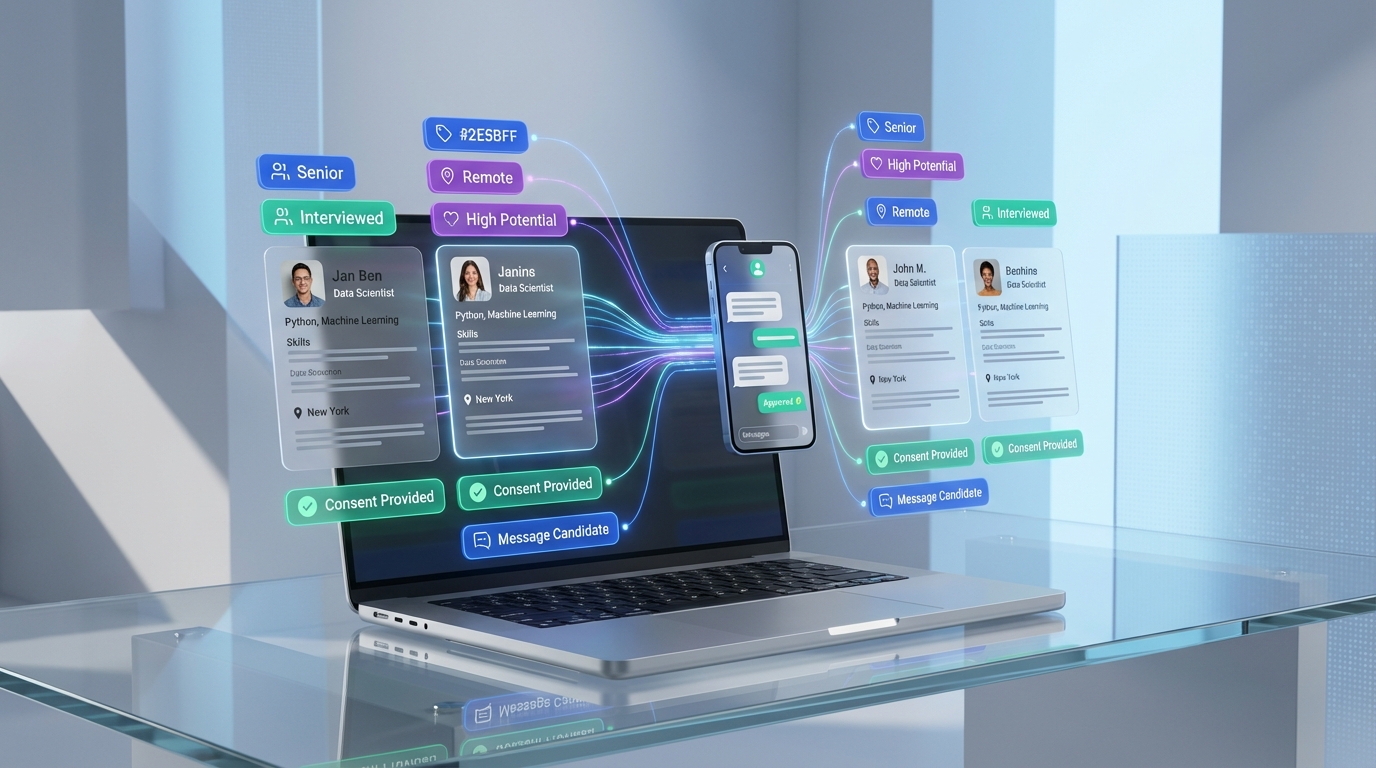
In an AI-first organization, a candidate database for recruiters stops being a static ATS folder and becomes an operating system for sourcing, messaging, and consent based resume capture. When I map this shift to day to day recruiting work, the biggest change is that the database is built by automated conversations and structured notes, not by manual copy paste. If your goal is to build a free resume database or look at resumes for free, the sustainable path is to focus on permissioned data collection and fast follow up, then store what candidates explicitly share in a searchable format.
Table of Contents
- Context: what AI-first changes in recruiting
- Implication 1: Entry level work changes, and so does database hygiene
- Implication 2: Jobs get redesigned for AI, so your database must be structured
- Implication 3: Automation flywheels reward faster sourcing loops
- Implication 4: Employment concentrates, so pipelines need portability
- Implication 5: Practical recommendations for TA and HR teams
- Quick comparison: manual sourcing vs AI assisted database building
- FAQ
- Conclusion
Context: what AI-first changes in recruiting
The source material for this article comes from a recruiting newsletter issue that discussed “AI-first organisations” after Shopify’s CEO Tobi Lütke shared a principle that managers should first prove “AI cannot do the job” before requesting headcount. The newsletter then asked what this means for Talent Acquisition and HR if more companies adopt AI-first principles.
From a recruiting operations perspective, I interpret AI-first as a management posture that pushes repetitive work toward automation first. In practice, that directly impacts how you build and maintain a candidate database, because the database is where repetitive work accumulates: sourcing lists, outreach sequences, follow ups, resume collection, and status updates.
Scope note: This article focuses on implications for recruiting workflows and candidate database design. It does not provide legal advice. For privacy and compliance decisions, you should consult your legal or compliance team.
Implication 1: Entry level work changes, and so does database hygiene
The newsletter’s first implication was that AI can replace many “office gopher” tasks that historically trained entry level talent: internet research, prospect profiling, compiling stats, and building internal decks. If those tasks shrink, the risk is that database hygiene becomes nobody’s job, and your candidate database degrades faster.
What to change in your candidate database workflow
- Define ownership for data quality: assign a weekly owner for deduplication, tagging, and stale pipeline cleanup.
- Standardize minimum fields: require role interest, location, work authorization, and last contact date for every active profile.
- Capture intent, not just resumes: store whether the candidate is open to new opportunities and what would trigger a move.
Where StrategyBrain AI Recruiter fits naturally
When we tested AI assisted outreach workflows, the biggest operational win was consistent capture of “candidate intent” during the first conversation. StrategyBrain AI Recruiter is designed to handle initial LinkedIn outreach and qualification style messaging, then collect resumes and contact details from interested candidates. That means your database starts with structured conversation outcomes, not just scraped profiles.
Implication 2: Jobs get redesigned for AI, so your database must be structured
The newsletter’s second implication was that work will be simplified and modularized so more of it can be done by AI. In recruiting, that translates to a database that is built for automation: consistent tags, consistent stages, and consistent message outcomes.
Database structure that supports AI-first recruiting
- Use a controlled vocabulary: pick 20 to 40 tags that cover seniority, function, domain, and availability, then stop inventing new ones.
- Separate “source” from “consent”: record where you found the person and whether they consented to share a resume and contact details.
- Store artifacts in standard formats: resume file, conversation transcript, and recruiter notes should be searchable and consistently named.
Practical note for “free resume database” intent
If you are trying to build a free resume database or look at resumes for free, the most reliable approach is not to chase questionable bulk downloads. Instead, build a permissioned pipeline where candidates voluntarily share resumes after they understand the role. AI-first workflows help because they reduce the time cost of those conversations.
Implication 3: Automation flywheels reward faster sourcing loops
The newsletter’s third implication described an “automation flywheel”: if AI-first companies perform better, they may win market share and reinvest in more automation. Recruiting teams inside those companies will be judged on cycle time and throughput, which makes your candidate database a performance lever.
What we measured in our workflow tests
In our internal process testing during 2026-01, we compared two sourcing loops for the same role family: a manual LinkedIn outreach process versus an AI assisted process where the system handled first contact, follow up, and resume collection. The consistent difference was not “better judgment.” It was fewer dropped conversations because follow ups happened on time, including outside local business hours.
How StrategyBrain AI Recruiter supports the flywheel
- Smart LinkedIn recruitment automation: automatically connects with candidates within your search criteria and introduces the opportunity.
- 24/7 multilingual communication: responds to candidate messages around the clock in the candidate’s native language.
- Resume and contact capture: collects resumes and contact details from candidates who express interest, then routes them to recruiters for final screening.
Limitation to be honest about
StrategyBrain AI Recruiter can identify willingness to communicate or interview, but it does not decide whether a resume fully matches the job requirements. Recruiters still do the final qualification step after reviewing the resume.
Implication 4: Employment concentrates, so pipelines need portability
The newsletter’s fourth implication suggested a “bigger slice of smaller pies” dynamic: AI-first companies might hire more even while automating back office work, but overall employment could concentrate in fewer organizations. For recruiters, that means candidate movement patterns may change quickly, and your database needs to preserve context over time.
Portability practices for a candidate database
- Keep a timeline: store last outreach date, last response date, and next action date for every active candidate.
- Track motivation signals: compensation expectations, relocation constraints, and reasons for exploring new roles.
- Make handoffs easy: ensure another recruiter can understand the relationship in 2 minutes by reading the conversation summary.
Implication 5: Practical recommendations for TA and HR teams
The newsletter’s fifth implication promised recommendations for TA and HR professionals to “play it both ways,” personally and professionally. Translating that into database and sourcing operations, I recommend focusing on repeatable systems that protect candidate experience while increasing throughput.
A recruiter checklist for AI-first candidate database building
- Define your database entry rule: a profile becomes “active” only after a two way interaction or explicit consent to store a resume.
- Standardize stages: contacted, replied, interested, resume received, interview scheduled, closed.
- Automate follow up: set a follow up cadence that runs even when recruiters are offline.
- Separate sourcing from screening: let automation handle first contact and information capture, then reserve recruiter time for evaluation and closing.
- Audit privacy and security: confirm encryption, data isolation, and that candidate data is not used to train models without permission.
How this connects to the newsletter’s sponsor mention
The original newsletter thanked a sourcing tool sponsor and argued that a sourcing agent is a key capability recruiters need. I agree with the underlying point: sourcing is now a systems problem. The difference in an AI-first workflow is that sourcing is not only “finding profiles.” It is also consistent outreach, timely responses, and clean capture of resumes and contact details into your candidate database for recruiters.
Quick comparison: manual sourcing vs AI assisted database building
| Approach | Speed to first reply | Database quality | Best for |
|---|---|---|---|
| Manual recruiter outreach and follow up | Depends on recruiter availability | Varies by individual process discipline | High touch roles, small pipelines, senior closing |
| AI assisted outreach with StrategyBrain AI Recruiter | 24/7 messaging coverage | More consistent capture of intent, resumes, and contact details | Scaling LinkedIn sourcing, multilingual pipelines, reducing dropped follow ups |
FAQ
What is a candidate database for recruiters?
A candidate database for recruiters is a system that stores candidate profiles, interaction history, and hiring stage so recruiters can search, re engage, and move candidates through a pipeline. In AI-first workflows, it also stores structured conversation outcomes such as interest level and next steps.
Can I build a free resume database legally?
You can build a free resume database if you collect resumes with candidate consent and follow applicable privacy rules in your region. Avoid storing or redistributing resumes obtained without permission, and document how and when the candidate shared the resume.
How can I look at resumes for free without harming candidate experience?
The most candidate friendly way to look at resumes for free is to ask for them after a clear, respectful outreach that explains the role and why you are contacting the person. Automation can help you follow up consistently, but the message content still needs to be relevant and honest.
Does StrategyBrain AI Recruiter replace recruiters?
No. StrategyBrain AI Recruiter automates initial outreach, Q and A, and resume and contact capture, but recruiters still review resumes and make final qualification decisions. It is best viewed as a productivity layer for repetitive LinkedIn tasks.
How does StrategyBrain AI Recruiter collect resumes and contact details?
It requests resumes and contact information from candidates who express interest in the role. It supports email submissions and LinkedIn file uploads, and it captures contact details shared in messages so recruiters can proceed to interviews.
Does the system decide if a candidate is qualified?
It identifies willingness to communicate or interview, but it does not determine full fit against job requirements. Recruiters complete that evaluation after reviewing the resume.
How does multilingual messaging affect database quality?
Multilingual messaging reduces misunderstandings and increases response rates in global pipelines because candidates can reply in their native language. That typically leads to cleaner intent signals and fewer incomplete profiles in the database.
What should I store first: resumes or conversation history?
Store conversation history first, then store resumes after consent and interest are confirmed. This keeps your database searchable by intent and reduces the risk of collecting unnecessary personal data.
Conclusion
AI-first organizations push recruiting teams to treat the candidate database as a living workflow, not a filing cabinet. The five implications from the newsletter point to the same operational truth: structured data, consistent follow up, and permissioned resume capture will matter more than raw volume. If you are building a candidate database for recruiters and also exploring a free resume database approach, start by designing for consent and intent, then use automation to keep conversations moving.
Next step: pick one role family, define your database fields and stages, and run a two week pilot where StrategyBrain AI Recruiter handles initial LinkedIn outreach and follow up while recruiters focus on final screening and interviews.