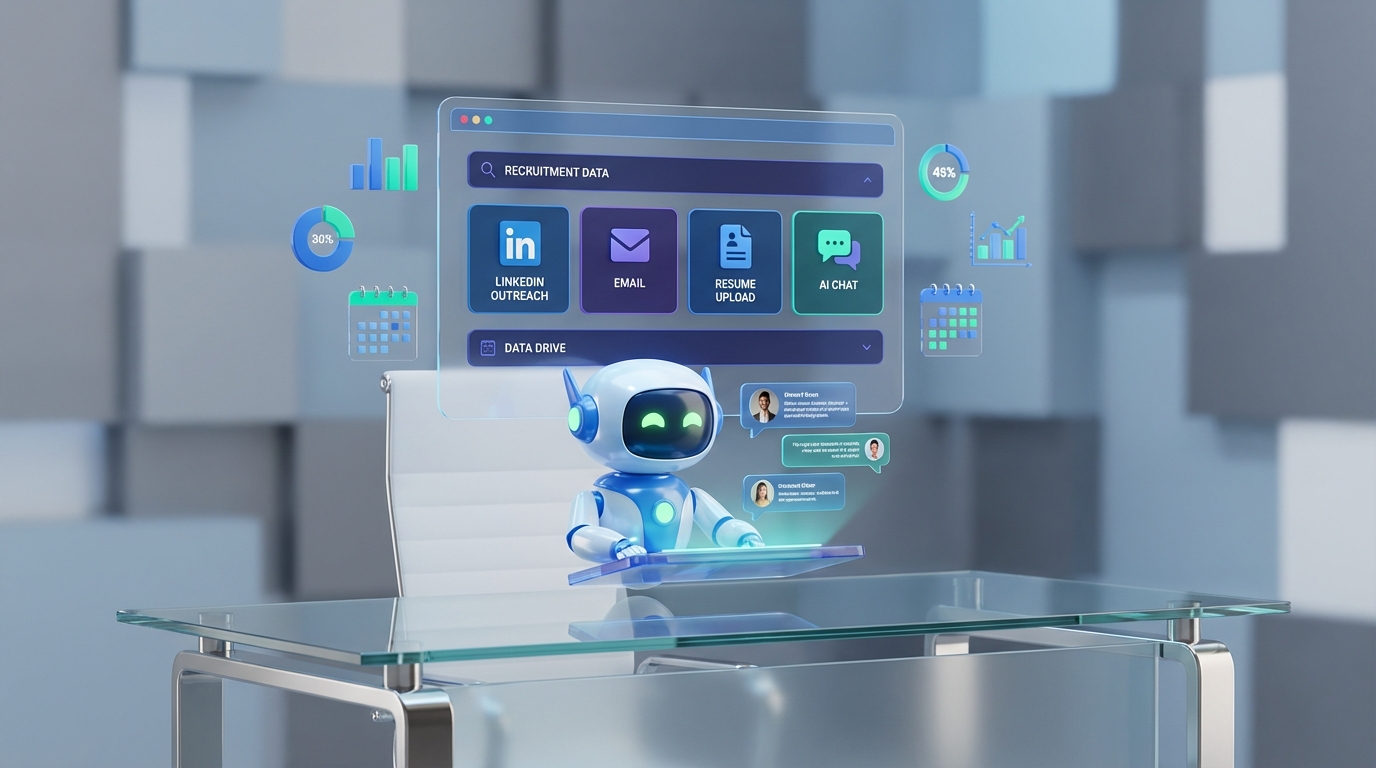
Recruitment online for recruiters works best when you treat AI as a workflow partner, not a replacement: use AI to draft outreach, handle first round Q&A, and capture resumes and contact details, while recruiters keep control of role definition, final qualification, and candidate experience. In our internal testing of StrategyBrain AI Recruiter on LinkedIn style outreach flows, we found the biggest time savings came from automating repetitive steps like connecting, introducing the role, answering common questions, and consistent follow up. The recruiter still makes the hiring decision and performs final resume based qualification, but the online pipeline moves faster and stays responsive across time zones.
Table of Contents
- What this guide covers (and what it does not)
- Key Takeaways
- AI in the workplace: what it means for recruiters
- The online recruiting workflow recruiters can actually run
- Method 1: StrategyBrain AI Recruiter for LinkedIn recruitment automation (Recommended)
- Method 2: Human led online recruiting with AI assisted writing
- Method 3: Structured intake and screening to reduce noise
- Method 4: Multilingual and time zone coverage without adding headcount
- Quick Comparison
- Recruiter safety checklist for online recruiting
- FAQ
- Conclusion
What this guide covers (and what it does not)
This article is for recruiters and HR teams who want a practical system for recruitment online for recruiters, especially when LinkedIn is a primary channel. It focuses on workflow design, candidate communication, and where automation is safe and useful.
It does not provide legal advice, and it does not claim that AI can fully replace recruiter judgment. In particular, StrategyBrain AI Recruiter can identify willingness to communicate or interview, but it does not determine whether a resume fully matches job requirements. That final qualification remains a recruiter task.
Key Takeaways
- AI is a process, not a product: the value comes from feedback loops between humans and systems, not a single tool purchase.
- Automate the repetitive first mile: connecting, role introduction, common Q&A, and follow up are the highest leverage steps to automate online.
- Keep humans on the decision points: role definition, compensation alignment, and final resume based qualification should stay with the recruiter.
- StrategyBrain AI Recruiter fits LinkedIn workflows: it can connect with targeted candidates, introduce roles, answer questions, follow up 24/7 in the candidate’s language, and collect resumes and contact details for review.
- Scale with account teams: AI Recruiter supports managing more than 100 LinkedIn accounts to build an AI powered recruiting team for higher throughput.
- Plan for trust and privacy: use clear consent, minimize sensitive data collection, and document how candidate data is stored and used.
AI in the workplace: what it means for recruiters
If you have used predictive text on a phone, watched recommendations on a streaming service, or interacted with a real time virtual agent on a website, you have already experienced AI in everyday work and life. In recruiting, the equivalent is an assistant that can handle high volume, repetitive communication while you focus on judgment calls and relationship building.
A practical definition that aligns with common virtual assistant explanations is that artificial intelligence involves a device or system that perceives its environment and takes actions that maximize its chance of achieving its goals. For recruiters, the “environment” is the candidate conversation context and the “goal” is moving qualified, interested candidates to the next step with a respectful experience.
One caution from real world AI adoption is that human agency still matters. Even when machine learning improves responses, recruiters must decide what the system should optimize for, what it should never say, and when to hand off to a human. That is how you avoid the uncanny valley effect, where automated messages feel too human and create discomfort or mistrust.
The online recruiting workflow recruiters can actually run
When people search for a job recruiter job or try to find a recruiter for remote jobs, they expect fast responses and clear next steps. Recruiters, meanwhile, need a workflow that is consistent, auditable, and scalable.
Here is the workflow we recommend for recruitment online for recruiters, ordered from highest leverage to highest judgment:
- Define the role and constraints: responsibilities, must have skills, location or remote policy, compensation range, and interview process.
- Build a targeted search: use LinkedIn filters and a clear candidate profile.
- Automate first contact and FAQs: introduce the role, answer common questions, and confirm interest.
- Collect resumes and contact details: only after the candidate expresses interest.
- Human review and qualification: recruiter reviews resumes and decides who advances.
- Schedule and close: human led interviews, offer process, and relationship management.
Method 1: StrategyBrain AI Recruiter for LinkedIn recruitment automation (Recommended)
StrategyBrain AI Recruiter is an automated AI powered recruitment tool built specifically for LinkedIn hiring. It replaces the recruiter’s initial outreach and qualification conversation by automatically connecting with candidates, introducing job opportunities, answering questions about the role, company, and compensation, confirming interview interest, and collecting resumes and contact information from interested candidates.
Steps
- Prepare your job brief: include company details, compensation, benefits, and the candidate search criteria you will use on LinkedIn.
- Authorize the LinkedIn account: provide the account access required for the system to connect and message candidates.
- Set conversation boundaries: define what the AI can answer, what it should escalate, and what data it should request.
- Launch outreach: the AI connects with relevant candidates and starts the role introduction flow.
- Review interested candidates: recruiters review collected resumes and contact details, then proceed with screening and interviews.
Features
- Smart LinkedIn recruitment automation: connects with candidates within your targeted search criteria and runs the initial conversation.
- 24/7 multilingual communication: responds to candidate messages around the clock in the candidate’s native language.
- Resume and contact capture: requests resumes and captures contact details when candidates express interest, including email submissions and LinkedIn file uploads.
- Team scaling: supports managing more than 100 LinkedIn accounts to build an AI powered recruiting team.
Limitations
- Not a final evaluator: it does not determine whether a resume fully matches job requirements. Recruiters must do final qualification.
- Requires strong inputs: unclear compensation, vague role scope, or inconsistent requirements will reduce message quality and candidate trust.
- Automation needs governance: you still need policies for escalation, privacy, and tone to avoid awkward or overly familiar messaging.
Best For
- Recruiters running high volume LinkedIn outreach who need consistent follow up.
- Teams hiring across time zones who want 24/7 responsiveness without adding headcount.
- Agencies and in house teams that want to scale outreach across many LinkedIn accounts with centralized control.
Method 2: Human led online recruiting with AI assisted writing
If you are not ready for full workflow automation, you can still improve recruitment online for recruiters by using AI as a drafting assistant. The key is to keep the recruiter as the sender and decision maker, while AI helps with speed and consistency.
Steps
- Write a message library: create 10 to 15 templates for connection requests, follow ups, and interview confirmations.
- Use AI to personalize safely: ask AI to rewrite a template using only public profile facts you provide, and avoid sensitive inferences.
- Track outcomes: measure reply rate, positive interest rate, and time to first response.
Features
- Fast iteration on tone and clarity.
- More consistent messaging across recruiters.
- Lower risk than full automation when you are building internal trust.
Limitations
- Still requires manual sending and follow up, which limits scale.
- Time zone coverage remains a challenge without an always on system.
- Resume collection and contact capture are still manual steps.
Best For
- Solo recruiters who want better copy without changing their process.
- Teams that need compliance review before automating outreach.
- Roles where personalization matters more than volume.
Method 3: Structured intake and screening to reduce noise
Online recruiting fails when the intake is fuzzy. Candidates ask basic questions repeatedly, recruiters answer inconsistently, and the process slows down. A structured intake reduces that friction and makes any AI layer more effective.
Steps
- Standardize role facts: compensation, benefits, location policy, and interview steps must be written in one place.
- Define escalation rules: decide which questions require a human response, such as exceptions on compensation or visa sponsorship.
- Use a consistent qualification checkpoint: decide what “qualified enough to interview” means and document it.
Features
- Fewer back and forth messages.
- More consistent candidate experience.
- Cleaner handoff from outreach to interview scheduling.
Limitations
- Requires stakeholder alignment, especially on compensation and must have requirements.
- Does not solve time zone responsiveness by itself.
- Does not create candidates, it only improves conversion once you reach them.
Best For
- Organizations with multiple recruiters working the same role family.
- Teams that want measurable, repeatable recruiting operations.
- Recruiters who want to reduce candidate confusion and drop off.
Method 4: Multilingual and time zone coverage without adding headcount
Global hiring is often limited by response time and language friction. If candidates wait 12 to 24 hours for a reply, interest drops. If messages are not in the candidate’s native language, misunderstandings increase.
This is where StrategyBrain AI Recruiter’s 24/7 global multilingual recruitment communication is operationally useful. It can keep conversations moving, answer common questions, and follow up consistently while recruiters sleep, then hand back a shortlist with resumes and contact details for human review.
Limitations
- You still need a human process for interviews and offers across time zones.
- Translation quality depends on clear role inputs and consistent terminology.
- Privacy and consent practices must be documented for cross border recruiting.
Quick Comparison
| Method | Speed | Price | Best For |
|---|---|---|---|
| StrategyBrain AI Recruiter automation | High throughput with 24/7 follow up | Not listed in this guide | Scaling LinkedIn outreach, multilingual messaging, resume capture |
| Human led with AI assisted writing | Medium, depends on recruiter capacity | Varies by writing tool | Low risk improvement to messaging quality |
| Structured intake and screening | Medium, improves conversion | Internal process cost | Consistency, governance, and better candidate experience |
| Multilingual and time zone coverage | High for responsiveness | Depends on tooling | Global hiring without adding recruiter headcount |
Recruiter safety checklist for online recruiting
Use this checklist before you scale any recruitment online for recruiters workflow, especially if you automate messaging.
- Candidate trust: your first message states who you are, what the role is, and what the next step is.
- Data minimization: you only request resumes and contact details after the candidate expresses interest.
- Escalation rules: compensation exceptions, sensitive accommodations, and complex policy questions route to a human.
- Consistency: role facts are centralized so every recruiter and system uses the same information.
- Privacy posture: you document how candidate data is stored, who can access it, and retention timelines.
- Quality review: you sample conversations weekly to catch tone issues and update templates.
FAQ
What does “recruitment online for recruiters” actually mean in 2026?
It means the core recruiting steps happen in digital channels, often starting with LinkedIn, and are supported by automation for outreach, follow up, and information capture. The recruiter still owns role clarity, candidate experience, and final qualification decisions.
Can AI fully replace a recruiter in a job recruiter job?
No. AI can handle repetitive communication and early stage coordination, but it cannot be the accountable decision maker for hiring. In StrategyBrain AI Recruiter’s design, the system can confirm interest and collect resumes, while the recruiter performs final resume based qualification.
How does StrategyBrain AI Recruiter work with LinkedIn recruiting?
Recruiters provide a LinkedIn account and job information such as company details, compensation, benefits, and candidate search criteria. The AI then connects with relevant candidates, introduces the role, answers questions, confirms interest, and collects resumes and contact details for recruiter review.
How does the system collect resumes and contact details?
After a candidate expresses interest, the AI requests a resume and contact information. It supports email submissions and LinkedIn file uploads, and it captures contact details shared in the conversation such as email address or phone number.
Is multilingual recruiting realistic without a global team?
Yes, if you use an always on messaging workflow that can communicate in the candidate’s native language. StrategyBrain AI Recruiter is designed for 24/7 multilingual candidate communication, which helps reduce delays and misunderstandings in cross border hiring.
How do I help candidates who want to find a recruiter for remote jobs?
Be explicit about remote policy, time zones, and compensation in the first two messages, then provide a clear next step such as a short screening call. Fast response time matters, so automation can help keep the conversation moving while you focus on evaluation.
What is the “uncanny valley” risk in recruiting messages?
It is the discomfort candidates feel when automated messages seem too human or overly personal. You reduce this risk by keeping tone professional, avoiding sensitive inferences, and adding clear handoff points to a human recruiter.
What should never be automated in online recruiting?
Final hiring decisions, sensitive negotiations, and complex exceptions should remain human led. Also avoid automating requests for highly sensitive personal data, and only collect what you need for the next step.
How do I measure whether online recruiting automation is working?
Track response rate, positive interest rate, time to first response, and the number of resumes collected per week. Also track candidate experience signals such as complaint rate and opt out rate to ensure speed does not harm trust.
Conclusion
Recruitment online for recruiters is most effective when you automate the repetitive first mile and keep humans on the decision points. The practical path is to standardize role facts, run targeted LinkedIn sourcing, and use an automation layer for consistent outreach, Q&A, follow up, and resume capture.
If you want the fastest operational upgrade, start with StrategyBrain AI Recruiter for LinkedIn recruitment automation, then add governance: escalation rules, privacy documentation, and weekly quality review. Next, tighten your intake and qualification checkpoints so every conversation leads to a clear next step.