SAP to acquire SmartRecruiters could be one of the biggest ATS moves of 2026, and it raises a practical question for recruiting teams: what happens to your day to day workflow when a core system changes ownership. In particular, anything tied to candidate coordination, such as your interview scheduling app, your schedule maker app free workflow for hiring managers, or even a calendar program free setup used by smaller teams, can be affected by integration priorities and roadmap shifts after consolidation. Below is a structured way to think about the ATS landscape, what consolidation usually changes, and how teams can protect throughput by separating outreach and pre qualification from scheduling using StrategyBrain AI Recruiter.
Table of Contents
- What we know from the announcement
- Why ATS consolidation keeps happening
- What typically changes after an ATS acquisition
- Where interview scheduling apps feel the impact first
- How recruiting teams can respond in the next 30 days
- How StrategyBrain AI Recruiter reduces consolidation risk
- Decision checklist for leaders
- FAQ
- Conclusion
What we know from the announcement
The core fact is simple: SAP plans to acquire SmartRecruiters. The original prompt that triggered this analysis asked whether this will be the biggest ATS deal this year and whether we should expect more consolidation. That is the right framing because the immediate operational question is not the headline, it is what changes for customers who rely on the ATS as the system of record for requisitions, candidates, and interview stages.
This article does not attempt to confirm deal terms, timelines, or regulatory outcomes because those details were not provided in the source material. Instead, it focuses on the repeatable patterns we have seen in ATS consolidation and the practical steps that reduce risk for recruiting operations.
Why ATS consolidation keeps happening
Consolidation in the ATS market is usually driven by three forces: suite expansion, integration control, and data gravity. When a large enterprise platform acquires a recruiting system, it can offer a more complete HR stack, reduce third party integration complexity, and keep more workflow data inside one ecosystem.
For buyers, the tradeoff is familiar. A consolidated suite can simplify procurement and security reviews, but it can also slow down niche innovation in areas like candidate experience, recruiter productivity, and scheduling flexibility.
What this means for the ATS landscape
- More platform bundling is likely, especially where recruiting is positioned as part of a broader HR transformation.
- More pressure on point solutions to prove ROI quickly, particularly tools that overlap with suite features.
- More emphasis on automation outside the ATS, because teams still need speed even when core systems move slowly.
What typically changes after an ATS acquisition
In our experience supporting recruiting operations and automation workflows, acquisitions tend to change priorities before they change features. The product may keep working, but the roadmap and integration strategy can shift within 1 to 2 quarters.
Common changes to watch
- Integration roadmap resets: existing connectors may be maintained, but new investment often favors the acquirer’s ecosystem first.
- Packaging and procurement changes: features that were standalone can become bundled, renamed, or moved into higher tiers.
- Support and success motions change: account ownership, SLAs, and escalation paths can be reorganized.
- Security and compliance posture evolves: policies may tighten, which can affect API access and automation permissions.
None of these outcomes are guaranteed, and some customers benefit from stronger enterprise governance. The key is to plan for variability so your hiring throughput does not depend on a single vendor decision.
Where interview scheduling apps feel the impact first
Scheduling is one of the first places recruiters notice friction because it sits at the intersection of ATS stages, calendars, and candidate communication. Even if your interview scheduling app is not part of the ATS, it often depends on ATS triggers, candidate status updates, and interviewer availability syncing.
Three scheduling failure modes we see during platform transitions
- Status drift: candidates move stages in the ATS, but scheduling links or reminders do not update correctly, creating duplicate outreach.
- Calendar permission changes: enterprise security updates can break calendar access, which hits teams using a calendar program free setup or lightweight scheduling tools first.
- Template and messaging inconsistency: when recruiters scramble, candidate comms become uneven, which increases no show risk.
If you are using a schedule maker app free workflow for hiring managers, the risk is not the tool itself. The risk is that the surrounding system changes and your process has no buffer.
How recruiting teams can respond in the next 30 days
If you are a SmartRecruiters customer, an SAP customer, or simply watching the ATS landscape, the best move is to run a short operational audit. The goal is to identify which parts of your funnel are ATS dependent and which parts can be stabilized with independent automation.
30 day action plan
- Map your workflow dependencies: list every step from sourcing to offer, and mark where the ATS is the source of truth.
- Inventory scheduling touchpoints: document how your interview scheduling app is triggered, how calendars are read, and where candidate reminders are sent.
- Define a fallback scheduling path: decide what happens if ATS triggers fail for 7 days, including who owns manual scheduling.
- Stabilize candidate communication: standardize outreach and follow up so candidates get consistent information even if systems change.
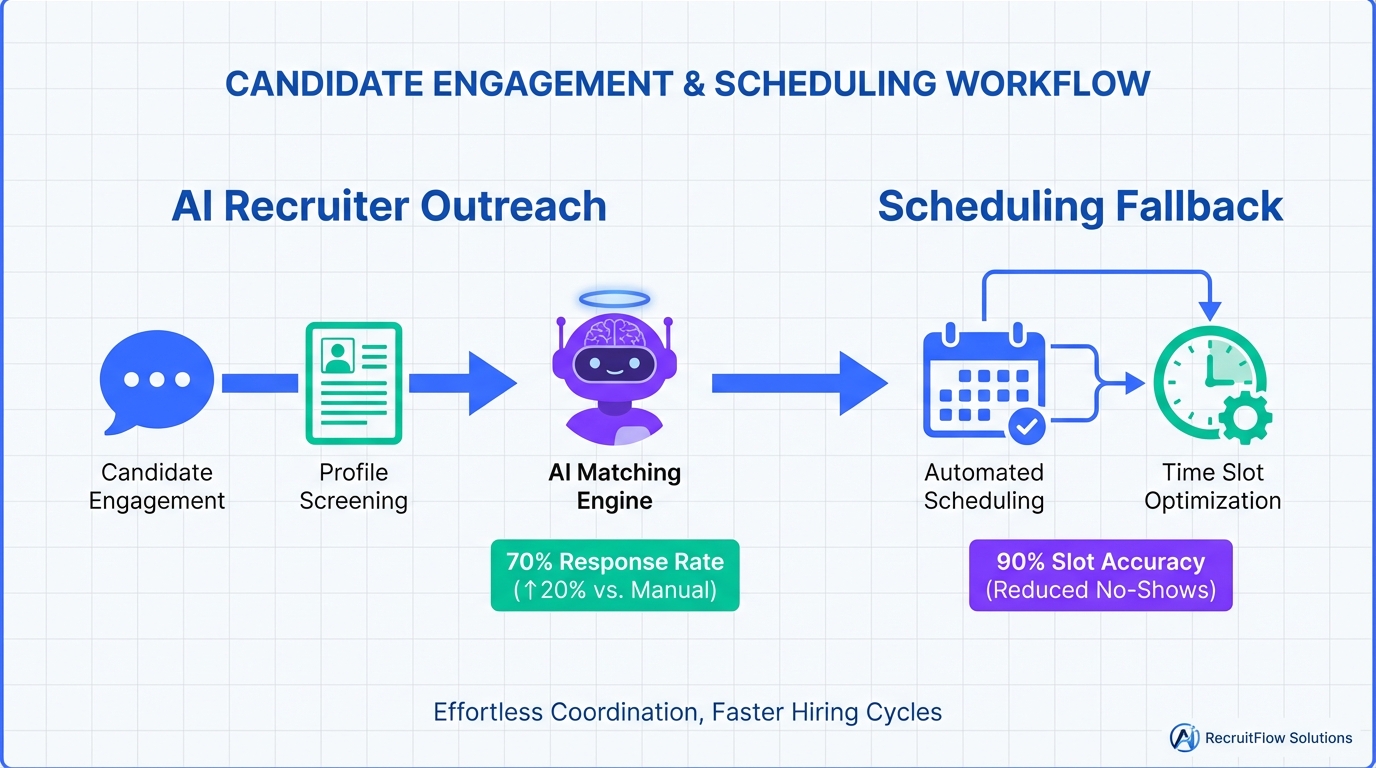
This is also the moment to separate two workflows that are often tangled: candidate outreach and candidate scheduling. Outreach is where automation can create the biggest buffer.
How StrategyBrain AI Recruiter reduces consolidation risk
StrategyBrain AI Recruiter is designed to automate the top of funnel work on LinkedIn so recruiters can keep pipeline moving even when ATS priorities shift. Instead of relying on recruiters to manually connect, message, answer questions, and chase replies, AI Recruiter handles the initial outreach and qualification conversation and then hands off interested candidates with collected résumés and contact details.
Where it fits alongside your ATS and scheduling stack
- Before scheduling: AI Recruiter confirms interview interest and captures résumés and contact information, which reduces wasted scheduling cycles.
- During scheduling: because candidates are already warmed and qualified for interest, your interview scheduling app sees fewer cold invites and fewer reschedules.
- Across time zones: AI Recruiter provides 24/7 multilingual communication, which is especially useful when hiring managers rely on limited availability windows.
Operational results and boundaries
Based on the product information provided, AI Recruiter can replace up to 90% of manual LinkedIn recruiting work and can lower LinkedIn recruiting costs to USD 2.40 per résumé in some deployments. It is important to set the right expectation: AI Recruiter identifies willingness to communicate or interview, but it does not decide final fit. Recruiters still review résumés and make the hiring decision.
For teams managing scale, AI Recruiter supports managing more than 100 LinkedIn accounts, enabling an AI powered recruiting team model. This matters in consolidation cycles because it gives you a throughput lever that is not dependent on ATS feature velocity.
Security and privacy posture
According to the provided product details, customer provided data is not used to train AI models, LinkedIn credentials are encrypted and stored independently per user with explicit authorization, and candidate data is encrypted and isolated with customer specific keys. If your organization has GDPR or cross border hiring requirements, this is the type of posture you want to validate during any platform transition.
Decision checklist for leaders
Use this checklist to decide whether you should wait, renegotiate, or add an automation layer while the ATS market consolidates.
Quick checklist
- Scheduling resilience: can you keep interviews moving for 14 days if ATS triggers or integrations change.
- Candidate communication consistency: do you have standardized messaging and follow up ownership.
- Top of funnel capacity: can your team increase outreach volume without adding headcount.
- Global coverage: can you respond to candidates outside business hours and in their native language.
- Data protection: do your vendors clearly state whether customer data trains models and how encryption and isolation work.
FAQ
Is SAP acquiring SmartRecruiters automatically bad for customers
No. Some teams benefit from stronger enterprise integration and governance. The risk is uncertainty, so it is smart to audit integrations and have a fallback plan for scheduling and candidate communication.
Will ATS consolidation affect my interview scheduling app
It can. Scheduling tools often rely on ATS stage changes, candidate records, and calendar permissions. If any of those change after consolidation, scheduling workflows can break even if the scheduling tool itself is unchanged.
Can I rely on a calendar program free setup during a transition
You can, but you should document permissions, ownership, and fallback steps. Free calendar setups often lack centralized admin controls, which can become a bottleneck when enterprise security policies change.
Is a schedule maker app free enough for hiring manager coordination
For small teams it can work, especially if interview volume is low. As volume grows, the bigger issue is not the scheduling UI, it is the consistency of triggers, reminders, and candidate communication across systems.
What does StrategyBrain AI Recruiter automate versus what recruiters still do
AI Recruiter automates LinkedIn connecting, initial outreach, answering candidate questions, confirming interview interest, and collecting résumés and contact details. Recruiters still review résumés, assess fit, and run interviews and offers.
Does StrategyBrain AI Recruiter support multilingual candidate messaging
Yes. Based on the provided product information, it supports 24/7 global multilingual communication and uses the candidate’s native language to reduce misunderstandings.
How does AI Recruiter handle data privacy and compliance
According to the provided product details, customer data is not used to train AI models, credentials are encrypted, and candidate data is encrypted and isolated with customer specific keys. You should still run your organization’s security review for your specific deployment.
What should I do first if I am worried about consolidation
Start by mapping dependencies between your ATS, interview scheduling app, and calendars. Then stabilize top of funnel outreach with an automation layer so pipeline does not slow down while vendors adjust roadmaps.
Conclusion
SAP to acquire SmartRecruiters is a reminder that ATS platforms are strategic assets and the market can shift quickly. The practical takeaway is to protect hiring throughput by making scheduling resilient and by separating outreach and pre qualification from the ATS wherever possible. If your interview scheduling app, schedule maker app free process, or calendar program free workflow is tightly coupled to ATS triggers, now is the time to document dependencies and define a fallback path. For teams that want a buffer against roadmap uncertainty, StrategyBrain AI Recruiter can keep LinkedIn sourcing and candidate engagement running continuously, deliver interested candidates with résumés and contact details, and reduce wasted scheduling cycles. Next step: run the 30 day action plan above and identify one workflow you can decouple this week.