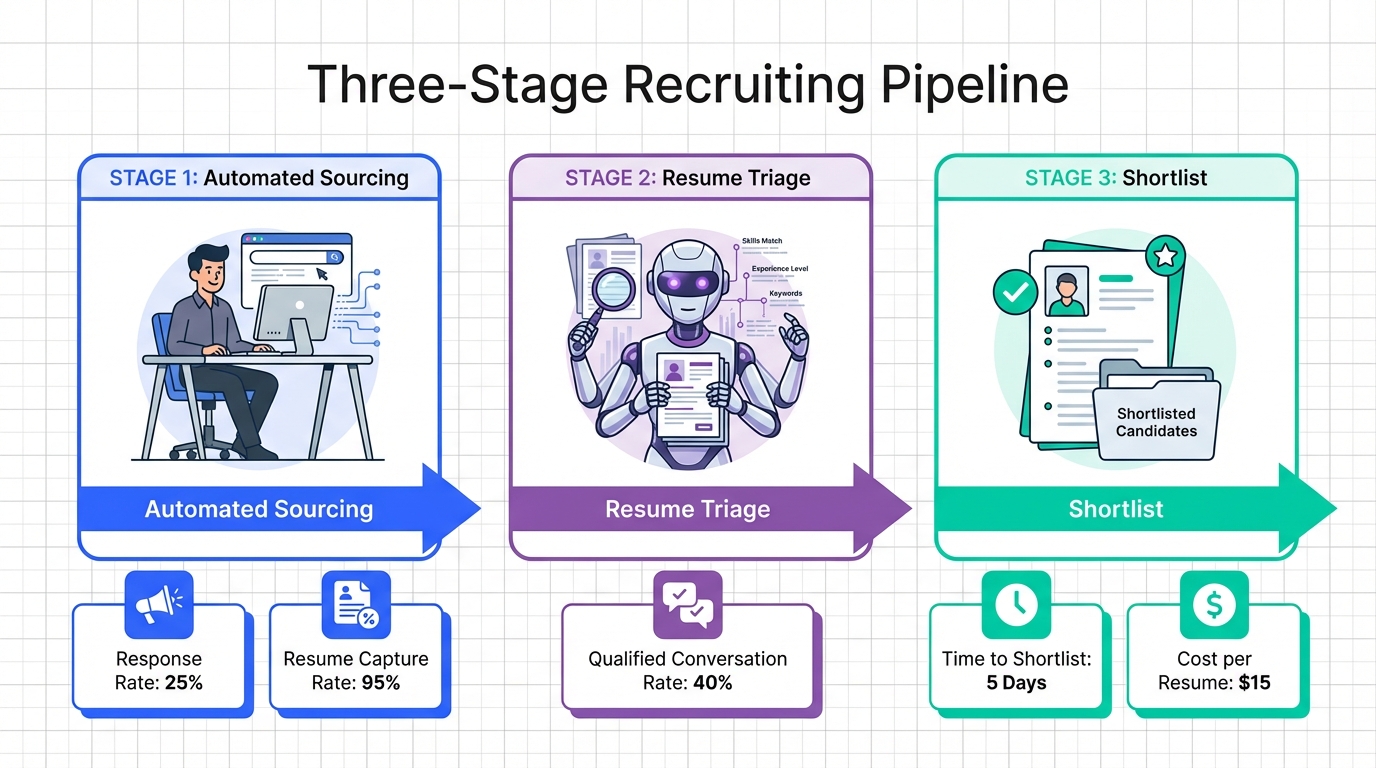
AI resume screening tools are forcing a KPI reset in talent acquisition because efficiency gains now come from automation in sourcing, AI resume filter triage, scheduling, and follow ups, not from adding recruiter headcount. The KPI shift is simple: measure pipeline outcomes and quality signals, not manual activity volume. We have been seeing step change improvements in recruiter capability as AI takes over tasks that previously required large teams and significant time. In our own LinkedIn workflow tests with StrategyBrain AI Recruiter, the most decision useful metrics were response rate, qualified conversation rate, resume capture rate, time to shortlist, and cost per resume, because they remain stable even when automation does the repetitive work.
Key Takeaways
- Activity KPIs lose meaning when AI automates sourcing, messaging, and scheduling, so shift to outcome KPIs tied to pipeline movement.
- Track conversion rates per stage such as response rate, qualified conversation rate, and resume capture rate to compare roles and channels fairly.
- Measure speed with timestamps including time to first response and time to shortlist, not just time to hire.
- Use cost per resume as a practical efficiency metric when outreach and collection are automated, including with StrategyBrain AI Recruiter.
- Define “qualified” explicitly to prevent an AI resume filter from optimizing for volume instead of fit.
- AI readable resume guidance matters because formatting and parsing issues can distort screening and KPI reporting.
Why KPIs change when AI does the work
We are beginning to see step change improvements in recruiter capability. The promise of AI has been overblown in many areas, but efficiency gains are clearly showing up in sourcing, CV review, interview note taking, interview scheduling, and follow ups. Those tasks used to consume a large portion of recruiter time and often required larger teams to keep pipelines moving.
When AI takes over parts of the workflow, traditional activity metrics can become misleading. For example, “messages sent” can spike without improving hiring outcomes. Similarly, “screens per day” can increase if an AI resume filter is doing the first pass, but that does not guarantee better shortlists.
The practical implication is that KPIs must move closer to business outcomes and candidate quality. You still need operational metrics, but they should be tied to conversion, speed, and quality rather than raw effort.
A KPI framework for AI assisted recruiting
To make KPIs comparable across roles, recruiters, and channels, we use a three layer framework. It is designed for teams using AI resume screening tools and LinkedIn automation, including workflows where StrategyBrain AI Recruiter handles outreach and resume collection.
Layer 1: Pipeline conversion
- Stage to stage conversion rates from outreach to response to qualified conversation to resume received to interview scheduled.
- Drop off reasons captured as structured tags, such as compensation mismatch or location constraints.
- Channel normalized performance so you can compare LinkedIn outreach versus inbound applicants.
Layer 2: Speed and responsiveness
- Time to first response from candidate side and recruiter side.
- Time to shortlist from first contact to a recruiter reviewed shortlist.
- Scheduling latency from interview intent to confirmed calendar slot.
Layer 3: Quality and compliance
- Shortlist quality measured by interview to offer rate and offer acceptance rate.
- Candidate experience measured by response sentiment and complaint rate.
- Data protection and consent measured by audit completeness and opt out handling.
The core KPIs to track with AI resume screening tools
Below are the KPIs we recommend as a baseline. They work whether you use an AI resume filter for inbound applicants, or you use LinkedIn automation to generate candidates and collect resumes.
1) Candidate response rate
This measures whether your targeting and message positioning are working. It is also the fastest feedback loop for outreach quality.
2) Qualified conversation rate
This measures how often a response turns into a meaningful exchange that confirms role fit constraints such as location, seniority, and compensation expectations.
3) Resume capture rate
This measures how often interested candidates actually provide a resume and contact details. It is especially relevant when StrategyBrain AI Recruiter is collecting resumes through LinkedIn file uploads or email submissions.
4) Time to shortlist
This measures speed from first contact or application to a recruiter reviewed shortlist. It is more actionable than time to hire because it isolates the recruiting team’s controllable steps.
5) Cost per resume
This measures efficiency in a way that remains meaningful when AI automates outreach. StrategyBrain AI Recruiter can reduce LinkedIn recruiting costs to as little as USD 2.40 per resume in supported workflows, which makes this KPI a practical north star for scaling.
6) Interview intent to scheduled rate
This measures whether candidates who say yes actually get scheduled. It highlights operational friction in scheduling and follow up.
7) Interview to offer rate
This is a quality KPI. If your AI resume screening tools are filtering correctly, this rate should improve or remain stable even as volume increases.
How to calculate each KPI
Use consistent definitions and time windows. Otherwise, AI driven volume changes will make comparisons unreliable.
Formulas
- Candidate response rate = Responses received / Outreach messages delivered
- Qualified conversation rate = Qualified conversations / Responses received
- Resume capture rate = Resumes received / Candidates who expressed interest
- Time to shortlist = Timestamp of shortlist created minus timestamp of first contact or application received
- Cost per resume = Total channel cost in USD / Resumes received
- Interview intent to scheduled rate = Interviews scheduled / Candidates who confirmed interview interest
- Interview to offer rate = Offers made / Interviews completed
Definition guardrails
- Outreach delivered should exclude bounced or failed sends.
- Qualified conversation should require at least one verified constraint, such as availability window or compensation range.
- Resumes received should include both LinkedIn uploads and email submissions, but you should tag the source.
Where the AI readable resume fits
An AI readable resume is a resume formatted so parsing systems can reliably extract fields like job titles, dates, skills, and education. If resumes are not machine readable, your AI resume filter can misclassify candidates, and your KPI reporting can drift because the underlying data is incomplete.
In practice, we treat resume readability as a data quality issue, not a candidate quality issue. The fix is to standardize intake and encourage candidates to submit common formats, then validate parsing before the resume enters automated screening.
Quick resume readability checks
- Consistent headings such as Experience, Education, Skills.
- Simple layouts that avoid multi column text blocks that can scramble parsing.
- Clear dates using a consistent month and year format.
How StrategyBrain AI Recruiter changes the measurement baseline
StrategyBrain AI Recruiter is built for LinkedIn hiring automation. It can automatically connect with candidates within your targeted search criteria, introduce job opportunities, answer questions about the role, company, and compensation, confirm interview interest, and collect resumes and contact information from interested candidates. It also provides 24/7 multilingual communication and can support managing more than 100 LinkedIn accounts for scalable recruiting teams.
Because AI Recruiter can handle the initial outreach and qualification conversation, the KPI baseline changes in two ways. First, you should expect faster response handling because the system can reply around the clock. Second, you should separate human recruiter KPIs from system KPIs so you do not penalize recruiters for tasks that are no longer manual.
Recommended KPI split
- System KPIs include response time, follow up completion rate, resume capture rate, and multilingual conversation coverage.
- Recruiter KPIs include shortlist quality, interview to offer rate, and stakeholder satisfaction with candidate fit.
One important boundary is that AI Recruiter identifies willingness to communicate or interview, but it does not determine whether a resume fully matches job requirements. That final qualification step remains with the recruiter, which is why shortlist quality KPIs still matter.
Common KPI mistakes to avoid
Using volume metrics as success metrics
Messages sent, profiles viewed, and resumes processed can all increase with automation. Treat them as capacity indicators, not performance outcomes.
Not tagging the source of resumes
If you mix inbound applicants with LinkedIn collected resumes, cost per resume and conversion rates become hard to interpret. Tag each resume by channel and by workflow.
Letting the AI resume filter define “qualified” implicitly
If “qualified” is not defined, the system can optimize for the wrong thing. Define qualification criteria in plain language and audit samples weekly.
Ignoring candidate experience
24/7 automation can improve responsiveness, but it can also create a robotic experience if messaging is not aligned with your employer brand. Track opt outs and negative sentiment as a trust signal.
Implementation checklist for the next 30 days
- Define stages and timestamps for outreach, response, qualified conversation, resume received, interview intent, interview scheduled, shortlist created.
- Write a one page KPI dictionary that defines qualified conversation, resume received, and shortlist created.
- Instrument your workflow so every stage change writes a timestamp and a source tag.
- Run a two week baseline before changing targets, then compare after enabling automation such as StrategyBrain AI Recruiter.
- Audit 25 resumes per role to validate AI resume filter decisions and AI readable resume parsing quality.
FAQ
What are AI resume screening tools?
AI resume screening tools are systems that help sort, rank, or route resumes using automated parsing and matching. They often include an AI resume filter that prioritizes candidates based on role criteria and extracted resume data.
Do AI resume screening tools replace recruiters?
No. In our experience, they replace repetitive steps such as initial triage and scheduling coordination, but recruiters still own final qualification, stakeholder alignment, and hiring decisions.
What KPI should I stop using first?
Stop treating “messages sent” as a success KPI. Keep it as a capacity metric, but shift performance evaluation to conversion rates and shortlist quality.
How does StrategyBrain AI Recruiter relate to resume screening?
StrategyBrain AI Recruiter automates LinkedIn outreach, answers candidate questions, confirms interview interest, and collects resumes and contact details. That increases resume inflow and makes resume capture rate and cost per resume especially useful KPIs.
What is an AI readable resume?
An AI readable resume is formatted so software can reliably parse sections, dates, titles, and skills. Better readability reduces parsing errors that can distort AI resume filter outcomes.
How do I measure time to shortlist accurately?
Use timestamps from first contact or application receipt to the moment a recruiter marks a shortlist as ready for hiring manager review. Keep the definition consistent across roles and channels.
Is 24/7 messaging always a good thing?
It improves responsiveness, but you should monitor opt outs and negative sentiment. Always on communication should still respect candidate boundaries and consent.
How do I keep KPI reporting fair when AI is involved?
Split system KPIs from recruiter KPIs. Evaluate recruiters on quality and decision making, and evaluate automation on responsiveness, follow up completion, and resume capture.
Conclusion
AI resume screening tools are changing recruiter performance measurement because automation is now doing work that used to define productivity. The KPI reset is to focus on conversion, speed, and quality, using metrics like response rate, qualified conversation rate, resume capture rate, time to shortlist, and cost per resume. If you are using StrategyBrain AI Recruiter for LinkedIn automation, separate system KPIs from recruiter KPIs so performance evaluation stays fair and actionable.
Next step: pick five KPIs from this guide, write a KPI dictionary, and run a two week baseline. Then enable automation and compare stage conversion and time to shortlist to confirm the efficiency gains are translating into better hiring outcomes.