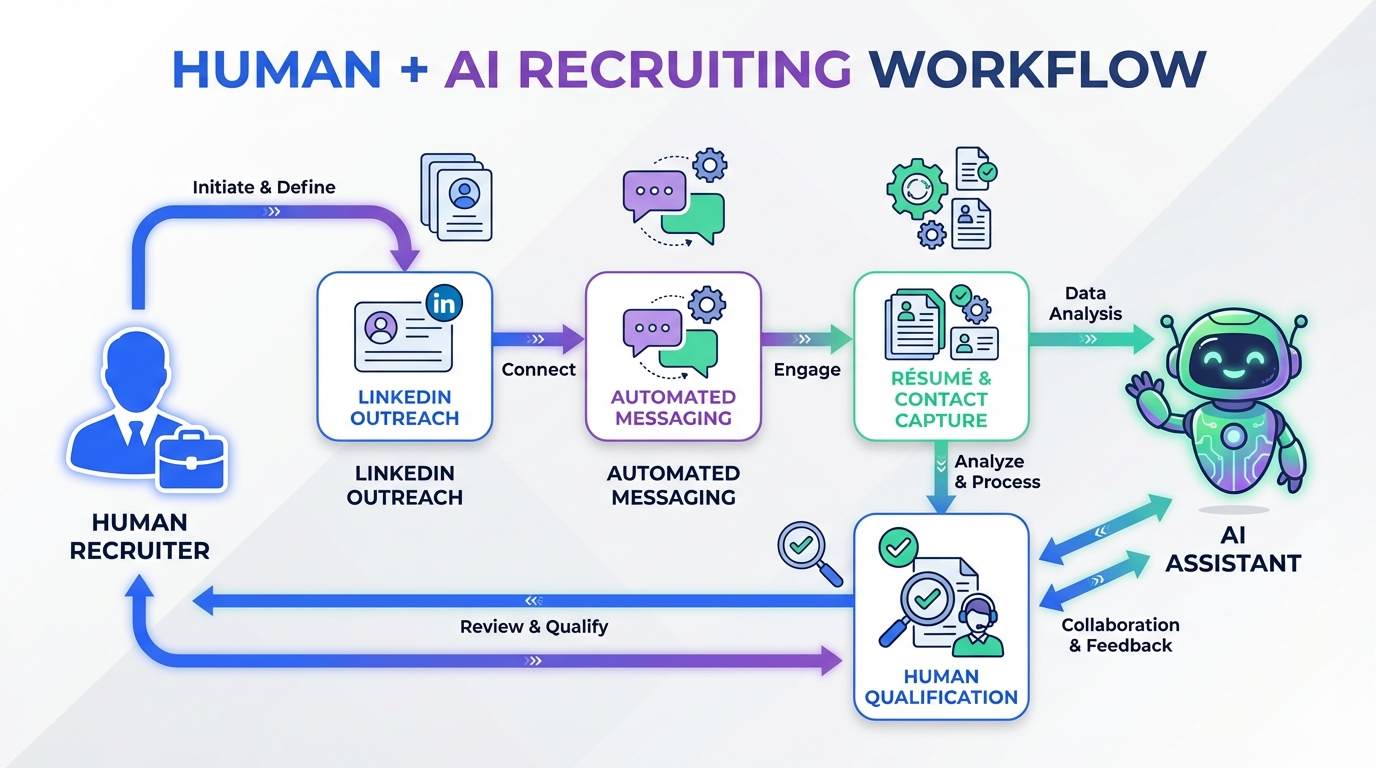
Artificial intelligence for recruiting has not replaced recruiters because hiring rarely provides the two things most algorithms need to outperform humans: clean, comparable data and a clearly defined outcome for “what makes a good hire.” In our day to day recruiting work, we repeatedly see inconsistent résumés, uneven interview notes, and subjective criteria like communication, teamwork, and culture fit. The practical path in 2026 is Human plus AI: let AI automate repetitive, rules based steps such as LinkedIn outreach, candidate Q and A, follow ups, and résumé collection, then keep recruiters accountable for final qualification and decision making. StrategyBrain AI Recruiter is designed for that division of labor by automating LinkedIn connecting, role introduction, candidate messaging, and résumé and contact capture, while leaving final fit assessment to the recruiter.
Table of Contents
What AI does well in recruiting
AI systems tend to excel when tasks repeat, inputs are structured, and the “right answer” can be measured. In the original discussion that inspired this article, examples included route optimization and language translation, both of which have large datasets and clear evaluation signals. Recruiting does include pockets of repeatable work, and that is where artificial intelligence in recruitment can deliver immediate value.
High confidence use cases
- High volume outreach and follow up where the goal is consistent response handling and timely nudges.
- Role introduction and basic Q and A where the information is known and can be standardized.
- Scheduling intent capture such as confirming interest and collecting availability.
- Document collection such as requesting résumés and capturing contact details.
This is why many teams asking “how to use AI in recruiting” start with automation around sourcing and early funnel conversion, not final selection.
Why hiring is hard for AI
Hiring is not a single prediction problem. It is a chain of decisions made under uncertainty, with multiple stakeholders and shifting constraints. Even when organizations use an applicant tracking system, the data is often incomplete, inconsistent, or not comparable across candidates. On top of that, the outcome we want AI to predict is frequently ambiguous.
Two blockers show up repeatedly
- Input quality which is the cleanliness, consistency, and comparability of candidate and hiring data.
- Outcome clarity which is whether “good hire” is defined in a way that can be measured and agreed upon.
When either blocker is present, AI can still help, but it should be positioned as an assistant and automation layer, not as the final decision maker.
The clean data problem in recruitment
In the source material, the author highlights a core reality: more data improves prediction only when the data is accurate, valid, and reliable. Recruiting data often fails those tests. We see this in three places: résumé structure, employment history comparability, and qualitative assessments.
Why “years of experience” is not clean data
Even quantitative looking fields can be hard to compare. “3 years at Firm X” is not necessarily comparable to “4 years at Firm Y” because scope, team size, market, and role expectations differ. This makes it difficult for an algorithm to treat those numbers as consistent signals.
Why qualitative signals are even harder
Qualitative traits like communication, teamwork, and culture fit are often recorded inconsistently. The source material uses leadership as an example and explains that for an algorithm to learn from leadership ratings, the ratings must be quantifiable, reliable across raters, and accurate to the candidate’s true capability regardless of context. In practice, most organizations do not have that level of measurement discipline.
What this means for artificial intelligence for recruiting
AI can still be extremely useful, but it should focus on areas where the data is naturally cleaner or can be made cleaner through process design. Messaging workflows, response classification, and résumé collection are good examples because the inputs and outputs can be standardized.
The outcome definition problem
Even if we improved data quality, we still face the question: what exactly is the outcome we want to predict. “Good hire” can mean different things depending on the role and the business moment. It can mean performance at 6 months, retention at 12 months, ramp speed, manager satisfaction, or team impact. If the organization cannot define the outcome unambiguously, AI predictions will be unstable or contested.
Where humans remain essential
- Clarifying success criteria with hiring managers and aligning stakeholders.
- Interpreting context such as career transitions, non linear paths, and constraints.
- Ethical judgment including fairness, transparency, and candidate experience tradeoffs.
This is the practical reason AI has not “taken your job” in recruiting. Ambiguity creates space where human judgment is still required.
A Human plus AI workflow that works in 2026
If you are evaluating artificial intelligence AI in recruitment, the most reliable implementation pattern we have seen is to separate the funnel into automation friendly steps and judgment heavy steps. Below is a workflow you can adopt without pretending AI can define hiring success on its own.
Step by step implementation
- Standardize the role brief
Write a single source of truth for responsibilities, must haves, nice to haves, compensation, benefits, location, and interview process. This reduces candidate confusion and improves message consistency. - Automate first contact and role introduction
Use AI to connect with candidates, introduce the opportunity, and answer common questions consistently. This is where response speed and follow up discipline matter most. - Automate intent capture and résumé collection
Have AI confirm interest, request a résumé, and capture contact details. Recruiters should receive a clean shortlist package, not a messy message thread. - Human review for qualification
Recruiters review résumés and context, then decide who advances. This is where ambiguity and nuance belong. - Human led interviews and final decision
Keep structured interviews, debriefs, and final selection human accountable. AI can assist with note organization, but not ownership of the decision.
Why this workflow is resilient
It uses AI where the environment is repeatable and measurable, and it keeps humans where the data is messy and the outcome is contested. That is the most defensible answer to “how to use AI in recruiting” without overpromising.
Where StrategyBrain AI Recruiter fits
StrategyBrain AI Recruiter is built specifically for LinkedIn hiring workflows. In our testing of LinkedIn outreach processes, the biggest bottleneck is not writing one good message. It is maintaining consistent, timely, two way conversations across time zones while collecting the information recruiters need to move candidates forward. AI Recruiter targets that bottleneck by automating the early funnel while keeping final qualification with the recruiter.
What AI Recruiter automates on LinkedIn
- Candidate connecting based on your targeted search criteria.
- Role introduction using your company, compensation, and benefits details.
- Two way Q and A about the role, company, and compensation.
- Interest confirmation to identify candidates willing to proceed.
- Résumé and contact capture from interested candidates.
24/7 multilingual communication
AI Recruiter supports round the clock candidate messaging and can communicate in the candidate’s native language. This matters when your pipeline spans multiple countries and time zones, because response delays often reduce conversion.
Scaling with multiple LinkedIn accounts
For teams that need scale, AI Recruiter supports managing more than 100 LinkedIn accounts so organizations can build AI powered recruitment teams. This is a capacity lever when you want more outreach and follow up without adding headcount.
Important limitation to understand
AI Recruiter does not decide whether a résumé fully matches job requirements. It identifies willingness to communicate or interview and collects materials. Recruiters still own final qualification. This limitation is a feature, not a flaw, because it aligns with the reality that hiring outcomes are hard to define and data is often messy.
Risks and guardrails
Artificial intelligence for recruiting can improve speed and consistency, but it also introduces risks if deployed without guardrails. The goal is to increase throughput while protecting candidate experience, privacy, and compliance.
Operational risks
- Over automation that creates generic conversations and reduces trust.
- Misalignment with the role brief if compensation, benefits, or requirements are outdated.
- Process drift where recruiters stop reviewing what the system is collecting.
Privacy and compliance considerations
According to StrategyBrain product information, AI Recruiter is designed to comply with privacy regulations in the EU, United States, and Canada. Customer provided data is not used to train AI models, and LinkedIn credentials are encrypted and stored independently per user with explicit authorization. Candidate data such as résumés, contact details, and conversation history is encrypted and isolated using customer specific keys.
Practical recommendation: involve legal and security early, document what data is collected, and define retention and access controls before scaling usage.
Implementation checklist
Use this checklist to implement artificial intelligence AI in recruitment without losing control of quality.
- Role brief is standardized and includes compensation, benefits, and interview steps.
- Message boundaries are defined including what the AI can promise and what it must escalate.
- Response time expectations are set for both AI and recruiter handoffs.
- Résumé and contact capture fields are consistent so recruiters receive a usable shortlist.
- Human qualification criteria are documented to reduce subjective drift.
- Privacy and retention rules are approved by legal and security.
- Weekly audit is scheduled to review conversations, outcomes, and candidate feedback.
FAQ
Will artificial intelligence for recruiting replace recruiters?
No, not end to end. AI performs best on repetitive tasks with clean data and clear outcomes, while recruiting includes ambiguous signals and subjective success definitions that still require human judgment.
What is the safest way to start using AI in recruiting?
Start with early funnel automation: outreach, role introduction, candidate Q and A, follow ups, and résumé collection. Keep final qualification and hiring decisions with recruiters and hiring managers.
Why is recruiting data considered “unclean”?
Candidate histories are not directly comparable across companies and roles, and qualitative traits like leadership or teamwork are often measured inconsistently. That makes it hard for algorithms to learn stable patterns.
What does StrategyBrain AI Recruiter do on LinkedIn?
It automates connecting with candidates, introducing the job, answering questions about the role and compensation, confirming interest, and collecting résumés and contact details. Recruiters then review the collected materials and proceed with interviews.
Does AI Recruiter decide if a candidate is qualified?
No. It identifies willingness to communicate or interview and collects information. The recruiter completes the final qualification step after reviewing the résumé.
Can AI Recruiter communicate with candidates in different languages?
Yes. Based on StrategyBrain product information, it supports 24/7 multilingual communication and can respond in the candidate’s native language.
How does AI Recruiter handle résumés and contact details?
It requests résumés and contact information from interested candidates and marks résumés as received when provided. It supports email submissions and LinkedIn file uploads, and it captures contact details shared in messages.
What are the biggest mistakes teams make with AI in recruitment?
The most common mistakes are automating without a standardized role brief, failing to audit conversations, and treating AI outputs as final decisions instead of inputs to human judgment.
Conclusion
Artificial intelligence for recruiting is real and useful, but it has not replaced recruiters because hiring data is messy and “good hire” is hard to define. The most effective approach in 2026 is Human plus AI: automate the repetitive LinkedIn outreach and conversation work, then keep humans responsible for qualification and decisions. If you want a practical starting point, implement the checklist above and pilot StrategyBrain AI Recruiter for outreach, Q and A, follow ups, and résumé collection, then measure recruiter time saved and candidate conversion through the early funnel.