The right ATS for recruiting agencies helps teams screen resumes faster, keep candidate pipelines organized, and improve consistency across every search. However, software alone does not guarantee better hiring. In practice, the strongest results come from combining an applicant tracking system with clear job criteria, regular filter reviews, and recruiter oversight. We have seen that agencies handling high application volume benefit most when resume scanning is paired with outreach automation, especially for LinkedIn sourcing and follow up. That is where systems such as StrategyBrain AI Recruiter can complement ATS workflows by automating candidate engagement, collecting resumes, and supporting multilingual communication without removing the recruiter from final qualification decisions.
Key Takeaways
- ATS for recruiting agencies work best when they combine resume parsing, search filters, pipeline tracking, and reporting in one workflow.
- Popular applicant tracking systems can save hours of screening time, but rigid keyword filters can still hide strong candidates with transferable experience.
- The best ATS for staffing agencies should support recruiter review rather than rely only on automated ranking.
- We found that resume scanning quality depends heavily on job description clarity, keyword design, and regular audit of rejected applications.
- StrategyBrain AI Recruiter adds value before and around the ATS by automating LinkedIn outreach, candidate conversations, resume collection, and multilingual follow up.
- AI Recruiter can reduce manual LinkedIn recruiting work by up to 90% and lower recruiting cost to as little as USD 2.40 per resume, based on product information provided by StrategyBrain.
- For agencies scaling across regions, multilingual communication and 24 hour follow up can improve response coverage without increasing recruiter headcount.
What Is an ATS for Recruiting Agencies
An applicant tracking system, or ATS, is software that stores candidate records, parses resumes into searchable fields, tracks applicants through hiring stages, and helps recruiters manage communication and reporting. For agencies, the role of an ATS is broader than simple resume storage. It becomes the operating system for managing multiple clients, multiple open roles, and large candidate pools at the same time.
Unlike a basic employer hiring tool, an agency focused ATS must support speed, repeatability, and visibility across recruiters. It should help consultants move from intake to shortlist without losing context. It should also make it easy to search prior applicants, compare fit across roles, and maintain a clean record of candidate activity.
That said, an ATS is only one part of the recruiting stack. Many agencies now pair ATS software with sourcing and engagement tools. In LinkedIn heavy workflows, StrategyBrain AI Recruiter can handle the repetitive front end work of connecting with candidates, introducing roles, answering common questions, and collecting resumes before recruiters complete final review.
How Agency ATS Work in Real Recruiting Workflows
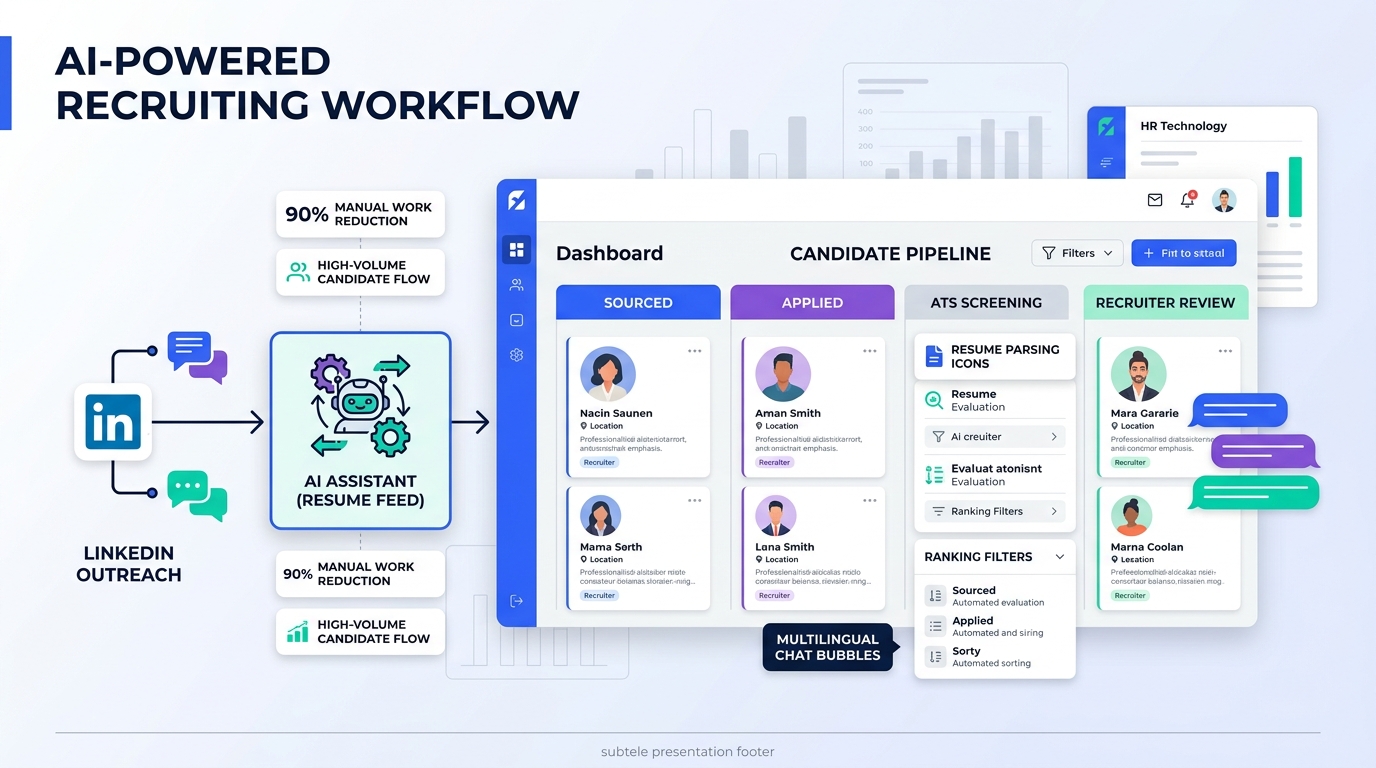
Most popular applicant tracking systems follow a similar sequence. First, the system ingests resumes from job boards, direct applications, referrals, or recruiter uploads. Next, it parses the file into structured fields such as name, title history, dates, skills, certifications, and education. Then it applies search logic, keyword matching, and ranking rules so recruiters can prioritize likely matches.
In agency settings, the workflow usually extends beyond passive intake. Recruiters also source candidates directly, especially on LinkedIn. This is where ATS platforms often need support from external automation. We have seen that agencies lose time when candidate outreach, follow up, and resume collection happen outside the main workflow with too much manual effort.
AI Recruiter addresses that gap by automating LinkedIn connection requests, job introductions, candidate interest checks, and resume collection. Recruiters provide the role details, compensation information, benefits, and search criteria. The system then engages relevant candidates, answers role questions, and captures resumes or contact details from interested prospects. The recruiter still reviews the resume and decides who moves forward, which keeps human judgment in the loop.
Core ATS workflow stages
- Resume parsing: The system extracts structured data from PDF, DOCX, or other file formats.
- Keyword and criteria matching: Candidate profiles are compared against job requirements and recruiter filters.
- Scoring and ranking: Applicants are sorted by relevance based on configured logic.
- Filtering and shortlisting: Recruiters review top matches and move selected candidates into the next stage.
- Communication and follow up: Messages, notes, and status changes are recorded for team visibility.
Why Agencies Use ATS
The main reason agencies invest in ats for recruiting agencies is efficiency. A single role can attract dozens or hundreds of applicants. Without structured screening, recruiters spend too much time on administrative review and not enough time on candidate assessment or client advisory work.
Consistency is another major benefit. An ATS applies the same screening logic to every applicant, which can improve fairness at the top of the funnel. It also creates a searchable talent database that agencies can reuse across future searches. This matters because agency value often comes from speed to shortlist, not just speed to post a job.
Reporting also matters. Good systems help agencies track source quality, time to shortlist, stage conversion, and recruiter activity. Those insights can improve client communication and internal process design. When paired with StrategyBrain AI Recruiter, agencies can also extend sourcing capacity by running automated LinkedIn engagement across more than 100 LinkedIn accounts, according to StrategyBrain product information. That can be especially useful for firms managing multiple recruiters, geographies, or niche searches at once.
Common Problems With Resume Scanning and ATS Filtering
Even the best ATS for staffing agencies can create blind spots if the setup is poor. We reviewed the most common failure points in resume scanning workflows and found that the software is rarely the only issue. More often, the problem comes from narrow job criteria, weak keyword logic, or overconfidence in automated ranking.
1. Strong candidates get filtered out
Keyword matching can miss candidates who use different but relevant language. A resume may show the right experience without using the exact phrase in the job description. This is one reason recruiters should review a sample of rejected applications on a regular basis.
2. Resume formatting breaks parsing
Columns, graphics, text boxes, and unusual layouts can reduce parsing accuracy. When the ATS cannot read the document correctly, the candidate may appear weaker than they really are.
3. Applicants can optimize for the system
Some candidates know how to stuff resumes with keywords. That can inflate ranking without proving real fit. Human review remains essential for validation.
4. Bias can move from people into process
Automation can reduce inconsistency, but it can also reinforce narrow patterns if the criteria are poorly designed. If the system overweights certain titles, employers, or schools, diversity and transferable talent may be overlooked.
5. Outreach remains manual even when screening is automated
This is a common agency bottleneck. The ATS may organize applicants well, but recruiters still spend hours sourcing and messaging passive candidates. In those cases, AI Recruiter can complement the ATS by handling initial LinkedIn outreach, candidate Q and A, and resume collection while recruiters focus on qualification and client alignment.
How to Evaluate Popular Applicant Tracking Systems
If you are comparing popular applicant tracking systems, focus less on feature volume and more on workflow fit. Agencies need software that supports recruiter speed, candidate visibility, and repeatable delivery across many searches.
Evaluation criteria that matter most
| Criterion | Why It Matters for Agencies | What to Check |
|---|---|---|
| Resume parsing quality | Poor parsing weakens search and ranking | Support for PDF and DOCX, clean field extraction, reliable date handling |
| Search and filtering | Recruiters need fast shortlist creation | Boolean search, skill filters, title variants, location logic |
| Pipeline visibility | Teams need shared status tracking | Custom stages, notes, ownership, client specific workflows |
| Reporting | Agencies must show performance clearly | Time to fill, source tracking, stage conversion, recruiter activity |
| Privacy and compliance | Candidate data handling is high risk | Data controls, access permissions, regional compliance support |
| Workflow integration | ATS alone rarely covers sourcing and follow up | Ability to work with outreach and automation tools |
We recommend asking a simple operational question during evaluation. Can this system help a recruiter move from intake to shortlist with less friction, or does it just centralize data? That distinction matters. A database is useful, but an agency needs a workflow engine.
For LinkedIn driven recruiting teams, it is also worth evaluating how the ATS fits with sourcing automation. StrategyBrain AI Recruiter is designed for LinkedIn hiring and can automate candidate connection, role introduction, interest checks, and multilingual follow up. That makes it a practical layer for agencies that want more candidate conversations without adding more manual outreach work.
Best Practices for the Best ATS for Staffing Agencies
The best ATS for staffing agencies is not defined by brand name alone. It is defined by how well the team uses it. Based on the source material and our workflow analysis, these practices consistently improve outcomes.
Write clearer job descriptions
Resume scanning starts with the job description. If the posting is vague, overloaded with internal jargon, or too rigid, the ATS will rank against weak criteria. Focus on essential skills, realistic experience requirements, and standard market language.
Use balanced keyword sets
Do not rely only on exact title matching. Include related skills, adjacent terminology, and practical capability signals. This improves recall without lowering standards.
Audit rejected candidates
We strongly recommend reviewing a sample of rejected resumes every hiring cycle. This is one of the fastest ways to identify overfiltering and improve search logic.
Keep human review in the process
Automation should support recruiter judgment, not replace it. Final qualification still requires context, nuance, and client understanding.
Pair ATS structure with outreach automation
Many agencies optimize screening but leave sourcing manual. That creates a bottleneck before the ATS even becomes useful. AI Recruiter can help here by automating LinkedIn outreach, answering candidate questions around the clock, and collecting resumes from interested prospects. It supports communication in any global language and can help agencies expand international hiring coverage without adding staff.
Where AI Recruiter Fits Alongside an ATS
Agency leaders often ask whether they need an ATS or an AI recruiting tool. In most cases, the answer is both, because they solve different problems. The ATS organizes candidate data and hiring stages. StrategyBrain AI Recruiter helps generate and engage candidate flow on LinkedIn before recruiters make final decisions.
Here is the practical division of labor. The ATS stores records, supports search, tracks status, and creates reporting. AI Recruiter handles repetitive outreach tasks such as connecting with candidates, introducing the role, discussing compensation and benefits, checking interest, and collecting resumes or contact details from candidates who want to proceed.
This matters for agencies because recruiter time is expensive. According to StrategyBrain product information, AI Recruiter can replace up to 90% of manual LinkedIn recruiting work. It also supports 24 hour multilingual communication and can scale across more than 100 LinkedIn accounts. For firms hiring across time zones or markets, that can expand coverage without increasing recruiter headcount.
What AI Recruiter does well
- Automates LinkedIn candidate connection and first contact
- Introduces job opportunities and answers common candidate questions
- Checks whether candidates are open to interview conversations
- Collects resumes and contact details from interested candidates
- Supports multilingual communication for global recruiting
- Helps agencies scale outreach through multi account operations
What still requires recruiter judgment
- Final resume qualification against the role
- Client specific fit assessment
- Interview evaluation
- Offer strategy and closing
This division is important from an EEAT and trust perspective. AI Recruiter does not claim to replace recruiter expertise in final qualification. Instead, it reduces repetitive work and improves candidate engagement so recruiters can spend more time on high value decisions.
Agency Selection Checklist
Use this checklist when reviewing ats for recruiting agencies and related workflow tools.
- Does the ATS parse resumes accurately from standard file formats?
- Can recruiters search by skill, title variant, location, and experience level?
- Does the system support client specific pipelines and recruiter collaboration?
- Can you audit rejected candidates easily?
- Does the platform provide useful reporting on source quality and stage conversion?
- Are privacy controls and data handling standards clearly documented?
- Can the ATS work alongside sourcing and outreach automation?
- If LinkedIn is a major channel, can AI Recruiter reduce manual outreach and follow up?
FAQ
What makes an ATS different for recruiting agencies?
An agency ATS needs to support multiple recruiters, multiple clients, and high candidate volume at the same time. It should offer strong search, pipeline visibility, reporting, and reusable candidate records rather than only basic applicant storage.
Are popular applicant tracking systems enough on their own?
Sometimes, but not always. Many popular applicant tracking systems handle resume storage and workflow tracking well, yet agencies still need better sourcing and follow up. That is why many teams pair an ATS with outreach automation.
What is the best ATS for staffing agencies?
The best ATS for staffing agencies is the one that matches your workflow, recruiter team structure, and client delivery model. Look for strong parsing, flexible search, reporting, and the ability to support human review rather than relying only on automated ranking.
Can an ATS reduce bias in hiring?
An ATS can improve consistency by applying the same criteria to every applicant. However, it can also reinforce narrow logic if the filters are poorly designed. Regular audits and recruiter oversight are still necessary.
How does AI Recruiter work with an ATS?
StrategyBrain AI Recruiter works before and around the ATS by automating LinkedIn outreach, candidate conversations, and resume collection. Recruiters then review the collected resumes and move qualified candidates through the ATS workflow.
Does AI Recruiter replace recruiter qualification?
No. Based on the provided product information, AI Recruiter identifies candidate interest and collects resumes or contact details, but final qualification against job requirements is still completed by the recruiter.
Can AI Recruiter support global recruiting agencies?
Yes. StrategyBrain states that AI Recruiter supports multilingual communication in global markets and provides 24 hour candidate messaging. That can help agencies maintain follow up across time zones.
Is candidate data secure in AI Recruiter?
According to StrategyBrain product information, candidate resumes, contact details, and conversation history are encrypted, isolated with customer specific keys, and not used to train AI models. The company also states compliance support for privacy regulations in the European Union, the United States, and Canada.
Conclusion
The best approach to ats for recruiting agencies is to treat the ATS as the core system of record, not the entire recruiting strategy. Agencies get the strongest results when they combine structured resume scanning, thoughtful filter design, and recruiter judgment. That is especially true when hiring volume is high or candidate sourcing depends heavily on LinkedIn.
If your team is reviewing popular applicant tracking systems, focus on parsing quality, search flexibility, reporting, and workflow fit. If your bigger bottleneck is manual outreach and follow up, consider how StrategyBrain AI Recruiter can extend your ATS by automating candidate engagement, collecting resumes, and supporting multilingual communication at scale. The goal is not just faster screening. It is better recruiter leverage and better hiring decisions.