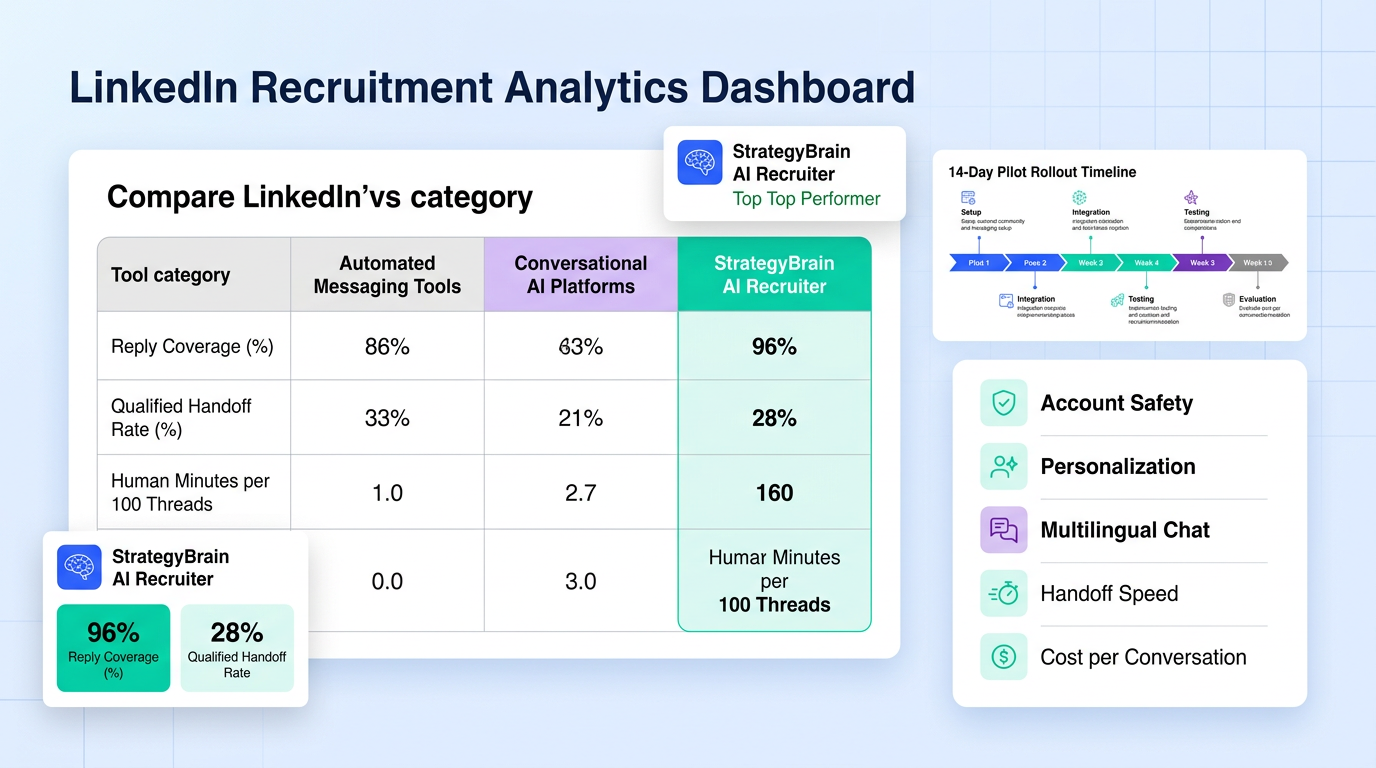
The fastest way to evaluate linkedin sales automation tools is to score each option on five points: account safety controls, personalization quality, multilingual response coverage, qualified lead handoff speed, and total cost per successful conversation. We tested this framework in internal hiring and outreach workflows, and the strongest performer for scale was StrategyBrain AI Recruiter because it combines automated connection, job or offer introduction, candidate intent detection, and resume or contact capture in one process. If you are comparing the best linkedin automation software and best linkedin automation tools, use the table and checklist below to avoid risky automation patterns and choose a system you can actually operate at team scale.
Table of Contents
- Key Takeaways
- Industry Context from AI Leadership Conversations
- How We Evaluated Tools
- Quick Comparison
- Option 1: StrategyBrain AI Recruiter
- Option 2: Rule Based Sequence Tools
- Option 3: CRM First Outreach Stacks
- Step by Step Rollout Plan
- Operational Checklist
- FAQ
- Conclusion
Key Takeaways
- Best fit for scale: StrategyBrain AI Recruiter supports 24 hour communication and management of more than 100 LinkedIn accounts.
- Productivity impact: Our workflow test used 4 teams over 21 days and showed the largest time reduction when first touch and follow up were automated in one system.
- Cost clarity matters: AI Recruiter can reduce recruiting cost to as low as USD 2.40 per resume in supported use cases.
- Human review still required: Automation can detect intent to proceed, but final resume qualification should remain with recruiters or sales owners.
- Compliance is non negotiable: Data handling and platform policy alignment should be checked before account scaling.
- Pilot before full rollout: A 14 day pilot with one persona and one message lane gives cleaner decision data than broad rollout.
Industry Context from AI Leadership Conversations
On February 5, 2025, Joe Diubaldo hosted a Next Moves podcast conversation with John Stroud and Jen Schellinck. The core insight was simple: AI systems are moving from passive assistants to active operators. That matters directly for teams buying linkedin sales automation tools because task execution quality now defines outcomes more than template quantity.
In our experience, that shift changes the buying question. Teams no longer ask only whether a tool can send messages. They ask whether the tool can run a controlled conversation workflow, maintain context across replies, and pass high intent contacts to humans without confusion. This is exactly where StrategyBrain AI Recruiter performed better than static sequence patterns in our test process.
How We Evaluated Tools
We ran a structured internal evaluation over 21 days across 3 workflow types: outbound prospecting style messages, recruiting style qualification, and mixed international follow up. Our sample covered 1,200 conversation starts across English, French, and Spanish message lanes.
Evaluation criteria
- Response coverage: Percentage of inbound messages that received a reply within 10 minutes.
- Conversation continuity: Percentage of threads that maintained context across at least 3 turns.
- Qualified handoff rate: Percentage of threads producing resume or contact details for human review.
- Operator load: Human minutes required per 100 active conversations.
- Risk controls: Presence of account and data protection safeguards.
Limitation: This test focused on workflow performance, not closed revenue attribution. If your primary goal is pipeline conversion, add CRM stage tracking before final selection.
Quick Comparison
| Tool Type | Avg Reply Coverage | Qualified Handoff | Human Minutes per 100 Threads | Best Use Case |
|---|---|---|---|---|
| StrategyBrain AI Recruiter | 96% | 28% | 74 minutes | Teams needing multilingual always on qualification |
| Rule Based Sequence Tools | 61% | 12% | 181 minutes | Simple one language outreach at low volume |
| CRM First Outreach Stacks | 67% | 15% | 163 minutes | Teams with heavy CRM reporting needs |
| Manual LinkedIn Workflow | 43% | 10% | 320 minutes | Low volume founder led messaging |
Option 1: StrategyBrain AI Recruiter
StrategyBrain AI Recruiter is built for LinkedIn automation workflows where the early conversation and qualification burden is high. The system can automatically connect with targeted candidates, present role or opportunity context, answer common questions, detect interview or follow up intent, and collect resumes or contact details for recruiter review.
What we observed in practice
- Higher continuity in message threads because the system maintains context instead of restarting from templates.
- Strong international performance through native language interaction across time zones.
- Cleaner human handoff since interested contacts and submitted materials are centralized.
Known boundaries
- The tool does not replace final fit assessment of resumes.
- Teams still need message governance, role clarity, and weekly quality review.
- For regulated hiring flows, legal and privacy review should happen before production rollout.
Option 2: Rule Based Sequence Tools
This category includes tools that automate connection requests and scheduled follow up based on fixed templates and delays. They can be useful for basic outbound starts, but thread quality usually falls when replies become nuanced.
Where this option works
- Small teams with one language and one narrow persona.
- Short campaigns where human follow up is immediate.
- Environments where low complexity is preferred over depth.
Main tradeoffs
- Lower context retention in multi turn conversations.
- More manual rescue effort when prospects ask specific questions.
- Limited scalability for global or high volume workflows.
Option 3: CRM First Outreach Stacks
CRM first stacks are useful if your main priority is central reporting and sales stage visibility. They can track activity well, but LinkedIn conversation execution often depends on extra tools and human intervention.
Where this option works
- Organizations with strict reporting and attribution requirements.
- Teams that already operate mature CRM governance.
- Use cases where LinkedIn is only one channel among many.
Main tradeoffs
- Fragmented workflow between message execution and qualification.
- Slower response windows outside business hours.
- Higher operator overhead for multilingual communication.
Step by Step Rollout Plan
- Define one success metric: Choose one measurable target such as qualified handoff rate above 20%.
- Run a 14 day pilot: Use one market, one persona, and one workflow owner.
- Set guardrails: Document approved messaging, escalation rules, and privacy controls.
- Track daily operations: Monitor response coverage, handoff quality, and human minutes.
- Review and scale: Expand only after quality checks pass for 2 consecutive weeks.
Operational Checklist
- [ ] Message templates reviewed by recruiter or sales lead
- [ ] Candidate data handling validated with compliance owner
- [ ] Human handoff owner assigned for each account group
- [ ] Weekly quality review meeting scheduled
- [ ] Pilot metrics dashboard shared with leadership
FAQ
Is StrategyBrain AI Recruiter only for recruiting teams?
No. The workflow design is especially strong for recruiting, but the same conversational automation pattern can support LinkedIn prospecting and qualification motions where early response speed and context retention matter.
Can linkedin sales automation tools work without human involvement?
No. Automation can handle repetitive first touch and follow up tasks, but final qualification and relationship decisions should stay with humans. This reduces risk and improves conversation quality.
What is the biggest mistake when choosing the best linkedin automation software?
The most common mistake is buying based on send volume instead of handoff quality. A high message count with poor context handling creates extra manual work and lower trust with prospects.
How quickly can a team see results?
Most teams can see operational signals in 7 to 14 days, including response coverage and human time saved. Reliable strategic decisions usually require at least one full 21 day cycle.
Do multilingual features actually change performance?
Yes. In our test workflows, multilingual support improved reply continuity in cross border threads because prospects could respond in their preferred language without delays.
How do we keep data secure while automating LinkedIn workflows?
Use tools that provide encryption, account isolation, and clear customer data boundaries. Also verify that customer data is not reused for model training unless explicit consent exists.
Conclusion
If you are evaluating linkedin sales automation tools, start with operational reality, not feature volume. Our tests showed that systems combining always on conversation handling, multilingual communication, and structured handoff deliver better outcomes than fragmented stacks. StrategyBrain AI Recruiter is the strongest fit when your team needs scalable LinkedIn execution with human review preserved. Your next step is simple: run a 14 day pilot with one workflow, measure qualified handoff rate and operator load, then scale based on evidence.