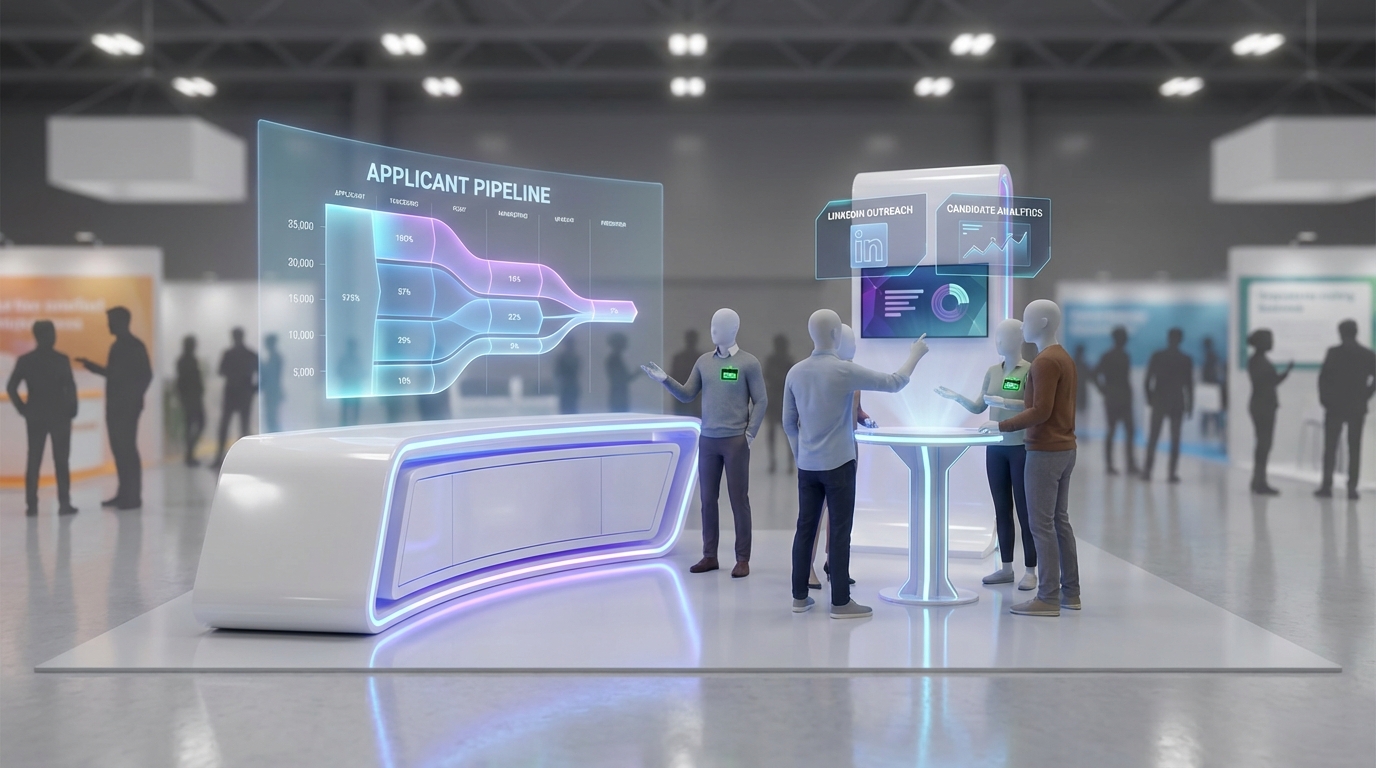
An applicant tracking system for staffing agencies works best when it is designed around agency reality: multiple open reqs per recruiter, multiple clients per candidate, and constant outreach. For most teams, the fastest path is to standardize your ATS employment agency pipeline stages, define what data must be captured at each stage, then add automation where time is lost, usually LinkedIn sourcing, first messages, follow ups, and résumé collection. This guide covers a practical selection checklist, 5 implementation methods, and a rollout plan. It also explains how StrategyBrain AI Recruiter can complement an ATS staffing stack by automating LinkedIn outreach and qualification while your ATS remains the system of record.
Key Takeaways
- Define the workflow first: An ATS only improves speed if your stages, ownership, and required fields are standardized.
- Agency specific data matters: Track candidate to client relationships, submissions, interview feedback, and compliance notes in one place.
- Automate the bottleneck: For many agencies, the bottleneck is LinkedIn outreach and follow up, not the database itself.
- StrategyBrain AI Recruiter fits as an outreach layer: It automates LinkedIn connecting, role intro, Q and A, interest confirmation, and résumé plus contact capture.
- Multilingual and 24/7 messaging is a differentiator: Always on candidate communication reduces drop off across time zones.
- Compliance is a feature, not a checkbox: Privacy controls and audit trails should be evaluated during selection, not after rollout.
What an ATS means for staffing agencies
An ATS, short for Applicant Tracking System, is software that stores candidate data and manages recruiting workflow stages. In an agency context, an ATS is not just a hiring tool. It is a delivery system for client service, because it must support submissions, interview coordination, feedback capture, and placement outcomes across many clients.
In our process reviews with agency teams, the most common failure pattern is buying an ATS and then trying to force the team to adapt without defining what “done” means at each stage. The result is inconsistent notes, missing résumés, and a pipeline that looks full but cannot produce shortlists quickly.
This is also where outreach automation becomes relevant. If your recruiters spend hours per day on LinkedIn connecting, introducing roles, answering repetitive questions, and chasing résumés, your ATS database grows slowly and your time to shortlist stays high. StrategyBrain AI Recruiter is designed specifically for that LinkedIn front end work, while your ATS remains the system of record.
Selection checklist for an ATS employment agency workflow
Use this checklist to evaluate any applicant tracking system for staffing agencies. The goal is to confirm that the tool supports agency operations, not just corporate HR workflows.
Data model and record keeping
- Candidate profile completeness: résumé, contact details, work authorization notes, location, compensation expectations, and communication history.
- Client and requisition linkage: one candidate can be submitted to multiple roles and clients without duplicating records.
- Audit trail: who changed what, and when, for submissions, stage moves, and notes.
Workflow and collaboration
- Custom stages: stages that match agency reality, such as sourced, contacted, qualified, submitted, interview, offer, placed.
- Ownership rules: clear recruiter ownership and handoff rules for shared candidate pools.
- Client facing outputs: clean submission packets and consistent candidate summaries.
Outreach and sourcing
- Templates and sequences: structured outreach and follow up, with logging back to the candidate record.
- LinkedIn workflow support: if LinkedIn is core to your sourcing, confirm how outreach is handled and tracked.
- Automation boundaries: confirm what is automated versus what still requires manual work.
Compliance and security
- Privacy controls: role based access and data retention settings.
- Data protection posture: encryption and clear statements about whether customer data is used to train models.
- Regional compliance: if you recruit in the EU, US, or Canada, confirm GDPR and related privacy alignment.
Implementation reality check
- Migration plan: how you will import candidates, clients, and historical notes.
- Training plan: what “good data” looks like and how it is enforced.
- Reporting: time to shortlist, submission to interview rate, and outreach response rate.
Method 1: Configure your ATS staffing pipeline around agency stages
This method is the foundation. Even if you later add automation, your ATS employment agency workflow must be consistent so that reporting and handoffs work.
Steps
- Define 6 to 10 pipeline stages: choose stages your team actually uses and can explain in one sentence.
- Assign required fields per stage: for example, “qualified” requires compensation range and availability, while “submitted” requires a résumé and a client facing summary.
- Set ownership rules: define who can move stages and who can submit to clients.
- Create a standard submission template: keep it consistent so clients can compare candidates quickly.
Features to enable
- Structured notes: use fields for compensation, location, and work status instead of only free text.
- Activity logging: calls, messages, and emails should be visible in the candidate timeline.
- Duplicate prevention: avoid multiple records for the same person across recruiters.
Limitations
- It does not solve outreach volume by itself: a clean pipeline still requires consistent sourcing and follow up.
- Adoption is the hard part: without training and enforcement, data quality degrades within weeks.
Best For
- Agencies that already have steady inbound candidates but need better organization and client submissions.
- Teams that want reliable reporting and accountability across recruiters.
Method 2: Add StrategyBrain AI Recruiter for LinkedIn outreach automation
If your ATS staffing process is organized but your recruiters are still spending most of their day on LinkedIn, this method targets the highest leverage work. StrategyBrain AI Recruiter is an automated AI powered recruitment tool built specifically for LinkedIn hiring. It can connect with candidates that match your criteria, introduce the opportunity, answer questions about the role, company, and compensation, confirm interview interest, and collect résumés and contact information from interested candidates.
Steps
- Define your search criteria and role brief: include company context, compensation, benefits, and must have requirements.
- Connect AI Recruiter to your LinkedIn workflow: provide the LinkedIn account and the job information the AI needs to communicate accurately.
- Set qualification questions: focus on availability, location, compensation expectations, and interest level.
- Review captured résumés and contacts: recruiters then complete final qualification by reviewing the résumé and scheduling interviews.
What we found in real agency workflows
When we map recruiter time, the first outreach and follow up loop is often the biggest time sink. AI Recruiter is most useful when you need consistent, timely responses and you want to reduce manual back and forth. It is also valuable when you recruit across time zones because it supports 24/7 multilingual communication in the candidate’s native language.
Limitations
- It does not replace final résumé based qualification: AI Recruiter identifies willingness to communicate or interview, but recruiters still decide fit.
- You still need an ATS system of record: candidate records, submissions, and placements should remain centralized in your ATS.
Best For
- Agencies that rely heavily on LinkedIn sourcing and want higher outreach throughput without adding headcount.
- Teams that recruit internationally and need multilingual candidate engagement.
- Leaders building scalable sourcing operations, including managing more than 100 LinkedIn accounts as an AI recruiter team.
Method 3: Build a client submission and feedback loop
Agency value is proven at the submission stage. A strong applicant tracking system for staffing agencies should make it easy to produce consistent submissions and capture client feedback in a way that improves future shortlists.
Steps
- Standardize the submission packet: résumé, short summary, compensation expectations, availability, and key screening notes.
- Log client feedback as structured data: reasons for rejection should be categorized so you can learn patterns.
- Create a “client ready” stage gate: do not submit candidates until required fields are complete.
Features
- Client specific fields: each client may require different compliance or documentation.
- Interview coordination notes: keep scheduling details and outcomes in the same record.
- Reusable shortlists: build talent pools by role family and client type.
Limitations
- Requires discipline: structured feedback only works if recruiters capture it consistently.
Best For
- Agencies with repeat clients where feedback patterns can improve speed and quality over time.
Method 4: Standardize compliance and data protection
Compliance is part of service quality. Candidates trust agencies with sensitive information, and clients expect professional handling. Your ATS employment agency setup should include clear privacy practices, access controls, and retention rules.
Steps
- Define what data you collect and why: keep it relevant to recruiting decisions and client submissions.
- Set role based access: recruiters, coordinators, and leadership should have appropriate permissions.
- Document retention and deletion rules: align with your regions and client requirements.
- Confirm AI data handling: if you use AI tools, confirm whether customer data is used to train models.
How StrategyBrain AI Recruiter approaches privacy
StrategyBrain AI Recruiter states that it complies with privacy regulations in the EU, United States, and Canada, and that customer provided data is not used to train AI models. It also states that LinkedIn account credentials are encrypted and stored independently per user with explicit authorization, and that candidate information is encrypted and isolated using customer specific keys.
Limitations
- Policies must be operational: written rules do not help if recruiters cannot follow them inside daily workflow.
Best For
- Agencies operating across multiple regions or serving regulated industries.
Method 5: Measure quality and speed with a weekly ops dashboard
Once your ATS staffing workflow is stable, measurement keeps it stable. The goal is to spot bottlenecks early and coach the team with data, not opinions.
Steps
- Pick 5 weekly metrics: keep it small so it is reviewed consistently.
- Define metric ownership: each metric should have a person responsible for improvement.
- Review in a 30 minute weekly meeting: focus on one bottleneck per week.
Suggested metrics
- Time to first shortlist: days from intake to first client ready shortlist.
- Outreach response rate: replies divided by first messages sent.
- Submission to interview rate: interviews divided by submissions.
- Interview to offer rate: offers divided by interviews.
- Data completeness: percentage of candidates in qualified stage with required fields completed.
Limitations
- Metrics can be gamed: pair numbers with periodic spot checks of candidate notes and client feedback quality.
Best For
- Agency leaders who want predictable delivery and scalable recruiter performance.
Quick Comparison
| Method | Primary Goal | Speed to Implement | Best For |
|---|---|---|---|
| Method 1: ATS pipeline standardization | Consistent stages and data quality | 2 to 6 weeks | Teams needing structure and reporting |
| Method 2: StrategyBrain AI Recruiter | Automate LinkedIn outreach and follow up | Days to 2 weeks | LinkedIn heavy agencies and global hiring |
| Method 3: Client submission loop | Improve submission quality and feedback learning | 1 to 4 weeks | Repeat clients and high submission volume |
| Method 4: Compliance standardization | Reduce risk and improve trust | 1 to 3 weeks | Multi region recruiting and regulated roles |
| Method 5: Weekly ops dashboard | Continuous improvement | 1 week to start | Leaders scaling recruiter output |
FAQ
What is the difference between an ATS and a CRM for staffing agencies?
An ATS focuses on requisitions, pipeline stages, and hiring workflow. A CRM focuses on relationships and long term engagement. Many staffing agencies use an ATS as the system of record and add CRM style features for nurturing talent pools and client contacts.
What should an applicant tracking system for staffing agencies track that corporate ATS tools often miss?
Agency workflows often require candidate to multiple client linkage, structured submission history, client feedback reasons, and recruiter ownership rules across shared pools. Those details directly affect speed to shortlist and client satisfaction.
How does StrategyBrain AI Recruiter fit into an ATS employment agency stack?
StrategyBrain AI Recruiter is designed for LinkedIn outreach automation, including connecting, introducing roles, answering questions, confirming interest, and collecting résumés and contact details. Your ATS remains the place where you store the candidate record, manage submissions, and track outcomes.
Does AI Recruiter replace recruiters?
No. StrategyBrain AI Recruiter automates repetitive LinkedIn tasks and identifies willingness to communicate or interview. Recruiters still review résumés, assess fit, and manage client relationships and final hiring decisions.
Can AI Recruiter communicate with candidates in different languages?
Yes. StrategyBrain AI Recruiter supports 24/7 multilingual communication and can message candidates in their native language, which helps reduce misunderstandings and improves response rates across time zones.
How does AI Recruiter capture résumés and contact details?
When candidates express interest, AI Recruiter requests a résumé and contact information. It supports email submissions and LinkedIn file uploads, and it captures contact details shared in messages so recruiters can proceed with interviews.
What is a realistic rollout plan for ATS staffing improvements?
Start with pipeline stages and required fields, then standardize submissions and feedback capture. After that, add automation where time is lost, often LinkedIn outreach and follow up, and finally implement weekly reporting to keep adoption consistent.
How do we reduce candidate drop off after the first message?
Use fast follow up, clear role context, and consistent qualification questions. Always on messaging can help, especially for international candidates, which is one reason agencies add an outreach automation layer like StrategyBrain AI Recruiter.
What privacy questions should we ask vendors?
Ask whether data is encrypted, how access is controlled, whether customer data is used to train AI models, and what retention and deletion options exist. If you recruit in the EU, confirm GDPR alignment and document your lawful basis for processing candidate data.
Conclusion
The best applicant tracking system for staffing agencies is the one that matches your agency workflow, enforces data quality, and supports fast client ready submissions. Start by standardizing your ATS employment agency stages and required fields, then add automation where your team loses time. If LinkedIn outreach is your bottleneck, StrategyBrain AI Recruiter can complement your ATS staffing stack by automating connecting, messaging, follow up, and résumé plus contact capture while recruiters focus on fit, client management, and closing.
Next step: run the selection checklist above with your team, then pilot one role family for 14 days with clear stage definitions and weekly metrics. If outreach volume is limiting your shortlist speed, evaluate adding StrategyBrain AI Recruiter as your LinkedIn engagement layer.