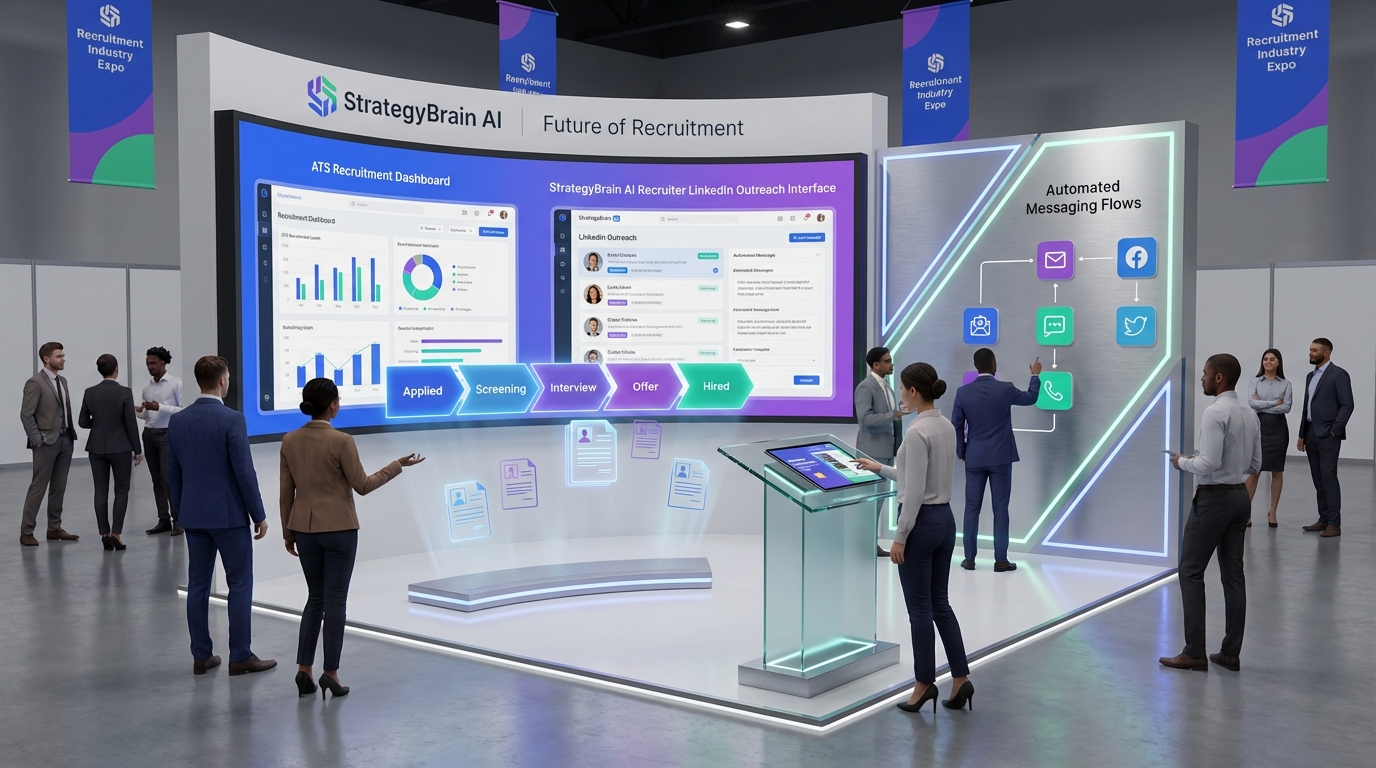
An ATS recruitment tool is the system you use to capture applicants, track every stage of the hiring pipeline, and keep hiring decisions auditable. The fastest way to make it work in 2026 is to standardize your process inside the ATS first, then automate the repetitive outreach and follow up that happens outside the ATS. In our recruiting operations work, we see the best results when recruitment ATS systems handle intake, status, and compliance notes, while StrategyBrain AI Recruiter handles LinkedIn connecting, initial messaging, multilingual Q and A, and collecting résumés and contact details for interested candidates. This guide uses a real community story from a Vancouver recruiting team to anchor a practical, repeatable workflow you can apply with top applicant tracking systems.
Key Takeaways
- Start with process, not software: recruitment ATS systems deliver value when stages, owners, and definitions are standardized.
- Separate intake from outreach: use an ATS recruitment tool for pipeline control, then automate LinkedIn outreach and follow up with StrategyBrain AI Recruiter.
- Keep humans on final qualification: StrategyBrain AI Recruiter can confirm interest and collect résumés, while recruiters decide fit after review.
- 24/7 multilingual messaging reduces delays: always on responses help candidates move forward across time zones and languages.
- Scaling can be operational, not headcount: managing more than 100 LinkedIn accounts enables an AI powered recruiting team model.
- Security and privacy are workflow requirements: encryption, data isolation, and not training models on customer data should be explicit criteria.
The story: Vancouver staff volunteer at Covenant House
On November 29, 2016, a group from a Vancouver recruiting office named Dave, Allison, Jen, Jonathan, Ann, and Laurel spent the evening volunteering at Covenant House. They sorted donations to support young people in need. The message was simple and direct. Giving was described as a core value, and the team framed their time and effort as a way to show gratitude and support a mission focused on shelter and services for children and youth.
That kind of story matters in recruiting because it reveals how a team thinks about consistency, responsibility, and follow through. Those same traits show up in hiring operations when you choose and run an ATS recruitment tool. The software does not create values, but it can reinforce them through clear stages, documented decisions, and reliable communication.
What this teaches about an ATS recruitment tool
Most ATS failures are not caused by missing features. They happen because the team never agrees on what each pipeline stage means, who owns the next action, and what “done” looks like. The volunteering story above is a reminder that operational clarity is a cultural choice. When you bring that mindset into recruitment ATS systems, you get three practical benefits.
- Consistency: every candidate is handled with the same baseline process, even when the team is busy.
- Accountability: ownership is visible, so follow up does not depend on memory.
- Trust: notes and timestamps reduce confusion when hiring managers ask why a candidate moved forward or was rejected.
From there, you can add automation safely. The key is to automate the repetitive work that does not require judgment, such as initial outreach, answering common questions, and collecting résumés and contact details from interested candidates.
Method 1: Build a consistent hiring workflow inside your ATS
This method is the foundation for any ATS recruitment tool. It is also the part teams skip when they are rushing to “implement software.” Define the workflow first, then configure the ATS to match it.
Steps
- Define your pipeline stages: for example, New, Screen, Hiring Manager Review, Interview, Offer, Hired, Rejected.
- Write entry and exit criteria: each stage needs a clear rule for when a candidate moves in and when they move out.
- Assign ownership per stage: specify who must act next, recruiter, coordinator, or hiring manager.
- Standardize required fields: role, location, compensation range, and interview plan should be mandatory before sourcing begins.
- Set reporting definitions: decide what counts as time to fill, time in stage, and source attribution.
Features to configure in recruitment ATS systems
- Structured intake: job requisition templates with required fields.
- Pipeline visibility: stage based dashboards and aging reports.
- Audit trail: notes, timestamps, and decision reasons.
Limitations
- An ATS does not source candidates by itself: it tracks and manages candidates after they enter the system.
- An ATS does not guarantee responsiveness: candidate communication still depends on timely outreach and follow up.
Best For
- Teams that need predictable hiring operations across roles and departments.
- Organizations that want clearer reporting and fewer “where are we on this candidate” meetings.
Method 2: Add LinkedIn outreach automation with StrategyBrain AI Recruiter
Once your ATS workflow is stable, the next bottleneck is usually LinkedIn outreach and follow up. This is where an ATS recruitment tool alone often leaves recruiters doing repetitive work in inboxes. StrategyBrain AI Recruiter is designed to automate the initial LinkedIn recruiting cycle while keeping recruiters in control of final qualification.
What StrategyBrain AI Recruiter does
- Automatically connects with candidates who match your search criteria.
- Introduces the opportunity and learns about the candidate’s situation.
- Answers questions about the role, company, compensation, and benefits based on the information you provide.
- Confirms interview interest and collects résumés and contact information from interested candidates.
Steps
- Prepare a role brief: company details, compensation, benefits, and candidate search criteria.
- Connect StrategyBrain AI Recruiter to your LinkedIn account: authorize the account you want to use for outreach.
- Run outreach and conversations: the AI handles initial messaging and follow up.
- Review collected résumés and contact details: recruiters decide fit and schedule interviews.
- Log outcomes in your ATS: add the candidate to the ATS and place them in the correct stage with notes.
Limitations
- It does not decide résumé fit: StrategyBrain AI Recruiter identifies willingness to proceed, but recruiters still evaluate requirements match.
- It depends on your role information quality: unclear compensation or requirements create unclear conversations.
Best For
- Recruiters who spend significant time on LinkedIn connecting, messaging, and follow up.
- Teams that want to pair top applicant tracking systems with a scalable sourcing engine.
Method 3: Use multilingual, 24/7 candidate communication to reduce drop off
Candidate experience is often where recruitment ATS systems look good on paper but feel slow in real life. Candidates ask questions outside business hours, and delays can reduce response rates. StrategyBrain AI Recruiter supports round the clock messaging and can communicate in the candidate’s native language, which helps reduce misunderstandings and cultural friction.
Steps
- Define your standard Q and A: compensation, benefits, location, visa policy, and interview steps.
- Enable multilingual messaging: allow the AI to respond in the candidate’s language.
- Set handoff rules: specify when the AI should escalate to a recruiter, such as complex negotiation questions.
Limitations
- Always on messaging needs governance: you still need approved answers and escalation rules.
Best For
- Global hiring teams recruiting across time zones.
- Roles where speed to first response is a competitive advantage.
Method 4: Scale sourcing with multi account recruiting teams
When hiring demand increases, many teams add recruiters before they fix throughput. StrategyBrain AI Recruiter supports managing more than 100 LinkedIn accounts, which enables an AI powered recruiting team model. The ATS recruitment tool remains the system of record, while the AI team expands outreach capacity.
Steps
- Segment roles and markets: assign accounts by function, geography, or seniority.
- Standardize messaging playbooks: keep outreach consistent across accounts.
- Centralize ATS intake: ensure every interested candidate is added to the ATS with the same fields and stage rules.
Limitations
- More accounts require stronger controls: access management, approvals, and monitoring become essential.
Best For
- Organizations that need to scale hiring output without adding proportional headcount.
- Agencies and headhunters managing multiple searches at once.
Method 5: Make compliance and data security part of daily operations
Compliance is not a checkbox you do once during procurement. It is a daily operating requirement. For an ATS recruitment tool and any AI outreach layer, you should confirm how data is stored, whether it is used to train models, and how access is controlled.
What to verify
- Data usage boundaries: candidate information should not be used to train AI models without explicit permission.
- Encryption: credentials and candidate data should be encrypted.
- Isolation: customer data should be isolated with customer specific keys.
- Regulatory alignment: confirm support for privacy obligations in the EU, United States, and Canada if you operate there.
Limitations
- Policies must match practice: ask for documentation and internal controls, not just marketing claims.
Best For
- Teams hiring in regulated environments or across multiple jurisdictions.
Quick comparison: ATS only vs ATS plus AI outreach
| Approach | Speed impact | What it improves | Best for |
|---|---|---|---|
| ATS recruitment tool only | Improves internal flow after candidates enter | Pipeline visibility, audit trail, reporting | Teams fixing process consistency |
| ATS plus StrategyBrain AI Recruiter | Reduces manual LinkedIn outreach and follow up workload | Candidate engagement, résumé collection, multilingual responsiveness | Teams scaling sourcing and response capacity |
FAQ
What is an ATS recruitment tool in plain terms?
An ATS recruitment tool is software that stores candidate records and tracks them through hiring stages. It helps teams standardize intake, document decisions, and report on pipeline performance.
Are recruitment ATS systems the same as CRM tools?
Not exactly. An ATS is typically focused on applicants for open roles, while a recruiting CRM focuses on long term talent pools and nurturing. Some top applicant tracking systems include CRM style features, but the core purpose is different.
Where does StrategyBrain AI Recruiter fit if I already have an ATS?
StrategyBrain AI Recruiter fits before the ATS stage work. It automates LinkedIn connecting, initial outreach, follow up, and collecting résumés and contact details from interested candidates, then recruiters add qualified leads into the ATS as applicants.
Does StrategyBrain AI Recruiter replace recruiters?
No. It replaces repetitive LinkedIn tasks such as connecting, messaging, and basic screening for interest. Recruiters still review résumés and decide whether a candidate matches job requirements.
Can StrategyBrain AI Recruiter communicate in different languages?
Yes. It supports multilingual communication and can respond in the candidate’s native language, which helps global hiring teams reduce delays and misunderstandings.
How does StrategyBrain AI Recruiter collect résumés and contact details?
When a candidate expresses interest, the AI requests a résumé and contact information. If the candidate shares details in LinkedIn messages, the system captures them for recruiter review.
What should I prioritize when choosing top applicant tracking systems?
Prioritize workflow fit, reporting clarity, and auditability. Then evaluate integrations and automation options, but only after your stages and ownership rules are defined.
How do I avoid an ATS implementation that nobody uses?
Start with a simple pipeline, define entry and exit criteria, and make required fields minimal but meaningful. Train hiring managers on what they must do inside the system, and measure compliance weekly for the first 30 days.
Conclusion
An ATS recruitment tool works best when it reflects a team’s commitment to consistency and follow through, the same qualities you see in community focused teams that show up and do the work. Start by standardizing your workflow inside recruitment ATS systems, then add automation where it removes repetitive effort without removing human judgment. If LinkedIn outreach is your bottleneck, pair your ATS with StrategyBrain AI Recruiter to automate connecting, messaging, multilingual follow up, and résumé collection, then keep final qualification with recruiters. Next step: document your pipeline stages today, then choose one role to pilot the ATS plus AI outreach workflow for 14 days and review conversion by stage.