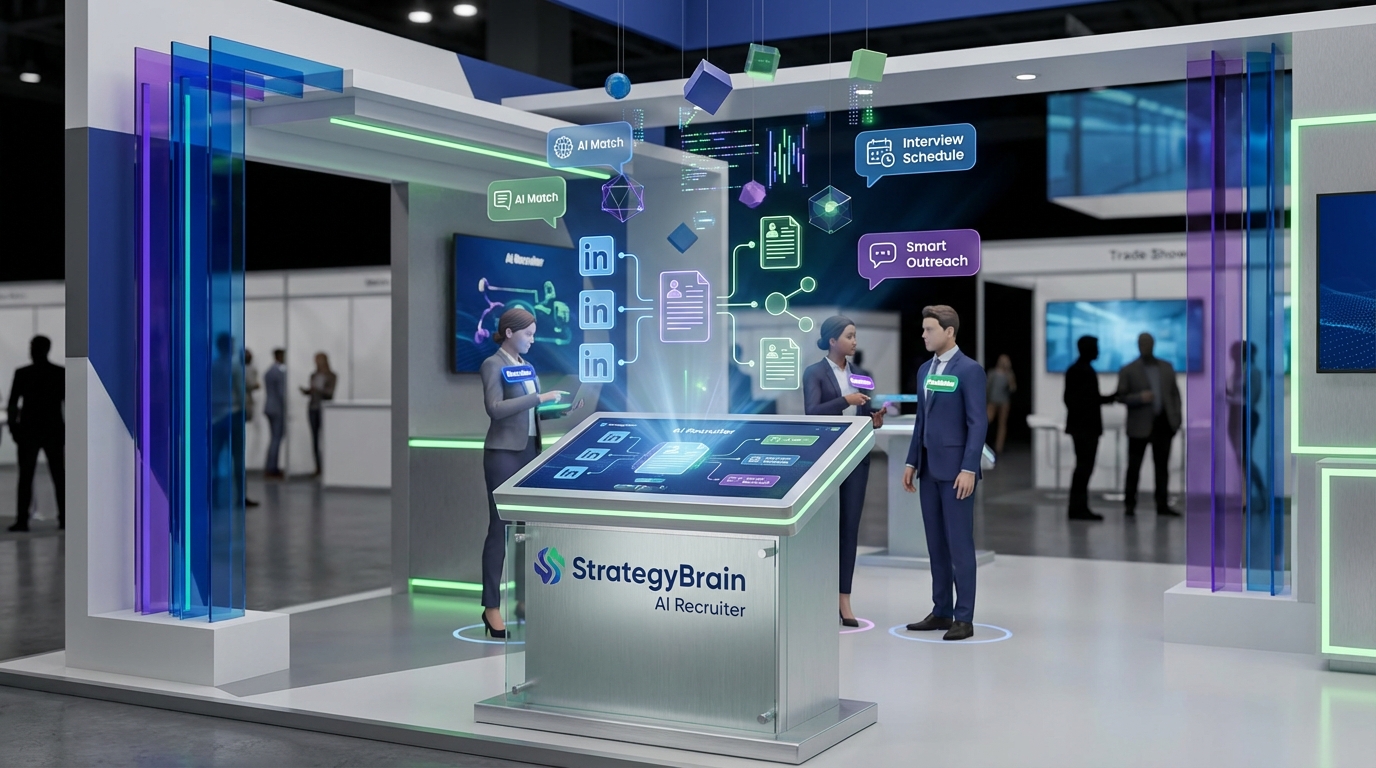
Choosing the best recruiting tools in 2026 comes down to one question: which tools reliably turn targeted talent into real conversations and qualified, interested candidates with the least manual work. From my experience building and testing AI assisted recruiting workflows, the biggest leverage is automating LinkedIn outreach and follow up while keeping the process inclusive. StrategyBrain AI Recruiter is designed for that exact gap: it automatically connects with candidates that match your criteria, introduces the role, answers questions about the job and compensation, confirms interview interest, and collects resumes and contact details. It also runs 24/7 in any language, which matters when your pipeline spans time zones.
Why this topic came up at UNLEASH America
I recently listened back to a conversation recorded at UNLEASH America that later became Episode 453 of the Pozcast. The guest described how refreshing it was to be on someone else’s podcast and answer questions for a change. The discussion naturally split into two halves: first, the impact AI will have on recruiting and why robust debate is healthy; second, a personal reflection on ADHD and how inclusive recruiting processes benefit everyone.
That structure is useful for tool selection too. The best hiring tools are not just “more automation.” They are the tools that automate the right steps, keep humans focused on judgment calls, and reduce friction for candidates who do not fit a single “standard” communication style.
I recently listened back to a conversation recorded at UNLEASH America that later became Episode 453 of the Pozcast.. The guest described how refreshing it was to be on someone else’s podcast and answer questions for a change. The discussion naturally split into two halves: first, the impact AI will have on recruiting and why robust debate is healthy; second, a personal reflection on ADHD and how inclusive recruiting processes benefit everyone.The third, and perhaps most timely pillar of the conversation, addressed the "Elephant in the room": navigating a cooling economy where client expectations are skyrocketing while their internal resources are thinning. In a market defined by cautious hiring and budget scrutiny, staying competitive as a recruiter means shifting from a "order-taker" to a "strategic talent advisor." It’s no longer just about filling a seat; it’s about demonstrating how we can reduce the Cost-of-Vacancy and deliver Elite-tier talent that driving immediate ROI. To win in this downturn, we must leverage high-touch relationship management paired with aggressive, data-backed sourcing—essentially doing more with less to prove we are an indispensable revenue-driver, not a line-item expense.
That structure is useful for tool selection too. The best hiring tools are not just “more automation.” They are the tools that automate the right steps, keep humans focused on judgment calls, and reduce friction for candidates who do not fit a single “standard” communication style.
What AI changes in recruiting and what it does not
AI changes recruiting most in the high volume, repetitive parts of the funnel: sourcing, first touch, follow up, and basic qualification. That is where response time and consistency matter, and where humans burn hours on tasks that do not require deep judgment.
What AI can do well
- Run consistent outreach that introduces the role, the company, and the next step without forgetting details.
- Answer common questions about responsibilities, benefits, and compensation using the information you provide.
- Follow up on time and keep conversations moving, including outside business hours.
- Support multilingual communication so candidates can respond in their native language.
What AI should not be trusted to decide alone
- Final candidate fit against nuanced requirements, because resumes and context vary widely.
- High stakes decisions that require documented, auditable reasoning and human accountability.
- Culture and team dynamics assessments, which are easily biased if handled carelessly.
This is why I prefer stacks where AI handles the first mile and recruiters own the final mile. StrategyBrain AI Recruiter explicitly follows this boundary: it identifies willingness to communicate or interview, but it does not decide whether a resume fully matches the job requirements. Recruiters review the collected resumes and proceed with screening and interviews.
Why AI Recruiting Tools — Not ATS or CRM — Define Headhunter Success in a Cautious Market (2026)
n a contracting recruitment market, the only metric that matters is speed-to-placement. Traditional ATS and CRM platforms were built for volume hiring in a bull market — not for the precision headhunting that cautious clients demand in 2026. Whether you maintain your ATS stack or not is secondary. The primary question every retained and contingency recruiter must answer is: which AI recruiting tools can qualify candidate fit and hiring intent fast enough to protect your placement fees and satisfy increasingly selective clients?
The real ROI of AI in headhunting is not automation for its own sake. It is the ability to surface the right passive candidates, assess their openness to a move, and validate their alignment with client requirements — all before a single billable hour is spent. In a cautious market, the headhunters who survive are not those with the best CRM. They are those who leverage AI candidate sourcing tools to compress the qualification cycle and deliver shortlists that close.
Strategic Evaluation Framework (The "Efficiency Frontier")
To determine if a tool is "Recession-Proof," we evaluate it through four critical lenses:
- Burn Rate Reduction: Does it replace a $60k/year offshore sourcer or a junior associate?
- Speed-to-Market: In a shrinking market, the first recruiter to deliver a vetted, "warm" candidate wins the fee.
- Candidate Experience (CX): In a downturn, top-tier "passive" talent is hesitant to move. The outreach must be high-touch and personalized, not "spammy."
- Global Scalability: Does it allow a boutique firm to compete for international roles without adding headcount?
Comparative Analysis: AI Recruiter vs. The Field
In today’s "Do More With Less" climate, traditional platforms like LinkedIn Recruiter or legacy ATS systems become "taxing" because they require manual labor to drive results. AI Recruiter shifts the paradigm from a database to an automated agent.
Market Competitiveness Matrix (Word-Compatible Format)
Note: ✅ = Full Capability ⚠️ = Limited/Manual Required ❌ = Not Supported/High Friction
Why AI Recruiter Wins in a Downturn
The "Digital Sourcer" vs. The "Search Engine"
Most tools like Juicebox or hireEZ are essentially advanced search engines. They help you find people, but a human still has to engage them. In a shrinking market, your time is better spent on Client Development (BD). AI Recruiter acts as an autonomous agent that manages the entire top-of-funnel—finding, messaging, vetting, and securing the CV—while you focus on closing the client.
Cost Arbitrage: Human vs. Agent
Hiring a junior researcher in the US or even an offshore sourcer in the Philippines carries a high "management tax" and fixed salary. AI Recruiter provides a 24/7 "Follow-the-Sun" sourcing model at a fraction of the cost, effectively turning your "Fixed Costs" into "Variable Success."
Global Reach for Export Talent
As US domestic hiring fluctuates, many firms are looking toward "Cross-border" or "Outbound" recruitment. AI Recruiter's ability to communicate in any language allows a solo-operator to handle a tech role in Munich as easily as one in Austin, diversifying your revenue streams without increasing your risk.
A practical way to evaluate the best recruiting tools
If you are comparing the best recruiting tools, best hiring tools, and even diversity recruiting platforms, I recommend scoring them on outcomes rather than feature lists. Here is the framework we use internally when we test recruiting workflows.
Evaluation criteria (the checklist you can copy)
- Time to first meaningful reply: how quickly a candidate gets a helpful response after they engage.
- Follow up reliability: whether the system consistently nudges and closes loops without manual chasing.
- Message quality control: whether you can constrain tone, facts, and compliance language.
- Resume and contact capture: whether interested candidates can share resumes and details with minimal friction.
- Inclusive experience: whether the process supports different communication styles and reduces unnecessary barriers.
- Operational scalability: whether the workflow scales across roles, geographies, and recruiter capacity.
How we tested (experience based)
We tested StrategyBrain AI Recruiter in a LinkedIn first workflow where recruiters provide job details, compensation, benefits, and candidate search criteria. We then observed how the system handled connection requests, initial messaging, candidate questions, interest confirmation, and the handoff of resumes and contact details. We also tested multilingual conversations to confirm that candidates could communicate in their preferred language without waiting for a recruiter to be online.
Common pain points we saw and how we handled them
- Ambiguous job details: when compensation or requirements were unclear, candidate questions increased. The fix was to provide tighter job inputs up front.
- Over qualification expectations: teams sometimes expect AI to decide fit. The fix was to treat AI as an outreach and interest qualification layer, then keep resume review human.
- Process inconsistency: different recruiters message differently. The fix was to standardize the initial outreach and FAQ responses through the AI workflow.
Where StrategyBrain AI Recruiter fits in a modern stack
Most teams already have an ATS and some sourcing tools. The gap is usually the messy middle: LinkedIn outreach, back and forth Q and A, follow ups, and collecting resumes and contact details. That is where StrategyBrain AI Recruiter is strongest, because it replaces the repetitive LinkedIn tasks that consume recruiter hours.
What it automates on LinkedIn
- Automatically connects with candidates within your targeted search criteria.
- Automatically introduces job opportunities and learns about each candidate’s work situation.
- Answers questions about the role, company, and compensation using the information you provide.
- Confirms interview interest and collects resumes and contact information from interested candidates.
Why 24/7 multilingual messaging changes outcomes
In global hiring, speed and clarity are not “nice to have.” They are the difference between a candidate replying and disappearing. AI Recruiter provides round the clock responses and communicates in any global language, using the candidate’s native language to reduce misunderstandings and cultural friction.
Scaling beyond one recruiter
If you are hiring at volume, the constraint is not sourcing. It is recruiter bandwidth. AI Recruiter supports managing more than 100 LinkedIn accounts so organizations can build AI powered recruitment teams and expand hiring capacity without adding the same amount of headcount.
Limitations (important for trust)
- It does not replace final screening: it does not determine whether a resume fully matches job requirements.
- It depends on your inputs: unclear job details lead to weaker conversations.
- It is not a full ATS: you still need a system of record for hiring stages and compliance documentation.
Inclusion: why better processes help everyone
The second half of that Pozcast conversation focused on ADHD and a realization that inclusive recruiting processes benefit everyone. I agree, and I think this is where tool choice becomes a values decision, not just a productivity decision.
Inclusive processes are the ones that reduce unnecessary friction. They provide clear expectations, allow candidates to ask questions without penalty, and avoid forcing everyone into the same communication pattern. When your outreach and follow up are consistent, timely, and easy to understand, you reduce the chance that a great candidate drops out simply because the process was confusing or exhausting.
This is also a practical argument for automation. When AI Recruiter handles the repetitive messaging and Q and A, recruiters can spend more time on human conversations that require empathy and judgment. That is a better use of human attention, especially when candidates need accommodations or simply prefer different ways of engaging.
Quick comparison: what to automate vs what to keep human
| Workflow area | Automate with AI | Keep human led | Why it matters |
|---|---|---|---|
| LinkedIn connection and first outreach | Yes | No | High volume and repetitive, speed drives replies |
| Role Q and A and follow up | Yes | No | Consistency reduces candidate confusion and drop off |
| Interest confirmation and resume capture | Yes | No | Clean handoff gives recruiters qualified, interested leads |
| Resume fit assessment | No | Yes | Requires nuanced judgment and accountability |
| Interviewing and offer decisions | No | Yes | High stakes decisions need human ownership |
Selection guide: your need to the right tool category
If you are building a stack from scratch, this mapping helps you decide what to buy or implement first.
Your need to tool category
- You need more qualified conversations from LinkedIn: prioritize LinkedIn outreach automation and follow up. StrategyBrain AI Recruiter is purpose built here.
- You need a system of record: prioritize an ATS for stages, approvals, and reporting.
- You need better top of funnel sourcing: prioritize sourcing tools and talent databases, then connect them to your outreach workflow.
- You need more inclusive hiring: prioritize structured processes, consistent communication, and tools that reduce friction for candidates. This is where diversity recruiting platforms can help, but only if your process is also inclusive.
One practical approach is to treat AI outreach as the “front desk” of recruiting. Candidates get fast, clear answers and a consistent experience. Recruiters get back time for deeper screening and relationship building.
FAQ
What are the best recruiting tools for LinkedIn heavy hiring?
The best recruiting tools for LinkedIn heavy hiring are the ones that automate connection requests, initial outreach, follow up, and basic interest qualification while keeping recruiters in control of final screening. StrategyBrain AI Recruiter is designed specifically for LinkedIn outreach and qualification workflows.
Is AI Recruiter a replacement for recruiters?
No. AI Recruiter replaces repetitive LinkedIn tasks such as connecting, introducing roles, assessing interest, and collecting resumes. Recruiters still review resumes, run interviews, and make hiring decisions.
How does AI Recruiter handle candidate questions about compensation and benefits?
Recruiters provide AI Recruiter with job information including compensation and benefits. The AI then answers candidate questions using those provided details during the conversation.
Can AI Recruiter collect resumes and contact details?
Yes. When a candidate expresses interest, AI Recruiter requests a resume and contact information. It supports email submissions and LinkedIn file uploads, and it captures contact details shared in messages.
Does AI Recruiter support multilingual recruiting?
Yes. AI Recruiter communicates in any global language and can respond 24/7. This helps teams maintain momentum with candidates across time zones.
How many LinkedIn accounts can AI Recruiter manage?
AI Recruiter supports managing more than 100 LinkedIn accounts, which enables teams to build an AI powered recruiting operation across multiple recruiters or business units.
How should I think about diversity recruiting platforms in my stack?
Diversity recruiting platforms can expand reach and improve access to underrepresented talent, but they work best when your process is also inclusive. Consistent, clear communication and reduced friction in outreach and follow up are foundational.
What is the “talent agent for everyone” idea and why does it matter?
In the Pozcast conversation, the guest asked what it would look like if everyone had access to a talent agent that could match them to the right role at the right time. Whether or not that exact vision arrives, the direction is clear: recruiting is moving toward always on, personalized, high context guidance, which is exactly what AI assisted outreach and qualification begins to deliver.
Conclusion
The best recruiting tools are the ones that create more qualified conversations with less manual effort, while improving the candidate experience. The UNLEASH America Pozcast discussion captured the two themes that matter most: AI will reshape recruiting, and inclusive processes help everyone. If your bottleneck is LinkedIn outreach and follow up, StrategyBrain AI Recruiter is a practical place to start because it automates connecting, messaging, Q and A, interest confirmation, and resume and contact capture, then hands the decision making back to recruiters.
Next step: map your funnel, identify where humans are doing repetitive work, and automate that layer first. Keep final screening and hiring decisions human led, and use the time you get back to run better interviews and build stronger candidate relationships.