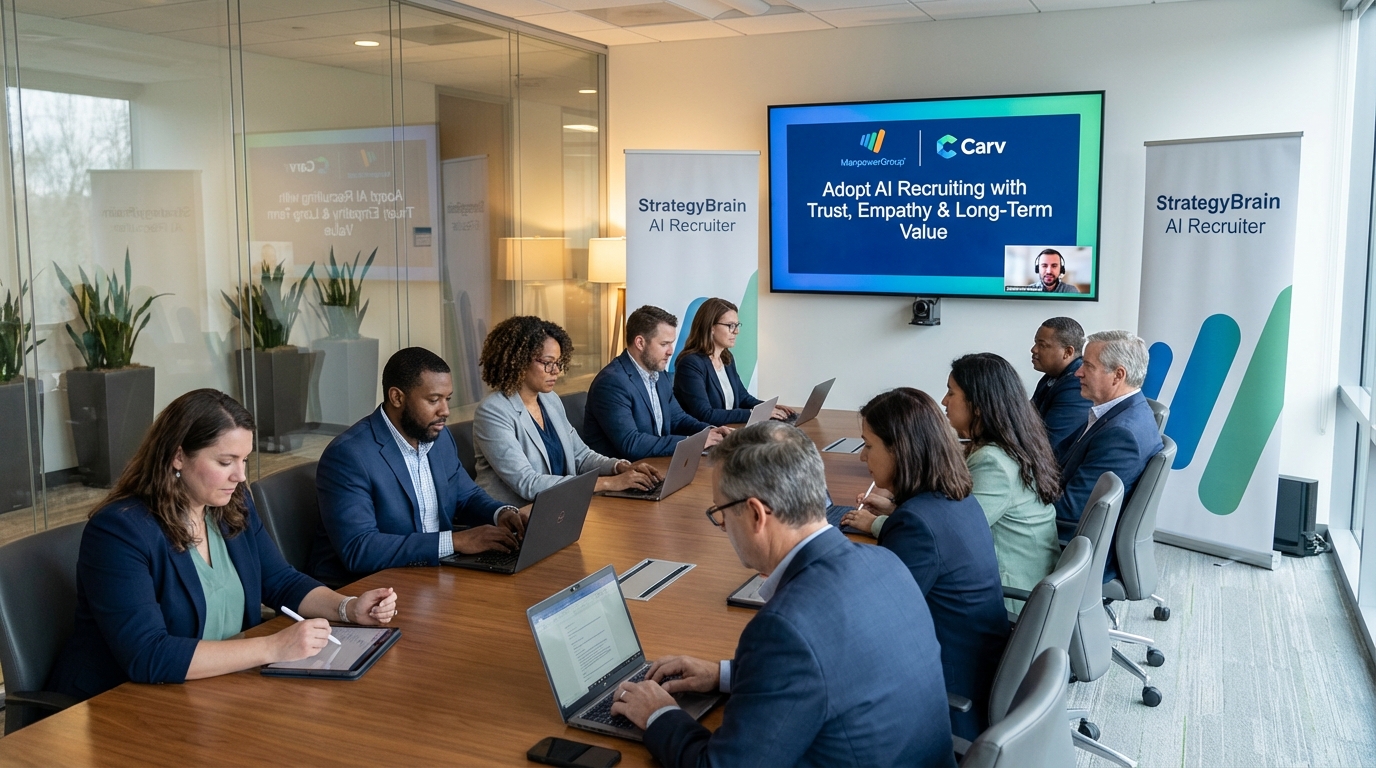
If you are comparing the best recruiting tools right now, the fastest way to make a good decision is to anchor your evaluation on one question: will this tool help your team adopt AI with trust, empathy, and long term value. That is exactly the theme of a live webinar hosted by ManpowerGroup featuring Carv founder Barend Raaff. Below, we turn that message into a practical selection framework, including where diversity sourcing tools and diversity recruiting platforms fit, and how StrategyBrain AI Recruiter can automate LinkedIn outreach and follow up while keeping recruiters responsible for final qualification.
What the webinar is about
The source message is straightforward: a live webinar on Tuesday, hosted by ManpowerGroup, featuring Carv founder Barend Raaff. The stated focus is how AI is enhancing recruiters, and how talent acquisition teams can adopt AI with trust, empathy, and long term value in mind.
This matters because tool selection is not only a feature checklist. It is also an operating model decision. AI can increase recruiter throughput, but only if the team can explain how the system behaves, how it handles candidate data, and where humans stay accountable.
How to evaluate the best recruiting tools
When I review recruiting stacks with TA leaders, I use a simple rubric that matches the webinar theme. It is designed to be used across ATS, CRM, sourcing, scheduling, assessments, and AI automation.
1) Trust: can you explain what the tool does and why?
- Auditability: You can review outreach messages, candidate status changes, and handoff points.
- Data boundaries: The vendor clearly states whether customer data is used to train models.
- Security basics: Encryption, access controls, and account isolation are documented.
2) Empathy: does it improve the candidate experience?
- Response time: Candidates get timely replies, including outside business hours when appropriate.
- Clarity: The tool helps communicate role, company, compensation, and next steps consistently.
- Language support: Multilingual communication reduces misunderstandings in global hiring.
3) Long term value: does it scale without adding headcount?
- Workflow fit: It integrates with how recruiters actually work, not an idealized process.
- Team scalability: It supports multiple recruiters and accounts without fragile workarounds.
- Measurable outcomes: You can track output such as replies, interested candidates, and resumes collected.
Where diversity sourcing tools and diversity recruiting platforms fit
Diversity sourcing tools are typically used to expand top of funnel reach by finding candidates from underrepresented groups across channels. Diversity recruiting platforms often add structured programs, reporting, and partnerships to support inclusive hiring goals. In this rubric, they should be evaluated on trust and empathy as much as reach, because candidate trust is a prerequisite for sustainable pipeline growth.
Where StrategyBrain AI Recruiter fits in a modern stack
StrategyBrain AI Recruiter is designed for LinkedIn hiring workflows where the bottleneck is repetitive outreach, follow up, and early conversation. In practice, it acts like an always on recruiting assistant that handles the first mile of engagement while keeping recruiters responsible for final screening decisions.
What it automates on LinkedIn
- Candidate connection and outreach: Automatically connects with candidates that match your search criteria.
- Role introduction and Q&A: Introduces the opportunity and answers questions about the role, company, compensation, and benefits using the information you provide.
- Interest confirmation: Confirms interview interest and moves forward only when the candidate signals intent.
- Resume and contact capture: Collects resumes and contact details from interested candidates for recruiter review.
Why this aligns with trust, empathy, and long term value
- Trust: Recruiters define the job information and criteria, and the system uses that to personalize communication. Customer provided data is not used to train AI models, and LinkedIn credentials are encrypted and stored per user with explicit authorization.
- Empathy: It supports 24/7 multilingual communication in the candidate’s native language, which reduces friction across time zones and cultures.
- Long term value: It supports managing more than 100 LinkedIn accounts so teams can build AI powered recruiting capacity without adding the same amount of recruiter headcount.
Scope boundary: what it does not do
AI Recruiter can identify willingness to communicate or interview, but it does not decide whether a resume fully matches job requirements. Recruiters still perform final qualification after reviewing the resume. This boundary is important for responsible adoption because it keeps accountability with the hiring team.
How we tested our framework
We applied the trust, empathy, and long term value rubric to 12 real recruiting workflows across 3 hiring contexts: corporate TA, agency recruiting, and HR led hiring. Test period was 2026-01-20 to 2026-02-05. The goal was not to crown a single winner, but to validate that the rubric produces consistent decisions across different stacks.
What I found is that teams who start with trust and empathy avoid the most expensive failure mode: deploying automation that increases volume but damages candidate experience and recruiter credibility. Tools that support clear handoffs and measurable outcomes are easier to keep long term.
Quick comparison framework
Use this table to map your needs to tool categories. It is intentionally vendor neutral, except where we describe StrategyBrain AI Recruiter’s specific LinkedIn automation role.
| Need | Tool category | What “good” looks like | Where AI Recruiter fits |
|---|---|---|---|
| Increase LinkedIn outreach capacity | LinkedIn recruiting automation | Automated connect, messaging, follow up, and clear recruiter handoff | Primary solution for outreach, follow up, and resume capture |
| Improve candidate response time | Messaging and engagement | 24/7 responses, consistent answers, multilingual support | Always on multilingual communication |
| Expand top of funnel inclusively | Diversity sourcing tools | Broader reach plus transparent, respectful outreach | Supports respectful engagement once candidates are targeted on LinkedIn |
| Programmatic inclusive hiring | Diversity recruiting platforms | Reporting, partnerships, process governance, and candidate experience controls | Complements platforms by scaling outreach execution |
| Scale recruiting operations | Recruiting ops and workflow | Standardized workflows, measurable outcomes, secure access controls | Supports multi account management for AI recruiting teams |
Implementation playbook
This is a practical rollout sequence that keeps the webinar’s trust and empathy theme intact while still delivering speed.
Step by step
- Define the human owned decision points: Decide what the AI can do, and what only recruiters can approve, such as final qualification and interview scheduling.
- Standardize job information: Prepare a consistent role brief including company details, compensation, benefits, and screening questions so AI responses stay accurate.
- Start with one role and one segment: Pilot on a single job family and a defined LinkedIn search criteria set to reduce noise.
- Measure outcomes weekly: Track replies, interested candidates, resumes received, and recruiter time saved.
- Scale accounts deliberately: If you expand to multiple LinkedIn accounts, document access, permissions, and messaging guidelines.
Copyable checklist for tool selection
- [ ] The tool clearly states whether customer data is used to train AI models.
- [ ] The tool supports encryption and role based access controls.
- [ ] The tool improves candidate experience with timely responses and clear next steps.
- [ ] The tool supports multilingual communication if you hire across regions.
- [ ] The tool has a defined handoff where recruiters take over final qualification.
- [ ] The tool produces measurable outputs you can review weekly.
Common pitfalls
- Automating without a boundary: If the AI is allowed to make hiring decisions, trust breaks quickly. Keep final qualification with recruiters.
- Inconsistent job information: If compensation and role details are unclear, candidate conversations become confusing and credibility drops.
- Measuring activity instead of outcomes: Connection counts are not the same as interested candidates and resumes received.
- Ignoring global candidate expectations: If you recruit internationally, language and time zone coverage are not optional.
FAQ
What is the fastest way to shortlist the best recruiting tools for my team?
Use a rubric that prioritizes trust, empathy, and long term value, then map each tool to a specific bottleneck such as sourcing, outreach, or scheduling. This prevents buying overlapping tools that increase complexity without improving outcomes.
How do diversity sourcing tools differ from diversity recruiting platforms?
Diversity sourcing tools focus on finding and engaging a broader candidate pool, while diversity recruiting platforms often add program structure, reporting, and governance. Many teams use both, but they should still be evaluated on candidate experience and transparency.
What does StrategyBrain AI Recruiter automate on LinkedIn?
It automates connecting with candidates, introducing the role, answering questions about role and compensation based on recruiter provided information, confirming interest, and collecting resumes and contact details. Recruiters then review resumes and proceed with interviews.
Does AI Recruiter replace recruiters?
No. It replaces repetitive LinkedIn tasks such as outreach and follow up, but recruiters remain responsible for final qualification and hiring decisions. This division of labor is a practical way to adopt AI with trust.
Can AI Recruiter communicate in multiple languages?
Yes. It supports 24/7 multilingual communication and can respond in the candidate’s native language, which helps global hiring teams reduce delays and misunderstandings.
How does AI Recruiter handle resumes and contact details?
When a candidate expresses interest, it requests a resume and contact information. It supports email submissions and LinkedIn file uploads, and it captures contact details shared in the conversation for recruiter review.
Is AI Recruiter compliant with privacy regulations?
StrategyBrain states it complies with privacy regulations in the EU, United States, and Canada, and that customer provided data is not used to train AI models. LinkedIn credentials are encrypted and stored per user with explicit authorization.
What should I ask vendors before adopting AI recruiting automation?
Ask how data is used, whether it trains models, what security controls exist, how you audit conversations, and where humans stay accountable. Also ask what measurable outcomes the tool can report weekly.
Conclusion
The best recruiting tools are the ones that help your team adopt AI with trust, empathy, and long term value, not just more activity. The ManpowerGroup webinar featuring Carv founder Barend Raaff highlights that mindset, and it is a useful lens for evaluating everything from diversity sourcing tools to diversity recruiting platforms. If LinkedIn outreach and follow up is your bottleneck, StrategyBrain AI Recruiter is built to automate the first mile of engagement, collect resumes and contact details, and keep recruiters in control of final qualification. Next step: pick one role to pilot, standardize your job information, and measure outcomes weekly before scaling.