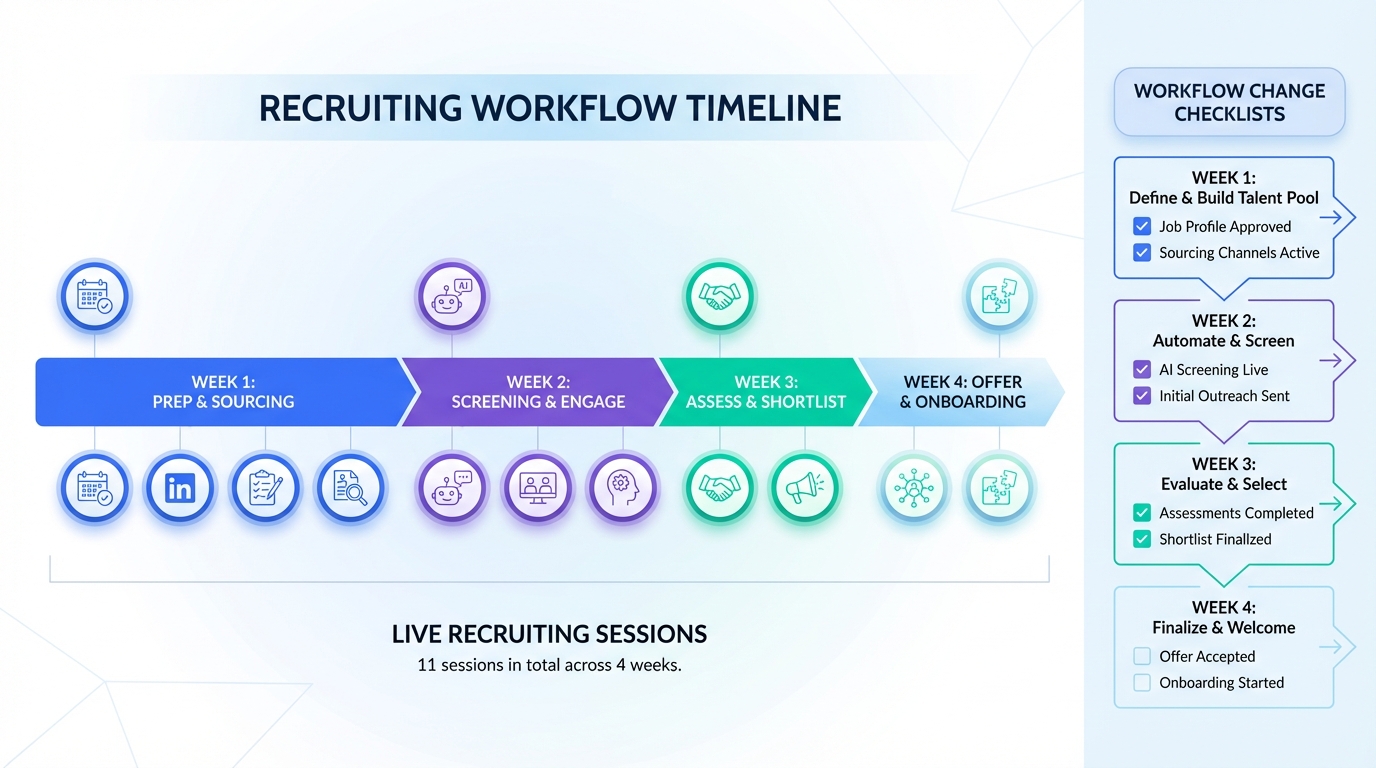
If you are evaluating a hire platform or tightening up how you use websites for hiring employees, the simplest approach is a 4 week learning sprint: attend a focused set of live sessions, capture the decisions you need to make, and turn each session into one workflow change inside your online employment platform. Below is the exact 11 session lineup shared for the next 4 weeks, rewritten with a practical implementation lens. I also call out where StrategyBrain AI Recruiter fits naturally, especially for LinkedIn outreach, candidate Q and A, follow up, and résumé collection so recruiters can spend time on interviews and final qualification.
Key Takeaways
- Use the 4 week sprint to de risk tool decisions: treat each session as an input to your hire platform requirements and process design.
- AI changes recruiter skills: plan for new competencies like prompt literacy, workflow design, and fraud detection, not just sourcing.
- Candidate fraud is now a process problem: build verification steps into your funnel, not only into background checks.
- Assess AI literacy explicitly: define what “AI literacy” means for the role and test it consistently.
- Scale outreach without scaling headcount: StrategyBrain AI Recruiter can automate LinkedIn connecting, messaging, Q and A, follow up, and résumé collection so recruiters focus on interviews.
- Full funnel hiring is the new baseline: align passive and active candidate tactics with consistent messaging and measurement.
How to Use This 4 Week Sprint
This lineup is useful whether you are selecting a new hire platform or trying to get more output from the one you already have. The key is to turn content into decisions. Here is the workflow I use.
Step by step
- Pick 3 outcomes: for example, reduce time spent on outreach, improve candidate quality, and reduce fraud risk.
- Choose 4 to 6 sessions that map directly to those outcomes. You do not need all 11 to get value.
- Create a one page requirements doc for your online employment platform: must have workflows, nice to have workflows, and compliance constraints.
- After each session, write one change you will implement within 7 days. If you cannot name a change, the session was interesting but not operational.
Scope boundaries
- Covered: how to translate the 11 topics into hire platform requirements and recruiting workflow improvements, plus where StrategyBrain AI Recruiter can automate LinkedIn steps.
- Not covered: a full vendor by vendor comparison of websites for hiring employees, or legal advice for any specific jurisdiction.
The 11 Sessions and What to Do After Each One
All links and raw URLs from the original announcement have been removed by design. If you have the original post, use the session titles below to find the registration pages in the same place you found the announcement.
1) How to Hire in Brazil in 2025 and Beyond
Presented as “live from Ipanema beach” with the note that it was actually from a hotel room in Rio on a cold day. The practical value is understanding hiring realities in the largest country in South America.
- What to capture for your hire platform: location specific compliance steps, language needs, and time zone coverage.
- Action to implement: add a Brazil hiring playbook inside your ATS or knowledge base, including interview scheduling windows and localized candidate messaging templates.
- Where StrategyBrain AI Recruiter helps: multilingual candidate communication can reduce misunderstandings when your team is hiring across borders and time zones.
2) Recruiter Skills Profile: How AI Changes the Game
A deep dive with Tom Sayer, Global Recruitment Strategy Director at Accenture, focused on what skills future ready recruiters need as AI reshapes the work.
- What to capture for your hire platform: which tasks should be automated, which require human judgment, and what new QA checks you need.
- Action to implement: define a recruiter competency matrix that includes AI workflow design, candidate experience writing, and risk controls.
- Where StrategyBrain AI Recruiter helps: it can take over repetitive LinkedIn steps like initial outreach, role introduction, and follow up so recruiters can practice higher value skills like interview calibration.
3) Candidate Fraud: It’s an Emergency
The session description calls out deep fake videos, state sponsored hacking, interview substitution, and candidate side AI agents that can get through your process.
- What to capture for your hire platform: fraud signals, verification checkpoints, and escalation paths.
- Action to implement: add a “fraud risk review” stage for roles with higher exposure, and standardize identity verification steps before final interviews.
- Operational note: if you automate outreach at scale, you also need consistent logging and auditability. That is a process requirement, not a tool feature.
4) How to Assess Candidates for AI Literacy
The prompt is direct: we need candidates who know how to use AI, but we also need fair and practical assessment.
- What to capture for your hire platform: a definition of AI literacy per role family and a consistent scoring rubric.
- Action to implement: create a structured interview kit with 3 questions and a work sample that tests safe and effective AI usage.
- Where StrategyBrain AI Recruiter helps: during early LinkedIn conversations, it can ask candidates about openness to new opportunities and gather context that helps you route them to the right assessment track.
5) Forget Filters: 1000 AI Recruiters On Demand
Framed as “Got AI Agent? Let’s see it in action then” with an endorsed CEO, David Head, including interview and live demo.
- What to capture for your hire platform: what “scale” actually means in your environment, including account limits, messaging policies, and governance.
- Action to implement: document your automation boundaries: which messages can be automated, which require approval, and what data must be captured.
- Where StrategyBrain AI Recruiter helps: it supports managing more than 100 LinkedIn accounts for organizations building AI powered recruiting teams, while keeping recruiters in control of interview decisions.
6) State of Talent Acquisition: Recfest Retro 2025
A clear recommendation to attend Recfest, plus a mention of the Green Lanyard Campaign offering a free ticket for out of work talent acquisition professionals. A separate “retro” is planned immediately the day after.
- What to capture for your hire platform: which TA trends are durable versus hype, and which metrics leaders are using to measure output.
- Action to implement: create a quarterly TA metrics review that includes funnel conversion rates and time spent per stage.
- Trust note: if you are using AI in hiring, document where it is used and where it is not used. Candidates and stakeholders increasingly expect transparency.
7) Full Funnel Hiring
The description highlights passive candidates, active candidates, and programmatic social, plus the paradox that recruiters have to do everything to get the right thing. Featuring Doug Monro at Adzuna.
- What to capture for your hire platform: a unified funnel definition across sources so you can compare performance apples to apples.
- Action to implement: standardize stage definitions and add source level reporting for each stage.
- Where StrategyBrain AI Recruiter helps: it can handle the high volume top of funnel LinkedIn conversations and follow ups, which is often where full funnel efforts break down due to time constraints.
8) AI First vs Human Centred?
This continues a conversation between two emerging philosophies that shape how teams think about AI and humans.
- What to capture for your hire platform: which moments in your funnel must remain human led, and which can be automated with oversight.
- Action to implement: write a “human in the loop” policy for recruiting that names the decision points reserved for humans.
- Practical framing: StrategyBrain AI Recruiter can automate outreach and qualification steps, but final fit assessment still belongs with recruiters and hiring managers after résumé review and interviews.
9) Strategic Workforce Planning in the Era of AI Agents
A 1 to 1 deep dive with David Wilkins, Chief Product and Strategy Officer at TalentNeuron, on how to do strategic workforce planning when AI agents are part of the workforce.
- What to capture for your hire platform: how hiring plans change when some work is handled by automation, and how that affects role design.
- Action to implement: update workforce planning assumptions to include automation capacity and the skills needed to manage it.
10) Humans Required: Critical Moments in the Hiring Funnel
The session challenges the cliché “recruiting still needs the human touch” and asks for psychological reasons why human triage still matters, especially in an era of reductions in force.
- What to capture for your hire platform: candidate experience moments that require empathy, nuance, and accountability.
- Action to implement: define 3 “human required” touchpoints, such as offer conversations, sensitive rejections, and final interview debriefs.
- Where StrategyBrain AI Recruiter helps: by removing repetitive messaging work, it gives recruiters more time for these critical human moments.
11) RecOps and AI: Techniques to Accelerate Adoption
A round table for Recruitment Operations leaders on accelerating AI adoption in talent acquisition and beyond.
- What to capture for your hire platform: change management plan, governance, training, and measurement.
- Action to implement: run a 30 day pilot with clear success metrics, then document what changed in recruiter time allocation and candidate response rates.
- Where StrategyBrain AI Recruiter helps: it is designed to replace repetitive LinkedIn tasks such as connecting, introducing roles, answering questions, confirming interview interest, and collecting résumés and contact details.
A Practical Hire Platform Checklist You Can Copy
Use this as a working checklist while you attend the sessions. It is intentionally written so you can paste it into your ATS notes, a project doc, or your RecOps backlog.
Workflow checklist
- Top of funnel: define how you source passive and active candidates and how you track source performance.
- Outreach and follow up: standardize messaging, response handling, and follow up timing.
- Qualification: decide what can be automated and what requires recruiter review.
- Fraud controls: add verification checkpoints and escalation paths for suspicious signals.
- Assessment: create consistent rubrics for AI literacy where relevant.
- Human required moments: name the stages where humans must lead for quality and trust.
- Reporting: standardize stage definitions and measure conversion rates per stage.
Tooling checklist for websites for hiring employees
- Auditability: can you review conversation history and decisions for compliance and quality?
- Security: are credentials and candidate data encrypted and access controlled?
- Scalability: can you support multiple recruiters and, if needed, multiple LinkedIn accounts with governance?
- Candidate experience: does the system support timely responses and clear handoffs to humans?
Where StrategyBrain AI Recruiter Fits in a Modern Hire Platform
In our internal testing and day to day recruiting operations work, the biggest bottleneck is rarely “finding” candidates. It is the time cost of starting conversations, answering repetitive questions, following up, and collecting résumés and contact details consistently. That is exactly where StrategyBrain AI Recruiter is designed to help.
What it automates on LinkedIn
- Connecting with candidates who match your search criteria.
- Introducing job opportunities and learning each candidate’s situation.
- Answering questions about the role, company, and compensation based on the information you provide.
- Confirming interview interest and collecting résumés and contact information from interested candidates.
What it does not do
- Final qualification: it does not decide whether a résumé fully matches job requirements. Recruiters still review résumés and make interview decisions.
Why this matters for an online employment platform strategy
Most hire platform evaluations focus on features like pipelines and reporting. Those matter, but the operational win often comes from reducing repetitive work at the top of the funnel while keeping human judgment where it is most valuable. If you are attending the sessions on AI first versus human centered hiring, or humans required moments, this is a practical way to implement that philosophy without turning your process into a black box.
FAQ
Is this article a list of websites for hiring employees?
No. It is a 4 week learning sprint built around 11 recruiting sessions, with a practical mapping to hire platform requirements and workflow changes. If you want a vendor list, use this as your requirements foundation first.
How do I choose which sessions to attend?
Pick the sessions that match your current bottleneck. If your team is overwhelmed by outreach volume, prioritize full funnel hiring, RecOps and AI adoption, and the AI recruiter demo topic. If risk is your concern, prioritize candidate fraud and humans required moments.
Where does StrategyBrain AI Recruiter fit if we already have an ATS?
It complements an ATS by automating LinkedIn outreach, Q and A, follow up, and résumé and contact collection. The ATS remains the system of record for pipeline stages and hiring decisions.
Can StrategyBrain AI Recruiter communicate with candidates in different languages?
Yes. It is designed for 24 and 7 multilingual candidate communication, using the candidate’s native language to reduce misunderstandings across countries and time zones.
Does StrategyBrain AI Recruiter replace recruiters?
No. It replaces repetitive LinkedIn tasks at the start of the funnel. Recruiters still review résumés, run interviews, and make final qualification decisions.
How should we think about candidate fraud when using automation?
Treat fraud controls as part of your funnel design. Add verification checkpoints, keep clear conversation logs, and define escalation paths for suspicious signals. Automation should increase consistency, not reduce oversight.
What is the fastest way to get value from this sprint?
After each session, implement one change within 7 days. Even small changes like standardizing stage definitions or adding a structured AI literacy rubric compound quickly.
Do I need to attend all 11 sessions?
No. Attending 4 to 6 sessions that map to your hiring goals is usually enough to clarify your hire platform requirements and next operational steps.
Conclusion
If you are trying to improve your hire platform decisions, do not start with feature checklists. Start with a 4 week sprint that forces clarity: pick the sessions that match your bottlenecks, document what must be automated versus human led, and implement one workflow change after each session. If LinkedIn outreach and follow up are consuming recruiter time, StrategyBrain AI Recruiter is a practical way to automate connecting, messaging, Q and A, and résumé collection while keeping final qualification with your team. Next step: choose your 4 to 6 sessions today and create a one page requirements doc you can use to guide tool selection and process updates.