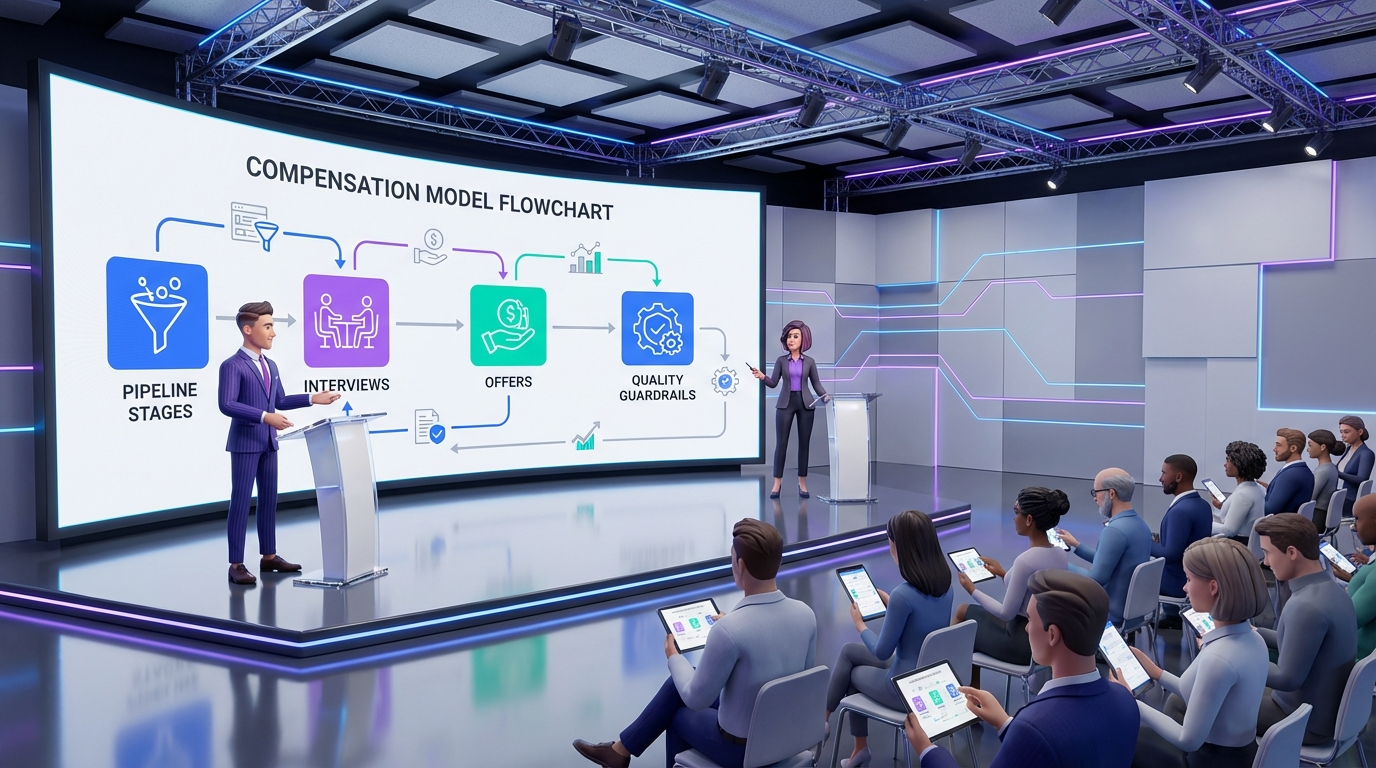
Recruiter compensation is hard to get right because incentives can either lift productivity or quietly reward the wrong behavior. After years of debating, testing, and operating under different commission and bonus schemes, our most reliable approach is this: define what “high performance” means in your context, pay for outcomes you can verify, and use human resource recruitment software as the system of record so the plan is transparent and enforceable. In practice, that means you track pipeline stages, response rates, interview progression, and accepted offers in one place, then align variable pay to those milestones with quality guardrails. This guide keeps the original event details intact and adds a practical framework you can apply, including where StrategyBrain AI Recruiter can remove repetitive LinkedIn outreach work so your incentives reward recruiter judgment and delivery.
Key Takeaways
- Comp plans fail when metrics are fuzzy: Use human resource recruitment software to define stages and count outcomes consistently.
- Pay for verified delivery: Tie variable pay to milestones like qualified shortlist delivered, interviews scheduled, and accepted offers.
- Protect quality: Add guardrails such as minimum hiring manager satisfaction checks and candidate experience standards.
- Reduce “busy work” incentives: Automating repetitive outreach with StrategyBrain AI Recruiter helps you reward judgment, not message volume.
- Small business friendly: Human resources software for small business should prioritize clarity, auditability, and simple reporting over complex dashboards.
- Nothing is perfect: Every scheme has downsides, so review quarterly and adjust based on observed behavior.
Why recruiter compensation is so hard
The way recruiters are paid has been a fraught topic forever. Business owners struggle with recruiter productivity, and recruiters struggle under schemes they feel are unfair, cumbersome, or miserly. The uncomfortable truth is that compensation can make or break performance in recruiting teams, but most models either kill motivation or reward the wrong behavior.
In our experience, the difficulty comes from moving parts that interact. Role complexity varies by job family, labor market, and hiring manager responsiveness. Candidate quality is not a single number. Time to fill can be influenced by factors outside the recruiter’s control. If you pay on the wrong proxy, you get the wrong behavior.
What high performance comp models look like
High performance compensation models do three things at the same time. They motivate effort, they reward delivery, and they discourage shortcuts that damage quality. That balance is why one dimensional plans tend to fail.
What to align incentives with
- Growth: building a healthy pipeline for priority roles and future demand.
- Delivery: moving candidates through stages to accepted offers.
- Quality: ensuring the right match and a professional candidate experience.
The psychology behind motivating top performers
Top recruiters want autonomy, fairness, and a clear line of sight between their work and rewards. If the plan is opaque, constantly changing, or dependent on subjective exceptions, you lose trust. A good human resource tool helps here because it makes the rules visible in the workflow and makes results auditable.
A practical framework you can implement
Below is a framework we have found workable across agency and in house teams. It is designed to be measurable, explainable, and hard to game.
Step 1: Define “countable outcomes” and stage definitions
- Pick 3 to 5 outcomes you will pay on, such as qualified shortlist delivered, interviews scheduled, offers accepted.
- Write stage definitions in plain language so everyone agrees what counts.
- Document exclusions such as roles paused, hiring manager non response, or candidate withdrawal after offer.
Step 2: Add quality guardrails
- Candidate experience: no spammy outreach, clear role and compensation communication, timely follow up.
- Hiring manager feedback: a lightweight check at shortlist and post hire.
- Data hygiene: no “stage inflation” and no duplicate candidates across roles.
Step 3: Choose a payout shape that matches your business
There is no single best plan. However, the payout shape should match your constraints. If you need predictable costs, keep variable pay narrower and tie it to verified milestones. If you need aggressive growth, you can weight pipeline building more heavily, but only if you can measure it without rewarding noise.
Step 4: Review behavior, not just numbers
Every scheme has downsides. The fastest way to improve is to run a quarterly review focused on observed behavior changes. Ask what the plan is encouraging, what it is discouraging, and what it is accidentally rewarding.
Where human resource recruitment software fits
Compensation plans break when measurement is inconsistent. This is where human resource recruitment software becomes more than an admin system. It becomes the enforcement layer for fairness.
What to track inside your system of record
- Pipeline stages: consistent definitions for sourced, contacted, responded, screened, interviewed, offered, accepted.
- Cycle time: time in stage and time to next action, used for coaching and workload balancing.
- Source attribution: where candidates came from, including LinkedIn, referrals, inbound, and agencies.
- Outcome audit trail: who moved a candidate, when, and why.
Why this matters for small teams
For human resources software for small business, simplicity is a feature. You want a small set of reports that answer: what did we deliver, what did it cost, and what is stuck. When the data is clean, compensation discussions become calmer because you can point to the same facts.
How StrategyBrain AI Recruiter changes the incentive problem
One reason commission schemes go sideways is that recruiters spend a large share of their day on repetitive outreach and follow up, especially on LinkedIn. If your plan rewards activity volume, you often get more messages, not better hiring outcomes. StrategyBrain AI Recruiter changes that dynamic by automating the initial LinkedIn workflow so the recruiter’s time shifts toward higher value work.
What it automates in LinkedIn recruiting
- Candidate connection and introduction: automatically connects with candidates that match your search criteria and introduces the opportunity.
- Two way Q&A: answers questions about the role, company, and compensation using the information you provide.
- Interest confirmation: confirms interview interest and collects resumes and contact details from interested candidates.
- Always on communication: provides 24/7 multilingual responses in the candidate’s native language.
How to reflect automation in your comp model
When outreach is automated, you can stop paying for raw activity and start paying for verified progression. For example, you can weight compensation toward qualified shortlist delivery and interview scheduling, because the system reduces the manual effort required to generate initial conversations. This is also where a human resource recruitment software stack matters, because you need clean stage tracking to avoid disputes.
Operational boundary you should keep
StrategyBrain AI Recruiter can identify willingness to communicate or interview, but it does not decide whether a resume fully matches job requirements. That final qualification remains a recruiter responsibility, which is exactly the kind of judgment you want your incentives to reward.
Common failure modes and fixes
Failure mode 1: Paying for speed alone
If you pay only on time to fill, recruiters may push weak fits through the funnel. Fix this by pairing speed metrics with quality guardrails and by paying on accepted offers rather than only interviews.
Failure mode 2: Paying for activity volume
If you pay for messages sent or candidates added, you can incentivize spam. Fix this by paying for response quality and stage progression. Automation can help here because it standardizes follow up and reduces the temptation to “spray and pray.”
Failure mode 3: Ambiguous definitions
If “qualified” means different things to different people, the plan becomes political. Fix this by writing definitions, training managers, and using your human resource tool to enforce required fields and stage criteria.
Event: Building Compensation Models That Drive High Performance
Join me and Manan Shah, CEO of Recruiterflow, for a session on Building Compensation Models That Drive High Performance.
- Date: 16th April
- Time: 10:30 AM BST
- You’ll learn: what high performance comp models look like, how to align incentives with growth and delivery, and the psychology behind motivating top performers.
The original invitation included a “Save your seat now” call to action and a registration link. Per publishing rules for this page, the link has been removed, but the event details remain unchanged.
FAQ
What is human resource recruitment software in the context of compensation?
It is the system that records recruiting activity and outcomes, such as pipeline stages, interviews, and offers, so compensation can be calculated from consistent data. Without a single system of record, comp plans tend to become subjective.
What should I pay recruiters for if I want better quality?
Pay for verified milestones that reflect quality, such as qualified shortlist delivery and accepted offers, and add guardrails like hiring manager feedback checks. Avoid paying only for speed or raw activity volume.
How does a human resource tool reduce disputes about commissions?
It creates an audit trail of who did what and when, using shared stage definitions. When everyone can see the same pipeline facts, disagreements become easier to resolve.
Is human resources software for small business enough, or do I need an enterprise suite?
Small teams often do better with simpler software that enforces consistent stages and reporting. The key requirement is clean, reliable data, not the number of features.
How does StrategyBrain AI Recruiter fit into a recruiting software stack?
It automates LinkedIn connection, initial outreach, follow up, and interest confirmation, then captures resumes and contact details from interested candidates. Your team can then use your system of record to track progression and make final qualification decisions.
Does StrategyBrain AI Recruiter replace recruiters?
No. It replaces repetitive LinkedIn tasks such as connecting, introducing roles, and collecting resumes, while recruiters keep responsibility for final qualification and hiring decisions.
Can StrategyBrain AI Recruiter communicate with candidates in different languages?
Yes. It supports 24/7 multilingual communication and can respond in the candidate’s native language, which helps reduce delays across time zones.
What data protection practices should I expect from an AI recruiting system?
You should expect encryption, customer specific data isolation, and clear statements that customer data is not used to train models. You should also confirm how credentials are stored and what authorization controls exist.
Conclusion
Recruiter compensation is not one dimensional. The plans that work best define measurable outcomes, protect quality with guardrails, and rely on human resource recruitment software to keep the rules transparent. If you also reduce repetitive LinkedIn work with StrategyBrain AI Recruiter, you can shift incentives away from busy work and toward delivery and judgment. Next step: write your stage definitions, pick 3 to 5 payable milestones, and run a 90 day trial with a quarterly behavior review so you can adjust before bad incentives become culture.