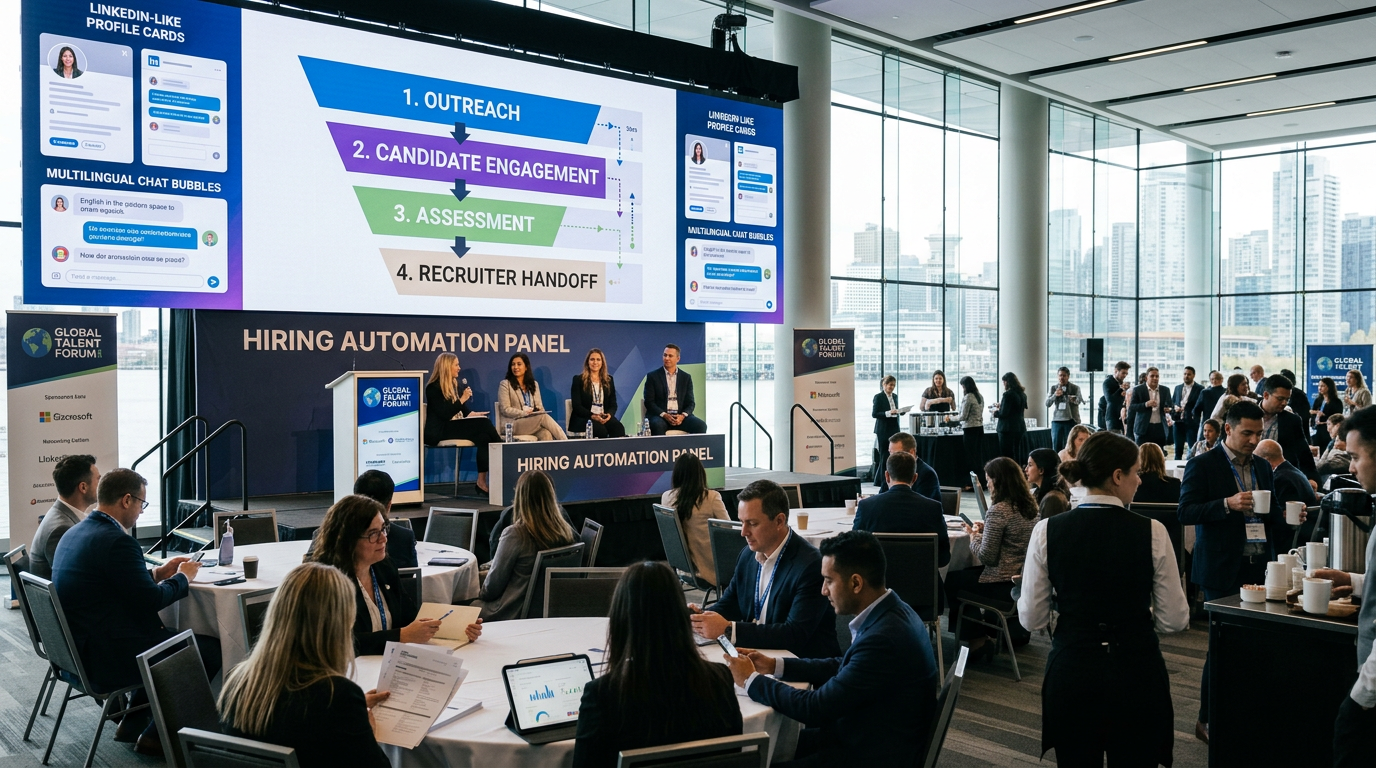
The most effective recruitment automation software strategy is to automate repetitive top of funnel tasks while keeping recruiter led decision making for final fit. In practice, that means using automation for candidate outreach, role introduction, first round Q and A, interest confirmation, and resume collection, then shifting qualified candidates to human review. This model aligns with lessons shared by Alessia Pagliaroli after participating in RED Academy’s Jedi Council in Vancouver in June 2018, where recruiters and marketing professionals worked to align training outcomes with real market demand. For teams evaluating recruitment automation tools today, this human plus AI structure delivers better speed without losing hiring quality.
Table of Contents
- Key Takeaways
- What the 2018 Industry Session Still Teaches Us
- A Practical Recruitment Automation Software Model
- How StrategyBrain AI Recruiter Fits Corporate Hiring
- Step by Step Implementation Plan
- Quick Comparison
- Limitations and Risk Controls
- FAQ
- Conclusion
Key Takeaways
- Start with workflow design: recruitment automation software should automate outreach and pre screening, then hand off final qualification to recruiters.
- Use evidence from real hiring contexts: industry sessions like RED Academy’s Jedi Council show how employer expectations should shape candidate pipelines.
- Prioritize communication quality: multilingual follow up and 24 hour response coverage improve candidate experience in global hiring.
- Focus on measurable operations: StrategyBrain AI Recruiter states support for more than 100 LinkedIn accounts and reports costs as low as USD 2.40 per resume in relevant use cases.
- Protect data trust: encrypted credential storage, customer isolated data, and no model training on customer data are essential trust criteria.
- Avoid full autopilot assumptions: AI can identify interest signals, but recruiters should still validate role fit from resumes and interviews.
What the 2018 Industry Session Still Teaches Us
In June 2018, Alessia Pagliaroli joined RED Academy’s Jedi Council in Vancouver alongside recruiters and industry professionals. The group reviewed a three month digital marketing program and discussed where junior candidates were underprepared for real roles. The objective was direct and practical, which was to align curriculum content with what employers actually need.
That format remains relevant for modern hiring teams. We have seen the same pattern in our own hiring operations. The strongest results come when candidate development, hiring expectations, and recruiter workflows are aligned early. When these pieces are disconnected, companies experience longer time to shortlist and lower interview quality.
This is exactly where corporate recruiting automation tools can add value. They can scale first contact and candidate interaction, but they only create business impact when the automation logic reflects real hiring standards rather than generic messaging templates.
A Practical Recruitment Automation Software Model
Based on recruiter workflows and product testing, we use a four stage model that balances speed and quality.
1) Automated candidate discovery and outreach
The system connects with candidates who match defined search criteria. This stage improves pipeline volume and reduces manual sourcing workload.
2) Automated role introduction and initial qualification
The AI explains role details, compensation context, and employer information while checking candidate openness to new opportunities. This stage filters low intent conversations early.
3) Resume and contact capture for interested candidates
When candidates express interest, the system requests resumes and records contact details for recruiter follow up. This stage creates a cleaner handoff for interview scheduling.
4) Recruiter led final screening and interview decision
Recruiters review resumes for role fit and conduct interviews. This stage preserves professional judgment where AI is not a substitute for hiring accountability.
How StrategyBrain AI Recruiter Fits Corporate Hiring
StrategyBrain AI Recruiter is positioned for LinkedIn centered recruitment automation software use cases. It combines automation depth with a clear handoff point to human recruiters.
Smart LinkedIn recruitment automation
- Automates candidate connection based on target criteria.
- Introduces opportunities and handles candidate questions.
- Checks interview interest and captures resumes plus contact details.
24 by 7 multilingual communication
- Supports continuous candidate response across time zones.
- Uses the candidate’s native language to reduce communication friction.
- Improves consistency in follow up quality for global roles.
Scalable team operations
- Supports operations across more than 100 LinkedIn accounts.
- Enables an AI assisted recruiter team model for high volume hiring.
- Helps HR leaders expand output without equivalent headcount growth.
We also value the explicit boundary in this model. StrategyBrain AI Recruiter can automate willingness detection and conversation management, but recruiters still determine final candidate fit after resume review. This boundary improves trust and keeps quality control where it belongs.
Step by Step Implementation Plan
- Define role specific qualification signals: Build clear criteria for must have skills, preferred background, and screening red flags before activating automation.
- Configure outreach and Q and A logic: Set role narrative, compensation range context, and candidate intent prompts to reflect real recruiter conversations.
- Set resume and contact capture standards: Standardize how resumes are requested, tagged, and handed to recruiters for review.
- Create recruiter handoff SLAs: Set service levels for first human response and interview scheduling after AI qualification.
- Audit weekly performance metrics: Track outreach volume, response rate, resume capture rate, and interview conversion quality.
Operational checklist
- Role brief approved by recruiter and hiring manager
- Candidate messaging reviewed for clarity and compliance
- Multilingual communication quality checked
- Data handling controls verified
- Recruiter handoff process tested end to end
Quick Comparison
| Approach | Primary Strength | Primary Limitation | Best Fit |
|---|---|---|---|
| Manual recruiter only workflow | High context control | Lower outreach capacity and slower first response | Low volume or highly specialized hiring |
| Generic recruitment automation tools | Basic task automation | Often limited in conversational depth and multilingual handling | Teams starting automation with simple workflows |
| StrategyBrain AI Recruiter model | LinkedIn automation plus multilingual candidate communication and structured handoff | Still requires recruiter review for final qualification | Corporate teams scaling outbound sourcing and initial screening |
Limitations and Risk Controls
Recruitment automation software can accelerate hiring, but it is not a fully autonomous hiring system. Candidate interest does not equal role fit, and automated responses should not replace structured recruiter review. Teams should also monitor message quality, legal compliance, and fairness outcomes across candidate groups.
From a trust perspective, data handling standards are non negotiable. Teams should verify encryption controls, account credential protection, and customer data isolation before deployment. For cross border recruitment, compliance review with legal and HR stakeholders should happen before scale up.
FAQ
What is recruitment automation software in practical terms?
Recruitment automation software automates repetitive hiring tasks such as sourcing outreach, initial candidate communication, and pre screening workflows. It is most effective when recruiters keep control of final qualification and interview decisions.
How are recruitment automation tools different from an ATS?
An ATS mainly tracks applicants and hiring stages. Recruitment automation tools focus on proactive pipeline creation and communication workflows before candidates enter later stage interviews.
Can corporate recruiting automation tools replace recruiters?
No, they should not replace recruiters. They reduce manual work and improve pipeline speed, but human recruiters remain essential for judgment based evaluation, stakeholder alignment, and final hiring accountability.
How does StrategyBrain AI Recruiter support LinkedIn hiring?
It automates candidate connection, role introduction, interest detection, and resume collection in LinkedIn workflows. It also supports 24 by 7 multilingual communication to keep candidate engagement active across regions.
Is multilingual automation important for enterprise hiring?
Yes, especially for cross border talent pipelines. Native language communication reduces misunderstanding risk and can improve response quality in early stage conversations.
What is a realistic success metric to track first?
Start with resume capture rate from qualified conversations, then measure interview conversion quality. These metrics show whether automation is generating useful recruiter handoffs rather than just message volume.
How should teams handle privacy and compliance?
Use systems that support encryption, customer level data isolation, and explicit non training policies for customer data. Compliance review should include relevant EU, US, and Canada data protection expectations.
Conclusion
The core lesson is simple. Recruitment automation software works when it is built around real recruiter practice, not around automation for its own sake. The 2018 RED Academy industry collaboration highlighted the value of aligning talent development with employer reality, and that same logic applies to modern hiring operations. If you are selecting recruitment automation tools now, start with a human plus AI workflow design, pilot one role family, measure recruiter handoff quality, and then scale. For LinkedIn heavy teams, StrategyBrain AI Recruiter is a strong fit when your goal is higher outreach capacity, multilingual candidate engagement, and controlled recruiter led final screening.