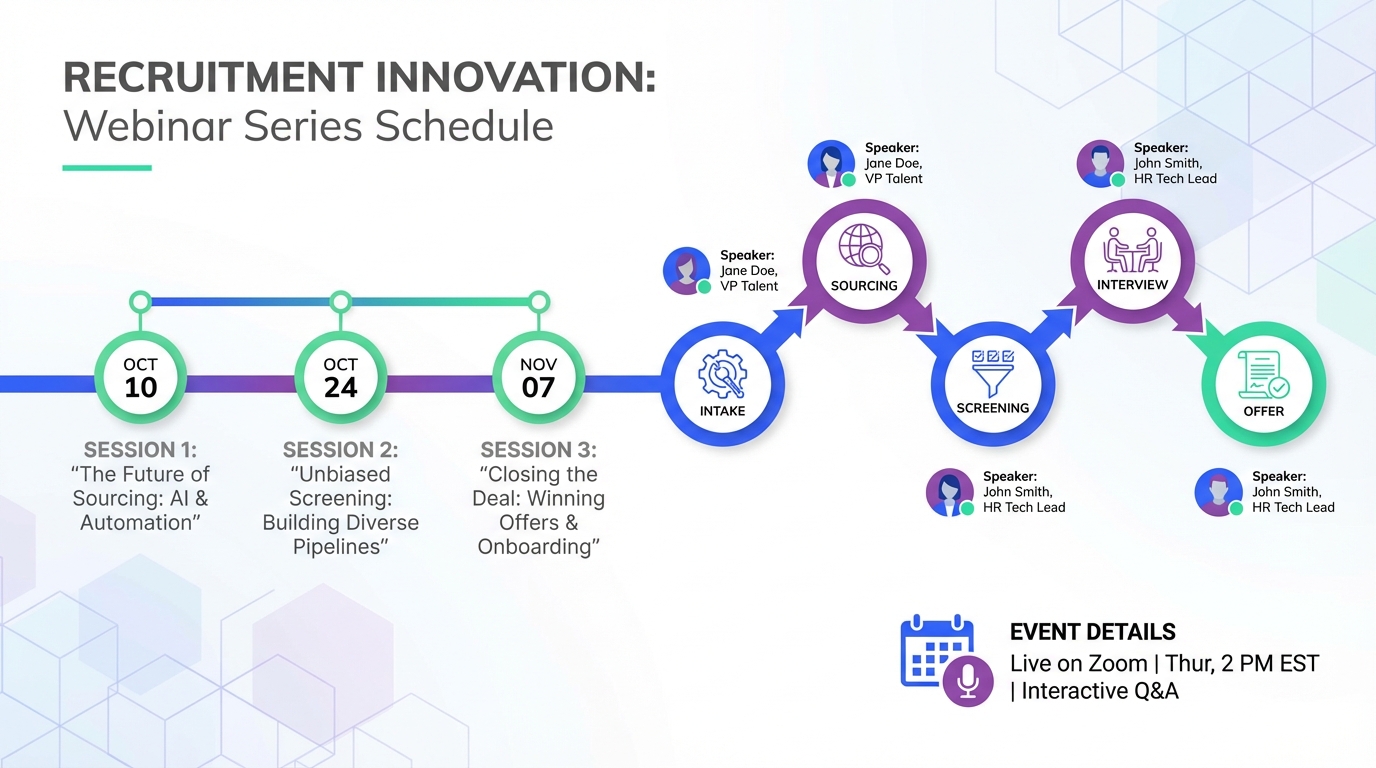
Recruitment monitoring is easiest to implement when you start with a clear map of your recruitment process, because the map turns “how we think hiring works” into a shared, measurable workflow. Once every step is visible, you can attach HR hiring metrics to each stage, collect consistent recruitment data examples, and decide where automation helps without breaking candidate experience. This guide keeps the original webinar context intact, including the SPHR (formerly PSZK) Recruiting & Sourcing webinar series that begins on 15 February 2024, and it adds a practical monitoring layer you can apply immediately, including how StrategyBrain AI Recruiter can automate LinkedIn outreach and follow up while still fitting into your measurement framework.
Why recruitment monitoring should start with a process map
A process map is a visual description of the steps, owners, inputs, and outputs in your hiring workflow. In recruitment monitoring, it becomes your “measurement backbone” because you cannot monitor what you cannot define.
When teams skip mapping, they often jump straight to dashboards. The result is predictable: inconsistent definitions, missing handoffs, and metrics that look precise but do not reflect reality. A process map fixes that by making each stage explicit, including where decisions happen and where data should be captured.
Who needs alignment and why it matters
Even if you personally know your process well, other stakeholders usually operate on partial mental models. That gap is exactly where monitoring breaks down.
- Hiring managers may assume the recruiter is screening for one set of requirements while the recruiter is optimizing for another.
- Technical interviewers or technical recruiters may run assessments that are not connected to the same evaluation criteria used earlier.
- External vendors such as an ATS provider may configure stages and statuses that do not match your real workflow.
Recruitment monitoring works when everyone shares the same stage definitions, the same “done” criteria for each stage, and the same data capture rules.
How to map your recruitment process in 60 to 90 minutes
This is a practical approach we have used with internal recruiting teams and agency style workflows. The goal is not a perfect diagram. The goal is a usable map that supports monitoring and improvement.
Steps
- List your stages from intake to offer
Write the stages you actually use today, not the ones you wish you used. Include handoffs such as “manager review” or “interview debrief.” - Define entry and exit criteria for each stage
For example, “Screen complete” might mean a completed scorecard plus compensation alignment captured in notes. - Assign an owner to each stage
Ownership clarifies who is responsible for moving the candidate forward and who is responsible for data quality. - Mark decision points and failure points
Decision points include shortlist approvals and offer approvals. Failure points include drop offs after outreach or after a technical test. - Attach the minimum data you must capture
This is where recruitment monitoring becomes real. If a field is not captured consistently, do not build a KPI around it yet.
What this mapping exercise often reveals
- Hidden steps such as informal manager reviews that add 2 to 5 business days.
- Unclear requirements where intake is treated as a meeting rather than a documented agreement.
- Unowned handoffs where candidates wait because no one is accountable for the next action.
Recruitment data examples and HR hiring metrics by stage
Below is a stage based monitoring template you can copy into your ATS configuration notes or a shared document. The point is to connect metrics to the process map so the numbers are interpretable.
Intake and requirements alignment
- HR hiring metrics: intake to approved role brief time in business days, number of requirement changes after kickoff (count).
- Recruitment data examples: role brief version, must have vs nice to have skills, compensation range confirmed (yes or no), interview plan agreed (yes or no).
Sourcing and outreach
- HR hiring metrics: outreach to first response rate (percentage), median time to first response in hours, follow up count per candidate (count).
- Recruitment data examples: sourcing channel, outreach message variant ID, candidate location and language, response category (interested, not interested, later, no response).
If LinkedIn is a primary channel, this is where StrategyBrain AI Recruiter can fit naturally into your monitoring plan. Because it automates connecting, introducing the role, answering candidate questions, and following up 24/7 in the candidate’s native language, you can standardize what “attempted contact” means and capture consistent outreach outcomes without relying on manual logging.
Screening and early qualification
- HR hiring metrics: screen pass through rate (percentage), screen to interview scheduling time in hours, candidate drop off rate after screen (percentage).
- Recruitment data examples: compensation alignment (yes or no), availability window, work authorization status captured (yes or no), key risk flags (text).
Scope boundary: StrategyBrain AI Recruiter can identify willingness to proceed and collect resumes and contact details from interested candidates, but final qualification against job requirements should still be completed by a recruiter or hiring manager after reviewing the resume.
Interviews and evaluation
- HR hiring metrics: interview to decision time in business days, interviewer scorecard completion rate (percentage), reschedule rate (percentage).
- Recruitment data examples: scorecard fields, interview outcomes, debrief notes completion (yes or no), decision rationale category.
Offer and closing
- HR hiring metrics: offer acceptance rate (percentage), offer to accept time in days, renegotiation count (count).
- Recruitment data examples: offer version, compensation components, start date, decline reason category.
Where automation fits without breaking monitoring
Automation only improves recruitment monitoring when it produces consistent actions and consistent data capture. If it creates new “shadow steps,” your map and your metrics drift apart.
Good automation candidates
- High volume outreach and follow up where consistency matters more than personalization at scale.
- First response handling such as answering common questions about role, company, and compensation.
- Resume and contact collection after a candidate confirms interest.
How StrategyBrain AI Recruiter supports monitoring on LinkedIn
- Standardized outreach workflow: automatically connects with candidates within your search criteria, introduces the opportunity, and follows up.
- Always on communication: responds 24/7 and can communicate in any global language, which reduces time zone delays that often distort funnel metrics.
- Scalable operations: supports managing more than 100 LinkedIn accounts, which enables an AI powered recruiting team model while keeping stage definitions consistent.
Monitoring tip: if you adopt automation, update your process map first. Add a clear label for which steps are human owned and which are AI executed, then keep the same stage exit criteria so your HR hiring metrics remain comparable over time.
SPHR webinar series details (February 2024)
If you want guided practice on mapping and improving your process, the SPHR (formerly PSZK) Recruiting & Sourcing webinar series is structured to start with the process map and then walk through the key elements of recruitment from intake through offer.
- Webinar 1: 15 February 2024, led by the original author. The session begins with building a recruitment process map and then covers the most important elements of the process, from the meeting with the manager and agreeing requirements, through sourcing and selection, to making an offer.
- Webinar 2: February 2024, led by Karolina Sokolowska. The session focuses on early stages and helps answer the question of how to know who to hire.
- Events calendar: the original post references an SPHR events calendar for February 2024. The link was provided in the source, but this article intentionally does not reproduce clickable links or URL strings.
Practical way to use the series for recruitment monitoring: treat each webinar topic as a checkpoint for your map. After each session, update stage definitions and confirm which recruitment data examples must be captured to make your HR hiring metrics reliable.
Common mistakes in recruitment monitoring
- Measuring before defining: dashboards built before stage definitions lead to misleading comparisons across roles and teams.
- Too many metrics: start with 5 to 8 metrics tied to your biggest bottleneck, then expand.
- Ignoring data quality: if recruiters do not trust the fields, they will not maintain them, and monitoring becomes noise.
- Not updating the map after automation: when AI or templates change the workflow, the map must change first so monitoring stays accurate.
FAQ
What is recruitment monitoring in practical terms?
Recruitment monitoring is the practice of tracking defined hiring stages with consistent HR hiring metrics and data capture rules so you can spot bottlenecks, quality issues, and drop offs early. It is most reliable when it is built on a documented process map.
Why does a process map matter if we already have an ATS?
An ATS stores stages, but it does not guarantee that everyone uses them the same way. A process map defines what each stage means, who owns it, and what data must be captured, which makes ATS reporting trustworthy.
What are good recruitment data examples to start with?
Start with data that is easy to capture and directly supports decisions: stage timestamps, source channel, response category, screen outcome, and offer outcome. Add richer fields only after the basics are consistently maintained.
Which HR hiring metrics are most useful for leadership?
Leadership usually benefits from a small set: time to fill in days, offer acceptance rate as a percentage, stage conversion rates as percentages, and candidate drop off rate as a percentage. Tie each metric to a stage definition so it is interpretable.
How can AI help without making metrics less comparable?
AI helps when it standardizes actions and data capture, especially in outreach and follow up. Keep the same stage exit criteria and update your process map to reflect which steps are automated so your metrics remain comparable across time periods.
How does StrategyBrain AI Recruiter fit into recruitment monitoring?
StrategyBrain AI Recruiter automates LinkedIn connecting, role introduction, Q&A, follow up, and resume and contact collection for interested candidates. Because the workflow is consistent and always on, it can improve the reliability of outreach stage metrics such as response rate and time to first response.
Does StrategyBrain AI Recruiter replace recruiter judgment?
No. It can confirm interest and collect resumes and contact details, but it does not decide whether a resume matches job requirements. Recruiters still complete final qualification and interview decisions.
How do we handle multilingual hiring in monitoring?
Track candidate language and time zone as fields, then segment response time and conversion metrics by those attributes. Always compare like with like so you do not misread delays caused by time zones as process failures.
What should I do before attending the 15 February 2024 webinar?
Bring your current stage list, your current intake template, and one recent role example. If you already track metrics, bring a screenshot or export of stage timestamps so you can validate whether your data matches your real workflow.
Conclusion and next steps
Recruitment monitoring becomes straightforward when you begin with a process map that everyone shares, then attach HR hiring metrics and recruitment data examples to each stage. If you are planning to change tools, add automation, or redesign selection, map first so you can measure the impact instead of guessing.
- This week: run the 60 to 90 minute mapping session and define entry and exit criteria for each stage.
- Next: choose 5 to 8 metrics tied to your biggest bottleneck and enforce consistent data capture.
- Then: if LinkedIn outreach is a bottleneck, pilot StrategyBrain AI Recruiter for standardized outreach and follow up while keeping your monitoring definitions unchanged.
If you have questions or suggestions about the recruiting track mentioned in the original post, capture them as “process map gaps” and bring them to your next stakeholder review so the map and the monitoring system evolve together.