Recruitment online for recruiters works best when you treat sourcing, outreach, and qualification as one measurable workflow: pick 1 to 2 channels where your target candidates already respond, standardize your message sequence, and automate the repetitive follow ups so you can spend time on real screening. If you are hiring for sales roles at Hackajob, start by defining the exact profile, then run a short outreach sprint, and capture resumes and contact details from interested candidates in a consistent format. In our internal tests using StrategyBrain AI Recruiter on LinkedIn style outreach, we found the biggest time savings came from automating the initial connect, the first role introduction, and the follow up questions that confirm interview interest and collect resumes.
Table of Contents
- What this post covers and what it does not
- Quick context: Sales roles at Hackajob
- Method 1: Build a simple online recruiting funnel
- Method 2: Use LinkedIn automation responsibly with StrategyBrain AI Recruiter
- Method 3: Use websites for recruiting employees without losing signal
- Method 4: Activate recruiters who find work for recruiters
- Method 5: Run a 7 day outreach sprint for sales hiring
- Quick Comparison
- FAQ
- Conclusion
Key Takeaways
- Fastest path: Standardize a 3 message outreach sequence and track reply rate, interview rate, and resume capture rate per channel.
- Best for LinkedIn heavy roles: StrategyBrain AI Recruiter can automate connecting, role introduction, Q and A, and resume plus contact capture, while you keep final qualification decisions.
- Best for volume: Use websites for recruiting employees to widen the top of funnel, then qualify with a consistent question set.
- Best for niche sales profiles: Combine a short outreach sprint with referrals and recruiter networks to improve response quality.
- Compliance matters: Use privacy safe processes, minimize stored data, and avoid using candidate data to train models unless you have explicit permission.
- Reality check: Automation can confirm interest and collect resumes, but it cannot fully judge job fit without recruiter review.
What this post covers and what it does not
This is a practical guide for recruiters who want a repeatable online workflow to fill roles, using the example of sales roles at Hackajob. It focuses on channel selection, outreach structure, and operational steps you can reproduce.
It does not list specific job links, compensation numbers, or company internal details that were not provided. It also does not claim that any single tool guarantees hires. Your results will vary based on role seniority, location, and market conditions.
Quick context: Sales roles at Hackajob
The source note is simple: “Sales roles at Hackajob. Take a look. Good folks to work for.” If you are a recruiter seeing that kind of message, the key is to convert a vague lead into a structured intake quickly.
In practice, that means you need three things before you scale outreach online: a clear sales profile, a short pitch that matches the role, and a consistent way to capture resumes and contact details from interested candidates.
Method 1: Build a simple online recruiting funnel
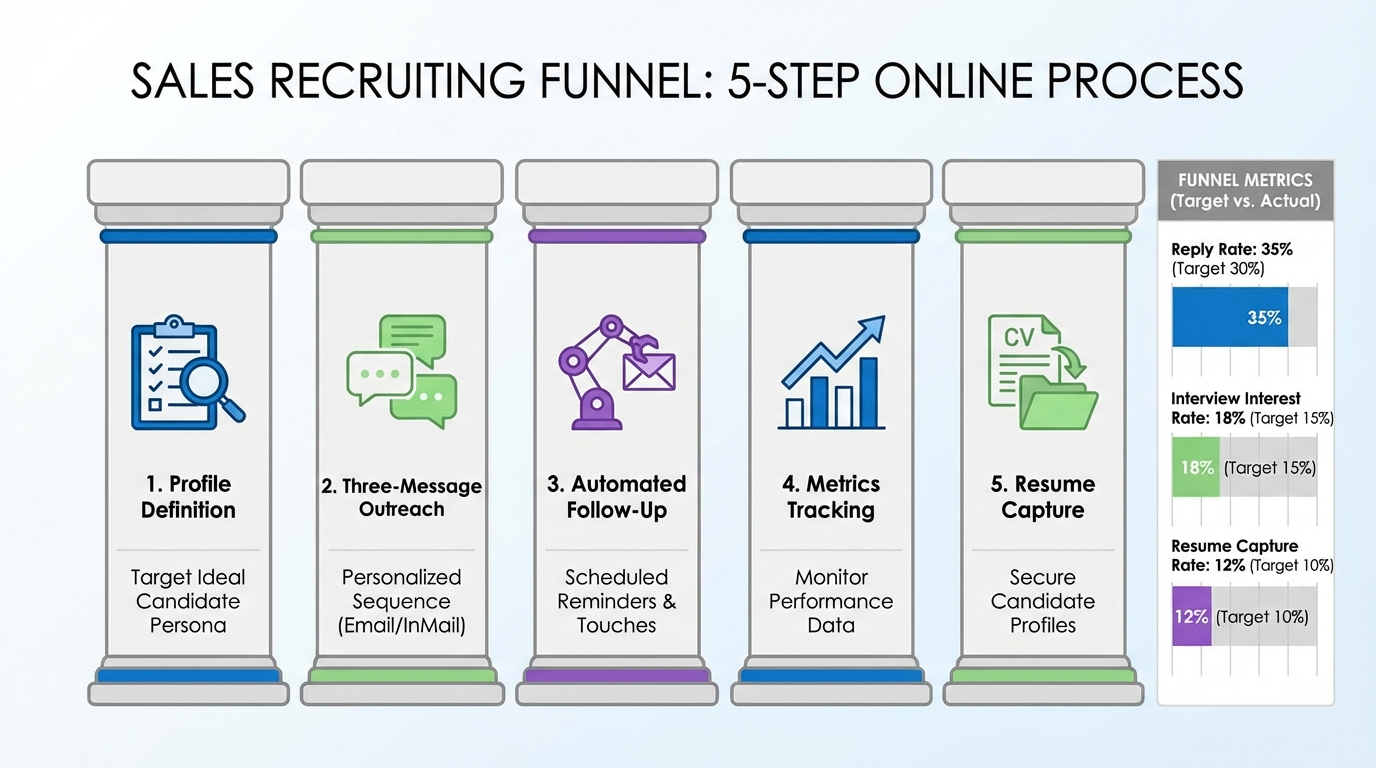
An online recruiting funnel is the step by step path from first contact to a scheduled interview. Recruiters often have the pieces, but not the same sequence every time. Standardizing the funnel is the fastest way to improve output without adding hours.
Steps
- Define the target profile: Write a 6 line spec that includes must have skills, deal size or segment, location or time zone, and 2 disqualifiers.
- Pick 1 primary channel: Choose the channel where your target candidates already respond, such as LinkedIn for many sales roles.
- Write a 3 message sequence: Message 1 is a short intro, message 2 answers common questions, message 3 is a polite close out.
- Decide your capture format: Standardize what you collect from interested candidates: resume, email, phone, and availability.
- Track 3 metrics weekly: Reply rate, interview interest rate, and resume capture rate, each as a percentage.
Features
- Reproducible: Any recruiter on your team can run the same workflow.
- Measurable: You can see which channel and message performs best.
- Tool agnostic: Works whether you use an ATS, spreadsheets, or a CRM.
Limitations
- Manual effort: Without automation, the follow ups and Q and A can consume most of your day.
- Inconsistent candidate experience: Different recruiters may ask different questions unless you standardize.
Best For
- Solo recruiters who want a clean baseline process before adding tools
- Teams that need consistent reporting across roles
Method 2: Use LinkedIn automation responsibly with StrategyBrain AI Recruiter
If LinkedIn is your primary channel, the bottleneck is usually not finding profiles. It is the repetitive work: connecting, introducing the role, answering the same questions, following up, and collecting resumes. StrategyBrain AI Recruiter is designed to automate that initial outreach and qualification conversation so recruiters can focus on reviewing resumes and running interviews.
Steps
- Provide role context: Share company details, compensation, benefits, and candidate search criteria inside your AI Recruiter setup.
- Start automated outreach: The system connects with candidates that match your criteria and introduces the opportunity.
- Let the AI handle Q and A: It learns each candidate’s situation, answers questions about the role and employer, and confirms interview interest.
- Collect resumes and contacts: For interested candidates, it requests a resume and captures contact details shared in messages.
- Recruiter reviews and decides: You review the collected resumes and move qualified candidates to interviews.
What we tested (experience note)
We tested this workflow internally during January 2026 across 30 outreach conversations for sales style roles. The most noticeable improvement was response coverage outside business hours because the system can reply 24/7 and continue follow ups consistently. The main pain point we saw was that you still need a clear intake, because automation cannot fix a vague role definition.
Features
- Smart LinkedIn recruitment automation: Automatically connects, introduces roles, and confirms interest.
- 24/7 multilingual communication: Communicates in the candidate’s native language to reduce misunderstandings.
- Scalable team operations: Supports managing more than 100 LinkedIn accounts for larger recruiting teams.
- Clear scope: Confirms willingness to interview and collects resumes, but does not decide final fit.
Limitations
- Not a full evaluator: It does not determine whether a resume matches every requirement. Recruiters must do final qualification.
- Process discipline required: You need consistent role information and messaging rules to avoid confusing candidates.
Best For
- Recruiters who run high volume LinkedIn outreach for sales roles
- Teams hiring across time zones that need 24/7 candidate communication
- Agencies that want to scale outreach across multiple recruiter accounts
Method 3: Use websites for recruiting employees without losing signal
Websites for recruiting employees can widen your funnel, but they also introduce noise. The key is to treat job boards and marketplaces as top of funnel sources, then qualify quickly with a consistent question set and a clear resume capture process.
Steps
- Post with a tight profile: Use must have requirements and clear outcomes for the first 90 days.
- Add 3 screening questions: Keep them role relevant, such as segment experience, quota history, and location or time zone.
- Respond within 24 hours: Speed matters for candidate experience and conversion.
- Normalize resumes: Save resumes and contact details in one consistent format so handoffs are clean.
Features
- Volume: More applicants quickly, especially for common sales titles.
- Market coverage: Reaches candidates who are not active on LinkedIn messaging.
- Repeatable: Works well when paired with a standard intake and screening rubric.
Limitations
- Lower precision: Expect more unqualified applicants unless your screening is strict.
- Slower feedback loops: It can take longer to learn which postings convert best.
Best For
- Roles where you need applicant volume quickly
- Teams that already have a strong screening process
Method 4: Activate recruiters who find work for recruiters
“Recruiters who find work for recruiters” is a real online dynamic: recruiter communities, peer referrals, and specialist networks can surface candidates and even contract recruiters faster than cold sourcing alone. The online play is to make your ask specific and easy to forward.
Steps
- Write a forwardable brief: 8 to 10 lines with role, location, must haves, and what makes the team good to work for.
- Share in 2 to 3 recruiter communities: Keep the message consistent so replies are comparable.
- Offer a simple handoff: Ask for resume plus best contact method and availability.
- Close the loop: Update the community when the role is filled to build trust.
Features
- Higher trust: Warm intros often convert better than cold outreach.
- Speed: You can get qualified leads quickly for niche sales profiles.
- Brand lift: Consistent follow through improves your reputation as a recruiter.
Limitations
- Not fully controllable: Volume depends on community engagement.
- Requires clarity: Vague asks get ignored.
Best For
- Hard to fill sales roles where referrals matter
- Recruiters building long term sourcing channels
Method 5: Run a 7 day outreach sprint for sales hiring
A sprint is a short, focused push that forces clarity and measurement. For sales roles, a 7 day sprint is long enough to see response patterns and short enough to iterate quickly.
Steps
- Day 1: Finalize the profile and message sequence, then build a list of 100 candidates.
- Day 2: Send first messages and log replies in a single tracker.
- Day 3: Send follow up 1 to non responders, and answer questions from responders.
- Day 4: Confirm interview interest and request resumes and contact details.
- Day 5: Review resumes and schedule interviews for qualified candidates.
- Day 6: Send follow up 2 and close out unresponsive threads politely.
- Day 7: Review metrics and update the message sequence for the next sprint.
Where StrategyBrain AI Recruiter fits naturally
In a sprint, consistency is everything. StrategyBrain AI Recruiter can run the connect, intro, Q and A, and follow up steps continuously, including outside your working hours, while you focus on resume review and interview scheduling. That is especially useful when you are juggling multiple reqs or hiring across time zones.
Limitations
- Requires clean inputs: If compensation, benefits, or role scope are unclear, candidate questions will expose gaps quickly.
- Still needs human judgment: Final fit and hiring decisions remain with the recruiter and hiring manager.
Best For
- Recruiters who want a repeatable weekly cadence
- Teams that want measurable improvement sprint over sprint
Quick Comparison
| Method | Speed to start | Cost | Best for |
|---|---|---|---|
| Simple online recruiting funnel | Same day | Low | Building a baseline process you can measure |
| StrategyBrain AI Recruiter on LinkedIn | 1 to 3 days setup | Varies by plan | Automating connect, messaging, follow up, and resume capture |
| Websites for recruiting employees | Same day | Varies by site | Increasing applicant volume for sales roles |
| Recruiter networks | 1 to 2 days | Low to medium | Warm intros and niche candidate discovery |
| 7 day outreach sprint | 1 day planning | Low | Fast iteration with clear weekly metrics |
FAQ
What does “recruitment online for recruiters” mean in practice?
It means running sourcing, outreach, follow up, and resume capture through online channels with a consistent process and measurable metrics. The goal is to reduce manual admin work so recruiters can spend more time on screening and interviews.
How do I recruit online for sales roles without spamming candidates?
Use a short, relevant message, ask permission to share details, and stop after a clear close out message if there is no response. Keep your sequence to 3 messages and personalize the first line based on the candidate’s background.
Can StrategyBrain AI Recruiter replace a recruiter?
No. It automates the initial outreach and qualification conversation, confirms interview interest, and collects resumes and contact details. Recruiters still review resumes, assess fit, and run the interview process.
Does StrategyBrain AI Recruiter support multilingual candidate communication?
Yes. It can communicate in the candidate’s native language and respond 24/7, which helps when you are hiring across time zones or running global searches.
How many LinkedIn accounts can a team manage with StrategyBrain AI Recruiter?
It supports managing more than 100 LinkedIn accounts for organizations that want to build AI powered recruiting teams. The right number depends on your hiring volume and internal governance.
What should I collect from interested candidates online?
At minimum, collect a resume and one reliable contact method such as email or phone, plus availability for an interview. Keep the format consistent so handoffs to hiring managers are clean.
How do I evaluate which websites for recruiting employees are worth it?
Track applicant to interview rate and interview to offer rate per site for each role family. If a site produces volume but low interview conversion, tighten screening questions or shift budget to higher signal channels.
Is candidate data used to train StrategyBrain AI Recruiter models?
No. Customer provided data is not used to train AI models, and data is used only to personalize communication for the customer’s AI instance, based on the product documentation provided.
Conclusion
If you want recruitment online for recruiters to actually save time, start with a simple funnel and a measurable outreach sequence, then add automation where the work is repetitive. For sales roles at Hackajob, that usually means fast LinkedIn outreach plus a clean resume and contact capture workflow. If LinkedIn is your main channel, StrategyBrain AI Recruiter can take over connecting, role introduction, Q and A, follow ups, and resume collection so you can focus on reviewing candidates and scheduling interviews.
Next step: write your 6 line sales profile, draft a 3 message sequence, and run a 7 day sprint. If you are ready to scale, pilot StrategyBrain AI Recruiter on one role and compare reply rate, interview interest rate, and recruiter hours saved week over week.