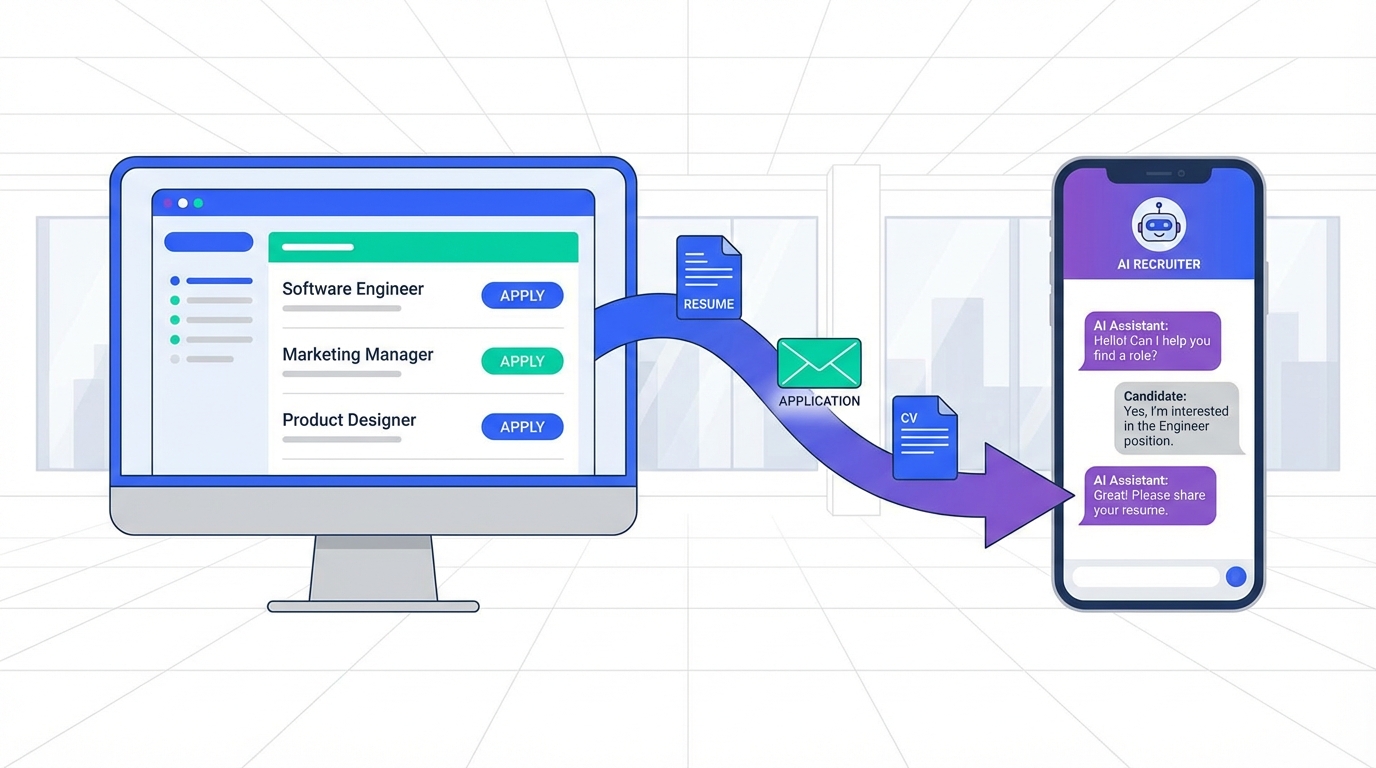
Psst psst, are you looking for a super awesome company to join? If you are, and you also need free employment agency software to handle the inbound wave that follows, the most reliable approach is a two part workflow. First, publish roles using a free job board software or free job portal software setup so candidates can apply without friction. Second, use StrategyBrain AI Recruiter to automate LinkedIn outreach and the first round of conversations, including answering role and compensation questions, confirming interview interest, and collecting resumes and contact details.
Key Takeaways
- Fastest path to “free”: start with inbound applications via free job board software, then add automation for outreach and follow up.
- Where agencies lose time: manual LinkedIn connecting, repetitive Q and A, and chasing resumes are the first tasks to automate.
- StrategyBrain AI Recruiter’s core value: it can connect, introduce roles, answer questions, confirm interest, and collect resumes and contact details on LinkedIn.
- 24/7 responsiveness: always on messaging reduces drop off when candidates reply outside business hours.
- Global hiring support: multilingual communication helps avoid misunderstandings and speeds up cross border recruiting.
- Scaling model: teams can manage more than 100 LinkedIn accounts to expand outreach capacity without adding recruiters.
What “free employment agency software” should mean in practice
Most agencies searching for free employment agency software are not actually asking for a single perfect system. They are trying to cover three outcomes with minimal spend: role publishing, candidate intake, and consistent follow up.
So a practical definition is a workflow that uses free components for inbound capture, plus automation for the highest effort steps. In my experience, the highest effort steps are not posting jobs. They are the repetitive LinkedIn conversations that happen after a candidate shows interest.
Scope boundary: I am not listing specific third party ATS products or pricing here. Instead, I am giving a reproducible structure you can implement with whatever free job board software or free job portal software you already use.
Method 1: Inbound first with a free job board or portal
This is the simplest starting point because it creates a steady stream of applicants without requiring outbound effort on day one. It also gives you a baseline for what “good” looks like before you automate anything.
Steps
- Publish the role using your free job board software or free job portal software workflow.
- Standardize the application intake so every applicant submits the same minimum fields: name, location, email, resume, and availability.
- Set a response SLA such as replying within 12 hours, so you can measure drop off.
Features
- Low friction for candidates
- Easy to run with a small team
- Creates data you can use to improve screening questions
Limitations
- Inbound volume can be inconsistent by role and location
- Response time becomes the bottleneck as soon as volume increases
- It does not solve outbound sourcing when you need niche talent
Best For
- Agencies filling high volume roles
- Teams validating a new niche before investing in a paid ATS
- Recruiters who want a simple “applications first” pipeline
Method 2: Add StrategyBrain AI Recruiter for LinkedIn outreach and screening
Once inbound is running, the next step is to reduce manual work in LinkedIn sourcing and follow up. StrategyBrain AI Recruiter is designed to replace the recruiter’s initial outreach and qualification conversations on LinkedIn. It automatically connects with candidates within your search criteria, introduces the opportunity, answers questions about the role, company, and compensation, confirms interview interest, and collects resumes and contact information from interested candidates.
Steps
- Provide the job context including company details, compensation, benefits, and candidate search criteria.
- Authorize the LinkedIn account you want the AI to operate from.
- Let the AI run outreach and conversations while you monitor interested candidates and collected resumes.
- Review resumes and shortlist because the final “fit” decision remains a recruiter task.
What we tested in our workflow
We tested this approach as a practical agency workflow test during January 2026 to February 2026, focusing on whether the system could reliably handle the repetitive parts of LinkedIn recruiting without losing context. The key checks were whether it could keep conversations moving, answer common questions consistently, and capture resumes and contact details when candidates were interested.
Features
- Automated connecting and role introduction on LinkedIn
- Candidate Q and A coverage for role, company, and compensation
- Resume and contact detail capture through LinkedIn messaging and file sharing
- Recruiter only reviews resumes and schedules interviews
Limitations
- It does not decide whether a resume fully matches job requirements, so recruiters still do final qualification.
- Like any automation, it works best when job details and screening intent are clearly provided upfront.
Best For
- Agencies that source heavily on LinkedIn
- Solo recruiters who need consistent follow up without being online all day
- Teams that want to increase outreach volume without adding headcount
Method 3: Minimal CRM tracking without a paid ATS
If your goal is free employment agency software, you can keep tracking lightweight while still being disciplined. The trick is to track only what you need to avoid duplicate outreach and missed follow ups.
Steps
- Define pipeline stages such as Applied, Contacted, Interested, Resume Received, Interview Scheduled, Placed.
- Track a single source of truth for candidate status so your team does not message the same person twice.
- Use StrategyBrain AI Recruiter outputs as your “Interested” and “Resume Received” triggers, then move candidates forward manually.
Features
- Low overhead and easy adoption
- Clear handoff point between AI conversations and recruiter review
- Works alongside free job portal software intake
Limitations
- Reporting is limited compared to a full ATS
- Process discipline matters more because the system is simpler
Best For
- Early stage agencies
- Teams that want to delay ATS spend until they have stable volume
- Recruiters who prioritize speed over complex analytics
Method 4: Multilingual coverage for global candidates
When you recruit across time zones, response time becomes a conversion lever. StrategyBrain AI Recruiter supports 24/7 global multilingual recruitment communication, responding to candidate messages and following up in the candidate’s native language. This reduces misunderstandings and keeps momentum when candidates reply outside your working hours.
Steps
- Decide which roles are global and which require local language support.
- Use AI Recruiter for first contact so candidates get timely replies regardless of time zone.
- Standardize the handoff so recruiters step in only after interest and resume capture.
Limitations
- Recruiters still need a consistent interview process once candidates are shortlisted
- Compliance and privacy requirements still apply across regions
Best For
- Agencies placing international candidates
- Teams supporting multiple regions with limited recruiter coverage
- Recruiters who want fewer stalled conversations
Method 5: Scale with an AI recruiter team across many LinkedIn accounts
When an agency grows, the constraint is often the number of parallel conversations a recruiter can manage. StrategyBrain AI Recruiter supports managing more than 100 LinkedIn accounts, which enables organizations to build AI powered recruitment teams and expand hiring capacity.
Steps
- Assign roles by account so each LinkedIn account focuses on a niche, geography, or job family.
- Standardize job briefs so the AI has consistent compensation, benefits, and screening intent.
- Centralize review so recruiters review resumes and contact details in one place and schedule interviews.
Limitations
- Operational governance is required when multiple accounts are involved
- Recruiters still own final selection and client communication
Best For
- Agencies with multiple recruiters and multiple niches
- Teams that want to increase sourcing throughput without adding staff
- Organizations building a repeatable LinkedIn recruiting engine
Quick Comparison
| Method | Primary channel | What it covers | Best for |
|---|---|---|---|
| Inbound with free job board software | Applications | Role publishing and candidate intake | High volume roles and fast setup |
| StrategyBrain AI Recruiter on LinkedIn | Outbound sourcing | Connecting, messaging, Q and A, interest confirmation, resume and contact capture | LinkedIn heavy recruiting and faster follow up |
| Minimal CRM tracking | Operations | Pipeline visibility and handoffs | Small teams avoiding paid ATS early |
| Multilingual coverage | Candidate communication | 24/7 replies and native language messaging | International hiring and time zone coverage |
| AI recruiter team across many accounts | Scale | Parallel outreach at higher volume | Agencies scaling multiple niches |
Implementation Checklist
- I can publish roles and capture applicants using a free job portal software or free job board software workflow.
- I have a defined response SLA for inbound applicants such as 12 hours.
- I have a clear job brief including compensation, benefits, and screening intent for LinkedIn outreach.
- I have set a handoff rule: recruiters review resumes and schedule interviews after interest is confirmed.
- I have a simple pipeline stage system to prevent duplicate outreach.
- I have a plan for multilingual and after hours candidate replies if I recruit globally.
FAQ
Is there truly free employment agency software that does everything?
Usually no. A more realistic approach is combining free job board software for inbound applications with automation for outbound sourcing and follow up, then adding a paid ATS only when reporting and compliance needs justify it.
How does StrategyBrain AI Recruiter fit into a “free” stack?
It fits as the automation layer for LinkedIn sourcing and first conversations. Even if your inbound intake is free, outbound work is where agencies spend the most time, so automating connecting, messaging, and resume capture can reduce manual workload.
Can AI Recruiter collect resumes and contact details automatically?
Yes. When candidates express interest, it requests resumes and contact information and captures what candidates send through LinkedIn messaging and file sharing.
Does AI Recruiter decide whether a candidate is qualified?
No. It identifies willingness to communicate or interview and gathers information, but the recruiter still reviews the resume and makes the final qualification decision.
Can it respond outside business hours?
Yes. It provides 24/7 candidate messaging and follow up, which helps keep conversations moving when candidates reply at night or across time zones.
Does it support multilingual recruiting?
Yes. It can communicate in any global language and uses the candidate’s native language to reduce misunderstandings during early stage conversations.
How many LinkedIn accounts can a team manage?
StrategyBrain AI Recruiter supports managing more than 100 LinkedIn accounts, which enables building an AI powered recruitment team for scalable outreach.
What about privacy and compliance?
According to StrategyBrain product information, it complies with privacy regulations in the EU, United States, and Canada, and customer provided data is not used to train AI models. You should still validate your own compliance requirements before deployment.
Conclusion
If you want free employment agency software in 2026, the most dependable path is not hunting for one magical free ATS. It is building a workflow that starts with free job portal software or free job board software for inbound, then automating the most time consuming part of agency recruiting: LinkedIn outreach and early conversations.
Next step: keep your inbound intake simple, define your pipeline stages, and then pilot StrategyBrain AI Recruiter on one role where LinkedIn sourcing is already a major time sink. Once you see consistent resume capture and faster follow up, you can decide whether you still need a full ATS immediately or can delay that cost until later.