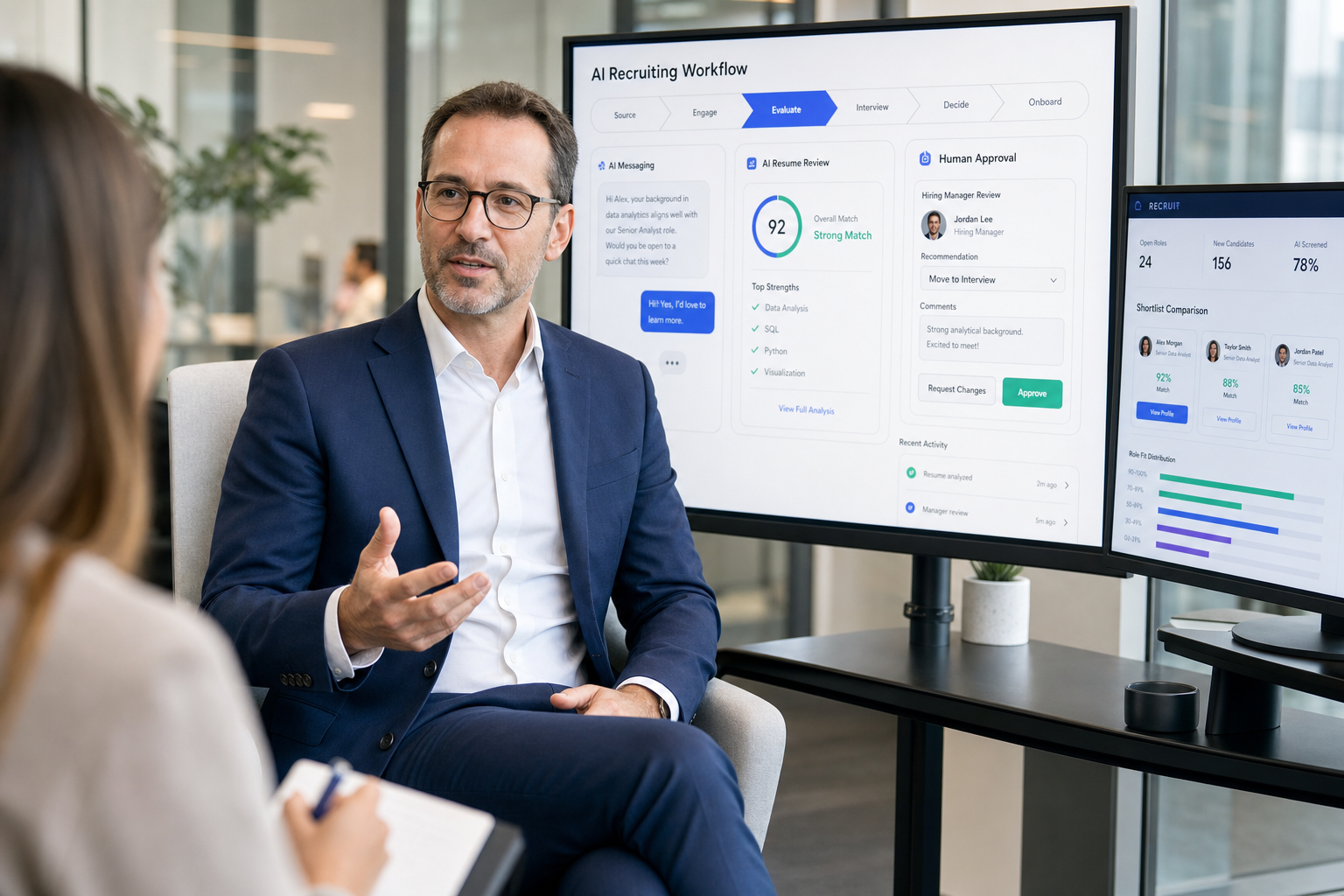
This article helps recruiting leaders judge artificial intelligence for recruiting, protect human review, and avoid weaker shortlists.
That matters because most recruiting teams do not lose momentum on strategy alone. They lose it in the handoffs: chasing replies after hours, rewriting outreach, sorting resumes without enough context, and trying to keep candidate conversations warm while req priorities shift. For a solo recruiter, that means missed follow-up and weaker relationships. For a small agency owner, it means fewer completed searches per desk. For an internal talent team, it often means slow hiring manager feedback, uneven candidate experience, and more cost hidden inside manual work.
In that gap between speed and judgment, tools like StrategyBrain AI Recruiter can help with the most repetitive top-of-funnel tasks. I see the practical value in three areas in particular: always-on candidate messaging, multilingual outreach when searches cross borders, and automatic collection of resumes and contact details from interested prospects. The useful boundary is that the recruiter still reviews the profile, decides whether the resume is a fit, and owns the next step.
A good way to think about this is not from software hype, but from career reality. In the reference interview behind this article, a finance leader described a career shaped by sudden change, ambiguity, and roles that did not unfold exactly as planned. One job ended early because of a major external event. Other roles demanded learning from scratch, taking on new responsibilities, and moving forward without perfect information. That is familiar to recruiters: the market shifts, a hiring plan changes, a shortlist goes cold, and you still have to keep the process moving.
She also made two points that map directly to modern hiring operations. First, people build real judgment by doing the work, not by skipping straight to oversight. Second, small comments, feedback, and informal support matter more than they seem in the moment. In recruiting, that translates into a simple truth: AI can support the work, but teams still need hands-on review, structured feedback, and enough context to judge people fairly. That is exactly why ai recruiting software should be evaluated as workflow support rather than an autopilot system for the ai in hiring process.
This article follows that logic. It looks at what AI recruiting software actually does, where it helps recruiters work through ambiguity, how to use ai in hiring without surrendering accountability, and what to evaluate before you trust any system with candidate communication, screening support, or hiring workflow decisions.
What AI Recruiting Software Really Means
AI recruiting software is best understood as a set of tools that helps recruiters process information, communicate faster, and keep hiring workflows moving. Depending on the system, that can include resume parsing, candidate matching, outbound messaging, interview summaries, scheduling support, and workflow nudges.
The practical definition is more useful than the technical one: artificial intelligence for recruiting helps talent teams handle volume and routine without removing human review from high-stakes decisions. That distinction matters because hiring is rarely a clean, linear process. Like the career path described in the reference piece, recruiting often requires flexibility, judgment under pressure, and the ability to make progress even when you do not have perfect data.
That is also why experienced recruiters tend to be skeptical of all-or-nothing automation claims. Strong recruiting is built on context: what the hiring manager really wants, what tradeoffs are acceptable, which candidate signals matter, and how much ambiguity the role can tolerate. AI can assist with those workflows, but it does not automatically understand the full business picture.
Common capabilities recruiters actually use
- Resume parsing: Turning unstructured resumes into searchable data.
- Candidate matching: Surfacing profiles that may align with role criteria.
- Outreach support: Drafting personalized first-touch and follow-up messages.
- Scheduling automation: Coordinating calendars and reducing manual back-and-forth.
- Interview intelligence: Capturing notes, transcription, and summary drafts.
- Workflow automation: Triggering reminders, stage movement prompts, and task updates.
Why Real Hiring Still Needs Human Judgment
One of the most valuable ideas in the reference interview is that you become effective by doing the actual work before trying to manage it from above. That applies directly to AI in recruiting. Teams that try to let software replace recruiter judgment too early usually discover the same problem: the process moves, but the quality gets thinner.
Good recruiters know why a candidate with an unconventional background may still be worth a call. They know when a hiring manager is over-specifying. They know how one line of candidate feedback can change an entire search strategy. AI can rank, summarize, and suggest, but it does not naturally absorb those nuances unless people build the process around them.
Key takeaway: The most defensible ai in hiring process keeps people accountable for decisions while letting software absorb repetitive execution.
That is also where mentoring, feedback, and informal support networks matter. In the reference interview, constructive criticism and small comments were treated as valuable inputs for growth. In recruiting operations, the equivalent is structured calibration: recruiter review, hiring manager feedback, corrected interview summaries, and regular checks on whether the workflow is surfacing the right people for the right reasons.
How AI Fits Into the Hiring Workflow
The easiest way to evaluate artificial intelligence for recruiting is to map it to the real work recruiters do every day. Most teams do not need a magic platform that promises to run everything. They need targeted support where manual effort is high, consistency is low, or responsiveness breaks down.
| Hiring stage | What AI can support | Where humans should lead |
|---|---|---|
| Sourcing | Search expansion, title variants, talent discovery | Target profile definition, market strategy, prioritization |
| Outreach | Drafting messages, multilingual communication, follow-up | Relationship building, approval, positioning the opportunity |
| Screening | Resume parsing, application triage, signal extraction | Contextual review, transferability judgment, fairness checks |
| Coordination | Scheduling, reminders, status updates | Exception handling, candidate care, stakeholder alignment |
| Interviews | Question prompts, note capture, summaries | Evaluation quality, structured assessment, final scorecards |
| Decision support | Workflow visibility, summary dashboards, nudges | Selection decisions, debrief facilitation, offer judgment |
Sourcing and first contact
For search work, AI can widen the top of funnel by generating Boolean strings, identifying adjacent job titles, and suggesting related skill clusters. It can also support first-touch outreach by drafting messages that feel more tailored than a blank template.
In my own workflow, I have tested AI Recruiter most usefully when a search depends on LinkedIn activity that normally consumes hours of manual effort. If candidates respond at night or across time zones, the always-on follow-up is where the tool helps most. It can continue the initial conversation, explain the opportunity at a high level, ask whether the person is open to a move, and gather resume or contact details from genuinely interested candidates. What it does not do for me is replace recruiter qualification. I still review the resume and decide whether the candidate belongs in the shortlist.
Resume review and application triage
Resume triage is one of the clearest use cases in the ai in hiring process. AI can pull structured data from resumes, cluster similar applicants, and push likely matches to the top of a queue. That saves time, especially in high-volume hiring, but it also creates a familiar risk: people begin to trust rankings as if they were decisions.
The better operating model is to use triage as a prioritization layer. Recruiters still need to look for adjacent experience, career progression, and signs of potential that keyword logic might miss.
Scheduling and process continuity
Hiring often slows down not because the shortlist is weak, but because coordination fails. Calendar friction, delayed reminders, and scattered communication can drain momentum from an otherwise healthy search. AI can keep this part of the workflow moving with less manual intervention.
This matters for exactly the reason highlighted in the reference interview: careers and projects rarely unfold in a straight line. Hiring does not either. Systems that preserve continuity when priorities change are often more valuable than systems that promise perfect prediction.
How to Use AI in Hiring
If your team is asking how to use ai in hiring, start with the same discipline you would expect from a strong recruiter learning a new market: get hands-on, define what success looks like, and do not skip the foundational work.
- Start with repetitive tasks
Use AI first for drafting outreach, summarizing notes, resume parsing, and scheduling. These are easier to audit and less risky than fully automated screening decisions.
- Keep qualification with the recruiter
Interest is not the same as fit. A candidate may be willing to talk and still be wrong for the role. Recruiters should own the final resume review and any movement into interviews.
- Build feedback loops
One useful lesson from the reference piece is that small comments and constructive criticism matter. Apply that to your workflow by checking whether AI-generated messages, summaries, and rankings are actually useful. Correct them, and let those corrections shape your process rules.
- Use AI to support flexibility, not hide weak process
When the market shifts or a req changes direction, AI can help recruiters adapt faster. It should not be used to paper over bad intake meetings, unclear scorecards, or inconsistent hiring manager expectations.
- Document the boundary between assistance and decision-making
Write down which tasks AI can handle and which decisions remain human-owned. That protects consistency across recruiters, coordinators, and hiring managers.
Practical takeaway: Teams usually get better results when they treat AI like a strong recruiting coordinator or sourcing assistant, not like a final decision-maker.
Where AI Helps Most
The strongest value from ai recruiting software usually appears in places where speed, consistency, and responsiveness matter more than abstract prediction.
1. Candidate communication that does not stall
Reply speed shapes candidate experience more than many teams admit. If candidates respond outside business hours or from another region, a delayed answer can cool interest quickly. That is one area where automated messaging support can make a visible difference to process continuity.
2. High-volume search support
When recruiters are juggling multiple searches, AI can reduce the time spent repeating basic sourcing and outreach tasks. This does not remove the need for recruiter judgment, but it can widen capacity.
3. Multilingual and cross-border recruiting
Recruiting internationally introduces language friction and timing issues. AI tools that can support communication in the candidate's language may improve clarity and reduce delays, especially at the early engagement stage.
4. Cleaner handoffs and better records
Structured data, stored conversations, and organized summaries help when multiple stakeholders touch the same search. That is especially important when recruiters need to explain why someone moved forward or stalled out.
5. Learning from each search
The reference interview emphasizes growth through varied experience. In recruiting terms, one benefit of AI-supported workflow is that it can make patterns easier to see across searches: where candidates drop off, which messaging themes work, and where manager delays keep repeating.
Risks and Controls
No serious discussion of artificial intelligence for recruiting should ignore risk. In hiring, speed without control creates exposure.
Bias and false confidence
AI can inherit patterns from training data or from the way teams define search criteria. If recruiters accept ranking outputs too quickly, they may reinforce exclusion instead of improving consistency.
Candidate trust
Candidates increasingly notice when communication feels automated. That does not make AI unusable, but it does mean messaging quality and transparency matter. If the interaction feels deceptive or careless, trust drops fast.
Data handling and compliance
Teams should know what candidate data is collected, where it is stored, and how it is used. If a system handles resumes, contact details, and conversation logs, recruiters need confidence that records are secure and reviewable.
For example, one reason some teams evaluate StrategyBrain seriously is the emphasis on isolated customer data handling, encrypted storage, and not using customer-provided data to train models. Whether you choose that route or another, the buying principle is the same: privacy and auditability are core hiring requirements, not nice-to-have extras.
Over-automation
The biggest implementation mistake is trying to automate decisions before the team has clear criteria. The finance leader in the reference piece talked about moving forward without ever having 100 percent of the information. That is true in hiring too, but there is a difference between informed ambiguity and unmanaged guesswork. Recruiters need enough structure to make judgment calls responsibly.
How to Choose AI Recruiting Software
When comparing options, evaluate workflow fit before feature volume. The best tool is rarely the one with the longest list of AI claims. It is the one that reduces friction in the exact places your process breaks.
Questions worth asking first
- What is the actual bottleneck? Sourcing volume, slow follow-up, screening overload, or interview coordination?
- Who remains accountable? Can recruiters override outputs, review message history, and document decisions?
- Does it fit recruiter behavior? Will the team use it inside the systems they already rely on?
- Can it handle cross-border communication? That matters if your hiring regularly spans time zones or languages.
- Can you explain outcomes later? In hiring, auditability is part of usability.
| Evaluation area | What to look for | Why it matters |
|---|---|---|
| Workflow fit | Easy use inside existing recruiting steps | Drives adoption |
| Communication support | Personalized outreach, follow-up, multilingual capability | Improves candidate engagement |
| Control | Human review, overrides, logs, permissions | Protects process quality |
| Data handling | Clear storage, privacy controls, secure records | Reduces compliance risk |
| Scalability | Ability to support growing search volume | Helps small teams do more without chaos |
For LinkedIn-heavy recruiting in particular, I would separate tools into three buckets: sourcing databases, outreach automation layers, and broader ATS platforms with AI add-ons. If your real pain is top-of-funnel outreach and candidate follow-up, then a specialized workflow such as AI Recruiter may be more relevant than adding another general platform. If your problem is downstream coordination and compliance, you may need your ATS to carry more of the load.
FAQ
What is AI recruiting software?
AI recruiting software is technology that supports recruiting tasks such as sourcing, outreach, screening, scheduling, interview summaries, and workflow automation. In responsible use, people still make the hiring decisions.
How does artificial intelligence for recruiting help recruiters?
It helps recruiters reduce manual work, respond to candidates faster, organize data more clearly, and keep searches moving. Its strongest value is usually in repetitive, high-volume tasks.
How to use AI in hiring without losing control?
Start with drafting, sourcing support, scheduling, and summaries. Keep recruiters and hiring managers responsible for qualification, evaluation, and final decisions.
Where does AI fit in the ai in hiring process?
AI can support sourcing, outreach, resume triage, scheduling, interview documentation, and reporting. It should support the process, not become the sole gatekeeper.
Can AI replace recruiters?
No. AI can help recruiters move faster and stay organized, but relationship building, judgment, hiring manager calibration, and candidate assessment still require human ownership.
Is AI in recruiting fair by default?
No. Fairness depends on process design, review rules, structured criteria, and ongoing checks for bias or irrelevant filtering behavior.
What should I look for in AI recruiting software?
Look for workflow fit, communication quality, human oversight, explainability, data security, and adoption potential. A tool only helps if recruiters will actually use it well.
Conclusion
Artificial intelligence for recruiting works best when it reflects the same lessons experienced professionals learn in their careers: be flexible, do the real work, accept that not every process is linear, and keep learning from feedback. That is why the strongest AI recruiting software does not try to eliminate recruiter judgment. It creates more room for it.
If you are evaluating ai recruiting software, focus on where your process loses momentum today. For many teams, that starts with outreach, responsiveness, resume handling, and coordination. Use AI there first, keep humans accountable for decisions, and build from actual workflow gains rather than promises. That is the most practical answer to both how to use ai in hiring and how to improve the broader ai in hiring process without turning hiring into a black box.