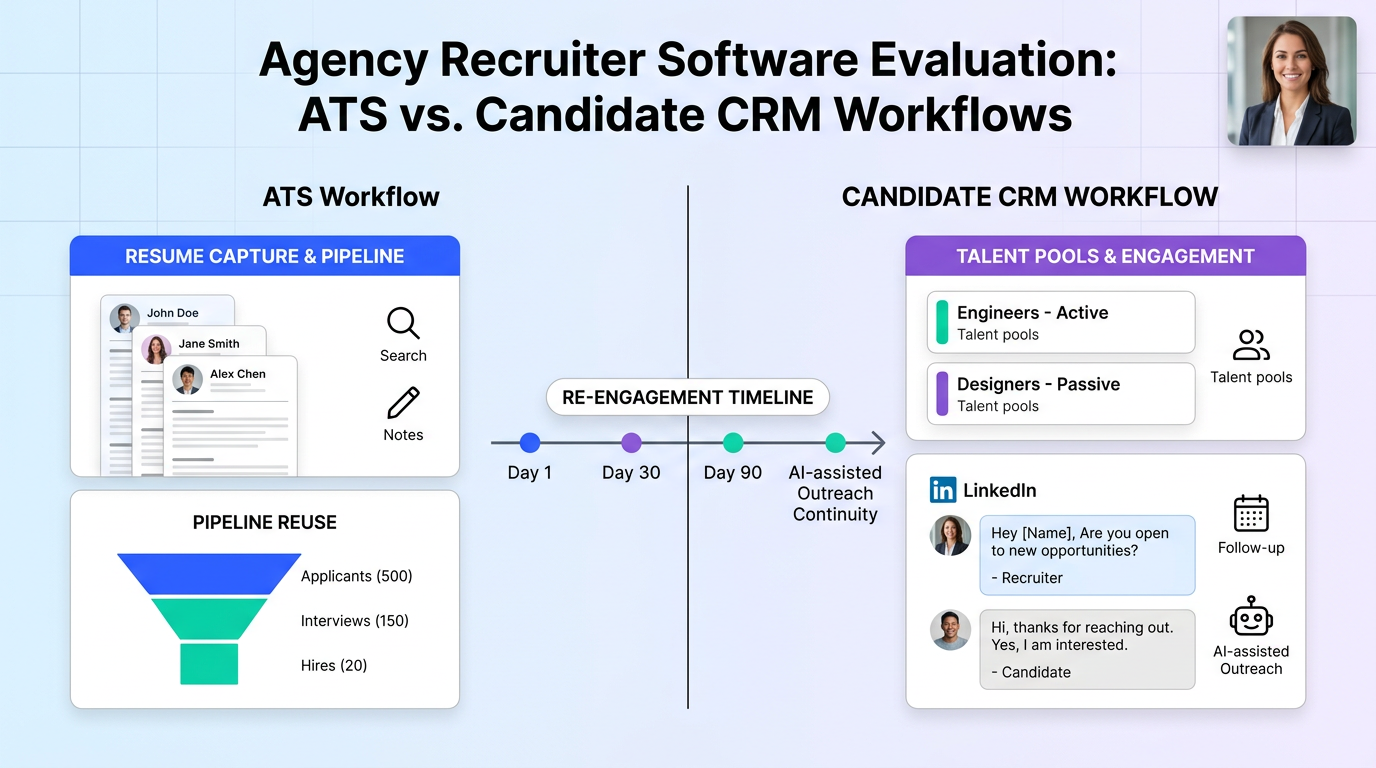
When live searches get messy, this article helps agency recruiters judge candidate crm options to avoid lost follow-up, repeated sourcing, and weaker client trust.
That sounds obvious until a live search gets busy. A recruiter sources strong people, loses the thread on who replied first, forgets why a silver medalist was declined, and reopens the same market map months later. For a small agency owner, that means wasted billable time and weaker client confidence. For an in-house talent lead, it means slower pipelines, duplicate outreach, and hiring managers who feel recruiting is starting from zero every time.
I have seen that gap most clearly in LinkedIn-heavy workflows, where conversation volume rises faster than record quality. In those situations, StrategyBrain AI Recruiter can help by automating first-touch LinkedIn outreach, keeping candidate communication moving after hours, and collecting resumes and contact details from interested people. Used well, it reduces repetitive messaging work without taking final judgment away from the recruiter, who still reviews the resume, decides fit, and owns the next step.
A useful way to understand the problem comes from a leadership story outside recruiting. In one high-performance internal audit group inside a large multinational business, the team had to compete for work, define scope, justify fees, and keep proving value or risk being shut down. They hired top performers, but pressure exposed something more important than raw technical skill: under stress, people hit emotional triggers that changed decisions, conversations, and outcomes before they realized it.
That insight maps surprisingly well to modern recruiting. When recruiters are overloaded, their own workflow triggers show up fast: chasing only fresh applicants, overreacting to the latest reply, neglecting older talent pools, or treating candidate records like storage instead of relationships. That is exactly why the best recruiting software now needs more than workflow control. It needs a candidate crm, stronger candidate relationship management, and practical candidate relationship management tools that keep outreach, context, and reuse aligned.
Quick answer: The best recruiting software usually combines ATS discipline with candidate CRM capability. If your team wants better pipeline reuse, more consistent outreach, and less value lost between searches, candidate relationship management should be a core buying criterion.
Table of Contents
- Why relationship management matters more under pressure
- What a candidate CRM is
- ATS vs candidate CRM
- How to evaluate the best recruiting software
- Features that actually help recruiters
- LinkedIn workflows and AI support
- Best-fit use cases by team type
- Buying considerations
- Implementation tips
- Common mistakes
- FAQ
Why Relationship Management Matters More Under Pressure
The reference case above was really about performance under stress. A technically strong team still needed better self-awareness, mentoring, and tools to avoid getting hijacked in critical moments. Recruiting works the same way. Most breakdowns in hiring are not caused by a total lack of candidates. They happen when pressure changes recruiter behavior.
In practice, those pressure points often look like this:
- Recruiters rely on new sourcing because old candidate records feel unusable.
- Strong past applicants disappear because nobody owns re-engagement.
- Outreach quality drops when inboxes, spreadsheets, and ATS notes are disconnected.
- Hiring teams confuse activity volume with actual pipeline quality.
- Recruiters lose intellectual judgment to workflow chaos, especially in fast-moving searches.
That is the operational case for candidate relationship management. It creates structure around relationships, not just applications. The result is a recruiting process that is less reactive and more reusable.
What Is a Candidate CRM?
A candidate crm is recruiting software built to help teams maintain relationships with candidates before, during, and after an open requisition. Instead of working only as a container for applicants, it supports segmentation, nurture workflows, searchability, re-engagement, and talent pool management.
In day-to-day recruiting, candidate relationship management is what keeps promising people from going cold. That includes sourced prospects, referrals, past finalists, prior applicants, event leads, alumni candidates, and passive talent who may not be ready to apply today.
Recruiters often discover they need this after an ATS implementation that improved compliance but did not improve pipeline reuse. The applicant tracking system records activity. The CRM helps you compound it.
Candidate CRM vs ATS: What Is the Difference?
An ATS and a candidate CRM support different parts of the hiring cycle. The ATS is strongest when the job is open and the process needs structure. The CRM is strongest when the relationship matters before a job exists, between searches, or after a candidate exits one process but should remain visible for another.
| Category | Applicant Tracking System | Candidate CRM |
|---|---|---|
| Primary purpose | Manage active applicants and requisitions | Build and nurture talent relationships over time |
| Main users | Recruiters, coordinators, hiring managers | Recruiters, sourcing teams, talent ops |
| Best for | Interview workflow, approvals, compliance | Talent pools, outreach, re-engagement, pipeline reuse |
| Typical records | Applicants tied to open jobs | Applicants, sourced leads, passive talent, past finalists |
| Communication style | Mostly transactional | Multi-touch and relationship-driven |
| Value signal | Process control | Pipeline quality and continuity |
The strongest teams rarely treat this as an either-or decision. They want ATS discipline and CRM depth together, because recruiting breaks when status tracking is strong but relationship memory is weak.
How to Evaluate the Best Recruiting Software
If you are comparing the best recruiting software, start with the same lesson the audit leader in the reference story learned: technical capability alone is not enough. Under stress, hidden blockers determine performance. In recruiting software, those blockers are usually poor handoffs, weak data discipline, and fragmented communication.
Use this evaluation framework.
1. Does the system preserve context?
Recruiters need more than names and resumes. They need prior conversations, source history, role fit notes, objections, timing signals, and past stage outcomes. If that context is hard to find, the database becomes a graveyard.
2. Does it support value beyond the current req?
One of the clearest buying signals for candidate relationship management tools is whether they help your team recover value from prior recruiting effort. If a platform only performs well when a requisition is active, it is not solving the whole problem.
3. Does it reduce emotional and operational reactivity?
This is where the reference case becomes practical. Under pressure, teams default to urgency over judgment. Good software should slow down avoidable chaos by making outreach visible, search reusable, and next actions clear.
4. Does it fit your actual sourcing motion?
Some teams are application-led. Others are sourcing-led and live in LinkedIn, email, and outbound touchpoints. The best recruiting software for one team may fail another if the daily recruiter behavior is different.
5. Can recruiters use it without admin drag?
Busy recruiters will not maintain complex records just because the system allows it. The tool has to make tagging, searching, and communication history easy enough to sustain in live searches.
Features That Actually Help Recruiters
Feature lists get inflated fast in this category. In my experience, the best candidate CRM capabilities are the ones that reduce repeated work and improve recruiter judgment.
Talent pools and segmentation
Your system should let recruiters organize people by function, location, level, readiness, source, prior stage, niche skill, and client or business unit relevance.
Search that surfaces old value quickly
When a new role opens, recruiters should be able to find known talent in minutes, not rebuild the market from scratch.
Structured nurture workflows
Good candidate relationship management tools support timed follow-up, community updates, event invites, and role-family-specific messaging without making outreach feel generic.
Communication history in one place
Email, LinkedIn replies, scheduling notes, and resume collection should not live across separate personal systems if you want usable team memory.
Analytics tied to reuse
Do not stop at applicant counts. Look for reporting on reactivated candidates, outreach engagement, source efficiency, and conversion from existing pools.
Workflow connection to active hiring
The handoff from nurtured contact to active applicant should feel clean. That is where a lot of teams lose momentum.
Practical AI assistance
AI is most useful when it helps with identification, prioritization, outreach continuity, and admin reduction while leaving final selection to the recruiter.
LinkedIn Workflows and AI Support
Because many sourcing teams now spend a large share of their week in LinkedIn, CRM quality is no longer just about database design. It is also about whether your outbound workflow creates usable records and reliable follow-up.
In my own testing of LinkedIn-heavy recruiting motions, the biggest failure point was not initial messaging. It was what happened after candidates replied at different hours, asked role-specific questions, or showed soft interest without applying. That is where AI Recruiter was useful. It kept first-response communication moving, handled multilingual conversations when timing mattered, and captured resume or contact details once a candidate chose to continue. I still had to review the profile, assess whether the background matched the brief, and decide whether to advance the person, but the repetitive front-end work became far easier to manage.
For teams comparing software around this workflow, three categories often come up:
| Software category | Use experience | Likely strengths | Likely limits | Best fit | How it can work with AI Recruiter |
|---|---|---|---|---|---|
| ATS with built-in CRM | Simpler for teams wanting one login and one source of truth | Cleaner handoff into formal hiring workflow | Often lighter on outbound sourcing depth | Mid-size internal TA teams | Useful when AI Recruiter handles early LinkedIn outreach and the ATS-CRM stack manages later-stage movement |
| Dedicated sourcing CRM | Usually stronger for outbound teams and agencies | Better segmentation and re-engagement | Can require tighter process discipline and integrations | Search firms, staffing, proactive talent teams | Can pair well with AI-supported LinkedIn communication and resume capture before deeper recruiter review |
| LinkedIn automation layer | Fast for top-of-funnel activity when managed carefully | Improves speed and response handling | Needs human control on fit, tone, and progression decisions | Recruiters with heavy outbound volume | StrategyBrain AI Recruiter fits here by supporting conversation continuity, multilingual replies, and candidate info collection |
The important point is not to treat AI support as a replacement for candidate relationship management. It works best when outreach automation feeds a stronger CRM process rather than creating another disconnected message stream.
Which Teams Need Candidate Relationship Management Tools Most?
Agency and search recruiters
Relationship memory is part of the business model. If consultants cannot quickly recover prior conversations, objections, and near-miss candidates, they keep paying for the same market mapping twice.
Lean in-house talent teams
Smaller internal teams need more leverage from existing pipelines because they cannot afford constant resourcing from scratch.
High-volume repeat hiring environments
When roles recur across the same functions or geographies, candidate relationship management becomes the difference between compounding work and repeating it.
Global or multilingual sourcing teams
Teams recruiting across time zones benefit from systems that can keep communication moving without forcing recruiters to monitor every reply manually.
Buying Considerations
When evaluating the best recruiting software, ask process questions before feature questions.
- Where does candidate context live today? If the answer is “in recruiter heads and inboxes,” your risk is already clear.
- How often do you reuse past finalists or sourced prospects? Low reuse often points to weak CRM design, not weak sourcing effort.
- Is communication functionality native? Bolted-on messaging often creates more admin than it saves.
- Will recruiters actually maintain the data? If not, the tool will decay fast.
- What part of the workflow needs AI support? Outreach continuity, after-hours replies, and early candidate response handling are very different from final qualification.
If LinkedIn outreach is central to your process, ask for a live walkthrough that shows how a candidate moves from first message to captured contact details, recruiter review, and future re-engagement. That reveals much more than a polished demo dashboard.
Implementation Tips
- Define what belongs in a talent pool. Set rules for tags, ownership, timing, and archive logic.
- Standardize why someone was not hired. That note becomes valuable later if the candidate should be reactivated.
- Keep recruiter judgment explicit. Even with AI assistance, fit, progression, and client or hiring-manager recommendations should remain human decisions.
- Connect outbound workflows to record quality. If LinkedIn activity never improves your CRM, the motion is incomplete.
- Mentor for process discipline. The reference case stressed coaching because awareness changes performance. Recruiting teams need the same reinforcement around data habits and follow-up standards.
Common Mistakes When Choosing the Best Recruiting Software
Confusing a large database with a useful one
Volume is not value if nobody can trust the records.
Buying for automation alone
Automation without candidate relationship management often speeds up the top of funnel while weakening long-term memory.
Ignoring recruiter stress behavior
Under load, teams revert to whatever is easiest. Choose software that makes the right behavior easier, not just possible.
Separating sourcing from system design
If your recruiters live in LinkedIn but your CRM strategy ignores that motion, adoption will stay partial.
Assuming AI can qualify fit by itself
Early communication support is valuable, but final evaluation still depends on recruiter review and judgment.
FAQ
What does candidate relationship management mean in recruiting?
It means building and maintaining relationships with potential hires over time, not only processing them once they apply. That includes segmentation, outreach, nurturing, and re-engagement.
How is a candidate CRM different from an ATS?
An ATS manages active hiring workflows and applicant status. A candidate CRM manages longer-term talent relationships and makes previous recruiting effort reusable.
Who needs candidate relationship management tools most?
Agencies, sourcing-heavy teams, high-growth employers, and lean internal TA functions usually benefit the most because they rely on repeat access to known talent.
Can AI help without replacing recruiter judgment?
Yes. AI can support early outreach, response handling, multilingual communication, and resume capture, while recruiters still assess fit and make progression decisions.
What should I look for in the best recruiting software?
Prioritize context retention, talent pool searchability, communication history, nurture workflows, clean ATS handoffs, and reporting that proves pipeline reuse.
Conclusion
The best recruiting software is not just the system with the longest feature list. It is the one that helps recruiters perform well when pressure rises and attention gets fragmented. That is why candidate crm capability matters so much. It protects context, reduces repeated sourcing work, and turns past effort into future hiring advantage.
If your team is comparing candidate relationship management tools, use a simple test: when a new role opens, can your recruiters immediately find relevant people, understand prior interactions, continue the conversation intelligently, and move the right candidates forward without rebuilding the process from zero? If not, your next software decision should focus less on storage and more on relationship management.