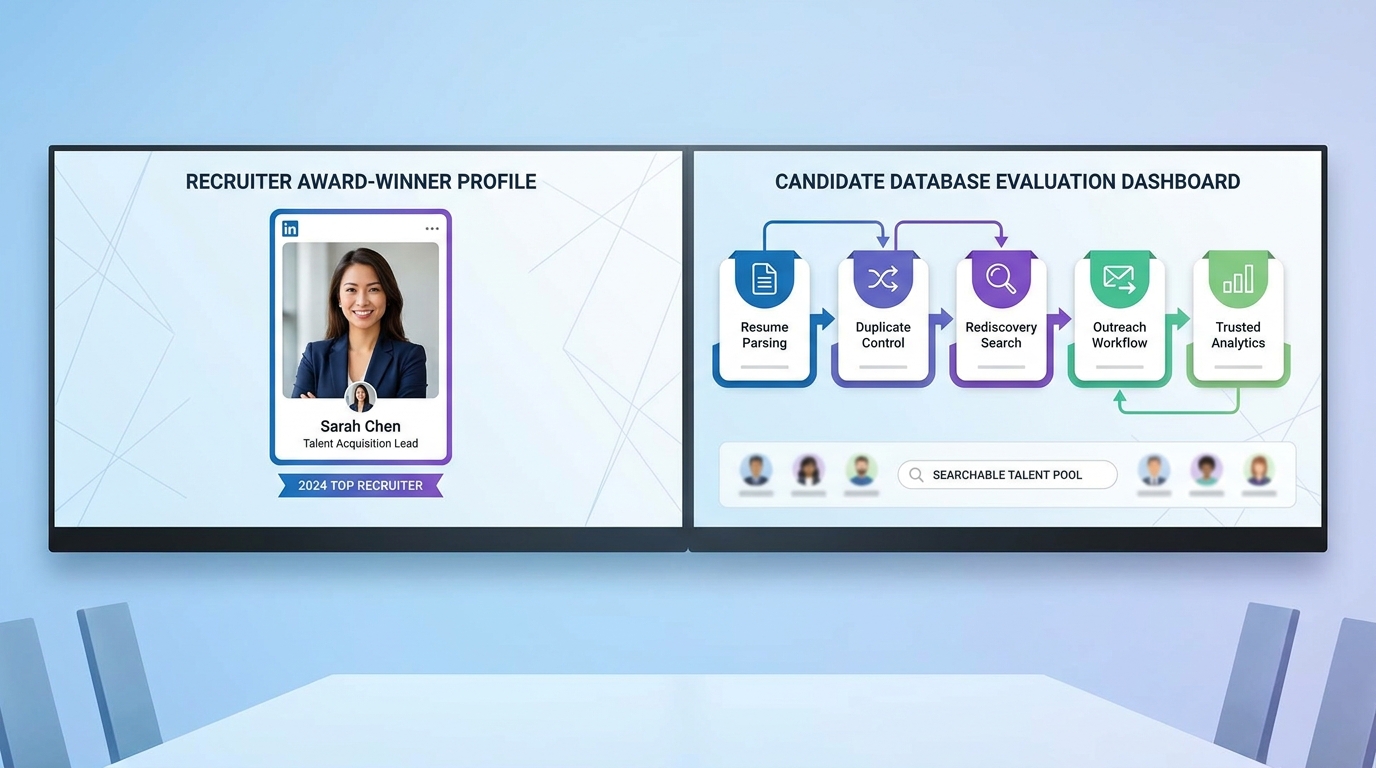
When candidate database for recruiters is weak, this article helps agency leaders judge software by rediscovery, data quality, and reuse risk.
When that foundation is weak, recruiters end up learning the system while trying to fill the role at the same time. Agency owners feel it in slower delivery and missed redeployment opportunities, solo headhunters feel it in duplicate outreach and scattered notes, and in-house teams feel it when hiring managers ask why strong past candidates cannot be found again. In practice, poor resume indexing and weak workflow design create the same operational problem: too much recruiting happens off the side of the desk.
That is where StrategyBrain AI Recruiter can help as a workflow layer rather than a replacement for recruiter judgment. In my own sourcing work, I have found its LinkedIn outreach automation, after-hours candidate messaging, and resume collection especially useful when a search needs steady top-of-funnel activity but the recruiter still wants to control final qualification, resume review, and interview decisions. It eases the repetitive chasing that often prevents a good system from being used consistently.
A useful way to think about software selection comes from implementation consulting, not recruiting demos. In the reference case behind this article, a finance leader moved from controllership into complex system implementation work after becoming more interested in how systems actually functioned than in repetitive month-end tasks. The turning point was not cosmetic software appeal. It was seeing that when teams fed poor information into a system, the output became unreliable, the metrics misled people, and the business kept blaming operations instead of the workflow underneath.
That logic maps directly to hiring. A recruiter can import profiles, search old pipelines, message prospects, and move candidates through stages all day, but if the data structure is weak, duplicates pile up, resumes are hard to parse, and activity history becomes fragmented. Then the recurring questions return: where to find resume sources that are actually usable, which resume finders surface the right people, and what separates the best recruiting software from a basic ATS with a pretty board.
- The best recruiting software is usually built around a strong candidate database for recruiters, not just applicant tracking.
- System quality matters most when recruiters need to rediscover candidates, trust search results, and explain decisions to hiring managers.
- If your team keeps asking where to find resume talent, the answer should include both external sourcing channels and your internal database.
- Modern resume finders should combine Boolean, semantic, and natural-language search with reliable resume parsing.
- Recruiter productivity improves when sourcing, outreach, and record capture work together, but recruiters should still own final qualification.
Table of Contents
- Why the best recruiting software starts with system quality
- Why a candidate database matters more than the demo
- Where recruiters find resumes now
- How modern resume finders should work
- How sourcing, outreach, and ATS workflow fit together
- Using AI Recruiter to support resume capture and follow-up
- How to evaluate the best recruiting software
- Quick comparison table
- Common buying mistakes
- FAQ
Why the best recruiting software starts with system quality
Most teams shop for recruiting software by looking at dashboards, automations, and pipeline boards. Experienced recruiters usually learn the hard way that those are not the features that decide whether the tool will hold up during a difficult search. The real test is whether the system can support the work recruiters do when titles vary, hiring managers change direction, and six-month-old candidates suddenly become relevant again.
That is why the implementation lesson from the reference case matters. Good outcomes depend on good inputs, and bad process design creates bad reporting. In recruiting, that means the best recruiting software should make it easy to capture candidate data correctly, maintain one reliable record, and search across resumes, notes, tags, activity history, and stage movement without guesswork.
For recruiters, this is not abstract systems thinking. It is daily execution. If your database cannot reflect what actually happened with a prospect, then every new requisition starts to feel like a fresh search even when your firm has already done the work.
Practical takeaway: Ask less about feature count and more about whether the system helps your team enter clean information, find it later, and act on it without rebuilding context.
Why a candidate database matters more than the demo
The strongest platforms treat the candidate database for recruiters as the operating core of the recruiting function. That matters because most breakdowns do not happen when a candidate first applies. They happen later, when someone tries to search, compare, re-engage, or report on that profile.
A database worth paying for should support:
- Resume parsing that turns documents into structured records
- Profile enrichment to add useful context for review and segmentation
- Duplicate control so candidate history stays unified
- Tagging and list building for niche pools, silver medalists, and role-specific pipelines
- Searchable records that include resume text, notes, activity, outreach history, and attached metadata
This is where the reference case offers a useful warning. In that consulting story, system inefficiency often came from people trying to use a tool and learn it simultaneously, without a clean implementation standard. Recruiting teams do the same thing when they adopt software but never establish how resumes are imported, how notes are written, how duplicates are merged, or how sourcing activity is captured. The result is familiar: unreliable metrics, poor rediscovery, and constant side spreadsheets.
For agencies, the cost is repeated sourcing. For internal teams, the cost is lost speed and lower confidence from hiring managers. For both, a reliable candidate database for recruiters is usually the difference between a system people tolerate and one they actively use.
Where recruiters find resumes now
One of the most common operational questions in talent acquisition is still where to find resume sources that produce candidates worth engaging. The practical answer is that good recruiters do not depend on one channel, and good software should not force them to.
External resume sources
Recruiters typically source resumes and profiles from:
- Job boards and searchable resume banks
- Professional networking profiles
- Personal websites and portfolios
- Industry communities and specialist directories
- Referrals and alumni networks
- Direct imports from public professional pages
If your team keeps asking where to find resume candidates more efficiently, the software should make capture simple. A profile should move into the system with minimal manual entry, then become searchable, taggable, and reusable.
Internal resume sources
The better long-term answer is often already inside your environment. Past applicants, previous finalists, sourced leads who were not ready earlier, and candidates who replied outside the timing of a prior search all belong in a living database.
This is exactly where weak systems underperform. Recruiters may know someone useful is “in there somewhere,” but if the resume is not parsed well, the notes are buried, or the candidate exists in three duplicate records, the internal database stops behaving like an asset.
That is also why the best recruiting software should not only answer where to find resume externally. It should make internal rediscovery a normal part of the workflow.
How modern resume finders should work
Good resume finders should support different search methods because recruiter search behavior changes by role, market, and urgency.
1. Boolean search for controlled precision
Boolean search still matters when title language is messy or false positives are costly. Operators like AND, OR, NOT, exact-phrase quotes, and wildcard logic help recruiters define inclusion and exclusion clearly.
- "technical recruiter" AND healthcare
- (java OR kotlin) AND backend NOT internship
- "account executive" AND enterprise NOT smb
This is especially useful for agency teams trying to maintain search consistency across recruiters.
2. Semantic search for adjacent talent
Semantic search helps when the right candidate has the right experience but not the expected wording. It can surface adjacent titles, related skill clusters, and practical equivalencies that basic keyword search might miss.
For recruiters working across niche verticals, this can be more valuable than another dashboard widget. It reduces the need to guess every keyword variation before a search even begins.
3. Natural-language search for speed
Natural-language search lets recruiters write a prompt closer to the way they think about a requisition, such as finding post-sales candidates with renewal ownership in B2B software. It can speed up query setup, especially for less technical users or hiring managers reviewing options.
The best resume finders combine these approaches rather than forcing a choice. Recruiters often start broad with natural language, expand with semantic matching, and tighten the shortlist with Boolean logic.
Practical takeaway: During evaluation, run the same search three ways and compare result quality. If the platform cannot explain why a candidate surfaced, recruiter trust will drop fast.
How sourcing, outreach, and ATS workflow fit together
The best recruiting software connects sourcing, communication, and tracking into one practical loop. It should support a workflow like this:
- Source candidates externally
- Capture profiles and resumes into the database
- Parse and enrich records
- Search and segment by role, skill, geography, and readiness
- Run outreach and record responses
- Move candidates through ATS stages with context preserved
- Rediscover prior talent for future roles
This end-to-end design matters for the same reason implementation projects succeed or fail. A system is only as useful as the discipline around how people use it. If sourcing happens in one place, outreach in another, and resume storage somewhere else, recruiter knowledge fragments quickly.
When that fragmentation happens, software stops serving the recruiter and starts creating extra admin. That is the point where teams begin saying the tool looks fine in demos but does not help in real searches.
Using AI Recruiter to support resume capture and follow-up
In my own workflow, I have found that sourcing pressure usually builds first in candidate contact, not in final assessment. That is why I see value in using AI Recruiter as a support layer for repetitive outreach rather than as a replacement for recruiting judgment.
For LinkedIn-heavy searches, it helps keep initial contact moving, responds across time zones, and gathers resumes or contact details from interested candidates so they can be reviewed in the main workflow. That is particularly helpful when a recruiter is balancing live searches with rediscovery projects and cannot manually chase every reply after hours. I still review the resume, decide whether the background fits the brief, and determine whether the next step should be a screen, shortlist discussion, or nurture follow-up.
If your team relies heavily on LinkedIn and wants to understand the broader use cases, the company’s overview of how AI Recruiter works in recruiter workflows and its explanation of conversation handling are useful starting points. The practical lesson is simple: automation is most helpful when it removes repetitive messaging friction while leaving final evaluation with the recruiter.
How to evaluate the best recruiting software
If you are comparing options, evaluate them the way a systems consultant would evaluate an implementation: by testing whether the workflow holds up under real usage.
1. Database reliability
Can the software parse resumes accurately, maintain structured records, merge duplicates, and preserve history in one candidate profile? A real candidate database for recruiters should feel durable, not temporary.
2. Search depth
Test search across resumes, notes, tags, employer history, communications, and stage records. Strong resume finders should support both exact matching and broader discovery.
3. Resume and profile capture
Because recruiters still ask where to find resume candidates, import should work smoothly from public sources, referrals, job boards, and external outreach channels. If profile capture is clumsy, adoption will suffer.
4. Outreach workflow
Look for support for reminders, messaging history, segmentation, and follow-up cadence. If your team sources actively on LinkedIn, consider whether an outreach support layer such as StrategyBrain AI Recruiter can complement your main system by keeping conversations moving and collecting interested-candidate information.
5. Reporting you can trust
Bad systems create bad metrics. Borrowing the implementation lesson again, reporting only becomes useful when the inputs are consistent. Review sourcing analytics, stage movement, activity logs, and talent-pool visibility with that in mind.
6. Data handling and permissions
Candidate data needs retention controls, access rules, and clear ownership. Compliance matters, but so does long-term trust in the system.
Live-test recommendation: Before buying, run three scenarios: a fresh external search, an internal rediscovery search, and an outreach-to-resume-capture sequence. Many tools pass the first and fail the other two.
Quick comparison table
| Evaluation Area | What Strong Software Should Do | Why It Matters |
|---|---|---|
| Candidate database | Parse, enrich, organize, and deduplicate records | Creates a usable candidate database for recruiters |
| Resume search | Support Boolean, semantic, keyword, and natural-language search | Improves the accuracy of modern resume finders |
| Sourcing inputs | Accept resumes and profiles from external and internal channels | Supports real-world where to find resume needs |
| Outreach workflow | Track communication, reminders, and engagement history | Connects sourcing activity to pipeline progress |
| Rediscovery | Surface past candidates for new roles quickly | Prevents repeated sourcing from scratch |
| Analytics | Show activity, funnel movement, and database health | Helps teams trust the operating data |
| Data controls | Support permissions, retention, and governance | Improves long-term system value |
Common buying mistakes
- Choosing for the demo, not the workflow: Attractive automation means little if recruiters cannot retrieve and reuse candidate history.
- Ignoring data-entry discipline: A system cannot fix poor process if teams never standardize imports, notes, and tagging.
- Overestimating AI without checking data quality: Search assistance helps, but weak parsing and duplicate records still damage results.
- Testing only inbound applicant flow: Serious recruiting teams need to test proactive sourcing and rediscovery.
- Separating outreach from the system: If communication happens outside the workflow, the database loses context fast.
A simple rule applies here: the best recruiting software should make strong recruiters more effective, not force them to compensate for the system.
FAQ
What is a candidate database for recruiters?
A candidate database for recruiters is a searchable record system that stores resumes, profiles, notes, tags, outreach history, and stage activity so recruiters can source, organize, and rediscover talent over time.
Where do recruiters find resumes?
Recruiters find resumes through job boards, professional profiles, referrals, public websites, communities, and internal ATS or CRM records. If you are asking where to find resume talent efficiently, the best answer usually combines external sourcing with internal rediscovery.
What are resume finders?
Resume finders are tools or search functions that help recruiters locate relevant candidates across resume databases, internal records, and sourced profiles. The best ones support Boolean, semantic, and natural-language search.
How is outreach automation different from candidate qualification?
Outreach automation can help initiate conversations, follow up, and collect resumes or contact details from interested candidates. Final qualification should still be handled by the recruiter, who reviews fit, context, and next steps.
What should I prioritize when evaluating recruiting software?
Focus on database quality, search depth, resume capture, outreach workflow, rediscovery, reporting integrity, and data controls. Those areas matter more in daily use than a polished front-end demo.
Conclusion
The best recruiting software is not the one with the flashiest interface. It is the one that helps recruiters capture clean information, find it later, and act on it with confidence. In other words, it behaves like a serious candidate database for recruiters rather than a passive log of applicants.
If your team is still debating where to find resume talent, or whether modern resume finders are worth the investment, start with the system question exposed by the opening case: can your workflow turn good input into trustworthy output? If the answer is yes, recruiters move faster and hiring managers get better context. If the answer is no, even strong sourcing effort will keep leaking value.