When deciding if LinkedIn or Indeed is better for jobs, recruiters can use this article to choose the right channel mix and avoid slow, low-fit hiring.
That shift matters because the wrong platform decision rarely fails in an obvious way at first. What usually happens instead is slower response time, weaker candidate intent, more irrelevant applications, more manual follow-up, and missed conversations with people who would have replied if the outreach had landed in the right place and at the right moment. For solo headhunters, small agencies, and in-house talent teams, those small losses stack into real delivery risk.
In my own LinkedIn-heavy searches, I have found that using StrategyBrain AI Recruiter helps most when the bottleneck is repetitive outreach, after-hours replies, and multilingual candidate communication. It can handle first-touch messaging, basic role introduction, and résumé collection, while the recruiter still owns final judgment, résumé review, and shortlist decisions. That matters when you need LinkedIn to stay productive without turning every search into a manual inbox exercise. For teams comparing workflows, the product overview and examples at this LinkedIn recruiting note are useful context.
A useful way to think about platform choice comes from a familiar high-growth hiring problem. In one discussion on scaling a fast-growing company, the turning point was not simply “post more jobs.” It was the realization that once the business started speaking with more sophisticated investors, the team needed senior finance talent that could present a clearer picture of performance and support the next stage of growth. The hiring need changed because the business context changed.
The same discussion also stressed three hiring filters that recruiters know well: cultural alignment with the mission, the ability to learn quickly during growth events, and the technical skills to contribute from day one. In practice, that means the right candidate would not be found through volume alone. Someone had to define the business story, judge fit beyond keywords, and choose channels that matched a nuanced brief. That is exactly why the debate around indeed or linkedin is too narrow. To choose among general LinkedIn alternatives, you need to know whether the search is really about scale, specialist credibility, passive candidate reach, or speed.
If you are searching for general LinkedIn alternatives, you are usually not looking for a clone of LinkedIn. You are looking for a better route to the right candidate or the right job. Sometimes that means a broad job board. Sometimes it means a niche community. And sometimes it means keeping LinkedIn in the mix but fixing the workflow around it.
Table of Contents
- Is LinkedIn or Indeed better for jobs? A recruiter answer
- Why hiring context matters more than platform size
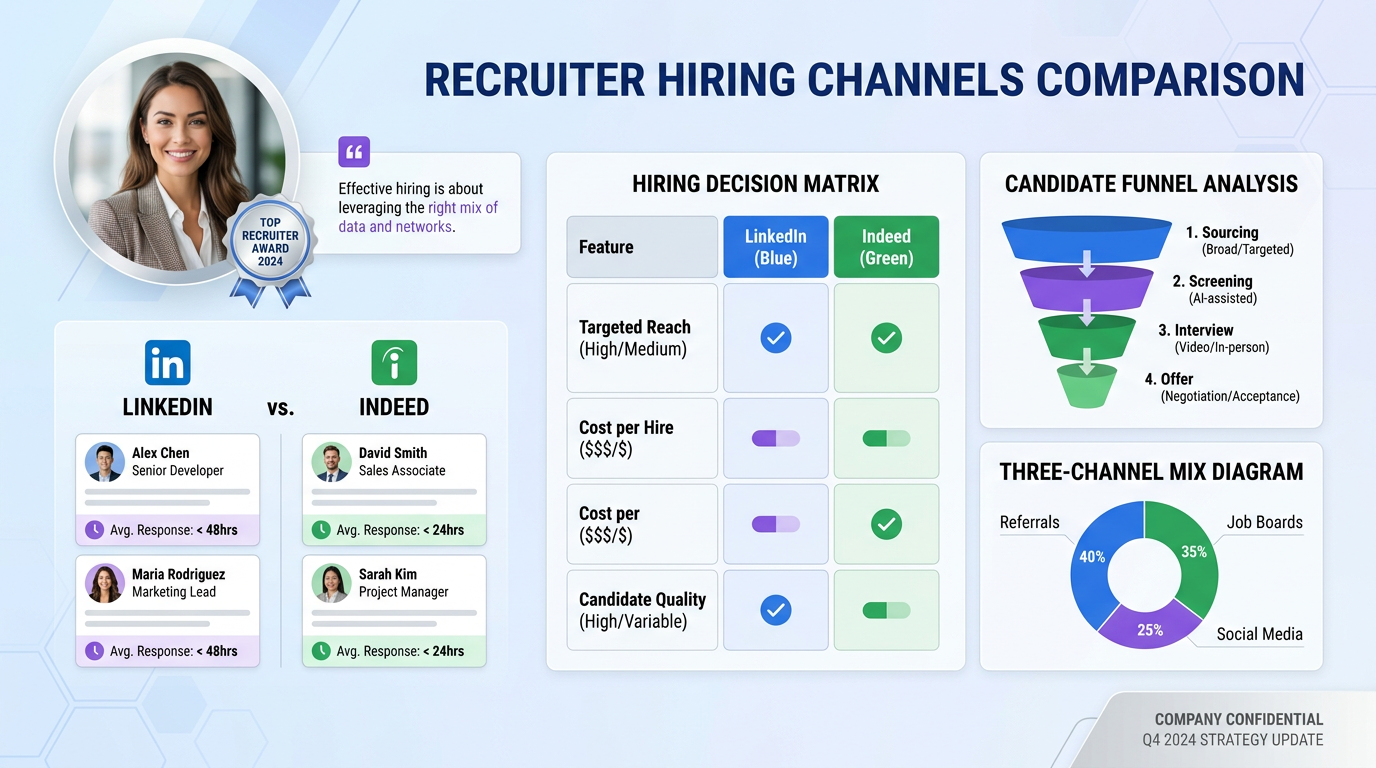
- Indeed or LinkedIn: what each does best
- General LinkedIn alternatives by use case
- What high-growth hiring teaches about channel choice
- How recruiters can make LinkedIn work better
- How to choose the right platform mix
- Common mistakes recruiters and job seekers make
- FAQ
Is LinkedIn or Indeed Better for Jobs? A Recruiter Answer
Indeed is often better when the search is active, search-led, and volume matters. It is usually stronger for candidates who want to apply broadly, and for employers who need steady inbound application flow for mainstream roles.
LinkedIn is often better when visibility, referrals, credibility, and passive talent access matter. It becomes more valuable when hiring depends on context, reputation, and recruiter outreach rather than job-board volume alone.
So if you are asking is LinkedIn or Indeed better for jobs, the best recruiter answer is usually: neither is better in every market. The stronger option depends on the role, the seniority, the urgency, and whether the search is driven by application activity or relationship-driven discovery.
Key takeaway: The best channel is the one that matches the hiring brief, not the one with the loudest market presence.
Why Hiring Context Matters More Than Platform Size
The reference case from high-growth company building is useful because it shows how hiring needs change as the organization changes. Early hiring may reward speed and adaptability. Later hiring may require stronger leadership credibility, investor readiness, and deeper functional experience. A generic platform decision misses that shift.
That is also why recruiters get stuck when they ask only indeed or LinkedIn. Those platforms serve different points in the funnel. Indeed tends to support broad demand capture. LinkedIn supports brand, sourcing, messaging, and passive candidate visibility. Alternatives matter when the hiring context no longer fits either default path.
For job seekers, this means the right platform depends on the type of opportunity you want. For recruiters, it means the same job ad should not automatically be pushed to every channel in the same form.
Indeed or LinkedIn: What Each Does Best
| Factor | Indeed | When It Wins | |
|---|---|---|---|
| Primary strength | Search-first job discovery | Network and profile-led discovery | Depends on search behavior |
| Best candidate type | Active job seekers | Active and passive candidates | LinkedIn for passive reach |
| Application pattern | Fast, high-volume | More selective, profile-backed | Indeed for scale |
| Recruiter value | Inbound applicant flow | Sourcing, outreach, referrals | LinkedIn for nuanced searches |
| Pain points | Outdated or duplicated listings | Crowded feed and response management | Both need process discipline |
| Best role types | Mainstream and high-volume hiring | Relationship-led and specialist hiring | Role dependent |
Where Indeed usually performs better
- Broad market roles with clear requirements
- Location and salary filter-driven search
- High application volume strategies
- Roles where recruiter outreach is less central
Where LinkedIn usually performs better
- Senior, specialist, or reputation-sensitive roles
- Passive candidate sourcing
- Referral-driven hiring
- Markets where a professional profile adds decision value
That is why the answer to is LinkedIn or Indeed better for jobs changes by function. A finance leadership search in a scaling company is not the same as filling a broad operations role quickly. The platform should reflect that reality.
General LinkedIn Alternatives by Use Case
The best alternative to LinkedIn is usually not one universal site. It is a channel category that fits the job-search or hiring situation better.
| Use Case | Best Alternative Type | Why It Helps | Recruiter Advice |
|---|---|---|---|
| General jobs | Large search-first job boards | Strong reach and keyword-location filtering | Use for stable, repeatable roles |
| Remote roles | Remote-specific boards | Higher intent and less location mismatch | Be precise on timezone and async expectations |
| Startup hiring | Startup-focused hiring platforms | Better alignment on stage, ownership, and pace | Write role context, not generic task lists |
| Technical roles | Niche tech communities and specialist boards | Better skill signal and portfolio visibility | Assess work proof, not just résumé keywords |
| Early-career hiring | Campus and graduate platforms | Better fit for internship and entry-level pathways | Simplify requirements and define development paths |
| Specialist professions | Industry-specific communities | Higher relevance and lower generic competition | Speak the language of the discipline |
General jobs
For broad job hunting, a large job board remains one of the strongest LinkedIn alternatives. In this category, many people asking is LinkedIn or Indeed better for jobs will find that Indeed supports the actual application process better, while LinkedIn helps create visibility around that process.
Remote roles
Remote-first boards often beat both large general platforms because the audience is already filtered by intent. That reduces wasted applications and recruiter follow-up with candidates who are not aligned on remote expectations.
Startup hiring
Startup recruiting needs clearer context than standard job ads usually provide. Candidates want to understand growth stage, mission, ownership level, and how much ambiguity comes with the role. This is one area where the high-growth reference case is especially useful: as a company scales, hiring criteria become more strategic, and platform choice has to keep up.
Technical and specialist hiring
For technical, analytical, or niche work, broad platforms can create a lot of noise. Recruiters often do better with smaller but more relevant communities where actual craft signal is easier to see.
What High-Growth Hiring Teaches About Channel Choice
One of the strongest lessons from high-growth company building is that hiring cannot be separated from business stage. When leadership realizes it needs senior finance talent to communicate performance clearly and support investor conversations, the role is no longer just another requisition. It is a business-critical hire with cultural, learning, and technical dimensions.
That same lens helps answer indeed or LinkedIn. If the role depends on speed and broad visibility, job boards can work well. If the role depends on trust, leadership fit, and passive-candidate engagement, LinkedIn or a specialist alternative often becomes more useful.
- Cultural alignment: Better assessed in profile-rich, conversation-led environments
- Learning agility: Easier to evaluate through recruiter interaction than mass applications alone
- Day-one capability: Often needs more targeted sourcing than general traffic can provide
In other words, platform choice should follow the hiring thesis. The more strategic the hire, the less sensible it is to rely on one default channel.
How Recruiters Can Make LinkedIn Work Better
Many teams looking for LinkedIn alternatives are not actually trying to leave LinkedIn entirely. They are trying to reduce the friction around using it well. That usually means solving three operational issues: repetitive outreach, slow candidate response handling, and poor follow-up discipline across time zones or after hours.
That is where I have seen AI Recruiter fit naturally into a recruiter workflow. In searches where I needed to keep LinkedIn active without spending every evening replying manually, it was useful for sending initial outreach, introducing the opportunity, handling routine questions, and collecting résumés or contact details from interested candidates. What it did not replace was the recruiter's final responsibility. I still reviewed résumés, judged real fit, and decided who moved to interview.
For agencies and in-house teams that work across borders, the multilingual and round-the-clock messaging side is especially practical. It helps keep response momentum alive when candidates reply outside business hours. If your pain point is scaling LinkedIn work rather than abandoning LinkedIn, the product details at this overview and sample conversations at these conversation cases show the workflow more clearly.
The important point is strategic, not promotional: better platform results often come from better process support. Recruiters do not just need access to candidates. They need a repeatable system for engaging them without losing quality control.
How to Choose the Right Platform Mix
If you want a practical answer to is LinkedIn or Indeed better for jobs, use this framework instead of looking for a universal winner.
Choose Indeed-first when
- You need broad application volume
- You are targeting mainstream, search-led roles
- You want strong keyword, location, and salary filtering
- You are dealing with active job seekers rather than passive talent
Choose LinkedIn-first when
- You need passive candidate access
- You want referrals or warm introductions
- You are hiring for senior, specialist, or credibility-heavy roles
- You need profile depth beyond a résumé alone
Choose alternatives-first when
- You are hiring remotely and need better intent matching
- You are filling startup roles where context matters
- You are hiring for niche or technical functions
- You are targeting students, graduates, or early-career talent
For most recruiters, the best answer is a three-channel mix: one broad job board, one network-led channel, and one niche source matched to the role family.
Common Mistakes Recruiters and Job Seekers Make
1. Treating platform choice as a brand preference
Platform decisions should come from the brief, not habit. The high-growth hiring example makes this obvious: when the business need changes, the channel strategy should change too.
2. Overvaluing volume
More applications do not mean better hiring. If the role needs trust, context, and judgment, quality signal matters more than inbox size.
3. Using LinkedIn without a response process
LinkedIn can underperform simply because outreach and follow-up are not managed consistently. That is often a workflow problem more than a platform problem.
4. Ignoring cultural and learning criteria
The reference case highlighted mission fit and learning speed alongside technical skill. Those factors are easy to lose if your process only optimizes for quick application count.
5. Forgetting direct employer channels
Career pages, employee referrals, and niche communities still matter. General platforms should support your strategy, not define it completely.
FAQ
Is Indeed better than LinkedIn?
Indeed is often better for search-led job hunting and broad application volume. LinkedIn is often better for recruiter visibility, networking, referrals, and passive-candidate discovery.
Should recruiters use Indeed and LinkedIn together?
Usually yes. They serve different purposes. Indeed helps with active inbound flow, while LinkedIn supports outreach, profile review, and relationship-led hiring.
What is the best general LinkedIn alternative?
For general jobs, large job boards are usually the closest alternative. For remote, startup, technical, or niche hiring, specialist platforms are often stronger than both LinkedIn and Indeed.
Indeed or LinkedIn for startup hiring?
Neither is automatically best. Startup hiring often performs better on focused channels where role scope, growth stage, and ownership expectations are clearer.
So, is LinkedIn or Indeed better for jobs overall?
Overall, there is no universal winner. Indeed usually works better for direct search and application scale. LinkedIn usually works better for visibility, referrals, and strategic sourcing. The best answer depends on the role and the hiring context.
Conclusion
The real lesson behind the indeed or LinkedIn debate is that hiring channels only make sense when tied to the business problem underneath them. A high-growth company hiring senior finance talent needs a different sourcing logic than a team filling broad-market roles quickly. The same principle applies to job seekers deciding where to spend their time.
So when you ask is LinkedIn or Indeed better for jobs, start with the hiring context first. Then choose the mix: broad board, network-led platform, and niche alternative where needed. And if LinkedIn remains important in your workflow, improve the execution around it rather than assuming the platform itself is the whole problem.