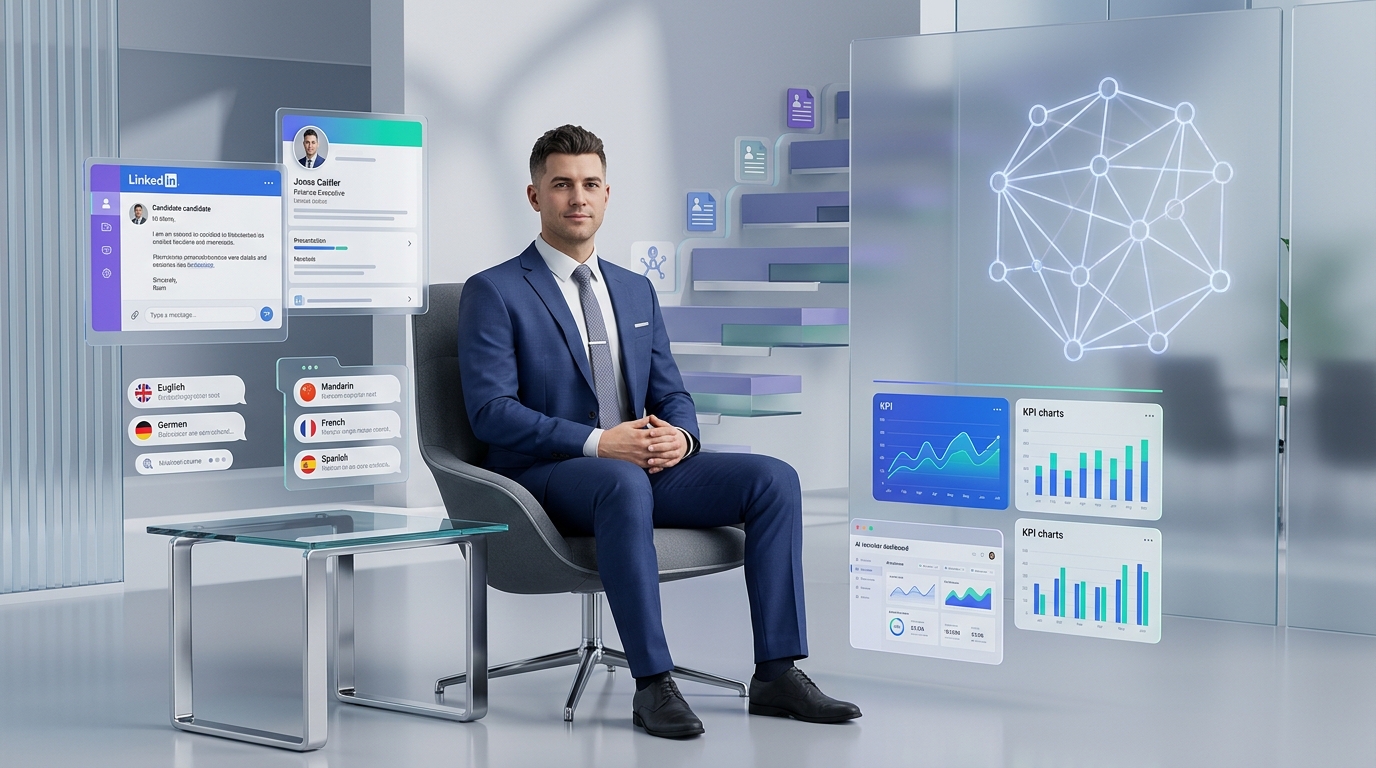
An ai recruiting tool creates the most value when it helps hiring teams move faster without losing judgment. Craig Hudson’s career story shows why that matters. Across roles at KPMG, Indigo, Knix, LumiQ, and Tulip, he built impact by combining analysis, communication, and leadership clarity. Those same principles now shape ai powered recruitment. For teams hiring through LinkedIn or across multiple markets, StrategyBrain AI Recruiter supports that shift by automating early candidate outreach, handling multilingual communication, and collecting candidate interest signals so recruiters can focus on evaluation and final decisions.
Key Takeaways
- Career growth follows skill stacking: Craig Hudson’s moves from audit to advisory, pricing, FP&A, operations, and CFO roles show that leadership depth often comes from combining analytical and communication skills.
- Hiring quality depends on timing: One of the clearest lessons is that organizations often bring in people leaders too late, which creates avoidable execution risk.
- AI in talent acquisition works best in the early funnel: Outreach, candidate engagement, follow up, and résumé collection are strong use cases for automation, while final qualification still needs human review.
- LinkedIn remains a high value channel: For many recruiting teams, an AI recruiting tool tied to LinkedIn workflows can reduce repetitive manual work and improve response coverage.
- Global hiring needs multilingual communication: StrategyBrain AI Recruiter supports candidate conversations in multiple languages, which is useful for cross border recruiting and distributed teams.
- Scale requires systems, not just effort: StrategyBrain AI Recruiter can support more than 100 LinkedIn accounts, which helps organizations build repeatable AI powered recruitment capacity.
- Leadership alignment still decides outcomes: Technology can accelerate hiring, but role clarity, CEO alignment, and strong recruiter judgment remain central to good talent decisions.
Craig Hudson’s career journey and why it matters
Craig Hudson, CPA, CA, CFA, was featured in an interview published on August 8, 2024 by Clarity Recruitment as part of The Next Moves podcast series. The conversation focused on his path through several organizations of different sizes and operating models. The value of that story is not only biographical. It also offers a useful lens for understanding how leaders think about hiring, growth, and organizational readiness.
His early move from KPMG audit into advisory is important because it reflects a pattern seen in many strong finance leaders. Technical competence opens the door, but broader business influence comes from interpretation, communication, and decision support. That transition laid the groundwork for later roles where he had to do more than report numbers. He had to shape business direction.
At Indigo, he joined the digital team as Manager of Pricing and Optimization. The role was not a perfect match on paper at the start, yet his analytical background gave him a foundation to grow into it. Over time, his responsibilities expanded into FP&A and then into operations, including customer service and supply chain. This matters for hiring because it shows how high potential talent often grows through adjacent capability, not only direct title matching.
At Knix in early 2020, he stepped into a leadership environment shaped by sudden market disruption. During the global pandemic, scenario modeling, fast financial decision making, and transparent communication became essential. The company later experienced major growth and was acquired by Essity in a transaction reported at USD 320 million. That period highlights a second hiring lesson. In volatile conditions, organizations need leaders who can combine financial rigor with calm communication.
He later became Chief Financial Officer of LumiQ, where he helped scale the business through annual strategy, collaborative budgeting, weekly KPI reporting, stronger board and investor reporting, and process automation. He now also takes on interim and fractional opportunities and serves as CFO at Tulip, an omnichannel retail solutions company. Across all of these moves, one pattern remains consistent. Career acceleration came from bridging gaps between functions, not staying inside a narrow lane.
Leadership lessons for modern hiring teams
1. Strong leaders are rarely one dimensional
One of the clearest themes in Craig Hudson’s story is that leadership readiness is built through range. He did not stay limited to one finance specialty. He moved across analysis, pricing, planning, operations, and executive leadership. For recruiters and hiring managers, this is a reminder that the best candidate may not be the person with the most linear résumé. It may be the person who has repeatedly learned how to translate expertise into business action.
2. Storytelling is a business skill, not a soft extra
The interview emphasizes that finance leadership is not only about running analyses. It is also about telling the story behind the numbers. In hiring terms, this means assessment should go beyond technical screening. Teams should evaluate whether a candidate can explain tradeoffs, influence stakeholders, and align decisions with company goals. This is where structured outreach and early qualification matter. An ai recruiting tool can help surface interested candidates faster, but the hiring team still needs a clear rubric for evaluating communication quality.
3. Leadership is about removing barriers
Craig Hudson’s reflections on leadership point to a practical truth. Effective leaders do not need detailed mastery of every task their teams perform. They need to understand performance, remove blockers, and align effort. The same principle applies to talent acquisition leaders. Their job is not to manually execute every outreach step. Their job is to design a hiring system that helps recruiters spend more time on judgment and less time on repetitive process work.
4. Hiring too late is a recurring organizational mistake
The interview also notes that people managers are often brought in too late. This is a common issue in scaling companies. Teams wait until pressure is already visible, then rush to hire under time constraints. In practice, that leads to weaker candidate experience, slower response times, and more reactive decision making. This is one reason ai in talent acquisition is gaining attention. Automation can help organizations maintain candidate engagement earlier and more consistently, especially when internal bandwidth is stretched.
What this means for an AI recruiting tool strategy
We reviewed the source interview and the product information for StrategyBrain AI Recruiter together because the most useful insight is not simply that AI can save time. It is where AI should and should not be used. Based on the available product details, StrategyBrain AI Recruiter is designed to automate the front end of LinkedIn recruiting. It can connect with candidates who match target criteria, introduce job opportunities, answer role and company questions, identify interest, and collect résumés and contact details from candidates who want to move forward.
That workflow aligns closely with the hiring challenges implied by Craig Hudson’s comments. Growing companies need better planning for people. Recruiters need more time for evaluation. Leaders need systems that support scale without adding unnecessary friction. In that context, an ai powered recruitment approach is strongest when it handles repetitive communication while preserving human control over final selection.
There is also an important boundary here. StrategyBrain AI Recruiter does not claim to make the final résumé match decision. According to the provided product information, it identifies willingness to communicate or interview, while the recruiter completes the final qualification step after reviewing the résumé. That distinction matters for trust. It keeps the system focused on process acceleration rather than overpromising judgment that still belongs with human recruiters and hiring managers.
Where StrategyBrain AI Recruiter fits
LinkedIn outreach and early engagement
For teams that rely on LinkedIn as a sourcing channel, StrategyBrain AI Recruiter is positioned as a specialized ai recruiting tool for automating initial outreach and candidate conversations. Recruiters provide job information such as company details, compensation, benefits, and candidate search criteria. The system then handles the first layer of communication. This can reduce the manual burden of sending connection requests, introducing roles, and following up with candidates who respond at different times.
24/7 multilingual communication
One of the more distinctive capabilities in the provided product information is multilingual candidate communication. StrategyBrain AI Recruiter can respond around the clock and communicate in the candidate’s native language. For companies hiring across regions, this is a meaningful operational advantage. It can reduce delays caused by time zones and lower the risk of misunderstanding in early candidate conversations.
Scalable recruiting teams
The product information also states that organizations can manage more than 100 LinkedIn accounts to build AI recruiter teams. That matters for firms with high volume hiring needs, agency models, or distributed recruiting operations. In practical terms, scale in recruiting is not only about more candidate volume. It is about maintaining response consistency, preserving recruiter capacity, and keeping the pipeline active without requiring every interaction to be handled manually.
Résumé and contact collection
StrategyBrain AI Recruiter can request résumés and contact details from interested candidates. It supports email submissions and LinkedIn file uploads, and it captures contact details shared in LinkedIn conversations. This is a useful bridge between sourcing and screening. It does not replace recruiter review, but it can shorten the time between initial interest and recruiter action.
Security and compliance positioning
According to the supplied product details, the platform states compliance with privacy regulations in the European Union, United States, and Canada. It also states that customer provided data is not used to train AI models, and that credentials and candidate data are encrypted and isolated. For teams evaluating ai in talent acquisition, these trust signals are important because data handling concerns often slow adoption more than workflow concerns do.
A practical framework for finance and executive hiring
Based on the interview themes and the product capabilities provided, here is a practical framework for teams hiring finance leaders, operators, and other high impact talent.
Define the real capability gap
- Clarify whether the role requires technical depth, cross functional leadership, or both.
- Identify which adjacent experiences matter most, such as pricing, operations, investor reporting, or transformation work.
- Avoid over filtering for linear career paths when the role actually needs adaptability.
Use automation in the early funnel
- Set candidate search criteria and role messaging clearly.
- Use an AI recruiting tool to handle connection requests, role introductions, and first response follow up.
- Collect résumés and contact details from interested candidates before recruiter review.
Keep human judgment in the decision layer
- Review résumés for actual fit against role requirements.
- Assess communication quality, leadership range, and stakeholder influence.
- Use interviews to test how candidates think through ambiguity and business tradeoffs.
Plan earlier than you think you need to
- Do not wait until a team is already overloaded to begin leadership hiring.
- Build candidate pipelines before the need becomes urgent.
- Use structured outreach to keep passive candidates warm over time.
Support global hiring with language coverage
- Use multilingual communication where candidate markets are international.
- Reduce time zone delays with always on response workflows.
- Standardize early candidate messaging while allowing recruiters to personalize later stage conversations.
We find this framework useful because it reflects both the leadership lessons in Craig Hudson’s story and the operational reality of modern recruiting. The goal is not to automate everything. The goal is to automate the right layer.
Limits and cautions
To keep this analysis fair and trustworthy, several limits should be stated clearly.
- We are drawing on one published interview and the supplied product information for StrategyBrain AI Recruiter. This article does not claim to be a full independent benchmark of all recruiting platforms.
- The source interview is primarily about leadership and career development, not a direct product review. The connection to recruitment technology is an interpretive analysis based on the hiring themes discussed.
- We do not add unsupported pricing comparisons or competitor claims. The only specific cost figure referenced from the supplied product information is that LinkedIn recruiting costs can be reduced to as little as USD 2.40 per résumé.
- As with any AI recruiting tool, final hiring quality still depends on role definition, recruiter judgment, and interview process design.
FAQ
What is an ai recruiting tool?
An ai recruiting tool is software that uses automation and AI to support recruiting tasks such as sourcing, outreach, candidate engagement, screening support, and workflow management. In practice, the best tools reduce repetitive work so recruiters can spend more time on evaluation and hiring decisions.
How does StrategyBrain AI Recruiter support LinkedIn hiring?
Based on the provided product information, StrategyBrain AI Recruiter automates LinkedIn candidate connection requests, introduces job opportunities, answers candidate questions, identifies interest, and collects résumés and contact details from interested candidates. Recruiters then review the information and decide who moves forward.
Does AI Recruiter replace recruiters?
No. The supplied product details indicate that the system automates early outreach and communication, but final qualification still belongs to the recruiter. That makes it a support layer for ai powered recruitment, not a replacement for human hiring judgment.
Why is Craig Hudson’s interview relevant to ai in talent acquisition?
His career story highlights the importance of skill stacking, leadership communication, planning for people, and hiring at the right time. Those themes help explain where AI can add value in recruiting and where human leadership still matters most.
Can StrategyBrain AI Recruiter help with global hiring?
Yes. According to the provided product information, it supports 24/7 multilingual communication with candidates in their native language. That can help teams engage talent across countries and time zones more consistently.
How many LinkedIn accounts can StrategyBrain AI Recruiter support?
The supplied product information states that organizations can manage more than 100 LinkedIn accounts. This is positioned as a way to build scalable AI recruiter teams for larger hiring operations.
How does the platform handle résumés and contact details?
Interested candidates can share résumés by email or LinkedIn file upload, and contact details shared in LinkedIn conversations are captured in the system. Recruiters are then able to review the collected information for next step decisions.
Is candidate data secure?
According to the provided product information, candidate data is encrypted, isolated with customer specific keys, and not used to train AI models. The product also states compliance positioning for privacy regulations in the European Union, United States, and Canada.
Conclusion
Craig Hudson’s career path is a strong reminder that growth comes from combining technical depth, business storytelling, and leadership range. The same idea applies to recruiting. A strong hiring system combines automation with judgment. For teams evaluating an ai recruiting tool, the practical takeaway is clear. Use AI to handle repetitive outreach, candidate engagement, and information capture, then keep recruiters focused on fit, context, and final decisions. That is where StrategyBrain AI Recruiter appears most relevant, especially for LinkedIn based hiring, multilingual communication, and scalable talent acquisition workflows.
If your team is trying to improve recruiting speed without weakening hiring quality, the next step is to map your current funnel and identify which early stage tasks can be standardized safely. That is usually the fastest path to better ai in talent acquisition outcomes.