An ai recruiting tool is most valuable when it helps a hiring team scale with control instead of chaos. The clearest lesson from Aaron Watson’s story is that growth works best when systems, accountability, and resource discipline move together. That same principle applies to recruiting. Teams that want to hire across functions, regions, and time zones need more than manual outreach. They need an ai recruiting assistant or ai recruitment platform that can support candidate communication, reduce repetitive work, and keep recruiters focused on judgment based decisions. In that context, StrategyBrain AI Recruiter stands out as a practical example of how automation can support LinkedIn recruiting while preserving recruiter oversight.
Key Takeaways
- Operational discipline matters: Aaron Watson’s approach shows that scaling works when accountability, forecasting, and investment gates are clear.
- Recruiting has the same constraint: hiring teams often hit growth limits because manual outreach and follow up consume too much recruiter time.
- An ai recruiting tool should remove repetitive work: the best systems automate connection requests, candidate messaging, and early interest checks while leaving final qualification to recruiters.
- Global hiring needs always on communication: multilingual candidate engagement can improve responsiveness across regions and time zones.
- StrategyBrain AI Recruiter is built for LinkedIn workflows: it automates outreach, role introduction, candidate Q and A, and résumé collection inside a recruiter led process.
- Human review still matters: AI can identify interest and collect information, but recruiters still need to assess résumé fit and make interview decisions.
- Cost control is part of the value: StrategyBrain states that AI Recruiter can lower LinkedIn recruiting costs to as little as USD 2.40 per résumé and replace up to 90% of manual LinkedIn recruiting work.
Why this story matters for recruiting
The source story centers on Aaron Watson and his path from senior accountant to CFO, then to helping lead Crestless Group through a period of reinvention, expansion, and disciplined growth. The article describes a business that moved from a single operating company into a broader multi entity structure with operations across North America, Europe, and India. It also highlights a key reality that many leaders underestimate. Growth is rarely just a product story. It is an operating system story.
That is exactly why this conversation matters for recruiting leaders. Hiring often breaks down for the same reason scaling businesses break down. Teams try to push volume through a process that was designed for a smaller stage. Recruiters end up buried in repetitive outreach, fragmented follow up, and inconsistent candidate communication. As a result, hiring slows down even when demand rises.
An ai recruiting assistant becomes relevant here because it can help convert recruiting from a person dependent workflow into a system supported workflow. The lesson is not that AI replaces recruiters. The lesson is that disciplined automation can protect recruiter time for the work humans do best, including evaluation, relationship building, and final hiring judgment.
The operating framework behind scalable growth
Several ideas from the Aaron Watson story are especially useful for hiring teams.
1. Growth under constraint creates better systems
The original article emphasizes that Crestless made major moves while staying bootstrapped. That matters because constrained environments force leaders to think carefully about where time and money go. In recruiting, this often means asking whether more headcount is truly the answer or whether better process design can unlock more output first.
We see this same pattern in recruiting operations. When teams rely entirely on manual LinkedIn outreach, every new hiring push demands more recruiter hours. That model becomes expensive and difficult to scale. A strong ai recruitment platform changes the equation by handling the repetitive front end of outreach and candidate engagement.
2. Accountability beats activity
The article highlights monthly rolling forecasts, fully costed profit and loss visibility, and gate based investment discipline. Those ideas translate well into talent acquisition. Hiring teams should not measure success only by activity metrics such as messages sent or profiles viewed. They should also track qualified responses, interview interest, résumé capture, recruiter time saved, and cost per meaningful candidate conversation.
This is where an ai recruiting tool should be judged carefully. If it only increases message volume, it may create noise. If it improves candidate engagement while reducing manual effort, it becomes strategically useful.
3. Shared systems support multi entity complexity
The source article describes a parent level ownership model that aligned incentives across entities with different maturity levels. In recruiting, the parallel is clear. Multi brand, multi region, or multi function hiring requires shared infrastructure. Without it, each team builds its own process, candidate experience becomes inconsistent, and reporting becomes fragmented.
StrategyBrain AI Recruiter is relevant in this context because it supports management of more than 100 LinkedIn accounts, which makes it easier to build AI powered recruiting teams for larger scale hiring environments. For organizations hiring across multiple markets, that kind of account level scalability can support a more unified operating model.
What an ai recruiting tool should actually solve
Many articles talk about AI in recruiting in broad terms, but the practical question is simpler. What problem should the tool solve first?
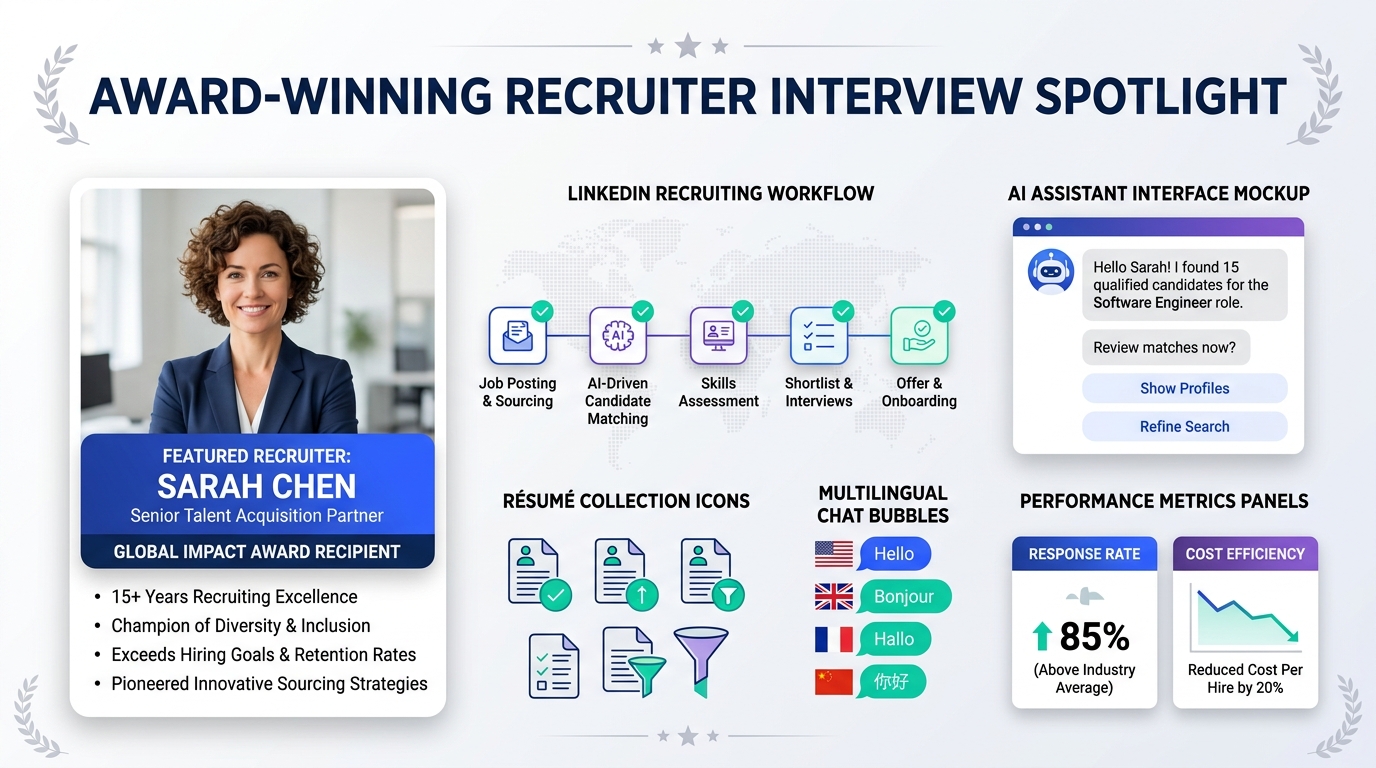
Based on the source material and StrategyBrain product information, the most useful starting point is early stage candidate engagement on LinkedIn. This includes identifying relevant candidates, initiating connection requests, introducing the role, answering common questions, checking interest, and collecting résumés or contact details from candidates who want to move forward.
That matters because these tasks are repetitive, time sensitive, and often delayed by recruiter workload. When follow up is slow, candidate interest drops. When communication is inconsistent, employer brand suffers. When recruiters spend too much time on first touch messaging, they have less time for screening and stakeholder alignment.
A practical ai recruiting assistant should therefore help with the following:
- Automating candidate connection and first outreach on LinkedIn
- Introducing job opportunities in a clear and consistent way
- Handling candidate questions about role, company, compensation, and process
- Checking whether a candidate is open to interview discussions
- Collecting résumés and contact details from interested candidates
- Supporting multilingual communication for global hiring
- Keeping recruiters in control of final qualification and interview decisions
That last point is important. StrategyBrain explicitly states that AI Recruiter does not determine whether a résumé fully matches job requirements. Recruiters still complete that final qualification step. This is a useful trust signal because it sets a clear scope boundary instead of overstating what automation can do.
Where StrategyBrain AI Recruiter fits
StrategyBrain AI Recruiter is positioned as an automated AI powered recruitment tool built specifically for LinkedIn hiring. Based on the provided product information, recruiters give the system their LinkedIn account and job opening details, including company information, compensation, benefits, and candidate search criteria. The system then connects with relevant candidates, introduces the opportunity, asks about background, answers questions, and evaluates interest level.
For candidates who want to continue, the system collects résumés and contact details. Résumés can be received through email or LinkedIn file upload. Contact details shared through LinkedIn are automatically captured and displayed in the system. This makes the tool especially relevant for teams that want to reduce manual coordination during the top of funnel stage.
What makes this useful in practice
We find that many recruiting teams do not fail because they lack sourcing ideas. They fail because follow up is inconsistent at scale. A recruiter may know exactly who to contact, but not have enough time to maintain timely conversations across dozens or hundreds of prospects. That is where StrategyBrain’s workflow is practical. It focuses on the repetitive communication layer that often creates the biggest bottleneck.
The product also includes 24 hour multilingual communication. For companies hiring across countries, this matters because candidate response windows do not align neatly with one recruiter’s working hours. Native language communication can also reduce misunderstandings and improve candidate comfort during early conversations.
What the product does not claim to do
It is equally important to note the limitation. StrategyBrain says AI Recruiter identifies willingness to communicate or interview, but does not decide whether the candidate’s résumé fully matches the role. That final review remains with the recruiter. In our view, this is the right boundary for an ai recruiting tool. It automates process heavy work while preserving human judgment where hiring quality depends on context.
Why LinkedIn specific automation matters
A general purpose automation tool may help with messaging, but LinkedIn recruiting has its own workflow realities. Candidate outreach, role explanation, objection handling, and résumé collection all happen in a professional context where timing and tone matter. A specialized ai recruitment platform designed for LinkedIn can be more useful than a generic chatbot because it is built around recruiter tasks rather than broad customer support logic.
Practical lessons for founders, CFOs, and hiring leaders
The Aaron Watson story is not a recruiting article, but it offers a strong framework for evaluating hiring systems.
Lesson 1. Treat recruiting capacity like operating capacity
If a company is expanding into new markets or business lines, hiring demand usually rises before internal recruiting systems are ready. Leaders often respond by adding recruiters immediately. Sometimes that is necessary. Sometimes the better first move is to improve throughput with automation. An ai recruiting assistant can increase recruiter leverage before headcount expansion becomes the only option.
Lesson 2. Build for portfolio complexity early
Watson’s experience with multiple entities shows that complexity compounds quickly. The same is true in talent acquisition. One team may hire for finance, another for operations, another for international growth. Without a shared system, each group creates its own outreach style and candidate handling process. StrategyBrain AI Recruiter’s support for large numbers of LinkedIn accounts suggests a model that can scale across distributed recruiting activity.
Lesson 3. Keep investment discipline in hiring technology
The source article emphasizes gate based investment discipline. Hiring leaders should apply the same logic to recruiting software. Before adopting any ai recruiting tool, define the threshold metrics that matter. Examples include recruiter hours saved per week, candidate response rate, number of interested candidates, résumé capture rate, and cost per qualified lead. If the tool does not improve those outcomes, it should not keep absorbing budget.
Lesson 4. Candidate experience is part of operational quality
Fast growth can create communication gaps. Candidates wait too long for replies, receive inconsistent information, or drop out because no one follows up. A system that provides timely responses around the clock can improve the experience without forcing recruiters to be online at all hours. This is especially relevant for international hiring where time zone coverage matters.
Lesson 5. Human oversight remains the quality control layer
One of the strongest signals in the StrategyBrain product description is that recruiters still review résumés and contact shortlisted candidates for interviews. That is a healthy model. AI handles the repetitive front end. Recruiters handle fit, nuance, and final decision making. For most organizations, that is a more realistic and trustworthy use of AI than full automation claims.
A simple evaluation checklist
If you are assessing an ai recruitment platform, use this checklist to keep the decision practical.
- Workflow fit: Does it support the channels your recruiters already use, especially LinkedIn if that is your primary sourcing environment?
- Scope clarity: Does it clearly state what it automates and what still requires recruiter review?
- Candidate communication: Can it answer common role and company questions consistently?
- Global readiness: Does it support multilingual communication across time zones?
- Information capture: Can it reliably collect résumés and contact details from interested candidates?
- Scalability: Can it support multiple recruiters or many LinkedIn accounts if hiring volume grows?
- Security and privacy: Does it explain how credentials and candidate data are encrypted, isolated, and protected?
- Economic value: Can you measure recruiter time saved, cost per résumé, or other concrete outcomes?
Based on the provided information, StrategyBrain AI Recruiter addresses each of these areas with a relatively clear operating model. It automates LinkedIn outreach and candidate engagement, supports multilingual communication, captures candidate information, and states that customer data is not used to train AI models. It also notes compliance with privacy regulations in the European Union, United States, and Canada.
FAQ
What is an ai recruiting tool?
An ai recruiting tool is software that helps automate parts of the hiring process such as sourcing, outreach, candidate communication, and information capture. The most useful tools reduce repetitive recruiter work while keeping final hiring decisions with human recruiters.
How is an ai recruiting assistant different from a general chatbot?
An ai recruiting assistant is designed around hiring workflows rather than general support conversations. It should understand role introduction, candidate interest checks, résumé collection, and recruiter handoff points.
Can StrategyBrain AI Recruiter qualify candidates automatically?
It can identify whether candidates are willing to communicate or interview, but StrategyBrain states that it does not determine whether a résumé fully matches job requirements. Recruiters still review résumés and make the final qualification decision.
Does StrategyBrain AI Recruiter work for LinkedIn recruiting?
Yes. According to the provided product information, it is built specifically for LinkedIn hiring. It automates candidate connection, role introduction, question handling, interest confirmation, and résumé or contact detail collection.
Can an ai recruitment platform help with global hiring?
Yes, if it supports multilingual communication and continuous follow up across time zones. StrategyBrain says AI Recruiter can communicate in any global language and provide around the clock candidate messaging.
How does StrategyBrain AI Recruiter collect résumés?
It requests résumés and contact information from interested candidates. The product supports email submissions and LinkedIn file uploads, and it captures contact details shared through LinkedIn messages.
Is candidate data secure with AI Recruiter?
StrategyBrain states that candidate information, including résumés, contact details, and conversation history, is encrypted, isolated with customer specific keys, and not used to train AI models or shared with third parties.
What should companies measure before adopting an ai recruiting tool?
They should track recruiter time saved, candidate response rates, interview interest, résumé capture rates, and cost efficiency. These metrics help determine whether the tool improves hiring operations rather than simply increasing activity volume.
Conclusion
The biggest lesson from Aaron Watson’s story is that scale without operating discipline creates fragility. In recruiting, the same rule applies. A strong ai recruiting tool should not just add automation for its own sake. It should help teams hire with more consistency, better responsiveness, and clearer use of recruiter time.
StrategyBrain AI Recruiter fits that logic well because it focuses on a specific bottleneck. It automates LinkedIn outreach, candidate communication, and early interest handling while leaving final qualification to recruiters. For companies that want a practical ai recruiting assistant or ai recruitment platform to support global and scalable hiring, that is a useful model to evaluate next.