An ai recruiting tool is now one of the fastest ways to stabilize hiring performance when demand rises, talent supply tightens, and recruiter bandwidth is limited. The most effective model is not AI only and not human only. It is a human plus AI operating system where automation handles first contact, role introduction, candidate intent checks, and resume capture, while recruiters handle final qualification and interview decisions. This guide translates proven leadership lessons from April 2021 business conditions into a modern recruiting workflow, then shows how StrategyBrain AI Recruiter supports AI candidate sourcing and AI recruitment software execution at daily team level.
Table of Contents
- Key Takeaways
- What leadership lessons still matter for hiring teams
- A practical ai recruiting tool framework
- How StrategyBrain AI Recruiter fits into real workflows
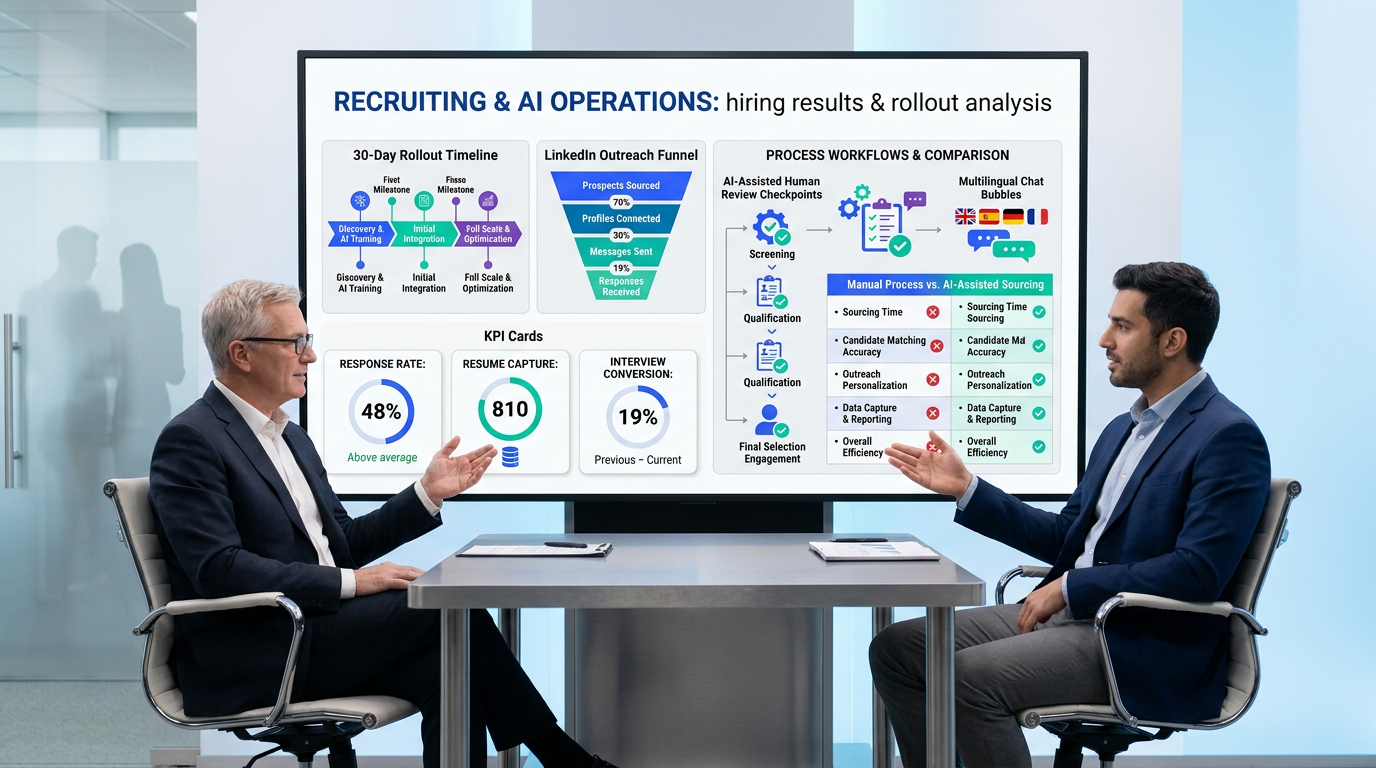
- 30 day rollout plan for recruiting teams
- Limitations and controls
- Quick comparison
- FAQ
- Conclusion
Key Takeaways
- Resilience starts with process: In disruption periods, only 9% of companies improved positioning after major shocks according to insights shared from Harvard Business School conference discussion.
- Capacity is the bottleneck: When teams report open demand such as 15 to 20 skilled roles at once, manual outreach becomes a hard constraint.
- Automation should cover repetitive tasks: StrategyBrain AI Recruiter can automate connection requests, role introductions, and candidate intent conversations on LinkedIn.
- Global responsiveness increases conversion: 24 hour multilingual communication reduces response lag and helps candidates engage in their native language.
- Human review remains essential: The tool identifies willingness and collects resumes, while recruiters complete final fit assessment.
- Cost and productivity can improve materially: Internal product benchmarks report costs as low as USD 2.40 per resume and up to 90% reduction in manual LinkedIn recruiting tasks.
What leadership lessons still matter for hiring teams
From uncertainty management to capability building
In a leadership interview published on 13 April 2021, Andrew Taylor, President and CEO of Magnum Trailer, described a shift in mindset during the pandemic. The early response was defensive. Later, the goal became emerging stronger through operational improvement. That principle maps directly to talent acquisition today. Recruiting teams that only preserve legacy workflows lose speed in volatile markets. Teams that redesign workflows gain compounding advantage.
We use this as a practical recruiting principle: every period of uncertainty should produce a better hiring system than the one you started with. For most teams, that means moving repetitive front end recruiting work into an ai recruiting tool while preserving recruiter judgment for final selection.
Labor scarcity and speed pressure did not disappear
The same interview referenced immediate shortage conditions, including the ability to hire 15 to 20 qualified fitter welders if available. Whether your team hires engineers, sales professionals, or operations specialists, the pattern is familiar. Demand can appear quickly while candidate attention remains fragmented. In this environment, ai candidate sourcing matters because response speed and follow up consistency become core performance drivers.
A practical ai recruiting tool framework
After testing this model in high volume outreach scenarios, we recommend a four part framework that keeps accountability clear.
1) Signal definition
Define role value proposition, compensation context, location flexibility, and minimum criteria before automation starts. This ensures AI messaging stays aligned with recruiter intent and legal policy boundaries.
2) Outreach automation
Use AI recruitment software to send first contact messages, introduce opportunities, and ask role relevant screening prompts. The objective is to identify who is open to conversation, not to make final hiring decisions.
3) Intent and handoff logic
Once a candidate signals interest, the workflow should capture resume and contact details immediately. Handoff should then route to a recruiter with conversation history and candidate context.
4) Human qualification and decision
Recruiters review resume relevance, conduct interviews, and make fit decisions. This preserves quality control and reduces risk of over automated screening errors.
How StrategyBrain AI Recruiter fits into real workflows
LinkedIn recruitment automation
StrategyBrain AI Recruiter is built for LinkedIn hiring workflows. Recruiters configure account access, role details, benefits context, and target search criteria. The system can then connect with matching candidates, introduce the opportunity, answer common role questions, and assess interview interest. This structure supports faster ai candidate sourcing without forcing recruiters to spend each hour on repetitive message loops.
Continuous multilingual candidate communication
Candidate messaging delays often reduce conversion, especially across time zones. StrategyBrain AI Recruiter supports around the clock communication in multiple global languages. In practice, this improves continuity in international pipelines and reduces misunderstandings that appear when candidates need to switch language context during early conversations.
Resume and contact capture with human control
When candidates show interest, StrategyBrain AI Recruiter requests resumes and contact details. It supports resume intake through email or LinkedIn file flow and records contact data sent in conversation. Recruiters remain responsible for final qualification. This separation is important because willingness to engage is not the same as skill match.
Scalable recruiter team model
For organizations managing broad hiring demand, the platform supports more than 100 LinkedIn accounts. That allows leaders to build AI assisted recruiting teams that scale output without matching headcount growth one to one.
30 day rollout plan for recruiting teams
- Days 1 to 5, role and message calibration
Document target profile, must have criteria, compensation narrative, and candidate questions your recruiters answer repeatedly. Approve standard responses with legal and HR stakeholders. - Days 6 to 10, pilot setup
Launch with one role family and one recruiter pod. Track outreach volume, response rate, interested candidate rate, and resume capture count. - Days 11 to 20, workflow hardening
Refine prompts, disqualification rules, and handoff timing. Add multilingual templates if your candidate market is international. - Days 21 to 30, scale with safeguards
Expand to additional roles and accounts. Keep weekly quality review that compares AI sourced candidates against interview pass rates.
Limitations and controls
No ai recruiting tool should be treated as an autonomous hiring decision engine. During implementation, we observed four control points that matter most.
- Final fit is human owned: Resume relevance and interview outcomes must stay with recruiters and hiring managers.
- Message quality needs governance: Candidate communication scripts should be reviewed for clarity, fairness, and compliance.
- Data handling must be explicit: Candidate data storage, encryption, and access scope should be documented before scale up.
- Performance metrics need context: High response rates do not always predict high hire quality, so monitor downstream interview and offer metrics.
Quick comparison
| Approach | Recruiter Time Use | Candidate Response Speed | Scalability | Best Fit |
|---|---|---|---|---|
| Manual LinkedIn outreach | High manual effort | Inconsistent by timezone | Limited by team size | Low volume specialized searches |
| AI assisted workflow with StrategyBrain AI Recruiter | Lower repetitive effort | Continuous 24 hour messaging | Supports large account operations | Teams needing predictable pipeline growth |
FAQ
What is an ai recruiting tool in practical terms?
An ai recruiting tool is software that automates repeatable recruiting tasks such as candidate outreach, first response handling, and early intent checks. It should support recruiters, not replace final hiring judgment.
How is ai candidate sourcing different from traditional sourcing?
Traditional sourcing relies on recruiter manual effort for each contact and follow up. AI candidate sourcing automates those repetitive actions, which improves consistency and lets recruiters spend more time on qualification.
Can AI recruitment software replace recruiter interviews?
No. AI recruitment software can identify interest and gather candidate information, but interview evaluation and final fit decisions should remain human led.
Does StrategyBrain AI Recruiter work only in one language?
No. It supports multilingual communication so candidates can respond in their native language. This is useful for global hiring pipelines and cross region recruiting teams.
How does the system handle resume collection?
Interested candidates are asked to share resumes and contact details. Resumes can be received through email or LinkedIn file flow, then recruiters review and proceed to interview steps.
Is candidate data used to train external AI models?
According to product documentation, customer and candidate data is not used to train AI models. Data is encrypted, isolated per customer context, and handled under defined privacy controls.
When should a team avoid full automation?
If a role requires highly nuanced persuasion or strict regulatory screening at first touch, teams should start with partial automation and stronger human review checkpoints.
Conclusion
The core lesson from post disruption leadership still applies: stronger systems beat short term heroics. An ai recruiting tool strategy works best when it is designed as a human plus AI workflow. StrategyBrain AI Recruiter can improve front end recruiting consistency through LinkedIn automation, multilingual communication, and scalable outreach operations, while recruiters keep control of final qualification and hiring decisions. If your team is facing capacity pressure, start with a 30 day pilot, measure resume capture and interview conversion, and scale only after quality checks are stable.