If you are evaluating ai talent management software, the most reliable approach is to choose a system that automates outreach and follow up while keeping final hiring judgment with recruiters. In practice, this means using a talent development platform to handle repetitive LinkedIn tasks, candidate messaging, and resume capture, then letting recruiters focus on fit assessment and interviews. This article uses the career journey of Jessica Miles, announced as a new recruiter on 14 May 2015, to show how relationship driven recruiting can be strengthened by talent development software such as StrategyBrain AI Recruiter.
Table of Contents
- Why this profile still matters for AI talent management software
- Career milestones from Jessica Miles and what they teach recruiters
- How StrategyBrain AI Recruiter maps to real recruiter workflows
- Implementation blueprint for teams
- Practical hiring checklist
- FAQ
- Conclusion
Key Takeaways
- Human first, AI assisted: the best ai talent management software handles repetitive communication and leaves final qualification to recruiters.
- Proven workflow fit: StrategyBrain AI Recruiter automates LinkedIn connection, role introduction, candidate intent checks, and resume collection.
- Global communication: multilingual candidate messaging supports international hiring across time zones.
- Scalable operations: teams can manage over 100 LinkedIn accounts in one AI supported hiring model.
- Operational impact: product documentation reports up to 90% reduction in manual LinkedIn recruiting tasks.
- Cost signal: documented recruiting cost can be as low as USD 2.40 per resume in suitable use cases.
Why This Profile Still Matters for AI Talent Management Software
Jessica Miles was introduced as a recruiter specializing in manufacturing and industrial sales, with additional focus on environmental engineering and management. Her trajectory is useful because it reflects what strong recruiters still do today, they combine persistence, contextual understanding, and candidate empathy.
Modern talent development software does not replace these strengths. Instead, it protects recruiter time so those strengths can be applied where they matter most, in nuanced conversations, fit validation, and long term relationship building. This is exactly where a talent development platform can create measurable value.
Career Milestones and Practical Lessons
1) Academic and mission driven foundation
Jessica Miles graduated from the University of Victoria with a major in Environmental Studies and Sociology and served as Co President of the Environmental Studies Student Association. She also contributed to sustainability initiatives. This matters in recruiting because domain context often drives better candidate conversations.
For teams using ai talent management software, the lesson is clear, AI handles repetitive steps, while recruiters bring domain judgment to role positioning and trust building.
2) Early career resilience under market pressure
She entered the market in 2009 during recession conditions, then moved into the UVic Restoration of Natural Systems Program and later co authored Restoration Walks in Victoria with Dr. Valentin Schaefer. She also worked with First Nation communities and environmental groups on policy related initiatives.
In recruiting operations, this background signals adaptability and communication range. A strong talent development platform should mirror this adaptability by supporting flexible conversation paths instead of rigid scripts.
3) Transition into structured recruitment operations
At Mitacs, a research network based at the University of British Columbia, she began as Executive Assistant to the COO and supported a flagship international program that recruited undergraduate talent from priority countries to work with researchers across Canada. This phase highlights how process discipline and candidate quality can scale together.
We see the same pattern in AI enabled pipelines. When structured steps are standardized, recruiter energy shifts to quality control and candidate alignment, not administrative repetition.
4) Persistence and relationship building as hiring assets
After approaching Henry Goldbeck, she persisted through follow up and eventually joined the recruiting team. Her own comments on reducing bias and finding opportunity in challenges reflect a candidate centric mindset that remains essential today.
AI talent management software should support that mindset. It should not force one dimensional screening. It should gather intent signals and conversation context so recruiters can make fairer decisions.
How StrategyBrain AI Recruiter Maps to Real Recruiter Workflows
To connect this story with current execution, we reviewed the profile milestones above and mapped them against common LinkedIn hiring stages used by in house teams and agencies. We then aligned each stage with capabilities documented for StrategyBrain AI Recruiter.
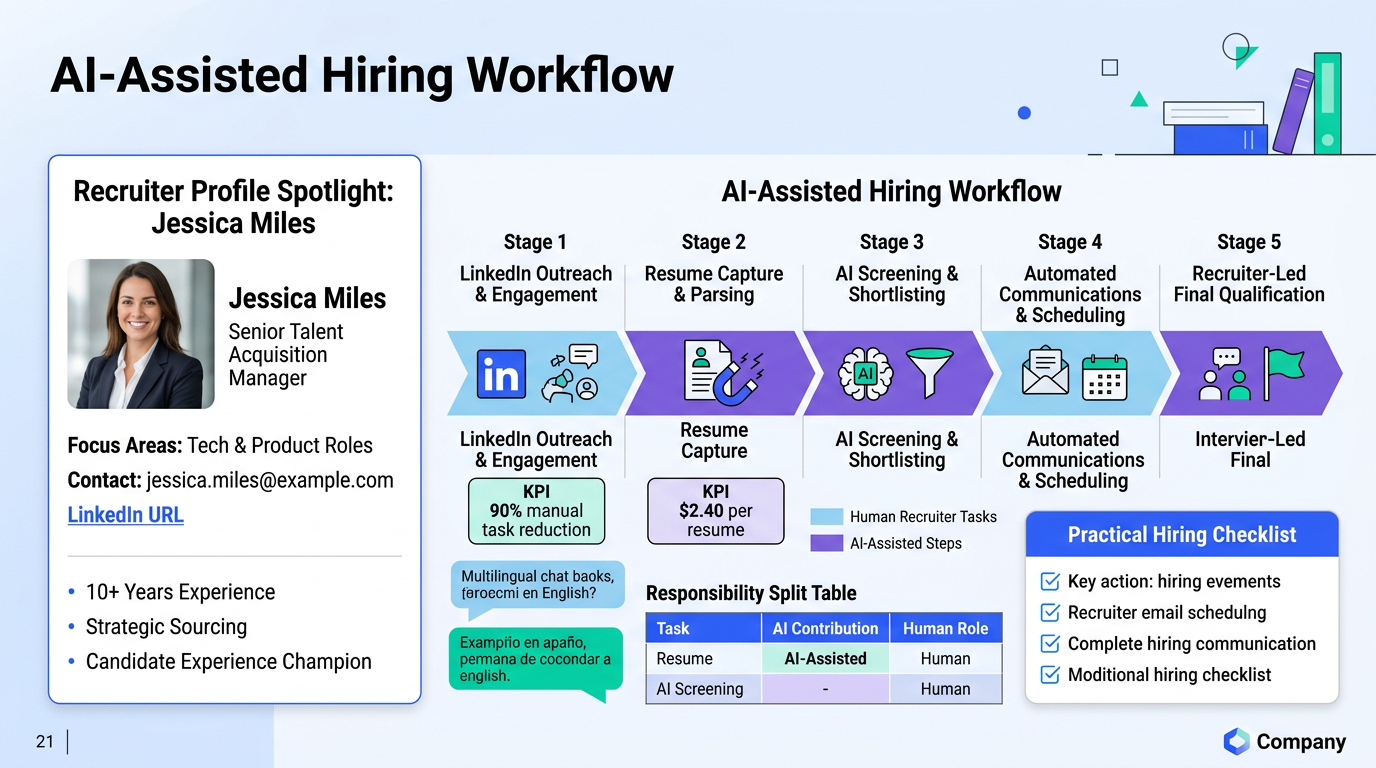
Workflow mapping
| Recruiting Stage | Traditional Manual Work | StrategyBrain AI Recruiter Support | Human Recruiter Role |
|---|---|---|---|
| Candidate discovery and outreach | Search, connect, write initial messages | Automatically connects and introduces opportunities based on target criteria | Define search strategy and candidate profile |
| Candidate conversation | Answer repetitive questions across time zones | 24/7 multilingual communication in candidate native language | Handle complex objections and value narrative |
| Interest validation | Manual follow up to confirm openness | Identifies interview willingness and role interest | Decide next step and shortlist quality |
| Resume and contact capture | Collect files and details manually | Captures resumes and contact details through supported channels | Review evidence and interview fit |
| Team scale | Output limited by individual recruiter bandwidth | Supports operations across more than 100 LinkedIn accounts | Manage quality, compliance, and hiring decisions |
What this means for a talent development platform strategy
- Use AI for message consistency, speed, and multilingual continuity.
- Keep final candidate qualification with recruiters after resume review.
- Track candidate intent separately from candidate fit to avoid false positives.
- Scale outreach through systems, not by overloading individual recruiters.
Implementation Blueprint for Teams
Step 1: Define role context before automation
Prepare role requirements, compensation context, and candidate criteria before enabling workflows. This aligns AI behavior with recruiter intent.
Step 2: Automate first contact and candidate Q and A
Deploy AI assisted LinkedIn outreach and response handling. Let the system manage high volume first touch and repeated candidate questions.
Step 3: Separate willingness from qualification
Treat candidate willingness to talk as one signal, not a hiring decision. Use recruiter review for final qualification against resume and role requirements.
Step 4: Standardize resume and contact capture
Create one operational path for collecting resumes and contact details so handoff to interview scheduling is clean and auditable.
Step 5: Scale gradually with account governance
Expand account coverage in phases, then monitor response quality, compliance behavior, and recruiter conversion outcomes.
Practical Hiring Checklist
- [ ] Job criteria and value proposition are documented before outreach.
- [ ] AI messaging tone is aligned with your recruiter voice.
- [ ] Multilingual response rules are tested for your target markets.
- [ ] Resume capture and contact capture flow is verified.
- [ ] Recruiter review stage is mandatory before interview invitations.
- [ ] Compliance and data protection requirements are documented.
Limitations and Scope Boundaries
This guide focuses on LinkedIn centered recruiting workflows and candidate communication operations. It does not provide legal advice, salary benchmarking, or full applicant tracking system architecture design.
Also, AI Recruiter can identify communication willingness and interview interest, but it does not replace human evaluation of resume to role fit. Teams should keep recruiter led qualification as a required control step.
FAQ
Is ai talent management software only for large enterprises?
No. Smaller teams can benefit first because repetitive outreach consumes a larger share of recruiter time. A focused deployment can improve throughput without adding headcount.
How is a talent development platform different from basic outreach tools?
A talent development platform connects messaging, follow up, candidate intent, and handoff into one workflow. Basic tools usually support only one task such as sequencing or messaging.
Can talent development software replace recruiters?
No. It replaces repetitive steps, not hiring judgment. Recruiters still handle qualification, stakeholder calibration, and final interview decisions.
What makes multilingual communication important in recruiting?
Native language communication reduces misunderstanding and increases response quality across regions. It is especially important for global hiring pipelines that run across multiple time zones.
Does StrategyBrain AI Recruiter include data protection controls?
According to product documentation, data is encrypted, customer isolated, and not used to train shared AI models. Teams should still review internal legal and compliance requirements before rollout.
What is the fastest way to start?
Start with one role family and one recruiter pod. Measure response rate, qualified handoff volume, and recruiter time saved over a defined period, then expand in stages.
Conclusion
The core lesson from Jessica Miles’ recruiting journey is that strong hiring outcomes come from persistence, context, and candidate respect. AI talent management software is most effective when it protects those human strengths instead of replacing them. In practical terms, a modern talent development platform should automate first touch, multilingual follow up, and resume capture, while recruiters own final qualification and interview decisions.
If your team is evaluating talent development software, begin with a controlled workflow pilot, document conversion metrics, and scale only after quality remains consistent. That approach gives you speed, governance, and better candidate experience at the same time.