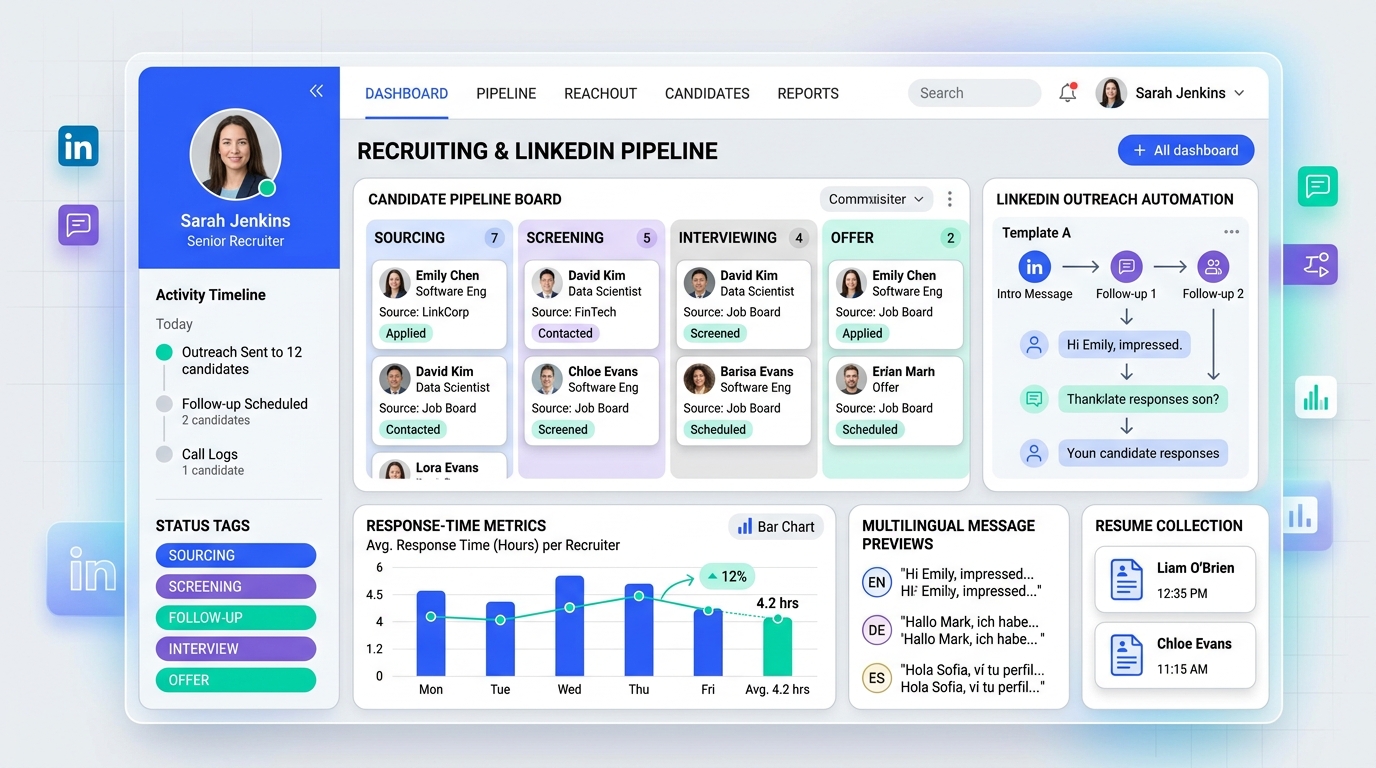
An applicant tracking system for staffing agencies helps teams centralize candidate records, speed up response times, and create a more reliable hiring workflow across sourcing, screening, and follow-up. If your agency recruits heavily on LinkedIn, the strongest approach is not just choosing staffing software with pipeline visibility, but pairing it with automation that keeps candidate conversations moving. In practice, agencies that respond quickly, maintain active outreach, and document candidate status clearly are more likely to look credible to applicants and operate like truly active recruiters. This guide explains how that works, what the LinkedIn actively recruiting signal really suggests, and how StrategyBrain AI Recruiter can extend an ATS workflow by automating outreach, multilingual messaging, and resume collection.
Key Takeaways
- Fast response matters: LinkedIn recruiting signals are closely tied to recruiter responsiveness and ongoing candidate engagement.
- An ATS is the system of record: The best applicant tracking system for staffing agencies keeps candidate status, notes, resumes, and communication history in one place.
- Automation fills the execution gap: StrategyBrain AI Recruiter can automate LinkedIn outreach, follow-up, and resume collection while recruiters focus on final qualification.
- Multilingual communication expands reach: For agencies hiring across regions, native-language messaging can reduce friction and improve candidate response quality.
- Reviewing is not the same as recruiting: A company can review applicants without actively sourcing or engaging new candidates.
- Top ATS systems should support agency speed: Pipeline visibility alone is not enough if recruiters still spend hours on repetitive outreach.
What the actively recruiting signal means
The actively recruiting label on LinkedIn is generally understood as a platform signal that an employer is engaged in hiring activity and responding to candidates in a timely way. Recruiters cannot simply switch it on manually. Instead, it reflects behavior patterns such as active job posting, candidate engagement, and prompt follow-up.
For staffing firms, this matters because candidate trust is heavily influenced by visible responsiveness. When applicants believe a recruiter or agency is actually moving, they are more likely to apply, reply, and stay engaged through the screening process. In our review of the source material, the core message was consistent: speed and visible activity shape candidate perception.
That is also why staffing software alone does not solve the problem. An ATS can track stages, but if no one is reaching out quickly, following up, or collecting candidate information efficiently, the workflow still feels slow from the candidate side.
Why it matters for staffing agencies
Staffing agencies operate differently from internal talent teams. Agency recruiters often manage multiple open roles, multiple clients, and large candidate pools at the same time. That creates a coordination problem. Without a strong applicant tracking system for staffing agencies, candidate records become fragmented across inboxes, spreadsheets, LinkedIn messages, and recruiter notes.
The result is predictable. Response times slip. Follow-ups get missed. Duplicate outreach happens. Strong candidates lose interest. This is exactly where modern staffing software should create leverage.
A good ATS for agency use should help recruiters do three things well:
- Track every candidate against the correct role and client
- Maintain a clear communication history and next action
- Reduce manual admin so recruiters can spend more time on qualified conversations
However, agencies that recruit heavily through LinkedIn often need one more layer. They need a way to automate repetitive outreach and early-stage engagement without losing control of the process. StrategyBrain AI Recruiter fits that gap by handling initial LinkedIn connection requests, job introductions, candidate interest checks, and follow-up messaging. It can also collect resumes and contact details from interested candidates, which supports a cleaner handoff into the ATS.
How an applicant tracking system for staffing agencies supports this workflow
1. Centralized candidate tracking
An applicant tracking system for staffing agencies acts as the operational backbone of the desk. It stores resumes, notes, stage updates, client submissions, and recruiter activity in one place. This is especially important when multiple recruiters touch the same account or when candidates are considered for more than one role.
In practical terms, centralized tracking reduces avoidable errors. Recruiters can see whether a candidate has already been contacted, whether a resume has been received, and what the next step should be. That level of visibility is one reason top ATS systems remain essential even when agencies add automation tools.
2. Faster candidate response management
One of the clearest lessons from LinkedIn recruiting workflows is that speed influences outcomes. Source material referenced response windows of 24 to 48 hours as a meaningful benchmark for active recruiting behavior. While exact platform logic is not fully public, the operational takeaway is simple: agencies that respond faster create a stronger candidate experience.
An ATS helps by assigning ownership, surfacing pending actions, and keeping candidate status current. When paired with StrategyBrain AI Recruiter, agencies can go further by maintaining 24 hour candidate communication across time zones and languages. That is useful for firms recruiting internationally or handling urgent roles outside standard office hours.
3. Better handoff from sourcing to qualification
There is an important distinction between early engagement and final qualification. StrategyBrain AI Recruiter can introduce roles, answer candidate questions, identify interest, and request resumes or contact details. It does not replace the recruiter’s final judgment on whether a resume matches the job requirements. That final qualification still belongs with the recruiter.
This division of labor is healthy. The ATS remains the place where recruiters review resumes, compare candidates, and move shortlisted talent toward interviews. Automation handles the repetitive front-end work. Recruiters handle the decision-making work.
4. Scalable agency operations
Agency growth usually creates a staffing ratio problem. More reqs and more clients do not always justify immediate headcount growth. According to StrategyBrain product information, AI Recruiter can support more than 100 LinkedIn accounts, allowing organizations to build AI-powered recruiting teams that expand outreach capacity. For agencies, that means the ATS can remain the control center while outreach volume scales beyond what a single recruiter could manage manually.
Actively recruiting vs actively reviewing
These two ideas are related, but they are not the same.
Actively recruiting
- The team is sourcing and engaging candidates proactively
- Outreach is happening through LinkedIn messaging or similar channels
- Applications and conversations are moving forward quickly
- The hiring process appears live and responsive
Actively reviewing
- The team is assessing applications already received
- The workflow is focused on screening rather than sourcing
- Candidate movement may be limited to internal review steps
- There may be less visible outbound activity
For staffing agencies, this distinction matters because clients usually expect both. They want recruiters to review inbound applicants efficiently, but they also expect active sourcing. A strong applicant tracking system for staffing agencies supports both functions. It tracks inbound applications and keeps outbound sourcing organized. When combined with LinkedIn automation, agencies can maintain visible recruiting momentum instead of waiting passively for applicants.
4 practical strategies for agency recruiters
1. Optimize job postings for clarity and search intent
Job posts still matter, even in outbound-heavy agency recruiting. Clear titles, accurate responsibilities, required skills, compensation context, and employer value points all improve candidate quality. This is also where staffing software should help standardize templates and approval workflows.
We recommend aligning job post language with the terms candidates actually search. That includes role titles, location details, seniority, and core skills. For agencies evaluating top ATS systems, posting workflow and job template control are worth reviewing because they directly affect consistency across clients and recruiters.
2. Use paid distribution selectively
Paid promotion can increase visibility for hard-to-fill roles, urgent openings, or niche searches. It should not replace recruiter execution, but it can widen the top of the funnel. The key is to make sure your ATS and reporting process can show whether paid traffic is producing qualified candidates rather than just more clicks.
For agencies, this means connecting campaign activity back to recruiter outcomes such as response rate, resume receipt, shortlist quality, and interview conversion. Without that feedback loop, ad spend becomes difficult to justify.
3. Protect recruiter research workflows when needed
Some recruiters prefer to review profiles discreetly before initiating contact. Private profile viewing settings can support that workflow. While this is a tactical choice rather than a strategic one, it can help recruiters evaluate fit before starting outreach.
Still, discretion should not become delay. The larger issue is whether your staffing software and outreach process let recruiters move from research to action quickly. If profile review is private but follow-up is slow, the operational benefit is limited.
4. Automate repetitive outreach and follow-up
This is where many agencies create the biggest efficiency gain. Manual LinkedIn outreach is time intensive because every recruiter must identify candidates, send connection requests, introduce the role, answer basic questions, follow up, and request resumes. Doing that at scale across multiple reqs is difficult.
StrategyBrain AI Recruiter is designed to automate that front-end workflow on LinkedIn. Based on the provided product information, it can automatically connect with candidates within target criteria, introduce job opportunities, answer questions about the role and compensation, confirm interview interest, and collect resumes and contact information from interested candidates. It also supports multilingual communication and around the clock follow-up.
For staffing agencies, that means the ATS can remain the source of truth while AI Recruiter handles repetitive candidate engagement. Recruiters then spend more time reviewing qualified resumes, speaking with interested candidates, and presenting stronger shortlists to clients.
There is also a cost and productivity angle. StrategyBrain states that AI Recruiter can lower LinkedIn recruiting costs to as little as USD 2.40 per resume and replace up to 90% of manual LinkedIn recruiting work. Those figures come from product information and should be evaluated against your own workflow, role type, and candidate market. Even with that caveat, the operational direction is clear: agencies can use automation to reduce repetitive effort without removing recruiter judgment.
How we evaluated this workflow
We reviewed the supplied source content about LinkedIn recruiting signals and compared it with the provided StrategyBrain AI Recruiter product information. Our goal was not to rank vendors or invent unsupported feature claims. Instead, we mapped the source material’s practical recruiting advice to the needs of agencies searching for an applicant tracking system for staffing agencies.
We focused on four evaluation criteria:
- Responsiveness: how quickly teams can engage and follow up with candidates
- Workflow control: whether candidate status and communication history stay organized
- Scalability: whether the process can support more roles and more recruiter activity without proportional headcount growth
- Candidate experience: whether communication remains timely, clear, and consistent
We also preserved an important limitation from the product information. AI Recruiter can automate outreach and identify candidate willingness to continue, but final resume qualification remains a recruiter task. That boundary is important for accuracy and trust.
Quick evaluation checklist for staffing software
If you are comparing staffing software or reviewing top ATS systems, use this checklist to assess fit for agency recruiting:
- Does the system centralize resumes, notes, and candidate stage history?
- Can recruiters see who contacted a candidate and when?
- Does it support fast handoff from sourcing to screening?
- Can it handle multiple clients and multiple open roles cleanly?
- Does it reduce duplicate outreach and missed follow-up?
- Can it integrate with or complement LinkedIn recruiting workflows?
- Does your process include automation for repetitive outreach tasks?
- Can your team support multilingual candidate communication when needed?
If the answer to the last two questions is no, your ATS may still be useful, but your agency may be leaving productivity gains on the table.
FAQ
What is an applicant tracking system for staffing agencies?
An applicant tracking system for staffing agencies is software that helps recruiters manage candidates, resumes, job orders, communication history, and hiring stages across multiple roles and clients. Unlike a simple CRM or spreadsheet, it is designed to keep recruiting workflows organized and visible.
How is staffing software different from general recruiting software?
Staffing software usually needs stronger support for multi-client workflows, recruiter collaboration, and high-volume candidate movement. Agency teams often need to track submissions, ownership, and candidate status across several openings at the same time.
Do top ATS systems include LinkedIn outreach automation?
Some do, but many ATS platforms focus more on tracking than on outbound execution. That is why agencies often pair an ATS with a specialized automation layer such as StrategyBrain AI Recruiter for LinkedIn outreach, follow-up, and resume collection.
Can automation replace recruiters in staffing agencies?
No. Automation can reduce repetitive work, but it should not replace recruiter judgment. In the StrategyBrain workflow, AI Recruiter handles initial outreach and candidate engagement, while recruiters still review resumes and make final qualification decisions.
Why does fast response matter so much in agency recruiting?
Fast response improves candidate experience and reduces drop-off. It also supports the kind of active recruiting behavior that candidates associate with serious hiring activity. In competitive markets, delays often mean losing strong candidates to faster-moving teams.
Can StrategyBrain AI Recruiter work with multilingual hiring?
Yes. According to the provided product information, it supports global multilingual communication and can respond to candidates in their native language. That can be useful for agencies recruiting across countries and time zones.
Does AI Recruiter qualify candidates automatically?
It identifies whether candidates are willing to engage and move forward, but it does not make the final judgment on whether a resume fully matches the role. Recruiters still complete that qualification step after reviewing the resume.
What should agencies prioritize when choosing staffing software?
Agencies should prioritize workflow visibility, speed, collaboration, and the ability to support outbound recruiting. The best applicant tracking system for staffing agencies is one that keeps records clean while allowing recruiters to move candidates forward quickly.
Conclusion
The best applicant tracking system for staffing agencies is not just a database for resumes. It is the operational center that helps recruiters stay organized, respond faster, and manage candidate movement across multiple clients and roles. But in LinkedIn-heavy recruiting environments, tracking alone is not enough.
Agencies that want stronger recruiting momentum should combine ATS discipline with automation that keeps outreach and follow-up active. That is where StrategyBrain AI Recruiter adds practical value. It supports LinkedIn recruitment automation, multilingual candidate communication, and scalable outreach while leaving final qualification in recruiter hands.
If your current staffing software tracks candidates well but still leaves recruiters buried in repetitive messaging, the next step is to evaluate how automation can extend your workflow. Start with your response speed, follow-up consistency, and resume collection process. Those are often the clearest signs that your recruiting stack is ready for improvement.