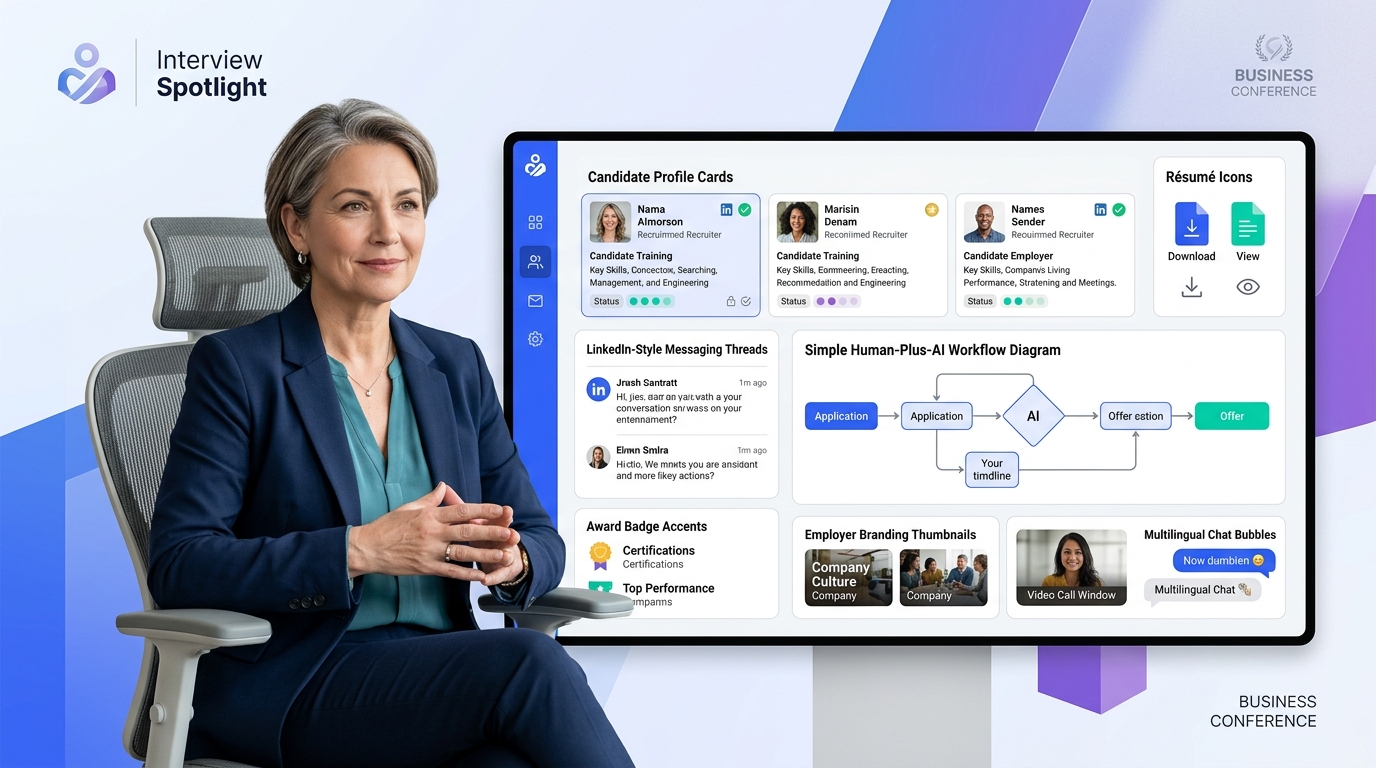
A modern hire platform works best when it supports real recruiter judgment instead of trying to replace it. In Sigal Posner’s perspective as a Senior Talent Acquisition Specialist, standout hiring still comes down to energy, motivation, and communication, while newer employment platform workflows help teams scale outreach and candidate engagement. Her comments also reflect a broader shift toward more visible employer brands, more conversational recruiting, and more efficient digital touchpoints. For teams hiring through LinkedIn and related channels, tools such as StrategyBrain AI Recruiter fit naturally into this model by automating early outreach, multilingual follow up, and résumé collection so recruiters can spend more time on relationship building and final screening.
Key Takeaways
- Candidate differentiation still starts with people skills: Sigal Posner highlights outgoing energy, motivation, and strong communication as three core qualities.
- Employer visibility matters more now: Social content and behind the scenes company storytelling help candidates assess culture before they apply.
- Great recruiters uncover hidden opportunities through conversation: Her story about a passive candidate shows how listening can reveal needs that a résumé alone will not show.
- A hire platform should support, not replace, recruiter judgment: Early outreach can be automated, but final qualification still requires human review.
- StrategyBrain AI Recruiter aligns with this model: It can automate LinkedIn outreach, answer candidate questions, collect résumés, and support multilingual communication 24 hours a day.
- Modern employment platform strategy is becoming more conversational: Recruiting is moving away from rigid screening and toward genuine candidate interaction.
- Video recruiting and social proof are becoming stronger signals: Candidates increasingly evaluate teams through visible content, leadership Q and As, and authentic employer presence.
Who Is Sigal Posner
Sigal Posner joined Clarity as a Senior Talent Acquisition Specialist and was introduced as a recruiter with extensive experience and a strong enthusiasm for connecting with people. The original profile emphasizes that she brings a fresh perspective to finding exceptional talent and believes successful hiring is not only about qualifications. It is also about matching candidates to the right culture and growth opportunities.
That point is especially relevant for any team evaluating a hire platform today. Technology can improve speed, consistency, and reach, but the strongest recruiting systems still need a clear view of culture fit, communication style, and long term alignment. In practice, that means the best employment platform setup is one that helps recruiters spend less time on repetitive outreach and more time on meaningful conversations.
What She Looks for in Candidates
The top three qualities
When asked what helps candidates stand out in the current market, Sigal identified three qualities: outgoing energy, motivation, and strong communication skills. She explained that she likes to break down barriers between interviewer and interviewee so the conversation feels genuine and reveals what makes a person different, unique, and eager to join the team.
This is a useful reminder that even in a more automated recruiting environment, soft skills remain highly visible signals. A résumé can summarize experience, but it rarely captures how a person communicates, how they build rapport, or how they express intent. Those qualities often emerge in live interaction, whether that happens through a phone screen, LinkedIn messaging, or increasingly through video recruiting workflows.
Why this matters for hiring teams
We see this same pattern in recruiting operations that rely heavily on digital channels. Teams often over optimize for keyword matching and under invest in candidate interaction quality. In our analysis of modern recruiting workflows, the strongest results usually come when automation handles the repetitive first touch while recruiters focus on evaluating communication, motivation, and context.
That is where StrategyBrain AI Recruiter fits naturally. It can initiate LinkedIn outreach, introduce the role, answer common questions about the company and compensation, and identify whether a candidate is interested in moving forward. However, based on the product information provided, it does not make the final résumé fit decision. That final qualification step remains with the recruiter, which is consistent with Sigal’s people first approach.
The Recruiting Trend That Stands Out
Sigal pointed to social media as one of the most interesting changes in recruiting. Her point was not casual scrolling. Instead, she highlighted how companies are showing more of their day to day operations, culture, upcoming projects, and leadership Q and As. That kind of visibility gives candidates a better sense of what a company is actually like before they engage deeply in the process.
This observation matters because it expands the definition of a hire platform. It is no longer just an applicant tracking system or a job board. A modern employment platform increasingly includes employer brand content, social proof, recruiter messaging, and candidate education across multiple channels. In many cases, candidates form an opinion before they ever submit an application.
There is also a growing connection here to video recruiting. Short team videos, leadership clips, and role explainers can reduce uncertainty and improve candidate response quality. While the source material did not describe a formal video process, Sigal’s comments about behind the scenes visibility point in the same direction. Candidates want context, not just job descriptions.
Why this trend is a game changer
- It improves candidate self selection: People can better judge whether the culture fits them.
- It reduces information gaps: Candidates learn about projects, leadership, and work style earlier.
- It supports stronger outreach: Recruiters can reference visible company stories instead of sending generic messages.
- It makes automation more effective: AI driven outreach performs better when the employer brand is already clear.
Why She Joined Clarity
When asked what drew her to the company, Sigal pointed to the top performers on the team, the industries the business serves, and the overall energy and philosophy. She said her goal is to maintain the company’s strong reputation, meet incredible new people, and continue to help drive innovation.
That answer reinforces an important hiring principle. Great recruiters are often attracted by the same things strong candidates care about: team quality, mission clarity, and momentum. For employers, this means internal hiring success is closely tied to how clearly the organization communicates its standards and culture.
From a systems perspective, this is another reason an employment platform should not be treated as a back office tool alone. It should support reputation, consistency, and candidate experience across every touchpoint. If recruiters are trying to scale hiring through LinkedIn, social channels, and direct outreach, they need workflows that preserve the company voice while reducing manual repetition.
Creativity Outside Work
Outside work, Sigal shared that she loves writing children’s books and has written two books inspired by her dogs, River and Storm. She described them as cute, colorful stories that follow her dogs on adventures and teach lessons along the way. She also joked that while she does not claim to be Tupac, her rhyming scheme cannot be beat.
This part of the profile may seem personal, but it adds useful context. Recruiters who are creative storytellers often communicate roles more effectively, ask better questions, and build stronger candidate relationships. In a market where many outreach messages feel interchangeable, personality and clarity still matter.
That is also why AI support should be designed to extend recruiter voice rather than flatten it. The best automation does not remove personality. It helps preserve consistency while freeing time for the moments where human style and judgment matter most.
What This Means for a Hire Platform
Using Sigal Posner’s comments as a lens, we can outline what a modern hire platform should actually help teams do.
1. Support genuine conversation
Recruiting works better when candidates feel they are in a real exchange, not a scripted funnel. Systems should make it easier to personalize outreach and continue conversations without delay.
2. Surface context beyond the résumé
Motivation, communication style, flexibility needs, and openness to change often emerge only through interaction. A good platform should capture these signals without forcing recruiters into excessive admin work.
3. Connect employer brand with outreach
Social content, leadership visibility, and team storytelling now influence candidate response rates. The platform should support this broader ecosystem rather than operate in isolation.
4. Scale early stage engagement responsibly
Recruiters need help with repetitive tasks such as connecting, introducing roles, answering common questions, and collecting candidate materials. Automation is most useful here.
5. Keep final qualification human led
Based on the product information provided, StrategyBrain AI Recruiter identifies willingness to communicate or interview, but it does not determine whether a résumé fully matches the role. That boundary is important. It keeps the recruiter in control of final judgment.
Quick evaluation checklist
- Does the platform improve candidate response speed
- Does it support multilingual communication if you hire globally
- Does it help collect résumés and contact details cleanly
- Does it preserve recruiter voice and employer brand
- Does it reduce manual LinkedIn work without removing human review
- Does it fit your current sourcing and screening workflow
How AI Recruiter Fits the Workflow
StrategyBrain AI Recruiter is positioned as an AI powered LinkedIn recruiting tool built to automate initial outreach and qualification related tasks. According to the provided product information, recruiters supply job details such as company information, compensation, benefits, and candidate search criteria. The system then connects with relevant candidates, introduces the opportunity, answers questions, evaluates interest, and requests résumés and contact details from candidates who want to move forward.
That workflow maps well to the kind of recruiting environment Sigal describes. Her approach values authentic conversation and strong communication, while the product is designed to handle repetitive first stage interactions that often consume recruiter time.
Relevant capabilities from the provided product information
- Smart LinkedIn recruitment automation: Automatically connects with candidates within targeted search criteria and introduces job opportunities.
- 24 hour multilingual communication: Supports candidate messaging across time zones and languages.
- Résumé and contact capture: Collects candidate files and contact details when interest is confirmed.
- Scalable account management: Supports management of more than 100 LinkedIn accounts for larger recruiting operations.
- Human final review: Recruiters still review résumés and make the final qualification decision.
Where it adds value in practice
For internal talent acquisition teams, this can reduce time spent on repetitive outreach and follow up. For agency recruiters and headhunters, it can expand capacity without requiring the same increase in manual effort. For HR leaders, it can support international hiring and multilingual candidate engagement while keeping recruiter headcount stable.
The product information also states that AI Recruiter can lower LinkedIn recruiting costs to as little as USD 2.40 per résumé and replace up to 90% of manual LinkedIn recruiting work. Because those figures come from the supplied product material, they should be treated as vendor provided claims rather than independent third party benchmarks.
Practical Takeaways for Hiring Teams
If your team is reviewing a hire platform or redesigning its recruiting workflow, Sigal Posner’s interview offers a useful operating philosophy.
- Hire for communication and motivation, not only credentials. These qualities often predict how well someone will engage, adapt, and contribute.
- Use social visibility as part of recruiting strategy. Candidates increasingly evaluate culture through public content and team storytelling.
- Do not ignore passive talent. Some of the best candidates are not searching actively. They respond when the context is right.
- Automate the repetitive first mile. Outreach, follow up, and basic candidate Q and A can be systematized.
- Keep final assessment human. Recruiters should still interpret nuance, review résumés, and decide fit.
- Explore video recruiting where it improves clarity. Team videos, role explainers, and leadership Q and As can strengthen candidate trust.
We find that the strongest recruiting operations combine these elements rather than choosing one over the other. Human connection creates trust. Automation creates consistency and scale. A good employment platform should make both easier.
FAQ
What is a hire platform in modern recruiting?
A hire platform is the system or workflow a company uses to attract, engage, and move candidates through the hiring process. Today, that often includes sourcing tools, LinkedIn outreach, employer brand content, messaging workflows, and candidate screening support.
How is an employment platform different from a traditional applicant tracking system?
An applicant tracking system mainly manages applications and hiring stages. A broader employment platform also supports sourcing, outreach, employer branding, candidate communication, and in some cases automation across channels such as LinkedIn.
Why are communication skills so important in recruiting?
Communication helps candidates stand out beyond the résumé and helps recruiters assess motivation, clarity, and fit. Sigal Posner specifically highlighted strong communication as one of the top three qualities she looks for.
How does social media influence recruiting today?
Social media gives candidates a view into company culture, leadership, and day to day operations. That visibility can improve candidate self selection and make recruiter outreach more credible and relevant.
Where does video recruiting fit into this process?
Video recruiting can help candidates understand the team, role, and culture more quickly. It is especially useful for employer branding, leadership Q and As, and early stage engagement where context matters.
How does StrategyBrain AI Recruiter support LinkedIn hiring?
Based on the provided product information, AI Recruiter automates LinkedIn candidate connection, role introduction, candidate Q and A, interest confirmation, and résumé and contact collection. Recruiters then review the materials and decide who should move to interviews.
Does AI Recruiter make the final hiring decision?
No. The supplied product information states that it identifies willingness to communicate or interview, but it does not determine whether a candidate’s résumé fully matches the job requirements. Recruiters complete that final qualification step.
Can AI Recruiter support global hiring?
Yes. The provided product information says it supports multilingual communication across global markets and time zones, which can help teams engage candidates in their native language and maintain faster follow up.
Conclusion
Sigal Posner’s profile is a useful reminder that recruiting still works best when it feels human. Her emphasis on energy, motivation, communication, and genuine conversation reflects what many hiring teams already know from experience. The difference now is that a modern hire platform can help scale those interactions more effectively.
For teams building a stronger employment platform strategy, the practical path is clear. Use technology to handle repetitive outreach, candidate follow up, and information capture. Keep recruiters focused on judgment, relationship building, and final fit assessment. If your workflow depends heavily on LinkedIn sourcing, StrategyBrain AI Recruiter is one example of how that balance can work in practice, especially for multilingual outreach and early stage engagement. The next step is to audit your current process and identify which tasks should stay human and which should be automated first.