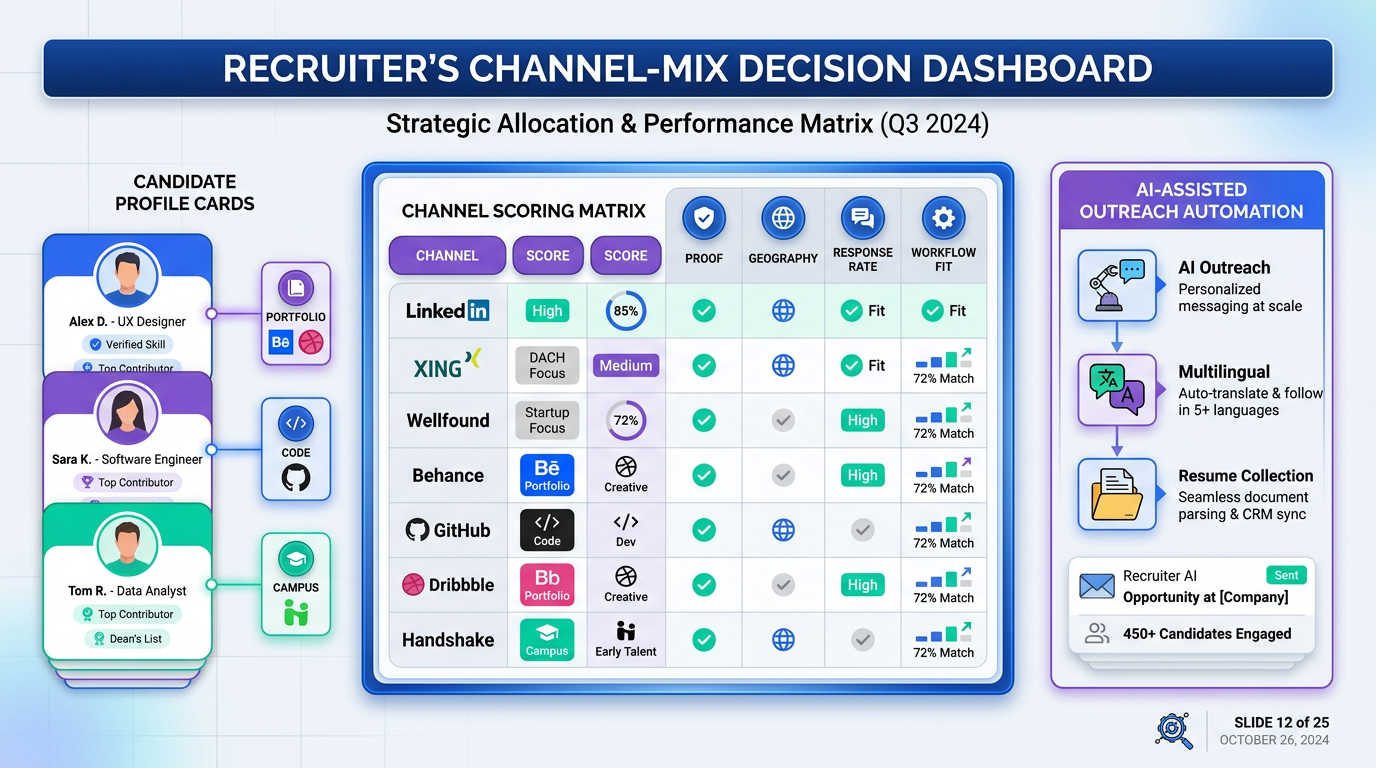
When sourcing stalls, this article helps recruiters judge which websites like LinkedIn reveal real candidate proof and avoid weak shortlists.
That sounds obvious until a search turns into wasted hours: polished profiles with weak evidence, strong candidates who never reply, regional talent hidden outside your usual tools, and hiring managers expecting one network to cover startup, creative, technical, and campus recruiting equally well. For a solo recruiter, that means slower outreach and weaker shortlists. For a small agency owner, it means missed placements and avoidable delivery strain. For an in-house TA lead, it often turns into poor channel mix, inconsistent candidate notes, and too much time spent chasing basic replies after hours.
That is also where StrategyBrain AI Recruiter can help inside a LinkedIn-heavy workflow. I have found it most useful for three practical gaps: keeping outreach moving with automated candidate messaging, handling after-hours follow-up in the candidate's language, and collecting resumes or contact details from interested people so the conversation does not stall. It does not replace recruiter judgment. I still review resumes, decide who moves forward, and make the final call on fit, but it reduces the repetitive front-end work that usually clogs sourcing.
The underlying issue is not new. Think about an accountant trying to move into a financial analyst role: on paper, the background may look close, but the actual move depends on whether the person can work across teams, explain finance to non-finance people, handle ambiguity, improve processes, and make recommendations when the answer is not clean. A recruiter evaluating that transition cannot rely on title match alone. They have to read for evidence, not just presentation.
The same logic is what makes comparing sites similar to LinkedIn more nuanced than most list posts admit. Some platforms are better at showing social credibility, some reveal project work, some expose how a candidate thinks in ambiguity, and some are simply stronger in a local market. If you want better sourcing decisions, the right question is not which single network replaces LinkedIn, but which of the professional networking sites like LinkedIn gives you the clearest signal for the role you need to fill.
Quick Answer: Which LinkedIn Alternatives Matter Most?
| Platform | Best For | What Signal It Gives | Recruiter Use Case |
|---|---|---|---|
| DACH hiring | Regional professional identity | Germany, Austria, Switzerland sourcing | |
| Wellfound | Startups | Stage and startup intent | Early-stage and venture-backed hiring |
| Behance | Creative roles | Portfolio quality | Design and brand hiring |
| GitHub | Engineering roles | Code and collaboration footprint | Developer sourcing and validation |
| Dribbble | UI and product design | Visual craft and style | Fast design screening |
| Handshake | Students and grads | Campus intent | Internships and graduate programs |
| ResearchGate | Academic and research talent | Research output | Scientific and specialist hiring |
| Stack Overflow communities | Developers | Technical problem-solving | Engineering brand and outreach context |
| Industry associations | Niche professions | Credentials and community standing | Hard-to-fill specialist roles |
| Regional business directories | Local markets | Trust-based local visibility | Country-specific relationship hiring |
Bottom line: the best LinkedIn alternative depends on whether you need networking reach, role-specific proof, geographic relevance, or easier candidate engagement.
Table of Contents
- Why LinkedIn alternatives need context
- How recruiters should evaluate platforms
- Best for general networking and business visibility
- Best for startup hiring
- Best for creative hiring
- Best for developer hiring
- Best for student recruiting
- Best LinkedIn alternatives outside the U.S.
- Using LinkedIn with AI support
- How to choose the right platform
- FAQ
Why LinkedIn Alternatives Need Context
Recruiters often search for websites like LinkedIn as if they are looking for one universal replacement. In practice, that is usually the wrong buying logic and the wrong sourcing logic. A general network can help with broad visibility, but it may tell you very little about whether a candidate can influence non-technical stakeholders, work through uncertainty, or show finished work.
That is why the accountant-to-analyst example matters here. The move succeeds only when the recruiter looks beyond title adjacency and starts checking for transition signals: cross-functional communication, willingness to challenge weak plans, ownership of projects, comfort with ambiguity, and sound decision-making. Those same evaluation habits should shape how you compare platforms.
If a network mainly rewards polished self-presentation, it may be weaker for roles where proof matters more than profile language. If a community shows actual work, peer interaction, or role-specific credibility, it may be one of the best professional networking sites like LinkedIn for that function even if it is not a classic networking platform.
How Recruiters Should Evaluate Platforms
From a recruiting operations perspective, I compare sites similar to LinkedIn against five practical criteria before I decide where to spend time.
- Can the platform show social skill or cross-team credibility? This matters for roles where influence and stakeholder alignment matter as much as technical ability.
- Can it reveal real work or process improvement? Portfolios, code, publications, and discussion history often tell you more than profile summaries.
- Does it help you judge ambiguity tolerance? Some platforms reveal how candidates think in open-ended environments better than a formal resume site.
- Is the audience actually active in your market? Local hiring behavior can beat global scale.
- Will the workflow fit your team? Good sourcing channels still fail if outreach, follow-up, and handoff are too manual.
Practical takeaway: The strongest alternative is the one that surfaces the proof your role requires, not the one that looks most like LinkedIn.
Best Websites Like LinkedIn for General Networking and Business Visibility
If you need broad professional discovery, start with channels that preserve some mix of profile visibility, employer presence, and networking utility.
Best for: professional hiring in Germany, Austria, and Switzerland.
XING remains one of the clearest examples of a regional platform outperforming bigger global networks when geography matters. For DACH recruiting, it can provide stronger language alignment, more local relevance, and a better sense of where candidates maintain their active professional identity.
- Strengths: regional credibility, local market fit, business networking
- Limitations: less useful for broad international searches
- Best use: market-specific sourcing where local context affects response rates
Regional Business Networks and Directories
Best for: trust-based local recruiting and relationship-led hiring.
In some markets, chamber-style networks, local directories, and country-specific professional communities function as effective websites like LinkedIn. They are rarely ideal for scale, but they can be useful where reputation and local business context matter more than volume.
- Strengths: location relevance, business trust, community overlap
- Limitations: inconsistent profiles, smaller reach
- Best use: localized searches for commercial, operations, and relationship-heavy roles
Best Websites Like LinkedIn for Startup Hiring
Startup recruiting usually benefits from platforms that reveal role scope, company stage, and mission alignment rather than polished corporate branding alone.
Wellfound
Best for: startup candidates, early-stage companies, and founder-led hiring.
Among sites similar to LinkedIn, Wellfound is often a better fit for startup searches because candidates there are more likely to self-select around growth stage, product interest, and role breadth. That context matters when a recruiter needs people comfortable with ambiguity and ownership, not just title progression.
- Strengths: startup intent, stage visibility, lean-team relevance
- Limitations: narrower talent pool than a broad professional network
- Best use: product, growth, and early team-build hiring
Founder and Operator Communities
Best for: first hires and trust-heavy recruiting.
Some of the best startup channels are not formal job networks at all. Operator communities and founder circles often surface candidates through peer trust, which can be especially useful when a role requires independent judgment, project ownership, and comfort with unclear conditions.
- Strengths: warm access, fast context, stronger fit signals
- Limitations: hard to scale, less structured search
- Best use: specialist startup roles where referrals outperform mass outreach
Best Websites Like LinkedIn for Creative Hiring
Creative recruiting is one of the clearest cases where profile polish is not enough. You need to see the work.
Behance
Best for: visual portfolios and creative proof of ability.
Behance is one of the most practical websites like LinkedIn for design, branding, illustration, and other visual fields because it allows recruiters and hiring managers to assess actual output instead of relying on resume language.
- Strengths: portfolio depth, visual storytelling, discipline-specific discovery
- Limitations: weaker as a general networking platform
- Best use: evaluating design quality before outreach
Dribbble
Best for: product, UI, and digital design hiring.
Dribbble can be especially useful when you need quick visual comparison across candidates. It helps surface style, craft, and presentation quality fast, though it should not be your only evaluation source.
- Strengths: rapid visual screening, strong design signal
- Limitations: may overemphasize polished presentation
- Best use: first-pass design sourcing paired with structured interviews
Best Websites Like LinkedIn for Developer Hiring
For engineering recruitment, some of the best professional networking sites like LinkedIn are not traditional networking sites at all. They show contribution, problem-solving, and technical credibility in context.
GitHub
Best for: developer sourcing and technical signal review.
GitHub is often more useful than broad professional profiles when you need evidence of engineering work. Public repositories, collaboration patterns, and visible interests can help a recruiter build a more grounded outreach strategy.
- Strengths: code visibility, technical context, collaboration history
- Limitations: many strong developers have limited public activity
- Best use: enriching outreach and validating technical background
Technical Community Platforms
Best for: outreach informed by expertise and participation.
Developer forums and Q&A communities can function as sites similar to LinkedIn because they reveal how people think, explain, and solve problems. For some engineering roles, that is a better signal than headline branding.
- Strengths: expertise visibility, peer recognition, topic relevance
- Limitations: less standardized, harder to fit into rigid sourcing process
- Best use: targeted engineering searches with hiring-manager input
Best Websites Like LinkedIn for Student Recruiting
Early-career hiring requires a different lens because many candidates have limited work history and weaker public professional profiles.
Handshake
Best for: internships, graduate programs, and student pipelines.
Handshake is one of the most useful professional networking sites like LinkedIn in the campus space because it helps employers reach students in a more focused environment than a general professional network.
- Strengths: campus access, student intent, university alignment
- Limitations: less useful for experienced roles
- Best use: recurring graduate and intern hiring programs
University Career Networks
Best for: school-specific sourcing and alumni engagement.
Career portals and alumni systems may lack broad scale, but they can be effective for targeted outreach where institution fit matters.
- Strengths: defined talent pools, event integration, institutional targeting
- Limitations: fragmented access across schools
- Best use: planned campus recruiting calendars rather than one-off posting
Best LinkedIn Alternatives Outside the U.S.
International hiring is where recruiters most often overvalue platform familiarity. The best websites like LinkedIn outside the U.S. are often local or regional because candidate behavior, language, and business trust vary by market.
If your target candidates maintain their real professional identity on a local network, forcing a global-first sourcing model usually creates weaker response rates and poorer relevance. XING is the best-known example in DACH markets, but the broader lesson applies everywhere: start with where your audience is active, not with the tool your team already knows best.
Using LinkedIn With AI Support Instead of Replacing It
One reason recruiters look for LinkedIn alternatives is not that LinkedIn stops being useful. It is that the workflow around it becomes too manual. Searching, opening conversations, following up after work hours, collecting resumes, and keeping contact details organized can consume more time than the sourcing decision itself.
In my own process, I have used AI Recruiter as support rather than as a replacement for recruiter judgment. It is especially useful when I already know LinkedIn is the right channel but I need help sustaining outreach volume and responsiveness. Its multilingual communication helps when candidates reply outside my working hours or prefer another language. Its automated follow-up helps keep intent discovery moving. And when an interested candidate sends a resume or contact information, the handoff becomes cleaner.
If you want to understand how that workflow is framed, the official setup overview and the broader LinkedIn sourcing notes are useful starting points. The important boundary is this: the system can automate repetitive front-end communication, but the recruiter still decides whether the candidate's background really matches the role, just as you would still need to judge whether an accountant truly shows analyst-level readiness.
Key insight: Sometimes the best answer is not leaving LinkedIn. It is using LinkedIn more intelligently while shifting specialized searches to better-fit communities.
How to Choose the Right Platform for Your Hiring Team
The most reliable way to compare sites similar to LinkedIn is to begin with the hiring problem, then choose the channel that reveals the right evidence.
- Start with the role's success conditions. Does the role require social influence, portfolio quality, project ownership, technical proof, or local market trust?
- Look for evidence, not title match. This is the same habit that helps when evaluating adjacent-career candidates.
- Separate sourcing from workflow. A strong platform can still underperform if your team cannot keep up with outreach and replies.
- Check geography early. Regional networks may outperform global ones.
- Use more than one channel when the role demands it. Broad visibility and specialized proof often come from different places.
| Hiring Need | Best Alternative Type | Why It Works |
|---|---|---|
| Broad professional hiring | General or regional professional networks | Good for visibility and employer presence |
| Startup recruitment | Startup-focused communities | Better stage and mission alignment |
| Creative roles | Portfolio platforms | Shows work quality directly |
| Engineering roles | Developer communities | Provides technical context and proof |
| Campus hiring | Student networks | Better early-career targeting |
| International local hiring | Regional platforms | Stronger language and market fit |
Common Mistakes When Comparing LinkedIn Alternatives
1. Expecting every platform to replace LinkedIn completely
Most alternatives are valuable because they are specialized, not because they mimic every LinkedIn feature.
2. Confusing profile polish with hiring signal
The accountant-to-analyst logic applies here too. Smooth presentation does not automatically mean cross-functional ability, project ownership, or decision quality.
3. Ignoring workflow friction
Even a good sourcing channel becomes inefficient if replies, follow-ups, and resume collection stay manual.
4. Overlooking geography
Local professional identity often lives outside global platforms.
5. Using the same platform mix for every role family
Creative, technical, startup, and student hiring each need different evidence environments.
FAQ
What is the best LinkedIn alternative?
There is no single best answer. The strongest option depends on the role, market, and type of evidence you need. XING is strong for DACH hiring, Wellfound for startups, Behance and Dribbble for creatives, GitHub for developers, and Handshake for student recruiting.
Which websites like LinkedIn are best for recruiters?
For recruiters, the best platforms are the ones that improve signal quality. General professional networks help with broad visibility, while niche communities often produce better fit for specialized searches.
Are there professional networking sites like LinkedIn for technical and creative roles?
Yes. GitHub and technical communities are often more useful for engineers, while Behance and Dribbble are stronger for visual and product design roles because they show actual work.
Can I keep using LinkedIn instead of moving to another platform?
Often yes. Many recruiters do better by keeping LinkedIn for broad sourcing and outreach, then adding specialized platforms for role-specific evidence. Workflow support tools can also reduce the manual burden without changing your main sourcing channel.
How does StrategyBrain AI Recruiter fit into this?
It fits best when LinkedIn is still part of your sourcing mix but the messaging and follow-up workload is slowing you down. It can automate outreach conversations, support multilingual replies, and collect candidate details, while the recruiter keeps control of fit assessment and next-step decisions.
Conclusion
If you are comparing websites like LinkedIn, the most useful shift is to think like a recruiter assessing a career transition: do not stop at labels, and do not assume similarity equals fit. Ask what evidence the platform reveals, what audience it actually reaches, and whether your team can manage the workflow around it.
That is how experienced teams get better results from sites similar to LinkedIn and other professional networking sites like LinkedIn. Sometimes that means choosing a regional network. Sometimes it means a portfolio or developer community. And sometimes it means keeping LinkedIn in the mix while using StrategyBrain AI Recruiter to make the repetitive parts of outreach easier to manage.