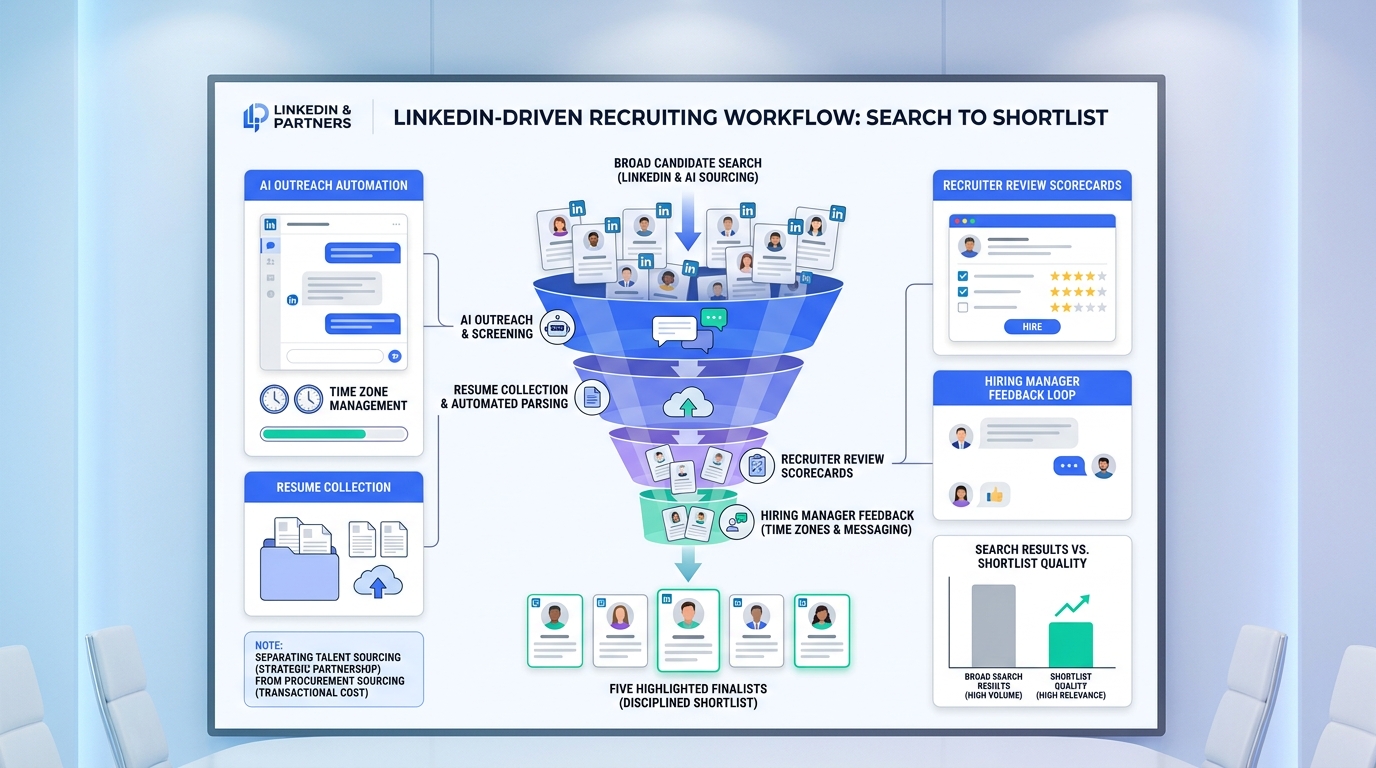
Recruiters can use this article to judge sourcing platforms by shortlist quality, avoiding wasted outreach and weak interview slates.
When that link breaks, the damage shows up fast: wasted outreach, weak interview slates, slower client feedback, and candidates who disengage while recruiters sort through profiles that looked right in search but fail under real review. In smaller search firms and lean in-house teams, that is not just a workflow problem. It hits revenue, credibility, and the hiring manager’s confidence in the recruiter’s market read.
That is why I increasingly separate search from shortlisting when I evaluate AI workflows. In practice, tools such as StrategyBrain AI Recruiter can help most on the repetitive front end: initiating candidate conversations, replying across time zones, and collecting resumes or contact details from interested people. That support matters when LinkedIn sourcing starts to sprawl, but the recruiter still has to make the final call on fit, shortlist balance, and whether a candidate should move forward.
The shortlisting problem becomes obvious in the middle of a live search. A hiring team has already posted the role and gathered applicants, or a recruiter has sourced a broad market list, but the process stalls before interviews. Someone has to define what qualified really means, compare required experience against the role’s longer-term goals, and decide which five to ten people deserve serious attention rather than another round of filtering.
That is the moment where many modern sourcing decisions are won or lost. If your system only returns literal matches, the shortlist becomes narrow and repetitive. If it surfaces too much without clear reasoning, recruiters lose trust and hiring managers get noisy slates. So when people research sourcing platforms for AI candidate sourcing, the real question is not just who the tool can find. It is whether it helps the recruiter move from broad discovery to a disciplined shortlist without confusing talent workflows with strategic sourcing software or sourcing tools for procurement.
Table of Contents
- Why shortlisting should shape platform evaluation
- Candidate sourcing vs. procurement sourcing
- How AI candidate sourcing supports shortlisting
- What good shortlisting looks like in practice
- AI sourcing vs. Boolean search in shortlist building
- How to evaluate sourcing platforms for recruiting teams
- Using AI support in LinkedIn-heavy workflows
- Common mistakes when buying sourcing technology
- FAQ
Why shortlisting should shape platform evaluation
Most conversations about AI candidate sourcing start too early in the process. Vendors and buyers focus on search speed, database breadth, or automation features. Recruiters, however, usually feel the real value later, when they need to convert a broad pool into a credible shortlist.
That is why shortlisting is a useful lens for evaluating sourcing platforms. In recruiting, shortlisting is the bridge between identification and interview scheduling. It narrows a large set of applicants or sourced profiles into a manageable group of serious contenders. Done well, it saves time, improves consistency, and reduces the risk of missing strong but non-obvious talent.
From experience, the best shortlist is rarely the one with the most exact title matches. It is the one built with clear criteria, structured review, and enough recruiter judgment to spot transferable value. AI can help surface those possibilities, but it cannot decide organizational fit, motivation, or whether the slate gives a hiring manager real options.
That distinction matters because many teams buy sourcing technology as if search were the end product. It is not. The output that hiring managers actually experience is the shortlist. If that shortlist is slow, bloated, repetitive, or poorly calibrated, the platform has not solved much.
Candidate sourcing vs. procurement sourcing
Because the language around “sourcing” overlaps across functions, it is important to define the category clearly before evaluating software.
| Area | Candidate sourcing platforms | Supplier sourcing software |
|---|---|---|
| Primary goal | Find and engage talent for open roles | Identify and evaluate suppliers for business purchases |
| Main users | Recruiters, HR, agency sourcers, hiring managers | Procurement, sourcing, finance, operations |
| Core workflows | Talent search, shortlist creation, outreach, pipeline handoff | Supplier discovery, RFx, negotiation, evaluation, source-to-contract |
| Success criteria | Search relevance, shortlist quality, recruiter efficiency | Cost control, risk management, spend visibility, supplier selection |
If you are researching strategic sourcing software or sourcing tools for procurement, you are usually looking at supplier selection, negotiation support, compliance, and spend management. That is a different buying category from AI candidate sourcing.
Recruiting teams should be especially careful when procurement helps manage software selection. The shared word “sourcing” can create false alignment in requirements gathering, demo invitations, and internal discussions. If the hiring goal is better talent pipelines and stronger shortlists, the category under review should stay anchored in recruiting workflows.
Key insight: In talent acquisition, the practical output of sourcing is not a list of names. It is a shortlist that a hiring manager can trust enough to interview.
How AI candidate sourcing supports shortlisting
AI candidate sourcing changes the top of funnel because it moves beyond exact keyword overlap. Instead of forcing recruiters to manually encode every title variation, skill synonym, and adjacent background, stronger systems interpret role intent and surface profiles that might reasonably fit.
That supports shortlisting in several ways.
1. It broadens discovery without forcing title clones
A recruiter may be hiring for a customer-facing implementation leader, but qualified people may come from operations, consulting, onboarding, or post-sale delivery roles. Traditional filters often miss that. Better sourcing platforms can widen the field while still preserving relevance.
2. It helps recruiters move beyond rigid keyword screens
One of the biggest shortlisting mistakes is over-reliance on keywords. Strong candidates often describe their work differently from how a job description is written. AI-supported matching can surface adjacent experience that deserves a second look rather than an immediate rejection.
3. It accelerates the first pass, not the final decision
In real recruiting, the software’s job is to reduce repetitive work at the top of the funnel. The recruiter still needs to review resumes, test assumptions, compare motivations, and build a balanced slate that includes ready-now talent, high-potential profiles, and perhaps one unconventional option worth discussing.
4. It can improve responsiveness in outreach-heavy searches
For LinkedIn-heavy sourcing, the volume problem is not only finding people. It is keeping the conversation moving. In my own workflow, AI-supported outreach has been most useful when it handles repetitive initial engagement and after-hours replies, then hands off interested candidates with resumes or contact details collected for human review.
What good shortlisting looks like in practice
The reference point I use for evaluating AI candidate sourcing is simple: does it help recruiters build a shortlist with discipline?
That usually means following a sequence like this:
- Define qualification criteria before search volume takes over. Separate must-haves from desirable traits, and make room for transferable backgrounds.
- Review candidates with structure. Use scorecards, matrices, or at least a repeatable comparison method so the shortlist is not driven by whoever scanned fastest.
- Blend technology with human judgment. Search tools can retrieve options; recruiters assess pattern, trajectory, communication signals, and likely fit.
- Assess soft indicators as well as hard requirements. Motivation, communication quality, progression, and adaptability often explain why one seemingly similar profile moves ahead of another.
- Build a balanced slate. A useful shortlist is not always a stack of nearly identical resumes. It should give the hiring manager strategic options.
These principles matter because shortlisting is where sourcing either becomes a hiring advantage or turns into noise. If the platform helps with discovery but makes review less transparent, it can still hurt decision quality.
AI sourcing vs. Boolean search in shortlist building
For experienced sourcers, the most practical comparison is still AI sourcing versus Boolean search.
| Approach | Strengths | Limits | Best use case |
|---|---|---|---|
| Boolean search | Precise control, transparent logic, useful for narrow criteria | Time-intensive, brittle queries, weak at adjacent talent discovery | Tightly defined searches with experienced sourcers |
| AI candidate sourcing | Semantic matching, broader discovery, faster iteration, natural-language search | Needs validation, ranking quality varies, can create noisy edge cases | Teams that need broader discovery and quicker shortlist formation |
In practice, I do not see this as an either-or decision. AI is useful for opening the market and catching people who do not mirror the job description. Boolean still matters when I want to pressure-test a niche requirement or validate whether the AI is overreaching.
The recruiter’s job is to keep both methods tied to the shortlist outcome. If the search gets broader but the slate gets weaker, the workflow has not improved.
How to evaluate sourcing platforms for recruiting teams
When comparing sourcing platforms, I recommend evaluating them against the point where recruiters actually create value: moving from broad search to a strong shortlist.
Search quality
Can the system understand plain-English role requirements? Does it retrieve adjacent but relevant profiles? Can it distinguish seniority, scope, and industry context?
Practical test: Run one straightforward role, one niche role, and one role with inconsistent market titles.
Transparency of matching
If a platform cannot explain why a person surfaced, recruiter trust drops. Opaque ranking is a common reason that AI adoption stalls after the demo stage.
Practical test: Ask reviewers to mark not only whether they agree with the results, but whether they understand them.
Shortlist workflow support
The platform should make it easy to compare candidates, reject quickly, document reasons, and hand off a clean slate to hiring stakeholders.
Practical test: Time how long it takes to go from intake to a reviewable shortlist, not just from prompt to search results.
Support for structured evaluation
The strongest systems fit into scorecards, team calibration, and hiring manager feedback loops. Shortlisting gets weaker when the software encourages browsing but not disciplined decision-making.
Practical test: Check whether your team can preserve must-have versus nice-to-have criteria during review.
Outreach and responsiveness
Some teams need search only. Others need help with candidate engagement, follow-up, and intake of resumes before the shortlist is finalized.
Practical test: Identify whether the system reduces actual recruiter workload or merely adds another layer to manage.
Use-case fit
Do not assume one strong demo translates across executive search, technical recruiting, volume hiring, and international sourcing. Shortlisting standards vary by search type.
Practical test: Score by use case, not feature count.
Using AI support in LinkedIn-heavy workflows
Where I have found AI support most practical is in LinkedIn workflows that become fragmented before the shortlist is even ready. Recruiters are sending outreach, checking replies after hours, collecting resumes in multiple ways, and trying not to lose momentum while hiring managers wait for a refined slate.
In that environment, a tool like AI Recruiter from StrategyBrain can help on the repetitive communication side. The capabilities that matter most in this context are automated candidate introductions, ongoing message handling across time zones, and collection of resumes or contact details once interest is confirmed. That can reduce the back-and-forth that usually delays shortlist formation.
My own takeaway from using this kind of workflow is that it works best when the handoff point is explicit. I want the AI to keep conversations active and organized, but I do not want it making the hiring judgment for me. Once a candidate expresses interest and sends information, the recruiter still needs to review the resume, compare it against the role brief, and decide whether that person strengthens the shortlist or just increases volume.
For teams doing a lot of outbound sourcing on LinkedIn, it is also worth reviewing examples and implementation material before rollout, such as the conversation cases and the setup overview. The useful lesson is not that outreach can be fully handed off. It is that repetitive sourcing work can be stabilized so recruiters spend more time on assessment and shortlist quality.
Common mistakes when buying sourcing technology
- Evaluating search without evaluating shortlist quality. A broad result set is not the same as a useful hiring slate.
- Over-relying on keyword logic. This often filters out candidates with relevant but differently described experience.
- Ignoring structured review. Even excellent search results create messy hiring decisions if the team lacks a consistent shortlist method.
- Confusing outreach automation with qualification. Candidate interest is helpful, but it is not the same as fit.
- Testing only easy roles. Hard searches reveal whether semantic matching is genuinely useful.
- Mixing talent software with procurement categories. Teams evaluating strategic sourcing software or sourcing tools for procurement are solving a different problem.
In most recruiting teams, better software does not remove the need for rigor. It raises the ceiling on what a disciplined recruiter can do.
FAQ
What is AI candidate sourcing?
AI candidate sourcing uses software to identify and rank potential candidates based on role context, related experience, and semantic matching rather than exact keyword overlap alone.
Why does shortlisting matter when evaluating sourcing platforms?
Because the real recruiting output is not a search result page. It is a shortlist of candidates credible enough to interview. If the platform cannot help recruiters build that shortlist efficiently and consistently, its value is limited.
Are sourcing platforms the same as strategic sourcing software?
No. In recruiting, sourcing platforms are for finding and engaging talent. Strategic sourcing software usually refers to procurement tools for supplier evaluation, spend control, and negotiation workflows.
How is AI sourcing different from Boolean search?
AI sourcing is better for broader discovery and natural-language search, while Boolean gives recruiters more precise manual control. Many teams get the best results by using both.
Can AI replace recruiter judgment in shortlisting?
No. AI can improve discovery, responsiveness, and early filtering, but recruiters still need to assess resumes, motivation, context, and shortlist balance before deciding who moves forward.
Where do sourcing tools for procurement fit here?
They do not fit the talent workflow directly. Sourcing tools for procurement are designed for supplier sourcing, RFx processes, cost management, and related procurement tasks rather than candidate search and shortlisting.
Conclusion
AI candidate sourcing is most valuable when it improves the part of recruiting that actually changes outcomes: the quality and speed of the shortlist. That is why experienced recruiters should judge sourcing platforms less by feature volume and more by whether they support clear criteria, stronger discovery, structured review, and better handoff to hiring managers.
If you keep that lens in place, it also becomes much easier to separate talent technology from strategic sourcing software and sourcing tools for procurement. They may share language, but they solve different business problems. For recruiting teams, the better question is simple: which tools help us find, engage, review, and shortlist the right people with less wasted motion and more confidence?