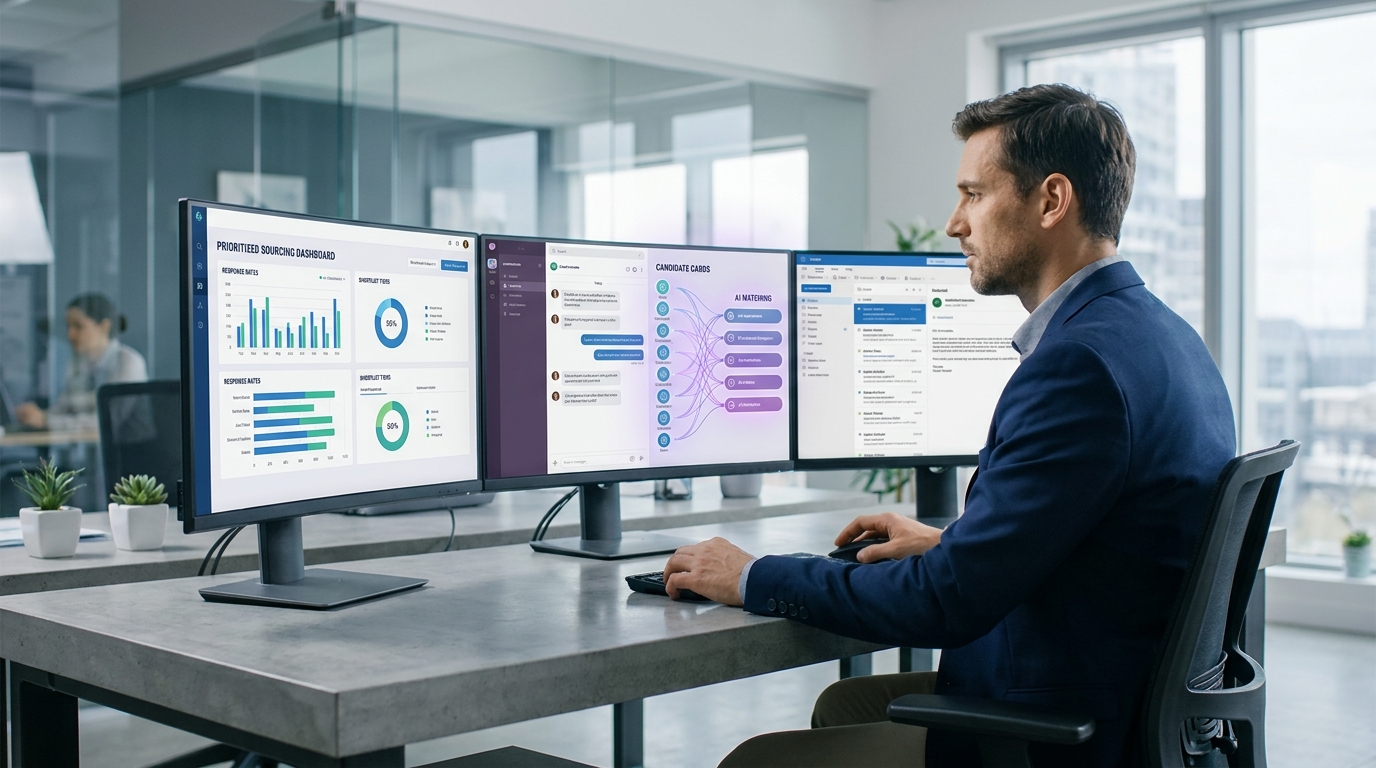
This article shows recruiters how to judge recruiting sourcing priorities to avoid slow outreach, weak shortlists, and cold candidates.
That sounds obvious until a live search spans several sectors, mixed seniority levels, and multiple hiring stakeholders at once. In smaller agencies, one consultant may be juggling finance, IT, administrative, and contract searches in the same week. In-house teams feel a similar squeeze when hiring managers want speed, but the market does not organize itself around one perfect title. The result is usually the same: slow outreach, missed replies, inconsistent notes, and candidates who go cold before anyone has made a confident judgment.
That is one reason I have found StrategyBrain AI Recruiter useful in active LinkedIn sourcing workflows. It helps with the repetitive front-end work that creates bottlenecks: connecting with targeted candidates, handling after-hours replies, and collecting resumes or contact details from interested people. What it does not do, and should not do, is replace recruiter judgment. I still review the profile, evaluate the resume, and decide whether the person belongs in the shortlist or should move to interview.
A good example of the pressure behind this comes from a market like Ottawa, where recruiting demand does not sit in one lane. Agencies there are expected to cover government-adjacent hiring, but also technology, finance, construction, manufacturing, healthcare, clerical work, and temporary labor across Ottawa, Gatineau, and nearby communities. In that kind of environment, recruiters are not just filling one role. They are switching between executive search, IT staffing, administrative recruitment, and contract needs while trying to keep service quality consistent.
Once that workload spreads across specialized firms, regional staffing offices, and sector-specific boutiques, the real issue becomes easier to see. The challenge is not simply finding more people. It is deciding which profiles deserve immediate outreach, which channels fit each role, and how to keep candidate conversations moving when the market is broad and the recruiter's time is not. That is exactly where AI candidate sourcing becomes useful, and it also explains why questions like what is HR sourcing and which sourcing strategies work best matter more than most teams expect.
Table of Contents
- Why Market Complexity Changes Recruiting Sourcing
- What Is AI Candidate Sourcing?
- What Is HR Sourcing?
- Sourcing vs Recruiting: The Operational Difference
- How AI Candidate Sourcing Helps in Daily Work
- Sourcing Strategies for Multi-Sector Hiring
- A Practical Recruiting Sourcing Workflow
- My LinkedIn Workflow Experience With AI Recruiter
- Benefits and Risks to Manage
- What to Measure
- Common Mistakes
- FAQ
Why Market Complexity Changes Recruiting Sourcing
When recruiters work in a city or region with a broad employer base, sourcing gets more complicated than a keyword search. Ottawa is a useful example because local recruiting firms often serve several very different hiring categories at once. Some agencies are broad staffing providers covering temporary, permanent, and contract work. Others specialize in finance and payroll. Others focus on technology, legal support, corporate services, or government-related hiring.
That kind of market teaches an important sourcing lesson: recruiting sourcing is rarely one universal process. The way you build a shortlist for an accounting search is different from the way you approach an IT contractor, an office administrator, or a construction hire. Sector spread changes where talent sits, how titles are used, and how quickly a candidate may respond.
It also changes how recruiters should judge tools. The best support is not the one that promises magic. It is the one that helps recruiters handle broad search coverage without losing relevance. If your workflow has to support specialized agencies, general staffing teams, and repeat hiring across several functions, then your sourcing process needs better prioritization, cleaner communication, and stronger pipeline discipline.
What Is AI Candidate Sourcing?
AI candidate sourcing is the use of intelligent search, matching, and outreach support to help recruiters identify and engage likely-fit talent before formal screening starts. In practical recruiting sourcing terms, it strengthens the discovery stage of hiring.
The reason it matters is simple. Traditional sourcing often relies too heavily on exact job titles or rigid Boolean strings. That works when the market uses consistent language. It breaks down when strong candidates have adjacent titles, transferable skills, or sector-specific wording that does not mirror the requisition.
AI candidate sourcing can help by connecting skill patterns, related backgrounds, and semantic profile signals that a manual title-only search might miss. In other words, it can widen the top of the funnel without forcing the recruiter to manually inspect every weak match.
Used properly, it is not a substitute for recruiter expertise. It is support for the highest-friction parts of outbound talent discovery: finding more relevant people, prioritizing who to message first, and keeping outreach moving while the recruiter focuses on fit, persuasion, and hiring-team alignment.
What Is HR Sourcing?
What is HR sourcing? HR sourcing is the proactive work of identifying, attracting, and engaging possible candidates for current or future roles before they enter the standard interview process.
That usually includes:
- Market mapping
- Talent pool building
- Direct outreach
- Referral activation
- Rediscovery of previous applicants
- Early interest qualification
In strong teams, HR sourcing is not a last-minute reaction after a requisition opens. It is an ongoing capability tied to workforce planning and recurring hiring demand. That is especially important in markets where employers hire across multiple functions, because waiting to source until the role is urgent usually leads to rushed searches and weaker outreach.
If you want the short version, HR sourcing is the discipline of creating access to talent before the rest of recruiting can work well.
Sourcing vs Recruiting: The Operational Difference
Many teams blur sourcing and recruiting together, but separating them improves execution.
| Function | Sourcing | Recruiting |
|---|---|---|
| Main goal | Find and attract relevant talent | Assess, coordinate, and close candidates |
| Typical timing | Before screening and interviews | After candidates enter process |
| Core work | Search, mapping, outreach, pipeline building | Screening, interviews, feedback, offers |
| Success signal | Qualified interest and usable shortlists | Progression, acceptance, and quality of hire |
This distinction matters because AI tends to be most useful in the sourcing portion. It helps teams discover, sort, and maintain momentum. It is much less reliable if teams expect it to replace human evaluation or hiring decisions.
In agency work, that matters even more. A recruiter serving several clients cannot afford to treat every search the same way. Sourcing needs to be calibrated to the role, market, and urgency level long before the recruiting process becomes visible to the candidate.
How AI Candidate Sourcing Helps in Daily Work
In real recruiting sourcing workflows, AI support is most valuable when it reduces repetitive front-end effort without removing human control.
1. It broadens role interpretation
If a hiring manager asks for one title, but the market uses five neighboring titles, AI can help surface candidates from adjacent backgrounds. This is often where manual LinkedIn searches lose time.
2. It improves skills-based candidate matching
Skills-based discovery matters in sectors where titles vary by company size, industry, or geography. Instead of forcing exact title alignment, AI can help recruiters identify profiles that share capability patterns.
3. It supports outreach prioritization
Once the search opens up, the next problem is deciding who to contact first. AI can help sort candidates by likely fit, profile completeness, or responsiveness signals so the recruiter can work a smarter outreach order.
4. It keeps conversations moving
One of the least discussed sourcing problems is reply lag. Good candidates often respond outside standard working hours. If the recruiter answers too slowly, momentum drops. That is where tools that support always-on communication can reduce drop-off in active sourcing.
5. It helps recover neglected talent pools
Older applicants, silver medalists, and past prospects are often useful but underused. AI support can make it easier to revisit those records and identify people worth re-engaging.
Practical takeaway: The best use of AI candidate sourcing is not replacing recruiter judgment. It is reducing search friction so recruiter judgment can be applied where it matters most.
Sourcing Strategies for Multi-Sector Hiring
The strongest sourcing strategies depend on the market you are covering. In broad hiring environments, recruiters need process discipline more than clever search strings.
Use role-based sourcing plans
Do not treat every requisition as a copy-and-paste exercise. A finance search, an IT search, and a temporary staffing search should each have different target profiles, channels, and outreach angles.
Map the market before sending volume outreach
In markets similar to Ottawa, where agencies may recruit across technology, accounting, administration, legal support, manufacturing, and government-related functions, the first task is to understand where relevant talent is likely to sit. That means clarifying sectors, neighboring titles, and employer clusters before outreach starts.
Balance specialization with range
Some agencies win through niche expertise, others through broad staffing reach. Your sourcing workflow should reflect that reality. If you recruit across several industries, AI support should help you maintain range without collapsing your standards for fit.
Use direct outreach thoughtfully
Passive candidate outreach still works, but only when the message sounds informed. Generic messages underperform, especially when candidates are experienced and not actively looking. AI can help with consistency and speed, but recruiter review is still what keeps the message credible.
Refresh internal and referral pipelines
Past applicants and referral networks often deliver faster results than a cold search. In repeat-hiring categories, this is one of the easiest ways to reduce wasted effort.
When teams ask which sourcing strategies age well, my answer is usually the same: the durable ones are multi-channel, role-specific, and disciplined enough to survive a busy desk.
A Practical Recruiting Sourcing Workflow
Here is the workflow I recommend when using AI candidate sourcing in a real desk environment.
- Define the hiring brief properly. Separate must-haves from preferences and identify adjacent profiles that could work.
- Check market shape first. Identify which sectors, companies, and title variations are likely to hold relevant talent.
- Build the outreach list. Use AI-assisted discovery to widen the search beyond exact title matches.
- Calibrate early. Review the first batch with the hiring manager or client before scaling outreach.
- Prioritize conversations. Focus on candidates with the best combination of fit, likely interest, and accessibility.
- Keep replies moving. Reduce delays in candidate communication, especially in direct LinkedIn sourcing.
- Review resumes and context manually. AI can assist with collection and organization, but the recruiter must still judge relevance.
- Feed learning back into the process. Track which backgrounds convert into qualified conversations and refine future searches accordingly.
This workflow is especially useful when one recruiter is covering multiple live searches and cannot afford to restart the same sourcing logic from scratch each time.
My LinkedIn Workflow Experience With AI Recruiter
Most of my hands-on use has been in LinkedIn-heavy recruiting sourcing, where the biggest drain is not search alone but the stop-start nature of candidate conversation. I can build a decent list manually. The trouble usually starts after that: connection requests sit unanswered, replies come in late at night, candidates ask practical questions, and strong prospects disappear if the handoff is too slow.
That is where I found AI Recruiter helpful. In my workflow, it handled three tasks that usually create friction: it automated initial connection and role introduction on LinkedIn, kept communication moving outside my working hours, and captured resumes or contact details when a candidate showed real interest. That removed a lot of repetitive follow-up without changing who made the actual recruiting decision.
I was careful about the boundary. The tool could help identify willingness to engage, but I still needed to read the profile, review the resume, and decide whether the person matched the search. That division of labor felt right. For me, the gain was not blind automation; it was cleaner momentum in the early sourcing stage.
If you work across time zones or hire internationally, the multilingual communication side is also relevant. I have seen how language or timing gaps slow down otherwise promising outreach. A tool that can continue the early conversation while preserving recruiter oversight can be genuinely useful there. Anyone evaluating that side of the workflow can review the broader product background at StrategyBrain or see more discussion of LinkedIn recruiting automation at this LinkedIn sourcing tutorial.
The main lesson from using it was simple: AI works best when it protects recruiter time from repetitive messaging, not when it pretends to replace recruiter judgment.
Benefits and Risks to Manage
Benefits
- Broader discovery: More adjacent-fit candidates appear than with title-only sourcing.
- Faster response handling: Candidate engagement does not stall as easily after hours.
- Better recruiter focus: More time goes to shortlist quality and stakeholder management.
- Stronger talent pipeline continuity: Useful for recurring roles and multi-sector desks.
- Improved operational consistency: Helpful when one team covers varied hiring categories.
Challenges
- Data quality risk: Weak or outdated profile data still leads to weak sourcing.
- Over-automation risk: Generic messaging can damage candidate experience if not monitored.
- Bias and narrow-fit replication: Teams should review results for hidden exclusion patterns.
- Workflow integration issues: If sourcing output is not easy to act on, adoption drops quickly.
- Misplaced expectations: AI can support the top of funnel, but it does not replace final qualification.
That final point is worth repeating because it sits at the center of responsible recruiting sourcing. Automation can accelerate contact and organization. It cannot own hiring judgment.
What to Measure
To know whether AI candidate sourcing is helping, track metrics that reflect sourcing quality rather than vanity activity.
- Sourced-to-response rate: Are the people you contact actually engaging?
- Response-to-qualified-conversation rate: Are replies turning into useful screening conversations?
- Hiring manager acceptance rate: Do sourced profiles survive stakeholder review?
- Time to first meaningful reply: Is conversation momentum improving?
- Pipeline contribution from sourced candidates: How much of your real funnel comes from proactive sourcing?
- Shortlist calibration speed: How fast can you produce a list that the client or manager accepts?
These measures matter more than outreach volume, especially in broad markets where role variety can make activity look impressive while relevance stays poor.
Common Mistakes
Treating sourcing like a title search only
This is one of the quickest ways to miss adjacent-fit talent. It is especially damaging in markets where sectors use inconsistent naming.
Skipping early calibration
Recruiters lose time when they run too far before checking whether the shortlist logic actually matches the hiring need.
Using one message for every role
A passive software engineer, a payroll specialist, and a temporary admin candidate do not respond to the same framing.
Confusing speed with quality
Fast lists are not useful if the recruiter still has to manually clean everything later.
Assuming AI has made the final call
Whether you use AI for search, messaging, or resume collection, the recruiter still owns fit judgment, candidate experience, and onward process quality.
FAQ
What is HR sourcing?
HR sourcing is the proactive process of identifying and engaging possible candidates before formal interviews begin. It includes market mapping, outreach, referrals, and pipeline building.
How is sourcing different from recruiting?
Sourcing focuses on finding and attracting talent. Recruiting covers the later stages such as screening, interviews, stakeholder coordination, and offers.
How does AI candidate sourcing help recruiters?
It helps recruiters discover broader candidate pools, prioritize outreach, maintain faster communication, and revisit past talent pools more efficiently.
Can AI replace a sourcer or recruiter?
No. It can automate repetitive front-end work, but recruiters still need to evaluate resumes, judge fit, personalize strategy, and manage hiring decisions.
Which sourcing strategies work best with AI?
The strongest sourcing strategies are role-specific, multi-channel, and calibrated early with hiring stakeholders. AI works best when it supports that structure rather than replacing it.
Why does market complexity matter in recruiting sourcing?
Because broad markets spread talent across sectors, titles, and channels. That makes simple keyword sourcing less reliable and increases the value of prioritization and workflow discipline.
Conclusion
AI candidate sourcing becomes most valuable when recruiting sourcing is already treated as a discipline, not just a search task. Markets with broad sector demand, like Ottawa's mix of technology, finance, administration, healthcare, manufacturing, and contract staffing, show why. The challenge is not only access to talent. It is managing varied searches with enough speed and enough judgment to keep quality intact.
For experienced recruiters, the right conclusion is practical. Use AI to expand discovery, support candidate outreach, and reduce communication lag. Keep humans responsible for fit, context, and hiring decisions. That balance is what turns sourcing technology from a novelty into a reliable recruiting advantage.