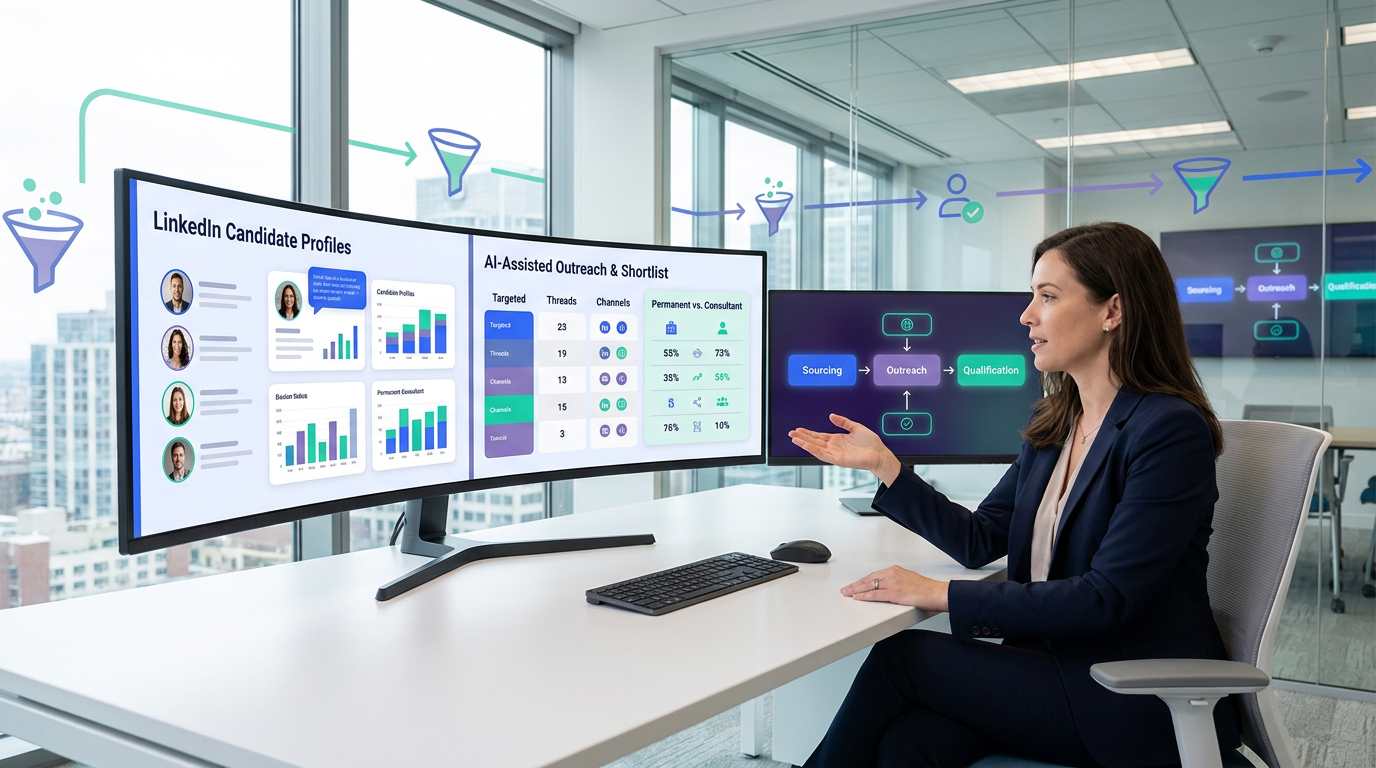
This article shows headhunters how to improve recruiting sourcing by judging channels and role shape to avoid low-fit shortlists.
That matters most when a team is under pressure to add skills quickly but does not want to create a full-time hire for a short-term need, a niche project, or a growth phase that may change again in a quarter. In that situation, weak sourcing creates expensive delays: agency owners lose recruiter time to manual search and follow-up, solo headhunters miss qualified passive talent while juggling replies, and in-house teams risk poor stakeholder trust when they deliver volume instead of role-fit candidates.
In my own workflow, StrategyBrain AI Recruiter has been most useful when the bottleneck is repetitive LinkedIn outreach, after-hours replies, and early interest checks across large talent pools. Its automation can connect with targeted candidates, continue multilingual conversations around the clock, and collect resumes or contact details from interested people, while the recruiter still handles final judgment, resume review, and the decision on who should move into screening.
The pressure becomes clearer when a company enters a new stage of growth and suddenly needs immediate finance talent for a defined project. The hiring team has to decide whether to add a permanent employee or bring in a consultant with specialized skills for a short-term objective. While that decision is being made, the recruiter is translating a narrow brief into search terms, reviewing prior applicants, and sending direct outreach to people whose background suggests they can step into the work without a long ramp-up.
If that search is handled like a generic requisition, the process slips fast. The recruiter spends hours sorting title matches that do not reflect project needs, passive candidates reply late across time zones, and stakeholders still need a shortlist that balances cost, speed, and flexibility. That is exactly where AI candidate sourcing becomes relevant: the real issue is not just finding more people, but building recruiting sourcing and job sourcing methods that surface specialized talent quickly and support better decisions across the main types of sourcing in recruitment.
- AI candidate sourcing works best when the hiring need is urgent, specialized, or time-bound.
- Recruiting sourcing is not the same as full-cycle recruiting; it is the discipline of building the right top-of-funnel pipeline.
- Job sourcing should reflect project scope, business timing, and whether the role needs permanent or interim talent.
- The most useful types of sourcing in recruitment combine referrals, direct outreach, internal databases, and active-candidate channels.
- AI can speed search, outreach, and early engagement, but recruiters should still own qualification and shortlist decisions.
Table of Contents
- Why urgent hiring needs better recruiting sourcing
- What candidate sourcing means in practice
- Recruiting sourcing vs. recruiting
- What job sourcing looks like role by role
- Types of sourcing in recruitment
- Where AI candidate sourcing actually helps
- My LinkedIn workflow experience with AI support
- A practical recruiting sourcing workflow
- Common sourcing mistakes
- FAQ
Why urgent hiring needs better recruiting sourcing
One of the most useful lessons from project-based hiring is that the business question often comes before the recruiting question. A company may not need another permanent headcount. It may need a specialist who can enter quickly, solve a defined problem, and leave the team with less overhead than a full-time hire. That is why strong recruiting sourcing starts with the shape of the work, not with the search bar.
In those situations, recruiters are usually balancing the same factors hiring leaders are weighing internally: access to specialized skills, speed to productivity, total cost, fresh outside perspective, and flexibility if priorities shift. Those are not abstract planning concerns. They directly change how you source. A finance consultant search, for example, should not be built the same way as a recurring staff-accountant search, because the success signals are different from the beginning.
That is also why many sourcing teams underperform when they rely only on inbound applications. Active applicants can help, but urgent and specialist hiring often depends on reaching people who are not applying at all. Recruiting sourcing has to support business timing, not just applicant flow.
What candidate sourcing means in practice
Candidate sourcing is the proactive work of finding, identifying, and engaging people who may fit an open role before or alongside inbound applications. It includes active candidates who are already looking and passive candidates who may only respond when the opportunity is timely and relevant.
From a practitioner standpoint, sourcing begins when the role is translated into search logic. That means clarifying must-haves, deciding which skills are trainable, identifying adjacent backgrounds, and choosing the channels most likely to produce the right slate. The output is not a pile of names. The output is a usable pipeline.
When people search for recruiting sourcing advice, they are usually trying to solve one of four problems: the pipeline is too thin, the response rate is too low, the shortlist is too generic, or the role itself is not being scoped realistically. Good sourcing addresses all four.
Recruiting sourcing vs. recruiting
Recruiters often blur these terms, but separating them improves execution. Sourcing is the top-of-funnel discipline of search, research, outreach, and engagement. Recruiting covers the broader process: intake, screening, interview coordination, stakeholder alignment, offers, and candidate experience.
This distinction matters because the fixes are different. If a search is slow because the market is narrow and the role needs rare project experience, adding interview panels will not help. If the problem is that hiring managers are not giving feedback quickly, adding more sourced profiles will not solve it either.
| Area | Candidate Sourcing | Recruiting |
|---|---|---|
| Main purpose | Build and engage a qualified talent pool | Move talent through the full hiring process |
| Typical activities | Search, mapping, outreach, follow-up | Screening, interviews, offers, coordination |
| Primary challenge | Finding relevant talent efficiently | Driving fair and timely selection |
| Best success signal | Qualified pipeline and response quality | Hire quality, speed, and candidate experience |
In practice, the cleanest teams give sourcing its own goals and review rhythm. That is especially important in specialist searches where the business is deciding between a contractor, consultant, or permanent hire.
What job sourcing looks like role by role
Job sourcing is the applied version of sourcing strategy for a specific opening. It asks a practical question: where will qualified candidates for this job actually come from?
For a role tied to a short-term transformation project, job sourcing may emphasize direct outreach, referrals, and prior talent pools over open-market posting volume. For recurring, high-volume hiring, job boards and process efficiency may matter more. For niche leadership work, recruiters often have to search beyond exact titles and focus on functional outcomes, reporting scope, and evidence of similar work under similar business conditions.
That is why experienced recruiters usually reframe the intake before they expand volume. If stakeholders say they want a specialist, but the budget, timeline, or employment type point to a different profile, job sourcing will fail unless the brief changes. In other words, many sourcing problems are not search problems. They are definition problems.
Practical takeaway: If the role exists because of a project, growth phase, or immediate capability gap, source for deployable expertise first and idealized resume patterns second.
Types of sourcing in recruitment
Understanding the types of sourcing in recruitment helps teams match channels to hiring reality instead of repeating the same motion on every role. The most useful mix depends on urgency, specialization, geography, and whether the team needs active job seekers or passive talent.
1. Referrals
Referrals work well when trust, context, and niche skills matter. They are especially useful for consultant, contractor, and specialist searches because employees often know who has already done comparable project work.
2. Job boards
Job boards remain valuable for active-candidate demand, especially in broad-market roles. But for specialist job sourcing, they often need to be paired with stronger filtering and structured screening to avoid high-volume noise.
3. Internal talent pools
Past applicants, silver-medalist candidates, former contractors, and alumni are often the fastest source of relevant talent. When a company needs someone quickly, this source can outperform cold market search because the relationship already exists.
4. Direct outreach
Direct outreach is central to recruiting sourcing for passive candidates. It works best when messages show why the person is relevant to the role, why the timing matters, and what outcome they would be stepping into.
5. Professional communities and events
Events, associations, and niche communities can surface candidates with specialized expertise that title-based searching misses. These channels are useful when the team needs practical skill depth more than polished applicant branding.
6. Social and professional platforms
These platforms help recruiters identify talent movement, recent achievements, and adjacent backgrounds. They are particularly useful in AI candidate sourcing because search, discovery, and direct engagement can be connected more tightly.
The strongest sourcing plans usually use more than one of these channels. If a company needs immediate expertise with flexibility, relying on one channel alone is rarely enough.
Where AI candidate sourcing actually helps
AI candidate sourcing is most helpful when the recruiter already understands the role and needs support with scale, speed, or pattern recognition. It can help parse role criteria, expand beyond exact-title matching, rank likely-fit profiles, and manage first-touch communication at a volume that would otherwise eat up the day.
In specialist searches, that matters because the first challenge is rarely finding people with the exact same title. The challenge is finding adjacent profiles who can solve the same business problem. AI can assist by broadening the search intelligently and prioritizing recruiter attention.
It also helps with the communication gap that slows many sourcing projects. Candidates reply after work hours, from different time zones, and in different languages. If no one responds until the next day, momentum drops. AI-supported workflows can keep the conversation moving long enough for the recruiter to step in at the right moment.
That said, AI should not decide who is qualified. The recruiter still needs to verify whether the resume reflects real scope, relevant outcomes, and the kind of role fit the hiring team actually needs.
My LinkedIn workflow experience with AI support
On LinkedIn-heavy searches, I have found that the biggest drain is not writing one message. It is repeating the same early-stage tasks across dozens or hundreds of prospects: connecting, introducing the role, checking whether the person is open, answering basic questions, and then trying not to lose the thread when replies come in overnight.
That is where I have used AI Recruiter as workflow support rather than as a replacement for sourcing judgment. It can automate initial outreach to targeted profiles, continue candidate conversations 24/7, and collect resumes or contact details from people who want to move forward. On searches involving international candidates, its multilingual communication is especially helpful because it reduces the lag and confusion that often happen when replies arrive outside business hours.
What I still keep firmly in recruiter hands is qualification. After resumes come in, I review whether the candidate actually matches the brief, whether the scope of prior work is comparable, and whether the next step should be a screen, a hold, or a pass. That division of labor is important. Automation can handle repetition, but shortlist quality still depends on human evaluation.
For recruiters who want to understand the broader use cases, the LinkedIn sourcing workflow notes here and the conversation examples here are useful references for how this kind of support fits into day-to-day recruiting sourcing.
A practical recruiting sourcing workflow
The best recruiting sourcing workflows are simple enough to repeat and disciplined enough to improve with each search.
1. Start with the business reason for the hire
Is the need permanent, project-based, urgent, exploratory, or market-driven? This decides more than sourcing channels. It changes the profile itself.
2. Define must-haves, trainable skills, and non-negotiables
For specialist searches, this is where you prevent the classic mistake of overfitting the search to titles instead of capability.
3. Build search logic from outcomes, not just keywords
Include title variants, adjacent backgrounds, comparable project environments, and Boolean patterns where useful.
4. Choose a channel mix that fits the role
Use referrals and direct outreach for narrow or urgent searches; use job boards and process efficiency for broader demand; revisit internal databases early instead of late.
5. Use AI for discovery and first-touch support
Apply AI candidate sourcing where scale helps most: large profile review, passive outreach, multilingual response handling, and early interest capture.
6. Review profiles with recruiter judgment
Do not confuse ranked results with qualified candidates. Verify actual scope, outcomes, and timing.
7. Recalibrate fast
If the market is telling you the profile is too narrow, too expensive, or mismatched to the employment type, change the brief before the pipeline stalls.
This workflow is especially effective when the hiring need resembles the consultant-style decision in the opening scenario: specialized skill, immediate need, and pressure to stay flexible.
Common sourcing mistakes
- Treating every role like a permanent hire. Some searches exist because the business needs short-term expertise, not long-term headcount.
- Overvaluing exact titles. Adjacent experience often matters more than title purity in specialist sourcing.
- Waiting too long to use internal data. Previous candidates are often the fastest route to qualified outreach.
- Confusing AI assistance with candidate qualification. Discovery and messaging can be automated; assessment still needs recruiter discipline.
- Using one channel for every search. Good job sourcing changes with urgency, market conditions, and role type.
- Ignoring response timing. Delayed follow-up loses passive candidates, especially across regions and time zones.
In my experience, teams improve fastest when they stop measuring sourcing by activity alone. The better question is whether the process is producing relevant conversations early enough to support a real hiring decision.
FAQ
What is candidate sourcing?
Candidate sourcing is the proactive process of finding and engaging potential candidates before or alongside inbound applications. It is a core part of recruiting sourcing.
How is recruiting sourcing different from recruiting?
Recruiting sourcing focuses on search, outreach, and pipeline building. Recruiting includes the full hiring process, from intake and screening to interviews and offers.
What does job sourcing mean?
Job sourcing refers to the specific methods used to find candidates for a particular role. It is the practical execution of sourcing strategy for an open position.
What are the main types of sourcing in recruitment?
Common types of sourcing in recruitment include referrals, job boards, internal talent pools, direct outreach, social and professional platforms, and community or event-based sourcing.
How does AI candidate sourcing help?
AI candidate sourcing helps recruiters discover, prioritize, and engage likely-fit talent faster. It is particularly useful for large searches, passive-candidate outreach, and around-the-clock communication support.
Is AI enough to qualify candidates?
No. AI can assist with discovery and engagement, but recruiters should still review resumes, assess fit, and decide who advances.
Why is AI candidate sourcing useful for LinkedIn recruiting?
LinkedIn sourcing often involves repetitive outreach, late replies, and high message volume. AI-supported workflows can keep conversations moving and capture candidate information more efficiently while recruiters focus on evaluation.
Conclusion
AI candidate sourcing is most valuable when it supports a clear recruiting sourcing strategy rather than replacing one. If the business need is specialized, immediate, or flexible, recruiters need more than raw search volume. They need better judgment about role shape, channel mix, passive-candidate outreach, and response handling.
That is why the strongest sourcing teams still start with fundamentals: what problem the hire is meant to solve, whether the work calls for permanent or interim talent, which job sourcing channels fit the market, and which types of sourcing in recruitment are most likely to produce a credible shortlist. AI can accelerate the work, but disciplined recruiter decisions are still what turn activity into hires.