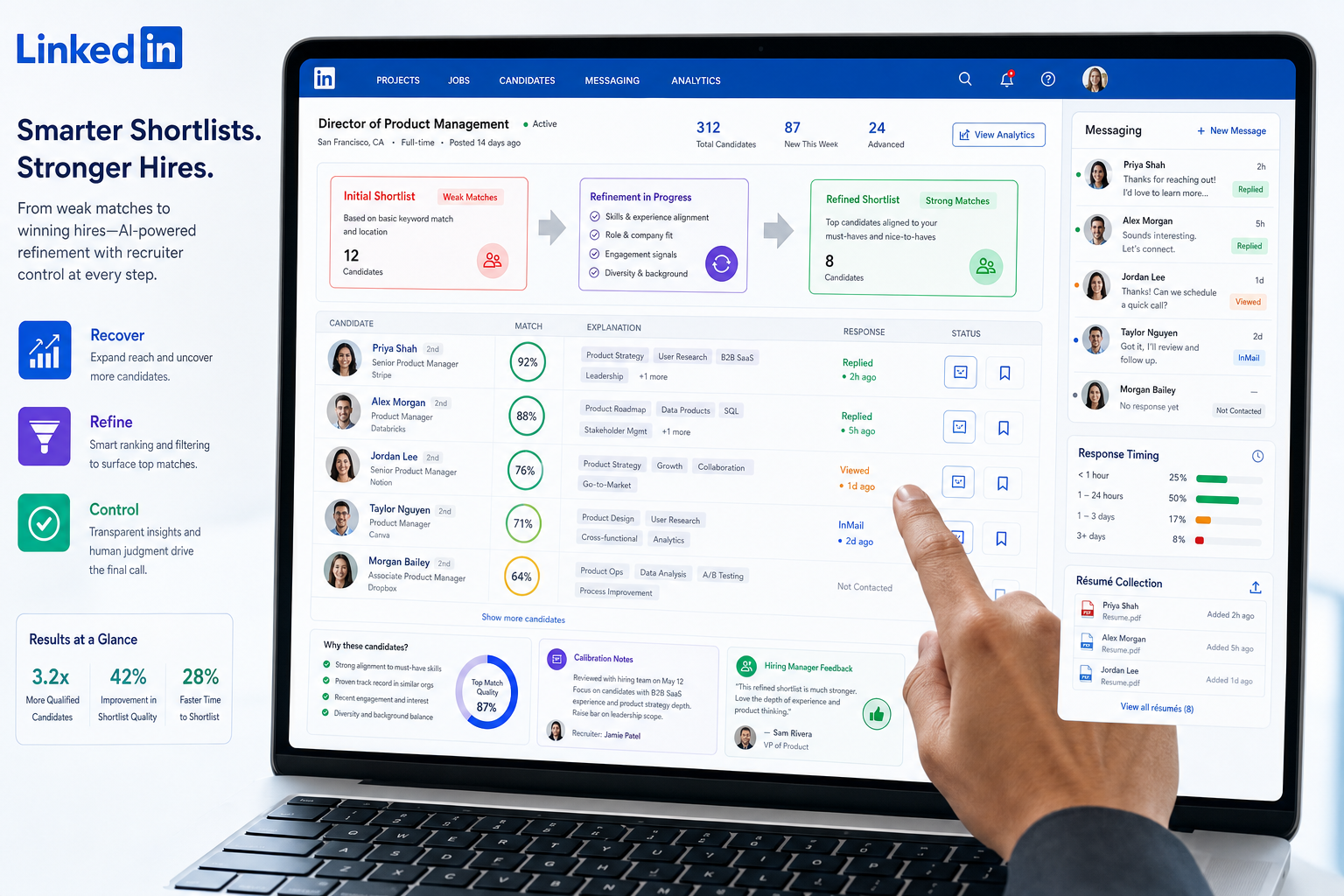
This article helps headhunters judge whether an ai recruiting tool can recover from weak searches before client trust starts to slip.
That matters because sourcing rarely breaks in one dramatic moment. More often, a recruiter realizes too late that the search brief was interpreted too narrowly, a passive candidate reply was mishandled, or a hiring manager lost confidence after seeing an off-target first batch. For a solo recruiter, that means wasted hours rebuilding lists. For a small agency owner, it can mean slower placements and avoidable client friction. For an in-house TA lead, it can damage trust in the sourcing function even when the role itself is still fillable.
In that gap between a shaky first pass and a recoverable hiring process, tools that support fast correction are more useful than tools that only promise speed. In my own workflow, AI Recruiter stood out when I needed help with repetitive LinkedIn outreach, after-hours candidate replies, and résumé collection without losing recruiter control. It can keep conversations moving, respond across languages, and capture candidate details for follow-up, but the recruiter still makes the final call on fit, résumé review, and who should move forward.
You can see the logic in a familiar candidate-side scenario: sometimes a strong person has a bad interview, answers the wrong question, feels the conversation drifting, and has to recover before the opportunity is lost. The practical recovery moves are simple but revealing. They pause, correct the answer, try to re-engage the other side, and if the meeting still goes off track, they follow up directly afterward instead of pretending nothing happened.
Sourcing teams face an almost identical problem earlier in the funnel. A weak Boolean string, a flat first outreach, or a tired hiring team reacting badly to an early shortlist does not always mean the search itself is doomed. It means the workflow needs a way to regroup, ask better questions, re-engage the decision-maker, and learn from the miss. That is why evaluating candidate sourcing platforms and comparing the best candidate sourcing tools should start with one question: how well does the system help recruiters recover, refine, and continue sourcing when the first attempt is not good enough?
Table of Contents
- Why Recovery Matters in AI Candidate Sourcing
- What an AI Recruiting Tool Should Actually Help You Do
- How Recruiters Recover From Bad Searches and Weak First Lists
- AI Recruiting Tool vs Candidate Sourcing Platforms vs Automation Layers
- What to Compare in the Best Candidate Sourcing Tools
- Where Candidate Data Comes From
- Why Natural-Language Search Helps, but Does Not Save Everything
- LinkedIn Workflow, Outreach Timing, and AI Recruiter Experience
- How to Choose the Right Platform
- Common Buying Mistakes
- FAQ
Why Recovery Matters in AI Candidate Sourcing
Most conversations about AI candidate sourcing focus on speed, automation, or database scale. In practice, experienced recruiters also care about recovery. Can the system help you notice when the search is drifting? Can you quickly restate the brief, revisit adjacent talent, or improve candidate engagement after a weak opening message? Those questions matter because sourcing is iterative by nature.
The comparison to a bad interview is useful here. A candidate who realizes they answered poorly does not always need a brand-new opportunity; sometimes they need a second attempt, a clarifying answer, or a better follow-up note. Recruiters work the same way when a search underperforms. The strongest sourcing workflows are not the ones that never miss. They are the ones that make correction fast, visible, and manageable.
That is where a modern ai recruiting tool earns its place. It should help with search, prioritization, contact flow, and handoff, but it should also make it easier to fix early mistakes before they become expensive pipeline problems.
What an AI Recruiting Tool Should Actually Help You Do
At a practical level, AI candidate sourcing means using software to identify, prioritize, and engage talent across multiple data sources. A useful ai recruiting tool does more than search a resume database. It may help interpret role requirements, surface passive candidates, organize outreach, support follow-up, and move information into ATS or CRM workflows.
That distinction matters because many teams still shop as if sourcing is only a database problem. It is not. Sourcing quality depends on several connected steps:
- Discovery of relevant candidates across external and internal sources
- Interpretation of what the role really requires
- Ranking based on likely fit rather than simple keyword overlap
- Engagement through outreach and response handling
- Recovery when the first shortlist or outreach wave misses the mark
- Handoff into ATS or CRM systems without messy duplication
If your team only evaluates the first step, you may buy software that looks impressive in a demo and underdelivers in live recruiting.
How Recruiters Recover From Bad Searches and Weak First Lists
The candidate-side advice from a bad interview scenario maps surprisingly well to sourcing. When the interaction starts going wrong, recovery depends on self-awareness, a direct correction, and a willingness to learn rather than hide the mistake.
1. Pause and restate the question
In interviews, a candidate may ask to answer again after realizing they misunderstood the prompt. In sourcing, recruiters need the same reset. If the first results are weak, the issue may not be the platform at all. It may be a vague intake, a badly weighted must-have, or a title assumption that is screening out adjacent-fit talent.
A strong sourcing system should let you revise the brief quickly and rerun the search without rebuilding everything from scratch.
2. Re-engage the other side
In a rough interview, a candidate may ask thoughtful questions to bring energy back into the room. In sourcing, recruiters often need to do the equivalent with hiring managers. If the manager looks unconvinced, the right move is not to defend a weak list forever. It is to ask better calibration questions: Which profile was closest? Which background felt off? Was the issue seniority, industry, scope, or timing?
The best candidate sourcing platforms support that recalibration by showing why candidates surfaced and by making refinements transparent.
3. Follow up directly when the first attempt misses
The original interview advice also recommends using a thank-you note to address what went wrong. Recruiters need a parallel move after weak outreach or a poor shortlist review. That may mean a revised outreach message, a better explanation of the search strategy, or a second pass focused on adjacent talent pools.
Key insight: Recovery is not a soft skill add-on in sourcing. It is part of shortlist quality, client trust, and recruiter productivity.
4. Learn from the miss
Some bad interviews cannot be rescued, and some poor searches should be retired. The lesson is still valuable. Did the role need deeper market mapping first? Was the hiring brief too narrow? Did the first outreach sound automated or generic? Recruiters who capture those lessons make better sourcing decisions on the next requisition.
AI Recruiting Tool vs Candidate Sourcing Platforms vs Automation Layers
One source of confusion in this market is category overlap. Not every ai recruiting tool is a sourcing platform, and not every sourcing platform helps with engagement or recovery once candidates begin replying.
| Category | Primary Job | Typical Strength | Main Limitation | Best For |
|---|---|---|---|---|
| Candidate sourcing platform | Search and filter talent profiles | Broad candidate discovery | Can remain highly manual after search | Teams that need search depth and control |
| AI recruiting tool | Support multiple recruiting tasks | Wider workflow assistance | Depth varies by sourcing use case | Teams wanting search plus workflow help |
| Outreach automation layer | Handle repetitive candidate contact | Follow-up speed and consistency | Does not replace recruiter judgment on fit | Lean teams working heavy passive outreach |
| Applicant tracking system | Manage applicants and hiring stages | Process control and records | Usually weak for passive-candidate discovery | Structured hiring operations |
For many teams, the smartest stack is not one tool pretending to do everything. It is a combination of search depth, engagement support, and a clean ATS handoff.
What to Compare in the Best Candidate Sourcing Tools
When evaluating the best candidate sourcing tools, feature lists are less useful than workflow tests. Recruiters should compare systems using the moments that actually decide whether a search becomes a placement, a hire, or a stalled requisition.
| Evaluation Signal | Why It Matters | What Recruiters Should Ask | Who Should Care Most |
|---|---|---|---|
| Data sources covered | Controls talent reach | Which professional, technical, research, and internal sources are available? | Sourcers, agency recruiters, TA leaders |
| Data freshness | Old records weaken outreach | How often are profiles refreshed or verified? | Recruiters running outbound campaigns |
| Natural-language search | Speeds up calibration | Can I describe the role in plain English and refine from there? | Busy recruiters and hiring managers |
| Match transparency | Improves trust in shortlists | Can the system explain why someone matched? | Recruiters presenting to stakeholders |
| Recovery workflow | Determines how fast you can correct a miss | How easy is it to rerun, revise, and compare searches? | Anyone hiring for hard-to-fill roles |
| Outreach support | Connects search to engagement | Does it help manage replies, follow-up, and candidate details? | Passive-candidate sourcing teams |
| ATS or CRM integrations | Prevents duplicate manual work | How do sourced profiles move into our existing workflow? | Ops teams and recruiters |
| Pricing clarity | Improves buying decisions | Are seats, limits, and add-ons explained clearly? | Budget owners |
This kind of comparison is more useful than generic rankings because it reflects how recruiters actually work under pressure.
Where Candidate Data Comes From
An ai recruiting tool can only be as effective as the candidate data behind it. Better prompts do not fix narrow coverage, stale records, or poor enrichment.
Common sourcing inputs include:
- Professional profile data for title history, employers, and progression
- Technical footprint data such as code or project activity
- Publications and research signals for specialist and academic hiring
- Patent records for deep-tech searches
- Internal ATS and CRM records for rediscovering overlooked talent
- Public web context that helps validate expertise and current activity
Ask not only how many profiles a system claims to cover, but where they come from and how often they can be actioned in real outreach.
Why Natural-Language Search Helps, but Does Not Save Everything
Natural-language search is valuable because it reduces the time needed to turn a hiring brief into a workable sourcing query. Recruiters can start with a plain-English description and then refine from real results instead of overbuilding Boolean strings at the start.
That said, natural-language search is not a magic fix. A bad interview does not improve just because someone speaks more fluently, and a poor search does not improve just because a prompt sounds polished. Dataset breadth, result explainability, and fast refinement still matter more.
The practical test is simple: can the tool help you move from rough brief to relevant shortlist, and can it help you recover quickly when the first search path is wrong?
LinkedIn Workflow, Outreach Timing, and AI Recruiter Experience
For many recruiters, especially headhunters and lean in-house teams, LinkedIn remains the real-world pressure point. The challenge is not only finding profiles. It is keeping outreach moving, replying when candidates answer late, collecting details consistently, and avoiding the drop-off that happens when a good prospect responds after hours and no one follows up.
That is where I found StrategyBrain AI Recruiter most practical. I did not use it as a replacement for sourcing judgment. I used it to reduce the repetitive parts of LinkedIn recruiting that usually create delays: initial candidate contact, timely follow-up, multilingual back-and-forth, and gathering résumés or contact details from interested prospects. In searches where the first outreach wave felt thin, that continuity helped me recover faster because candidate conversations did not stall while I was tied up elsewhere.
Another useful part of the experience was role clarity. The AI handled repetitive communication, while I stayed responsible for shortlist review, final qualification, and whether a profile truly matched the search brief. For recruiters who want automation without giving up control, that split is important. If you want to see how the workflow is positioned, the product overview and the public conversation examples make the use case easier to understand.
In other words, LinkedIn sourcing often fails for the same reason bad interviews do: the moment that needed a calm correction or a timely response passes too quickly. A support layer that keeps communication alive can make a noticeable difference, especially for agencies, independent recruiters, and hiring teams working across time zones.
How to Choose the Right Platform
If you are comparing candidate sourcing platforms, use a framework grounded in live recruiting work rather than vendor language.
- Define your sourcing motion. Are you filling niche roles, building passive pipeline, or reactivating internal talent?
- Audit current failures. Is the real issue search quality, candidate engagement, slow response handling, or ATS handoff?
- Test real requisitions. Use open roles with different levels of difficulty.
- Check recovery speed. Measure how quickly the tool lets you revise and improve a weak first pass.
- Review source transparency. Ask where data comes from and how fresh it is.
- Validate recruiter control. Automation should reduce repetitive work, not hide logic or override judgment.
- Assess stack fit. The best tool is the one that works with your existing ATS, CRM, and team habits.
For hiring managers, define what a good shortlist means before the trial starts. For recruiters, track time to first usable list, relevance after refinement, and whether candidate engagement continues smoothly when the team is busy.
Common Buying Mistakes
Most disappointments in AI candidate sourcing come from weak evaluation, not from AI alone.
- Confusing search with full workflow support. A large database is not the same as a workable sourcing process.
- Ignoring recovery. If the first search misses, the team still needs a fast way to regroup.
- Overvaluing interface polish. Clean design is helpful, but data quality and explainability matter more.
- Testing only easy roles. Many tools look better on common searches than on specialized hiring.
- Skipping outreach workflow checks. A platform may surface candidates well and still fail on response handling.
- Assuming automation replaces qualification. Recruiters still need to review resumes, validate fit, and decide next steps.
FAQ
What does AI candidate sourcing mean in practice?
It means using software to help recruiters find, rank, and engage talent across multiple sources. A modern ai recruiting tool may support search, matching, outreach flow, and ATS or CRM handoff.
How are candidate sourcing platforms different from an ATS?
Candidate sourcing platforms focus on finding and organizing talent, especially passive candidates. An ATS is designed to manage applicants, hiring stages, and recruiting records after people enter the process.
What makes the best candidate sourcing tools stand out?
The strongest tools combine relevant data coverage, explainable matching, easy refinement, recruiter-friendly outreach workflow, and clean integration into the broader recruiting stack.
Why does recovery matter in sourcing?
Because first attempts are often imperfect. Strong recruiting teams need systems that let them correct weak searches, revise outreach, and recalibrate quickly with hiring managers instead of restarting from zero.
Can LinkedIn workflow support improve sourcing results?
Yes, especially when recruiters lose momentum because replies arrive after hours, across time zones, or in multiple languages. Support for timely messaging and résumé collection can keep promising conversations alive while recruiters retain final decision authority.
Is automation enough to qualify candidates?
No. Automation can help with repetitive communication and organizing candidate information, but recruiters still need to assess resumes, interpret role fit, and decide who should move into interviews.
Conclusion
AI candidate sourcing is not only about finding more profiles faster. It is about building a workflow that can recover when the first pass is weak, the shortlist misses, or outreach loses momentum. That is the practical standard experienced recruiters should use when evaluating any ai recruiting tool.
If you keep the buying process grounded in real recruiting work, especially data quality, refinement speed, candidate engagement, and recruiter control, you will make better decisions about which candidate sourcing platforms truly deserve a place in your stack. And when you compare the best candidate sourcing tools, remember that the strongest systems are rarely the ones that promise perfection. They are the ones that help you recover, recalibrate, and keep the search moving.