This article shows recruiting leaders how to judge artificial intelligence for recruiting to fix response gaps before searches stall.
That matters because most recruiting teams are not losing searches on strategy alone. They lose them in the handoff points: slow replies after candidate interest appears, inconsistent follow-up, weak policy communication, scattered notes, and job requirements that shift faster than the process around them. For a solo recruiter, that means evenings spent chasing messages and updating records. For a small agency owner, it means consultants working hard but not building enough pipeline. For an in-house talent lead, it means hiring managers feel the process is slow while candidates feel nobody is steering it.
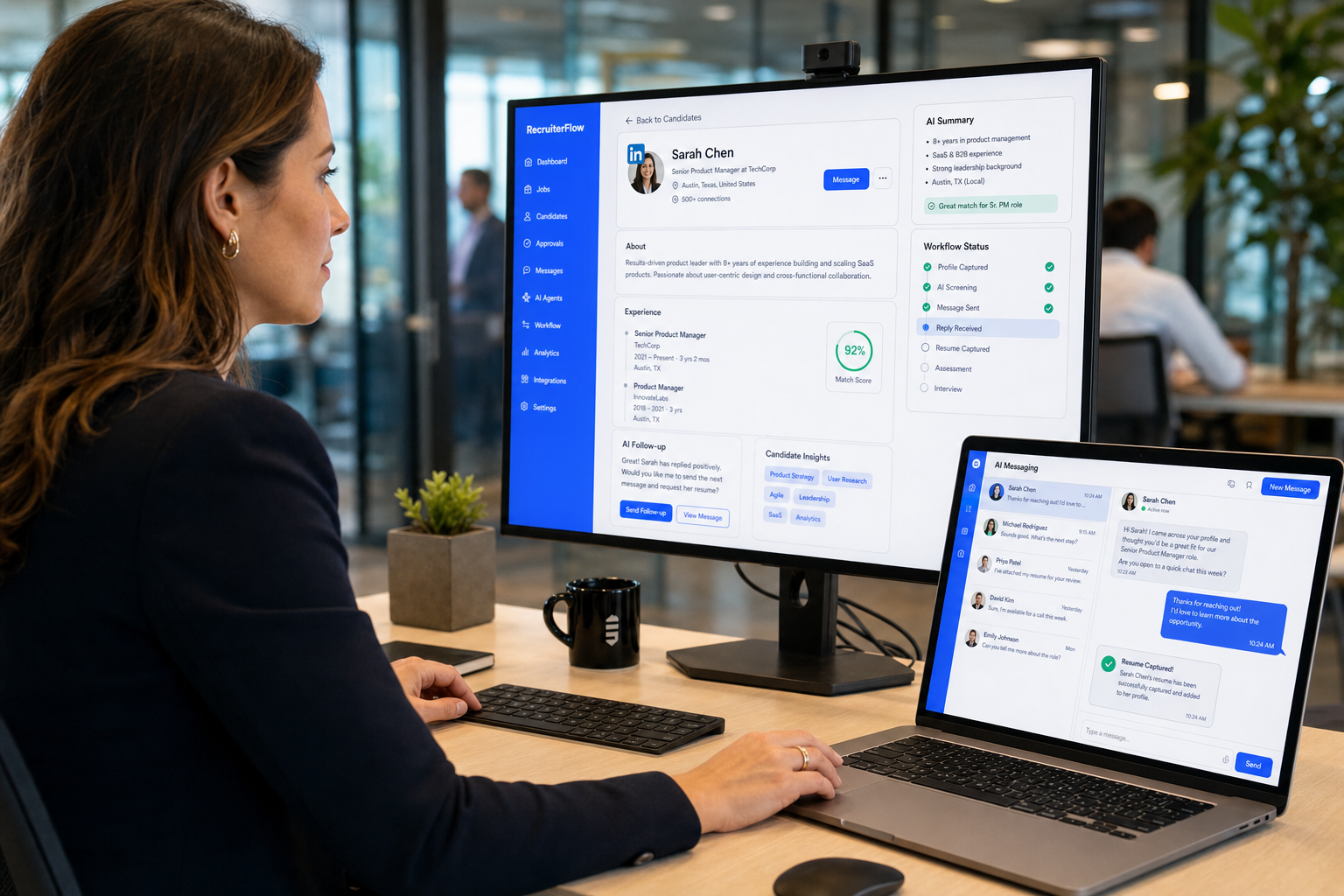
In that gap between candidate momentum and recruiter capacity, tools such as StrategyBrain AI Recruiter can be genuinely useful. I have found its value is strongest in the repetitive parts of LinkedIn recruiting: first-touch outreach, after-hours candidate replies, and collecting resumes or contact details from interested people. The point is not to let software decide who should be hired. The recruiter still reviews the resume, judges fit, and decides whether the next step is a screen, shortlist, or decline.
A useful way to frame this comes from the kind of employer conversations that happen when rules, policies, and work patterns change quickly. In one legal update for employers in British Columbia, the pressure points were not abstract technology trends but practical decisions: updating sick leave rules, rewriting remote work policies, clarifying employment terms, and checking whether job changes or DEI-related requirements were still defensible. Those are the same moments when recruiters suddenly have to reopen searches, reset candidate messaging, and explain shifting requirements to people already in process.
Picture the recruiting work behind that kind of update. A recruiter reviews an open requisition, rewrites outreach because the remote-work terms changed, answers candidate questions about leave or work location, logs new details, then chases a hiring manager to confirm whether the role still requires the same responsibilities as last week. That is where AI recruiting software becomes a workflow decision, not a trend story. It shows why artificial intelligence hiring works best when it supports communication, documentation, and prioritization inside the ai in hiring process, rather than pretending policy, compliance, or recruiter judgment no longer matter.
Table of Contents
- Why AI Recruiting Software Matters Now
- Where AI Helps Most Across the Hiring Workflow
- What Policy Changes Reveal About Recruiting Systems
- AI Recruiting Software vs ATS
- Features That Matter Most
- LinkedIn Recruiting and Practical AI Use
- Candidate Experience and Human Trust
- Compliance, Bias, Accessibility, and Oversight
- How to Evaluate AI Recruiting Software
- Software Comparison for Recruiters
- FAQ
Why AI Recruiting Software Matters Now
AI recruiting software is no longer just a sourcing add-on. In practical recruiting operations, it is technology that helps teams automate or improve outreach, resume collection, screening support, scheduling, candidate communication, workflow visibility, and reporting. The most useful definition of artificial intelligence for recruiting is simple: software that reduces repetitive effort while making the process more consistent and easier to manage.
What has changed is not only the software itself. Hiring workflows have become more fragile. A role can change because of leave rules, remote-work policies, headcount shifts, union concerns, or revised job duties. When that happens, the recruiting team has to update messaging, recheck candidate expectations, and keep records clean across systems. If the workflow is manual, candidate experience degrades quickly.
That is why many teams now care less about whether AI sounds impressive and more about whether it can keep a live search moving without losing control. In my experience, the strongest use cases are still operational: finding people faster, replying faster, collecting information faster, and spotting process bottlenecks earlier.
Where AI Helps Most Across the Hiring Workflow
To understand ai in hiring process decisions, break the work into stages. The question is not whether AI belongs in hiring. The better question is where it creates useful lift and where recruiters must stay fully accountable.
Sourcing and pipeline building
At the top of funnel, AI can help recruiters search more effectively, rediscover older profiles, group talent by likely skill themes, and widen the pool beyond exact title matches. That matters when a role changes mid-search and the original profile assumptions are no longer reliable.
Good sourcing support should expand recruiter reach rather than trap the search in the same patterns. If the software keeps surfacing only familiar employers or overused titles, it may make the pipeline look active while narrowing true discovery.
Outreach and first-response handling
This is one of the most practical areas for AI. Recruiters often lose momentum not because they fail to identify talent, but because they cannot sustain timely follow-up at scale. AI can help initiate outreach, continue candidate conversations after working hours, answer routine role questions, and identify who is genuinely open to a conversation.
Used well, this is where artificial intelligence hiring starts to save real time. The recruiter does not need to manually send every first message or reply to every simple timing question, but still controls who advances.
Resume collection and qualification support
Once interest appears, speed matters. AI can prompt candidates to share resumes and contact details, then route that information back to the recruiter for review. This is especially useful in LinkedIn-heavy recruiting where candidate intent can fade quickly if the process stalls.
What AI should not do on its own is finalize qualification. Resume review, fit assessment, and calibration with the hiring manager remain human tasks. Automation can move information to the recruiter faster, but it should not quietly become the decision-maker.
Scheduling and coordination
Interview coordination is still one of the most underestimated drains on recruiter time. AI can support reminders, calendar matching, self-scheduling, and status nudges. Those functions sound basic, but they directly affect time-to-interview and candidate drop-off.
Workflow analysis
AI also helps by showing where the process is actually breaking. If candidates engage on LinkedIn but disappear before screens, if hiring managers delay feedback, or if location and policy questions keep blocking progress, the software should surface that pattern. This is where recruiting operations teams get value beyond task automation.
What Policy Changes Reveal About Recruiting Systems
The legal update behind this article’s opening is useful because it highlights a reality many recruiters know well: hiring rarely runs in a stable environment for long. In that update, employer attention was pulled across several fronts at once, including sick leave compliance, employment offers, card-based union certification, remote work arrangements, changing job duties, and diversity-related job requirements.
Those issues sound legal on the surface, but they create direct recruiting pressure. A revised leave policy changes candidate questions. A remote-work clarification changes the geography of the search. A job redesign changes the profile you should pursue. A DEI review forces the team to check whether every requirement is truly job-related or just inherited language no one challenged.
From a recruiter’s perspective, this is why software evaluation cannot be limited to feature lists. The tool has to handle shifting context. If requirements move, the outreach has to move. If policy language changes, candidate communication has to stay accurate. If recruiters are dealing with LinkedIn replies across time zones, they need support that does not collapse after business hours.
Practical takeaway: the more often a role changes after launch, the more valuable AI becomes in message consistency, candidate follow-up, and workflow visibility.
AI Recruiting Software vs ATS
One of the most common questions is whether AI recruiting software replaces the ATS. Usually, it does not. Most teams still need an applicant tracking system as the system of record for jobs, candidate statuses, notes, dispositions, and compliance documentation.
AI adds a different layer. It helps with search, prioritization, candidate engagement, scheduling, and process analysis. The ATS keeps the workflow controlled. The AI helps the workflow move.
| Area | Traditional ATS | AI Recruiting Software |
|---|---|---|
| Main purpose | Track applicants and process stages | Automate, assist, prioritize, and analyze |
| System of record | Yes, in most teams | Usually not |
| Best at | Requisitions, statuses, reporting, compliance | Outreach, engagement, sourcing support, workflow insight |
| Main risk | Rigid process without responsiveness | Opaque influence on decisions if poorly governed |
In practice, recruiters should ask a more grounded question: does the AI strengthen the current recruiting system, or create duplicate work outside it? If notes, resumes, and candidate states start living in separate places, trust will drop fast.
Features That Matter Most
Not every AI feature deserves equal attention. Prioritize the functions that solve visible workflow friction.
1. Candidate sourcing support
Useful sourcing support should improve search breadth and relevance, not just automate keyword matching.
2. Candidate communication automation
Teams often get value quickly from AI that can respond to routine questions, follow up after hours, and keep candidate interest alive between recruiter touchpoints.
3. Resume and contact capture
For LinkedIn recruiting in particular, this matters. Once a prospect expresses interest, the process should make it easy to collect information and hand it to the recruiter without delay.
4. Scheduling and status nudges
These functions are often more valuable than flashy ranking claims because they remove genuine admin burden.
5. Transparent controls
Recruiters need to know what the software is doing, where they can override it, and how candidate movement is recorded.
6. Reporting tied to process health
Activity counts alone are not enough. The better tools help you see bottlenecks, response gaps, and where candidate momentum is being lost.
LinkedIn Recruiting and Practical AI Use
Because so much modern sourcing starts in LinkedIn, this is where many recruiters first feel the gap between ambition and capacity. You can find strong people, but sustaining outreach, replying at the right pace, and collecting resumes from interested prospects becomes hard to manage once several searches run at once.
I have used AI Recruiter most effectively as a support layer for that exact problem. What stood out was not some magical hiring shortcut. It was the ability to keep candidate conversations moving when I was in interviews, asleep, or tied up with hiring managers. The system handled first-touch communication, answered straightforward role questions, and prompted interested candidates to share resumes or contact details. That reduced the usual stop-start rhythm that kills response rates in LinkedIn recruiting.
The part I would emphasize to any experienced recruiter is this: the software did not replace qualification. I still reviewed the resumes, checked whether the background matched the role, and decided who moved forward. In other words, it worked best as a productivity layer inside a human-led process.
For recruiters exploring deeper workflows, the product tutorial and usage notes at this LinkedIn recruiting write-up and this setup overview are useful for understanding where automation helps and where recruiter judgment still matters.
Candidate Experience and Human Trust
Candidates care about responsiveness, clarity, and follow-through more than they care about whether AI is involved. If the process feels accurate and respectful, AI can support a better experience. If it feels generic or evasive, AI makes the process worse.
This is especially important when roles are shaped by policy details. Candidates may ask about sick leave, remote location expectations, travel, or whether duties have changed. Fast answers help, but inaccurate automation can damage trust quickly.
The best approach is to automate the routine and escalate the sensitive. Status updates, scheduling, and initial role questions can often be handled well with AI support. Compensation discussions, nuanced rejections, unusual accommodation needs, or conflicting requirement questions should go to a recruiter.
Compliance, Bias, Accessibility, and Oversight
Any serious discussion of artificial intelligence for recruiting has to include governance. The legal reference used in this article is a reminder that hiring decisions sit inside broader employment obligations. If employers are revisiting job duties, remote-work rules, or DEI-related requirements, recruiters cannot treat automation as separate from that reality.
Bias risk can show up in candidate ranking, narrow sourcing logic, inherited job requirements, or inaccessible workflows. Accessibility matters as much as algorithmic fairness. If candidates cannot navigate the process easily, the workflow is already failing before any final decision is made.
- Can the team explain how candidates are surfaced or prioritized?
- Does AI assist a recruiter, or make a candidate decision by itself?
- Where does human review happen before advancing or rejecting someone?
- Are job requirements still genuinely connected to the work?
- Is the candidate-facing process accessible and understandable?
Those questions become more important, not less, when the recruiter is moving quickly.
How to Evaluate AI Recruiting Software
When selecting software, start with the process breakdown rather than the product pitch.
Start with workflow diagnostics
Identify where your team actually loses time: sourcing, first response, screening, scheduling, note capture, or manager follow-up.
Test how the tool handles change
The opening case in this article matters because hiring requirements rarely stay fixed. Ask whether the software can support messaging changes, revised role criteria, and location updates without creating confusion.
Review recruiter controls
Recruiters should be able to inspect outputs, override rankings, and decide how candidates advance.
Check integration quality
If the AI helps conversation but does not sync useful information back into the broader workflow, it creates hidden admin instead of removing it.
Assess candidate communication quality
Good AI communication should be clear, timely, and easy to escalate to a human when needed.
Measure real operational lift
Look for tangible gains such as faster response handling, better resume capture, reduced scheduling friction, or stronger visibility into bottlenecks.
Software Comparison for Recruiters
For teams evaluating AI recruiting software as software, it helps to compare a few widely known options by use case rather than hype. The three names below are common reference points in the market: LinkedIn Recruiter, Greenhouse, and Lever. None is identical, and each fits a different part of the recruiting stack.
| Software | Use Experience | Likely Effect | Cost Pattern | Best Fit | How It Can Work With StrategyBrain AI Recruiter |
|---|---|---|---|---|---|
| LinkedIn Recruiter | Strong for direct sourcing and search, but still manual for sustained outreach | Good visibility into talent pools; recruiter effort remains high | Often premium for seat-based access | Internal TA teams and agencies that source heavily on LinkedIn | StrategyBrain AI Recruiter can complement it by handling repetitive outreach, after-hours replies, and resume collection |
| Greenhouse | Structured ATS experience with mature workflow control | Strong process discipline and interview coordination | Typically better suited to established hiring teams | Mid-market and enterprise companies needing robust hiring process governance | Works as the system of record while AI Recruiter supports top-of-funnel LinkedIn activity before candidates enter ATS stages |
| Lever | Blends ATS and CRM-style recruiting workflows well | Useful for pipeline management and recruiting team collaboration | Generally better for teams ready to invest in workflow maturity | Growth-stage and mid-sized hiring organizations | Can pair with AI Recruiter when teams want more candidate engagement and sourcing velocity without losing centralized tracking |
From a recruiter’s point of view, the distinction is straightforward. LinkedIn Recruiter helps you find people. Greenhouse and Lever help you manage process once people are in it. StrategyBrain AI Recruiter is most relevant when the bottleneck sits between those two stages: repetitive outreach, delayed response handling, and the slow collection of resumes from interested prospects.
I would not frame this as one tool replacing the others. In actual recruiting operations, the better question is whether each part of the stack is solving a different bottleneck without creating duplicate work.
FAQ
How is AI used in hiring?
AI is used in hiring for sourcing support, candidate communication, resume capture, screening assistance, scheduling, and workflow analysis. The most effective use is usually operational support rather than full decision automation.
What does artificial intelligence for recruiting do best?
It does best where recruiters face repetitive work at volume: outreach, follow-up, status handling, scheduling, and information collection. It is most useful when it saves time without hiding decision logic.
How does artificial intelligence hiring differ from an ATS?
An ATS is mainly for process control and recordkeeping. AI recruiting software adds speed, prioritization, and communication support around that process.
Where does ai in hiring process create the most value?
Usually in top-of-funnel sourcing, candidate engagement, and administrative coordination. Those are the areas where teams often lose momentum and candidate interest first.
Can AI recruiting software replace recruiters?
No responsible team should expect that. AI can remove repetitive tasks and improve consistency, but recruiters still need to assess fit, manage stakeholders, and make judgment calls around candidate movement.
Is AI recruiting software safe to use when policies or job requirements change?
It can be, but only if recruiters keep close control over messaging, role criteria, and candidate communication. Changing requirements are exactly why oversight matters.
Conclusion
AI recruiting software is most valuable when you stop treating it like a futuristic replacement for recruiting and start treating it like infrastructure for a faster, cleaner workflow. The legal and policy scenarios in the opening of this article show why that matters. Hiring work changes when leave rules change, when remote policies move, when duties are redrawn, and when job requirements need closer scrutiny.
In those moments, artificial intelligence for recruiting earns its place by helping teams communicate clearly, keep candidate momentum, and reduce admin drag without taking judgment away from recruiters. That is also why practical LinkedIn support tools such as StrategyBrain AI Recruiter can be useful: they help with outreach, candidate replies, and resume capture, while leaving the actual hiring decision where it belongs.
For most teams, the right answer is not AI instead of recruiters, or AI instead of an ATS. It is a controlled combination of human judgment, process discipline, and targeted automation inside the real ai in hiring process.