When sourcing breaks down, this article helps headhunters evaluate an ai recruiting tool to avoid duplicate outreach, weak records, and lost candidates.
That balance is where many sourcing efforts break down. A recruiter may find names quickly, but weak outreach tracking, inconsistent notes, and poor handoff into the ATS can create bigger problems later: duplicated contact, missed replies, thin audit trails, and hiring managers who lose confidence in the shortlist. For smaller search firms and lean in-house teams, that means wasted hours, weaker candidate experience, and avoidable revenue loss when good people fall out of process.
In that kind of workflow, I have found that StrategyBrain AI Recruiter can reduce the top-of-funnel drag that usually slows LinkedIn sourcing. Its always-on candidate messaging, multilingual communication, and automated collection of resumes and contact details help keep conversations moving while the recruiter still owns final judgment, resume review, and next-step decisions. Used properly, it supports recruiter control rather than replacing it.
The underlying issue is not only speed. HR teams have long dealt with situations where a complaint, concern, or sensitive candidate interaction triggers a chain of obligations: separate the parties, document what happened, gather emails or messages, compare different accounts, and make sure nobody is punished for speaking up. In workplace investigations, those steps matter because trust collapses when records are incomplete. In sourcing, the stakes are different, but the operational lesson is similar: once multiple conversations are happening across LinkedIn, email, and the ATS, sloppy documentation creates confusion fast.
Think about a recruiter who receives a candidate reply that raises a concern about previous outreach, role clarity, or how their data is being handled. The recruiter now has to review the message history, check whether anyone else contacted the same person, pull notes from prior conversations, and decide whether the candidate should stay active in the pipeline. That is two or three concrete actions before any real sourcing judgment even begins, and if those records are scattered, both compliance confidence and recruiter credibility start to erode.
That is why AI candidate sourcing should be evaluated as a workflow discipline, not just a search feature. The real question is whether an ai recruiting tool, broader ai recruitment software, or newer ai based recruitment tools help recruiters search well, communicate consistently, preserve records, and hand candidates into the hiring process without losing context. The rest of this article looks at those standards in practical recruiting terms.
Table of Contents
- What AI Candidate Sourcing Really Means
- Why Recordkeeping Matters in Sourcing
- How an AI Recruiting Tool Supports Daily Sourcing
- Semantic Search vs Boolean Search
- LinkedIn Workflows and Recruiter Control
- How Sourcing Connects to ATS and CRM Workflows
- How to Evaluate AI Recruitment Software
- Common Mistakes With AI Based Recruitment Tools
- FAQ
What AI Candidate Sourcing Really Means
AI candidate sourcing is the use of software to help recruiters identify, organize, and engage potential candidates before they apply. In day-to-day recruiting, that usually means turning a hiring brief into a usable search, surfacing relevant profiles from external or internal sources, and managing outreach without losing visibility into who was contacted, what was said, and what happened next.
That practical definition matters because sourcing is often confused with screening. Sourcing happens at the top of the funnel and focuses on discovery, matching, enrichment, and outreach. Screening comes later, once someone is actively in process. When teams blur those two stages, they usually create messy workflows and unnecessary governance risk.
The category also overlaps more than it used to. Many teams no longer buy a standalone sourcing database and stop there. Instead, they evaluate sourcing as part of a larger stack that may include CRM functionality, outreach automation, rediscovery of past applicants, and ATS integration. That is where terms like ai recruitment software and ai based recruitment tools start to matter in the same conversation.
Key insight: The best sourcing systems improve recruiter memory, documentation, and follow-through as much as they improve search.
Why Recordkeeping Matters in Sourcing
The harassment reference point is useful here because it highlights an HR truth recruiters already know: once an issue becomes sensitive, people need a clear sequence of actions. In investigations, that means collecting reports, preserving evidence, interviewing parties separately, comparing accounts, and documenting outcomes. Sourcing is not an investigation, but it does share one important operating principle: if communication history is incomplete, decision quality drops.
In candidate sourcing, the equivalent failures are familiar. A candidate gets two different messages from the same company. A recruiter cannot see that someone already replied after hours. A hiring manager asks why a profile was shortlisted and the recruiter has no clean explanation. Or a candidate asks how they were found and no one can reconstruct the source path with confidence.
That is why mature sourcing teams care about more than search volume. They care about documented outreach, visible ownership, searchable conversation history, and clear handoff rules. Those are not back-office details. They are what keep candidate relationships intact and make recruiter decisions easier to defend.
How an AI Recruiting Tool Supports Daily Sourcing
A useful ai recruiting tool usually combines five layers: discovery, matching, outreach support, response handling, and workflow handoff. Recruiters should look at the full chain, because one strong feature rarely fixes a weak process.
1. Discovery and search
The system helps recruiters find likely candidates from public profiles, internal databases, CRM records, past applicants, referrals, or talent communities. This can be especially helpful when the hiring manager gives a rough brief rather than a clean search string.
2. Matching and prioritization
Matching is where ai recruitment software tries to interpret fit beyond exact title matches. It may cluster related skills, recognize alternative titles, or surface adjacent backgrounds that a Boolean search would miss. The practical value is not perfection. It is helping recruiters decide where to spend time first.
3. Outreach drafting and response continuity
Many ai based recruitment tools can draft personalized first-contact messages. In my experience, the bigger operational gain comes when the system also keeps the conversation moving after the initial send. That matters on LinkedIn, where candidate replies often arrive outside business hours and momentum is easy to lose.
That is one reason I paid attention to AI Recruiter. In actual sourcing use, the value was not just automation for connection requests. It was the ability to continue role-related conversations, answer common candidate questions, and collect resumes or contact details without forcing me to babysit every reply in real time. I still reviewed the resume myself and decided whether the person moved forward, but the system reduced the dead time between interest and action.
4. Resume and contact capture
One overlooked sourcing problem is what happens after a candidate says yes. If resumes, contact details, and intent signals are collected inconsistently, the recruiter creates new admin work instead of moving faster. A strong sourcing workflow should make that handoff clean.
5. ATS or CRM handoff
Once a candidate engages, structured transfer into the ATS or CRM becomes essential. That includes source data, conversation notes, resume status, and owner visibility. Without that, sourcing remains a side process rather than part of the hiring system.
| Function | Recruiter use | Why it matters |
|---|---|---|
| Search | Find relevant profiles faster | Reduces manual sourcing time |
| Matching | Prioritize likely fit | Improves focus and shortlist quality |
| Messaging | Keep outreach moving | Protects candidate response momentum |
| Capture | Collect resumes and details | Prevents admin gaps after interest |
| Integration | Sync to ATS or CRM | Keeps records centralized |
Semantic Search vs Boolean Search
Recruiters still debate semantic search versus Boolean search for good reason. Boolean remains useful when precision matters, especially in highly specific or compliance-sensitive hiring. But it can be too rigid when skills are described differently across industries, geographies, or seniority levels.
A modern ai recruiting tool usually applies semantic or natural-language logic to interpret intent, not just exact phrasing. That helps when the hiring manager wants someone with transferable experience rather than a copy-and-paste background.
Where semantic search helps most
- Roles with inconsistent job titles
- Cross-functional searches where adjacent experience matters
- Global hiring where terminology changes by market
- Hard-to-fill roles with thin keyword results
Where Boolean still earns its place
- Narrow role requirements with little flexibility
- Searches that need transparent inclusion and exclusion logic
- Audits or reviews where methodology must be easy to explain
- Situations where recruiters need exact control over results
The best setup is usually not one or the other. It is semantic expansion plus recruiter control. Strong ai recruitment software should help recruiters widen the pool, then narrow it with evidence and market feedback.
LinkedIn Workflows and Recruiter Control
Because so much top-of-funnel work now happens on LinkedIn, the quality of that workflow matters as much as the search itself. Recruiters do not just need help finding people. They need help managing outreach volume without creating duplicated effort, delayed responses, or unnatural messaging.
For teams that rely heavily on LinkedIn, I have seen three recurring friction points:
- Candidate replies arrive outside working hours
- Personalization takes too long to do at scale
- Resume collection happens in too many places
That is where a tool like StrategyBrain AI Recruiter is most relevant. It is built around LinkedIn recruiting activity, including ongoing messaging, multilingual communication, and collecting resumes or contact details from interested candidates. For recruiters handling cross-border or high-volume sourcing, that can reduce the backlog that normally builds between outreach and human review.
Still, recruiter control matters. I would not delegate final qualification to any system based only on messaging signals. Interest is not fit. A candidate may be willing to talk and still be wrong for the role. The recruiter should remain responsible for resume review, shortlist quality, and the final recommendation to the hiring manager.
How Sourcing Connects to ATS and CRM Workflows
The workplace-investigation parallel also points to a second lesson: process quality depends on central records. In harassment cases, HR professionals are expected to gather written reports, interview parties in a structured order, monitor contradictions, and document outcomes carefully. In sourcing, recruiters also need a system of record, even if the stakes are different.
That system is usually the ATS or a connected CRM. Once sourced candidates show interest, their history should not remain trapped in chat threads or browser tabs. It should move into a shared workflow where source, notes, communication status, and stage movement are visible to the people making hiring decisions.
Why this matters operationally
- Recruiters avoid duplicating candidate records
- Hiring managers can see a consistent candidate history
- Compliance and privacy reviews are easier to support
- Teams can explain how a candidate entered the process
- Future sourcing becomes stronger because data is reusable
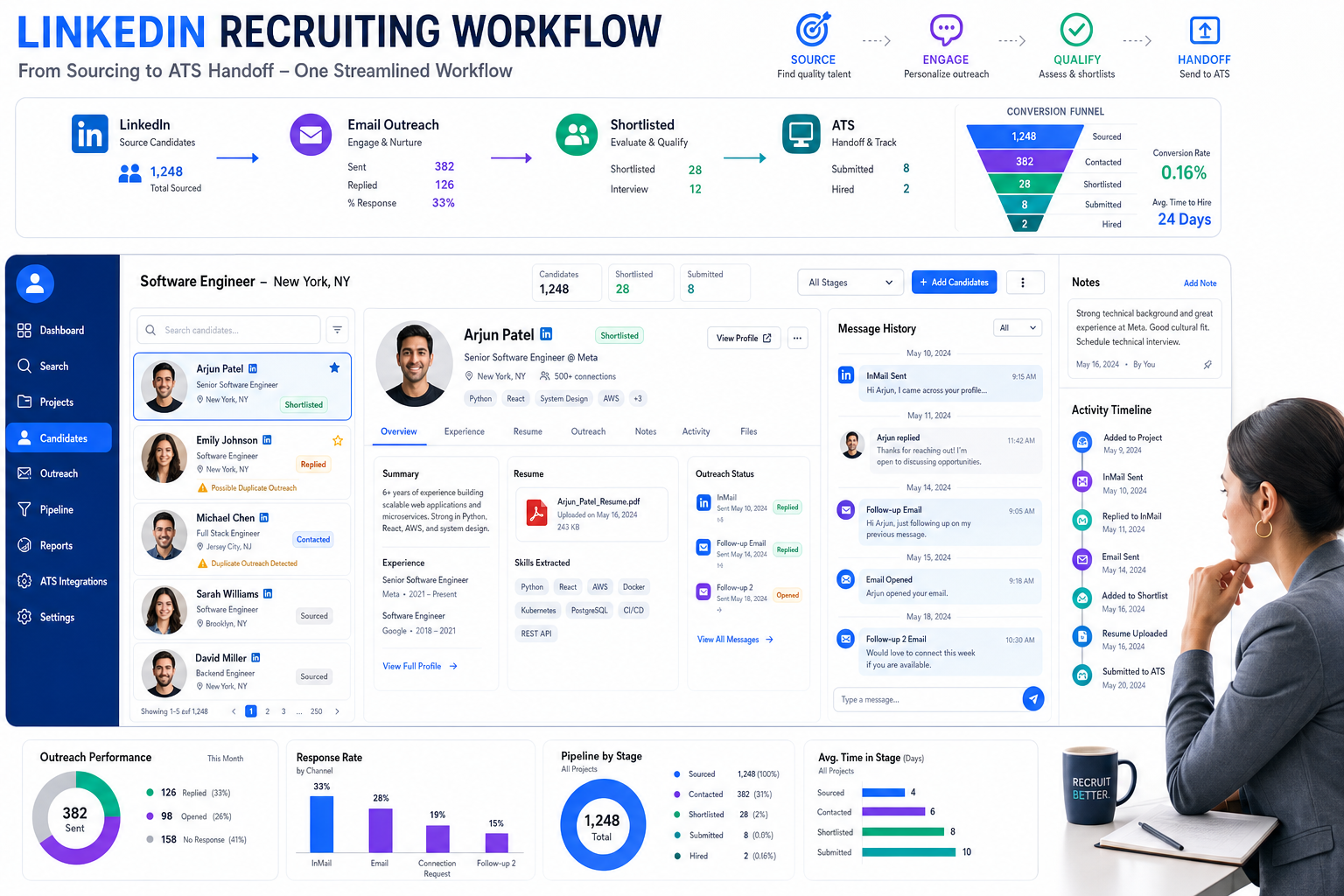
A simple sourcing workflow usually looks like this:
- Align with the hiring manager on must-haves and realistic alternatives
- Build the search using semantic logic, Boolean, or both
- Source from external profiles and internal records
- Review matches manually and refine the criteria
- Use AI support for outreach and follow-up continuity
- Collect resumes and contact details from interested candidates
- Move engaged candidates into ATS or CRM with full context
- Track response quality and adjust future searches
When this flow is weak, the same problems show up repeatedly: unclear ownership, inconsistent notes, and hard-to-explain shortlists. When it is strong, sourcing becomes much easier to scale without losing recruiter judgment.
How to Evaluate AI Recruitment Software
If you are evaluating ai recruitment software or ai based recruitment tools, I would focus less on polished demos and more on how the product behaves under real recruiting conditions.
1. Data source transparency
Ask where the profiles come from, how internal data is used, and whether source boundaries are clear. Transparency matters for both quality and compliance.
2. Match explainability
Recruiters need to understand why someone was surfaced. If the tool cannot explain fit in practical terms, trust drops quickly.
3. Outreach continuity
Do not evaluate only first-message generation. Ask how candidate replies are handled, how after-hours engagement works, and whether the process stays coherent when conversations continue across time zones.
4. Resume and contact capture
If the system creates interest but leaves collection and organization messy, it only shifts the workload downstream.
5. ATS and CRM integration
This should be a core requirement. Sourcing activity needs to land in the system your team already uses to manage hiring decisions.
6. Human-in-the-loop controls
Look for override options, review checkpoints, and visible recruiter ownership. Better tools support judgment rather than hiding it.
7. Privacy, documentation, and governance
Ask how candidate data is stored, whether customer data is used for model training, and what auditability exists around recommendations and outreach history. These are not legal side notes. They affect adoption.
| Evaluation area | What to ask | Why it matters |
|---|---|---|
| Sources | Where does candidate data come from? | Determines search quality and trust |
| Reasoning | Why was this candidate matched? | Helps recruiters defend the shortlist |
| Messaging | How are replies handled over time? | Protects candidate engagement |
| Capture | How are resumes and details collected? | Reduces manual cleanup |
| Integration | What sync exists with ATS or CRM? | Keeps the workflow usable |
| Governance | How are privacy and audit needs handled? | Supports responsible adoption |
Common Mistakes With AI Based Recruitment Tools
Most teams do not fail because AI sourcing is a bad idea. They fail because they treat it as a shortcut instead of an operating system improvement.
Assuming search is the whole problem
Often the bigger issue is what happens after the search: duplicated outreach, weak note capture, and inconsistent handoff.
Over-automating candidate communication
Automation should support recruiter responsiveness, not remove human accountability. Candidates can tell when no one is really steering the process.
Ignoring internal talent pools
Past applicants, silver medalists, and prior outreach records are often the fastest sourcing win, but many teams search outside first and leave value buried in their own systems.
Using AI without workflow standards
If nobody knows who owns the conversation, where records live, or when a candidate becomes active in the ATS, the tooling will not fix the process.
Confusing candidate interest with candidate qualification
A person replying positively is not the same as a person matching the role. Recruiters still have to evaluate resumes, context, and hiring-manager fit carefully.
Practical checklist:
- Define what sourcing success means before rollout
- Set clear rules for outreach ownership and recordkeeping
- Audit search quality by role and geography
- Track response quality, not just send volume
- Review how resumes and contact data are captured
- Keep final qualification with the recruiter
FAQ
What is AI candidate sourcing?
AI candidate sourcing is the use of software to help recruiters find, organize, and engage potential candidates before they apply. It usually includes search, matching, enrichment, and outreach support.
How does an AI recruiting tool help recruiters?
An ai recruiting tool can help recruiters search more intelligently, prioritize likely matches, maintain candidate outreach, and move engaged people into the ATS or CRM with better records.
What is the difference between sourcing and screening?
Sourcing happens at the top of the funnel and focuses on finding and contacting talent. Screening happens later and evaluates whether interested candidates actually fit the role.
Why does documentation matter in sourcing?
Documentation matters because recruiters need clean records of who was contacted, what was said, where the profile came from, and how the candidate moved through the process. Without that, shortlists become harder to defend and candidate experience suffers.
Can AI based recruitment tools replace recruiter judgment?
No. Good ai based recruitment tools support recruiter judgment by improving search and workflow efficiency, but recruiters should still make the final decisions on fit, resume review, and next steps.
How does LinkedIn fit into AI candidate sourcing?
LinkedIn is often a major top-of-funnel channel for outbound recruiting. AI-supported workflows can help maintain message continuity, handle candidate replies, and collect resumes or contact details more consistently.
What should teams ask when evaluating AI recruitment software?
Teams should ask about data sources, explainability, outreach handling, integration with ATS and CRM systems, privacy controls, and how much recruiter oversight the workflow supports.
Conclusion
AI candidate sourcing works best when recruiters evaluate it the way HR evaluates any sensitive people process: with attention to records, consistency, ownership, and judgment. Search quality matters, but so do communication history, handoff discipline, and the ability to explain why a candidate was surfaced and how the conversation progressed.
That is why the right ai recruiting tool is not just a faster search box. It is a sourcing workflow that helps recruiters discover talent, keep LinkedIn conversations moving, capture interest cleanly, and transfer context into the hiring system without losing control. If you are comparing ai recruitment software or ai based recruitment tools, that is the standard worth using.