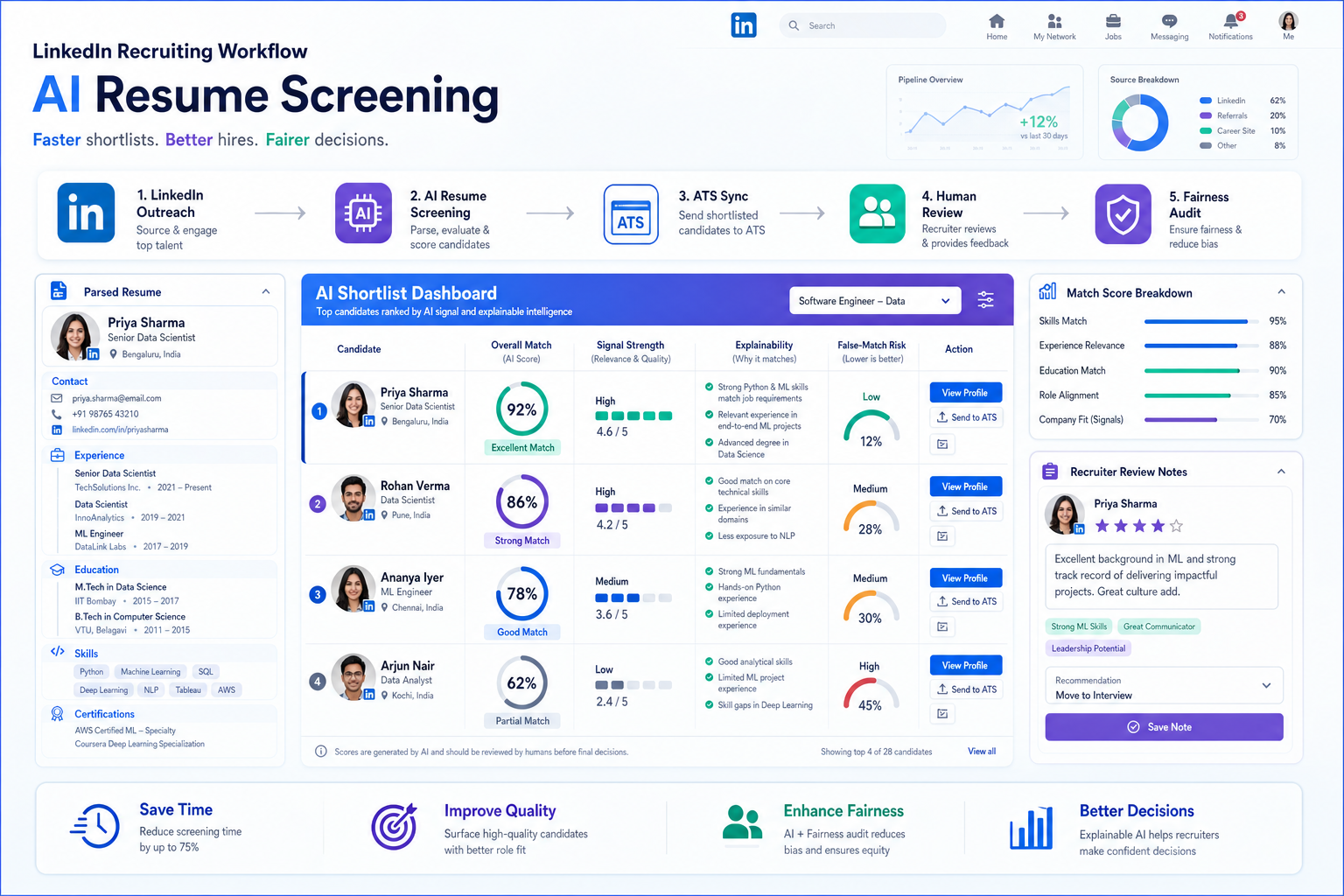
Shortlists improve when recruiters use this article to judge ai resume screening tools by signal, explainability, and false-match risk.
That matters because early screening is not only about speed. In retained search, agency recruiting, and in-house talent teams, the first-pass review affects workload, recruiter credibility, candidate experience, and the quality of the slate a hiring manager sees. When the first filter is sloppy, strong people are buried, weak profiles consume attention, and teams often mistake volume for pipeline health.
In my own workflow, I have found that outreach automation can ease this pressure before screening even starts. Used carefully, StrategyBrain AI Recruiter helps by keeping candidate conversations moving, collecting resumes and contact details from interested people, and replying across time zones when recruiters are offline. That support is useful in high-volume sourcing, but the recruiter still has to make the final judgment on resume quality, shortlist fit, and next-step decisions.
A useful way to frame this comes from a familiar HR mistake: treating every departure as bad news. Experienced operators know some turnover is healthy when poor performers, toxic contributors, or people dragging down the team choose to leave. The point is not that turnover feels good in the moment. It is that the real signal only appears when you separate harmful loss from desirable change and look at the person’s contribution before they exited.
The same logic applies to AI candidate screening. A shortlist is not good just because it is short, and a rejection is not smart just because software made it quickly. Recruiters need screening that distinguishes between genuinely desirable signals and noise, just as HR leaders should separate unhealthy attrition from functional turnover. That is why this article focuses on how ai resume screening tools work, what reliable cv screening software should actually prove, and how candidates can create a resume that pass the ai reviews without turning it into a keyword dump.
- AI screening is most useful as a structured first-pass review, not a final hiring decision engine.
- A strong screening workflow separates signal from noise the way good HR analysis separates desirable turnover from harmful loss.
- The value of ai resume screening tools depends heavily on job requirement quality and recruiter calibration.
- Good cv screening software should parse, match, rank, and explain rather than simply count keywords.
- Candidates improve results by making resumes relevant, readable, and easy for both software and recruiters to verify.
Table of Contents
- Why screening quality is really about signal vs noise
- How AI resume screening tools work in practice
- ATS vs AI candidate screening
- How to choose cv screening software
- What recruiters actually gain from AI screening
- Limits, risks, and fairness controls
- How to create a resume that pass the AI reviews
- Implementation advice for recruiting teams
- FAQ
Why Screening Quality Is Really About Signal vs Noise
One reason recruiters become skeptical of screening technology is that many tools promise efficiency but do not clarify what kind of efficiency they create. Faster rejection is not the same as better judgment. In practice, the core question is simple: can the system help your team distinguish useful candidate signals from misleading ones?
That is where the turnover analogy is helpful. HR leaders who understand workforce metrics know that not all turnover should be read the same way. When an under-performing or corrosive employee exits, the result can lower stress on coworkers, improve trust in leadership, open space for stronger talent, and lift morale. The lesson is not about celebrating exits. It is about classifying outcomes properly before deciding whether the business has a real problem.
Recruiters should apply the same discipline to screening results. Not every resume that looks polished is a strong match. Not every unconventional profile is a miss. Not every low-ranked candidate should stay low after human review. The strongest ai resume screening tools help teams sort desirable fit from misleading similarity, instead of flattening every applicant into a shallow score.
What this means in day-to-day hiring
- A good match is evidenced: the resume shows real alignment to required work, not just adjacent wording.
- A useful rejection is explainable: recruiters can see which must-haves were missing.
- A surprising candidate is still reviewable: strong systems do not hide the reasons behind the ranking.
- A shortlist should improve the pool: it should raise review quality, not just reduce the number of resumes.
Key insight: The goal of AI screening is not to eliminate people faster. It is to classify fit more accurately so recruiter time goes where it matters most.
Once you view screening through that lens, the software conversation becomes more practical. You stop asking whether AI can scan a resume and start asking whether it can support a defensible hiring judgment.
How AI Resume Screening Tools Work in Practice
The best way to understand ai resume screening tools is as a sequence of recruiting decisions, not a single magic score. Each step affects whether the final shortlist is trusted or ignored.
- The system parses the resume or CV. It extracts work history, titles, skills, education, dates, certifications, and other structured fields.
- It maps the content to job requirements. The software compares what it found against the role criteria, including must-have skills, functional background, seniority, and relevant domain signals.
- It ranks or scores fit. Better tools weight requirements rather than treating every keyword equally.
- It exposes the reasoning. Recruiters should be able to see where evidence exists, where it is thin, and where it is missing.
- Humans calibrate the output. Recruiters and hiring managers review edge cases, transferable skills, and unexpected profiles before moving candidates forward or out.
That last step is where many implementations succeed or fail. Screening technology works best when recruiters use it to sharpen review, not outsource review.
Why job descriptions matter more than most teams admit
If the job description is vague, inflated, or internally inconsistent, even smart software will rank against weak instructions. This is similar to misreading turnover data without separating desirable from undesirable exits. In both cases, the interpretation fails because the categories were not well defined from the start.
A recruiter evaluating screening output should ask:
- Which requirements are truly mandatory?
- Which are preferred but trainable?
- Which signals indicate direct fit?
- Which profiles deserve human reconsideration because they may be non-linear but still strong?
What explainability looks like in real screening
Useful explanations are concrete. A recruiter should be able to open a ranked profile and understand why it surfaced, why it dropped, or why confidence is limited. A raw score without evidence is hard to defend in hiring manager conversations and even harder to improve over time.
In my own recruiting process, I treat explainability as the dividing line between software that assists and software that distracts. I have used AI-supported recruiting workflows to reduce the manual load of candidate outreach and after-hours follow-up, especially when prospects reply late or from different regions. That made it easier to spend more energy on resume judgment itself. The lesson was straightforward: automation helps most when it removes repetitive front-end work but leaves fit evaluation in recruiter hands.
ATS vs AI Candidate Screening
Many recruiting teams still mix up applicant tracking with candidate evaluation. Both matter, but they solve different problems.
| Function | Traditional ATS | AI Candidate Screening |
|---|---|---|
| Application storage | Core function | Usually secondary |
| Pipeline tracking | Core function | Limited or integrated |
| Candidate communication history | Common | May connect but not primary |
| Keyword filtering | Often basic | Usually included |
| Semantic or requirement matching | Limited to moderate | Core focus |
| Explainable ranking | Often weak | Important differentiator |
| Recruiter calibration support | Varies | Should be strong |
An ATS keeps the hiring process organized. AI screening helps determine which resumes deserve closer attention first. The distinction matters because teams often buy technology to solve a judgment problem when what they really have is a workflow problem, or vice versa.
If your recruiters are drowning in inbound applications, then cv screening software can add value. If your real issue is inconsistent hiring stages, weak feedback notes, or poor stakeholder coordination, the ATS process itself may need work before screening automation can help.
How to Choose CV Screening Software
Most bad software decisions happen because a team compares features before it defines the hiring problem. Start with the operating conditions first: role type, application volume, recruiter capacity, hiring manager behavior, and the level of explanation required.
Questions worth asking before you buy
- Are we trying to speed up first-pass review, improve shortlist quality, or create screening consistency across recruiters?
- Do our job descriptions separate must-haves from preferred qualifications clearly enough for software to score against them?
- Can recruiters and hiring managers see why a profile ranked where it did?
- How easy is it to review unusual candidates who may have transferable experience?
- What human checkpoints remain in place before rejection or advancement?
Selection criteria that matter in practice
- Parsing accuracy: If resumes are read badly, every later step is compromised.
- Requirement logic: The system should reflect how your team defines fit, not just how text overlaps.
- Ranking transparency: Black-box output rarely earns recruiter trust.
- Workflow compatibility: The software should fit the way recruiters already work.
- Review controls: Teams need a way to inspect false negatives and false positives.
A practical test is to run the tool against a mixed resume set that includes obvious fits, obvious misses, and a few debatable profiles. If the system cannot help your team discuss those gray-area candidates intelligently, it is unlikely to improve real hiring decisions.
What Recruiters Actually Gain From AI Screening
The main benefits of ai resume screening tools are usually better prioritization, more structured review, and clearer hiring manager discussions. Speed matters, but speed alone is a weak buying reason.
1. More consistent first-pass review
When multiple recruiters support the same role, screening software can create a common frame for what counts as evidence of fit.
2. Better use of recruiter time
A ranked shortlist helps recruiters focus first on the candidates most likely to justify deeper review, while still keeping the wider pool visible.
3. Stronger shortlist discussions
Explainable ranking gives hiring managers a reasoned starting point rather than a list based on gut feel alone.
4. Better top-of-funnel discipline
Combined with sourcing and candidate communication support, screening becomes part of a more coherent early-stage workflow. For example, I have found that using StrategyBrain AI Recruiter for repetitive LinkedIn outreach, multilingual follow-up, and resume collection made it easier to protect recruiter time for actual evaluation. It did not replace screening judgment; it cleared the operational clutter around it.
5. Cleaner handling of high-volume roles
Roles with stable requirements benefit most because the screening logic is easier to define and audit.
In all of these cases, the gain is not that AI suddenly knows talent better than recruiters do. The gain is that it can help teams process early evidence more consistently and with less wasted motion.
Limits, Risks, and Fairness Controls
No serious recruiting team should treat AI screening as a final decision-maker. The risks are familiar: weak input criteria, resume parsing errors, overconfidence in scores, under-valued non-linear careers, and hidden bias in the way requirements are encoded.
Common failure points
- Bad role definitions: software can only rank against the hiring criteria it receives.
- Overly rigid matching: career changers and adjacent talent may be missed.
- Formatting distortions: resumes that parse poorly can be scored unfairly.
- Metric confusion: teams may optimize for low review time instead of high shortlist quality.
Useful guardrails
- Use screening as a first-pass support layer, not a sole gatekeeper.
- Require recruiter review before final rejection decisions.
- Audit false negatives and false positives on a regular basis.
- Keep must-have criteria narrow, job-related, and defendable.
- Train hiring managers to challenge rankings when context suggests the software missed something.
This returns to the opening lesson: classification matters. Just as turnover analysis improves when you divide healthy departures from harmful ones, screening improves when you separate meaningful candidate signals from noise and keep humans responsible for the interpretation.
How to Create a Resume That Pass the AI Reviews
Job seekers searching how to create a resume that pass the ai reviews are usually trying to solve a practical problem: how to be read correctly by software without sounding robotic to a recruiter. The answer is to make relevance visible and formatting simple.
What candidates should do
- Match the resume to the role. Reflect the real responsibilities, tools, and skills named in the job description where they genuinely apply.
- Use standard headings. Keep sections like Experience, Skills, Education, and Certifications easy to parse.
- Show evidence, not just labels. If a skill matters, connect it to actual work, scope, or ownership.
- Clarify title overlap. If your prior job title is different from the target role, use bullet points to show comparable responsibilities.
- Keep formatting clean. Dense graphics, unusual layouts, and decorative section names often reduce machine readability.
What candidates should avoid
- Keyword stuffing with no context
- One generic resume for every application
- Missing must-have qualifications near the top of the document
- Fancy designs that interfere with parsing
- Vague claims without role-specific proof
The real goal is not to outsmart software. It is to remove ambiguity so both the system and the recruiter can verify fit quickly.
Candidate tip: A resume that passes AI review well is usually also a resume that makes a recruiter’s first-pass judgment easier.
Implementation Advice for Recruiting Teams
If you are introducing AI candidate screening into your process, start with a narrow use case. Stable role families, repeat hiring patterns, and clear minimum criteria are usually the safest first environment.
A practical rollout sequence
- Clean up the job description. Separate must-haves from preferred qualifications.
- Write a screening rubric. Define what evidence counts and what should trigger manual review.
- Test with sample or historical resumes. Compare results with recruiter judgment and discuss disagreements.
- Train recruiters and hiring managers. Make sure they understand what the scores mean and where the system is limited.
- Review exceptions regularly. Pay special attention to unusual but promising backgrounds.
If your team also runs heavy outbound sourcing, this is where communication automation can support the process without taking over decision-making. I have seen value in using AI Recruiter to keep candidate replies moving after hours, gather resumes from interested prospects, and reduce repetitive LinkedIn follow-up. That is especially useful when recruiters need more top-of-funnel continuity but still want all fit assessment to stay in human hands.
The most mature recruiting teams do not ask whether AI should replace judgment. They ask where automation reduces friction, where human review must remain non-negotiable, and how to keep evidence visible at every stage.
FAQ
Are AI resume screening tools the same as an ATS?
No. An ATS primarily manages applications, stages, notes, and workflow history. AI screening is focused on evaluating fit between resumes or CVs and job requirements.
Can AI candidate screening replace recruiters?
No. It can support first-pass review, but recruiters still need to interpret context, transferable experience, motivation, and fairness concerns.
What should recruiters look for in cv screening software?
Focus on parsing quality, requirement-based matching, explainable ranking, workflow fit, and the ability to review edge cases rather than trusting opaque automation.
How can a candidate create a resume that pass the AI reviews?
Use role-relevant language truthfully, keep the layout simple, show real evidence behind key skills, and avoid keyword stuffing or complicated formatting.
Is AI screening fairer than manual screening?
It can improve consistency, but fairness depends on the criteria, configuration, and review process around it. Human oversight remains essential.
Conclusion
AI resume screening tools are most valuable when they help recruiters classify candidate quality more clearly, not when they try to replace recruiter judgment with a score. The strongest systems improve first-pass consistency, support explainable ranking, and make shortlist conversations more defensible.
For recruiters, the practical takeaway is simple: define fit well, review output critically, and use automation where it removes repetitive work without blurring accountability. For candidates, the rule is equally simple: make your evidence easy to read, easy to parse, and directly connected to the job you want.