When hard-to-fill roles stall on missed follow-up, this article helps recruiters judge ai sourcing software by shortlist quality, workflow control, and fit risk.
That matters most when the search is not for interchangeable talent. In construction and other field-led hiring markets, one missed follow-up can delay a shortlist, frustrate a hiring manager, and leave revenue tied up in an unfilled role. For solo recruiters, that turns into late-night admin and weaker candidate relationships. For small agency owners, it means consultants spend too much time chasing replies and not enough time qualifying fit. For in-house teams, it can damage hiring credibility when project leaders need certified, safety-aware people now, not another stack of poorly matched profiles.
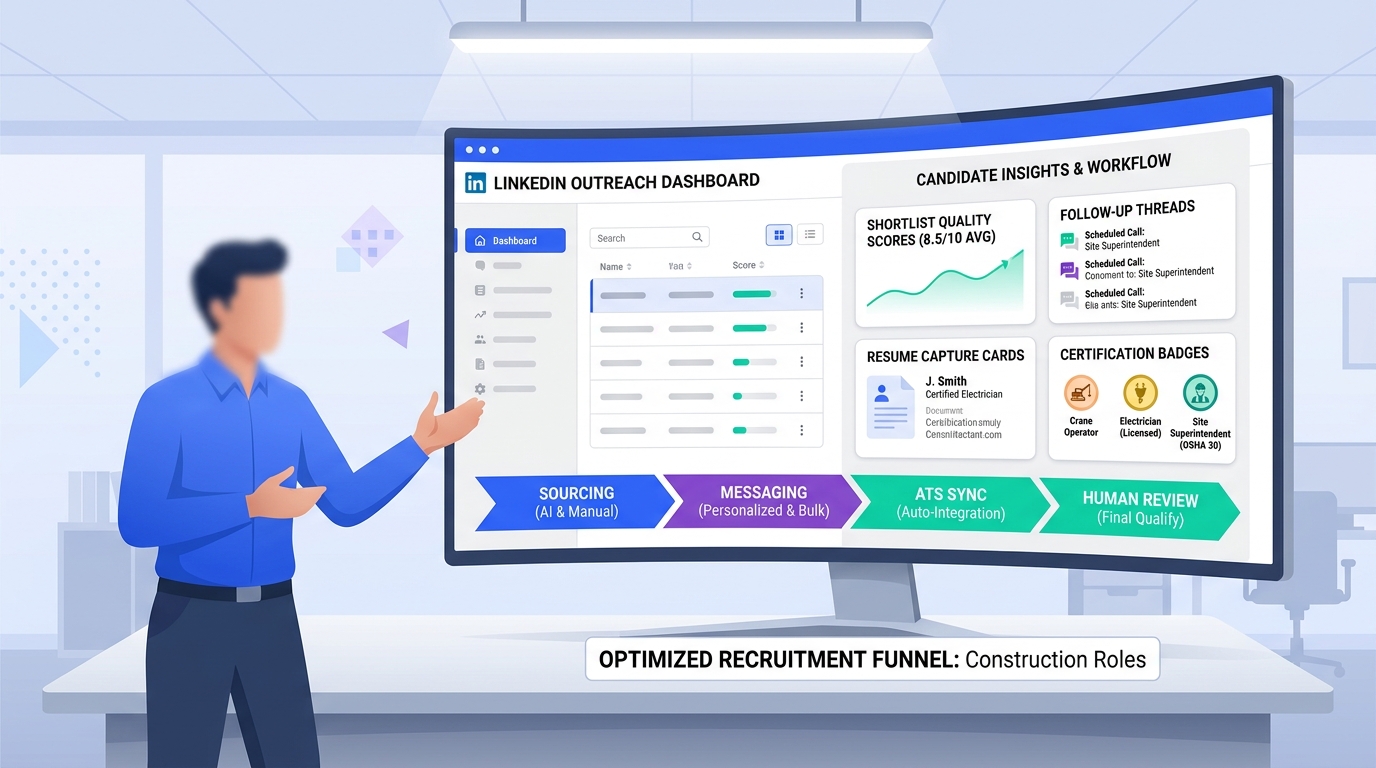
That is why I now look at AI support as workflow relief rather than magic. In my own sourcing work, StrategyBrain AI Recruiter has been most useful when a role needs steady LinkedIn outreach, after-hours replies, and multilingual follow-up without losing recruiter control. It can handle first-touch messaging, continue candidate conversations, and collect resumes or contact details from interested people, while I still review the resume, decide whether the background fits, and choose the next step.
A good example comes from construction hiring in Western Canada, where employers may need crane operators, site superintendents, estimators, project managers, electricians, or welders across changing project timelines. The work is safety-sensitive, often seasonal, and rarely follows a calm hiring rhythm. A recruiter can be checking certification requirements for one requisition, updating candidate notes for another, and trying to re-engage a previously interviewed tradesperson before a competing employer reaches them first.
The difficulty is not only volume. It is coordination under pressure. In that market, hiring teams are balancing housing and infrastructure demand in British Columbia, industrial and diversification projects in Alberta, and smaller talent pools in Saskatchewan and Manitoba. Recruiters have to confirm trade credentials, judge whether someone can work in a union or non-union environment, and keep communication moving fast enough that a qualified candidate does not disappear between message threads, resume collection, and hiring-manager alignment.
That opening case exposes the real evaluation standard for ai candidate sourcing: not whether software sounds intelligent, but whether ai sourcing software helps recruiters handle scarce, safety-sensitive, project-based hiring without drifting into the logic of an artificial intelligence procurement platform or ai procurement platform. Supplier sourcing and candidate sourcing may share a word, but the workflows, risks, and judgment calls are completely different.
Table of Contents
- Why Hard-to-Fill Roles Change the Evaluation
- How AI Sourcing Software Actually Helps Recruiters
- What Construction Recruiting Teaches About AI Candidate Sourcing
- How to Evaluate AI Sourcing Software
- Why ATS and Stack Fit Matter
- Benefits and Limits to Expect
- Implementation Advice for Recruiters and HR Teams
- Common Buying Mistakes
- FAQ
Why Hard-to-Fill Roles Change the Evaluation
When recruiters fill repeat office roles, weak software can sometimes be masked by volume. That is not true in construction, industrial hiring, or any market where candidate pools are thin and speed matters. If a role depends on certifications, safety records, leadership under field conditions, or willingness to join a project in a specific region, the sourcing process has to preserve nuance.
The Western Canada construction example makes that clear. Employers are not just buying labor capacity. They are trying to staff dynamic project teams where a bad match can affect safety, timelines, and client delivery. A site superintendent is not interchangeable with a project manager. A welder with the wrong background may slow a critical phase. A health and safety officer who lacks credibility on site can create operational risk. That is why experienced recruiters care less about AI theater and more about whether software helps them identify the right people, keep them engaged, and move them through a clear process.
Practical takeaway: The best ai sourcing software is judged by how well it supports role-specific judgment, urgency, and recruiter follow-through in difficult hiring markets.
How AI Sourcing Software Actually Helps Recruiters
A useful way to assess ai sourcing software is by recruiter workflow rather than feature category. In practice, most teams need help in four places: finding candidates, keeping outreach active, resurfacing older talent, and organizing the handoff to human review.
1. Candidate discovery beyond exact keywords
Strong systems should widen the search without lowering the bar. For hard-to-fill roles, that means identifying adjacent experience, transferable project backgrounds, and candidates already known to the business. In construction hiring, a recruiter may need someone with direct infrastructure exposure, heavy-equipment familiarity, or safety-led supervision experience, not just a title match.
2. Outreach continuity
Many sourcing bottlenecks are not search problems. They are follow-up problems. Recruiters get responses after hours, across time zones, or in bursts while they are handling intake calls, candidate debriefs, and hiring-manager questions. This is one place where I have found AI Recruiter genuinely useful. It can continue the conversation, answer common role questions, and collect resume or contact details from interested candidates so the recruiter is not manually babysitting every early exchange.
That said, automation should stop short of final qualification. The recruiter still has to decide whether the resume reflects the right trade background, leadership depth, project exposure, or relocation reality.
3. Candidate resurfacing
In project-based hiring, old records often become newly relevant. A candidate who was unavailable during one build may now be ready for another. A prior finalist may fit a different superintendent opening. AI can help recruiters search previous applicants, organize talent pools, and flag likely matches already sitting in the ATS or CRM.
4. Workflow support, not replacement
The most credible systems reduce repetitive steps and protect recruiter attention. They should not pressure teams into sending more messages just to create activity. In field recruiting especially, quality of contact, speed of response, and clarity of next steps matter more than dashboard volume.
What Construction Recruiting Teaches About AI Candidate Sourcing
The reference case from Western Canada is helpful because it shows what real recruiting complexity looks like. Construction teams hire across a wide spectrum: tradespeople, supervisors, estimators, project managers, safety professionals, and executives. The hiring cycle is uneven. Demand shifts with seasons, new projects, infrastructure expansion, and regional labor shortages. Competition is strong because retirements, local supply constraints, and active project pipelines all compress the market.
Those conditions create three lessons for anyone evaluating ai candidate sourcing.
Hiring complexity is role-specific
Recruiters need systems that handle more than title search. In this market, they must assess certifications, worksite safety habits, leadership style, and fit for the project environment. The sourcing layer should help surface context, not flatten it.
Speed matters, but weak speed is expensive
Construction delays cost money. Yet fast sourcing only helps if the shortlist remains credible. That means software should accelerate first contact and organization while making it easy for recruiters to reject weak-fit profiles quickly.
Regional context changes candidate behavior
In British Columbia, housing pressure and infrastructure work may drive demand for electrical, mechanical, and project leadership talent. In Alberta, industrial and energy-linked roles may require different positioning around stability and long-term opportunity. In Saskatchewan and Manitoba, smaller local talent pools often increase the need to source more broadly. Useful software should support these realities rather than assume every market behaves the same way.
This is also where people get misled by overlapping search language. Someone researching sourcing software may encounter terms like artificial intelligence procurement platform or ai procurement platform. Those labels usually belong to supplier and spend workflows, not recruiter-led talent sourcing. If the product language centers on bids, vendors, spend optimization, or purchasing decisions, it is solving a different problem.
How to Evaluate AI Sourcing Software
In my experience, the cleanest evaluation process starts with a live set of roles your team actually struggles to fill. If construction is one of those categories, test with a mix of trades and management openings rather than one generic requisition. Look at whether the system helps with urgency, fit, and recruiter action.
| Evaluation Area | What to Check | Why It Matters in Hard-to-Fill Roles |
|---|---|---|
| Search and matching | Skill adjacency, role nuance, transparency | Exact-title matching is too narrow for specialist hiring |
| Outreach handling | First-touch support, follow-up continuity, response capture | Late or missed replies lose scarce candidates |
| Resume and contact capture | Simple collection and clear recruiter handoff | Interested candidates should move quickly into review |
| ATS integration | Searchable history, synced notes, stage visibility | Past applicants often become today's best leads |
| Human override | Easy approval, rejection, editing, and audit trail | Recruiters need control in safety-sensitive hiring |
| Communication quality | Personalization support without robotic messaging | Candidate experience affects response and trust |
| Data governance | Access controls, ownership clarity, privacy handling | Candidate information must be managed carefully |
If your workflow relies heavily on LinkedIn sourcing, it is worth testing whether the tool can reduce manual messaging without turning outreach into spam. In that context, I have found StrategyBrain AI Recruiter most effective as a front-end assistant for repetitive outreach and candidate response management. It is not a replacement for recruiter judgment, but it can remove the drag of constant first-touch and follow-up work.
Why ATS and Stack Fit Matter
No sourcing tool should be judged in isolation. Recruiters work across intake notes, candidate histories, outreach records, interview movement, and hiring-manager feedback. If the software cannot fit inside that operating reality, adoption usually fades.
That is especially true in project-led hiring. A recruiter may source a site superintendent today, revisit an estimator from six months ago tomorrow, and reopen an electrician pipeline next quarter. If candidate history is trapped in separate systems, the team repeats work and loses context. Good ai sourcing software should strengthen the ATS and CRM environment you already use, not create another disconnected layer.
This is also why procurement language causes confusion. An ai procurement platform may be excellent at formalizing supplier workflows because supplier records, contract terms, and spend decisions often follow a more structured buying logic. Candidate hiring is more fluid. Motivation changes, availability moves, and fit depends on interpersonal, operational, and situational judgment.
Benefits and Limits to Expect
Where recruiters usually gain value
- Better use of recruiter time: Less manual chasing, more time spent on qualification and stakeholder alignment.
- Faster early-stage movement: Interested candidates can be identified and routed to review more quickly.
- Improved use of existing talent pools: Prior candidates and warm records become easier to find again.
- More stable communication flow: After-hours and multilingual exchanges are less likely to stall.
Where expectations should stay realistic
- AI does not certify fit: A response is not the same as a qualified candidate.
- Ranking is only a starting point: Recruiters still need to challenge weak matches.
- Automation can hurt brand perception: Poorly handled outreach feels obvious fast.
- Human accountability remains essential: Final decisions on resumes, shortlists, and next steps belong to recruiters and hiring teams.
That balance matters in industries like construction because the cost of a poor shortlist is not theoretical. It affects project timing, team coordination, and sometimes safety outcomes.
Implementation Advice for Recruiters and HR Teams
If you adopt ai sourcing software, start with one narrow recruiting bottleneck. For many teams, that is active outreach for hard-to-fill roles or resurfacing neglected ATS talent. Keep the first implementation close to a recruiter-led workflow so results can be checked quickly.
- Choose a live hiring segment. Construction management, skilled trades, or other specialist roles are good tests because the pain is visible.
- Define the machine-human split. Let the system assist with search, messaging, or data capture, but keep resume review and shortlist decisions with recruiters.
- Audit candidate communications. Make sure outreach sounds credible and role-specific.
- Use the ATS as the source of truth. Notes, stage changes, and candidate history need to remain visible.
- Review outcomes with hiring managers. Ask whether the software improved relevance and speed, not just activity levels.
In my own workflow, the biggest benefit of using AI Recruiter has been operational consistency. Candidates often reply outside business hours, and letting an AI layer handle initial engagement, role explanation, and resume collection has reduced the need to monitor every thread manually. The real value is not that it “decides” for me. It keeps the process moving until I step in to assess the candidate properly.
Common Buying Mistakes
- Confusing supplier sourcing with candidate sourcing. Terms like artificial intelligence procurement platform and ai procurement platform usually describe another software category.
- Buying broad AI claims instead of workflow help. Recruiters need support at known friction points.
- Ignoring communication quality. Outreach automation that sounds generic can lower response rates and trust.
- Skipping stack-fit questions. If ATS and CRM alignment are weak, recruiter adoption drops.
- Expecting software to replace recruiter judgment. Especially in hard-to-fill roles, final evaluation still depends on experience.
FAQ
Is AI candidate sourcing the same as an artificial intelligence procurement platform?
No. AI candidate sourcing supports recruiter workflows such as finding, engaging, and resurfacing talent. An artificial intelligence procurement platform usually supports supplier selection, spend analysis, bidding, or contract-oriented procurement work.
What should headhunters look for in ai sourcing software?
Look for matching quality, follow-up support, ATS fit, response capture, and clear human control. In hard-to-fill markets, speed without relevance is not enough.
Why is construction recruiting a useful test case?
Because it combines scarce talent, compliance needs, uneven demand, regional market pressure, and high cost of delay. If software helps there, it is more likely to help in other specialist hiring environments too.
Can AI handle candidate outreach while recruiters keep final control?
Yes. That is often the most practical model. Tools can assist with first contact, follow-up, and collecting resumes or contact details, while recruiters review fit and decide on interviews or shortlists.
How does LinkedIn fit into ai candidate sourcing?
For many recruiters, LinkedIn remains a major sourcing channel. AI can help manage repetitive outreach and ongoing message handling there, but the recruiter still needs to own targeting quality, candidate judgment, and relationship tone.
What is the biggest mistake buyers make with an ai procurement platform search?
They assume the same language applies to recruiting. The word sourcing appears in both procurement and talent acquisition, but the workflows, data, and decision logic are very different.
Conclusion
AI candidate sourcing becomes most valuable when you evaluate it against real recruiter pressure: scarce talent, delayed replies, project deadlines, and the need to keep judgment human. The construction market example from Western Canada shows why. When roles are safety-sensitive, regionally constrained, and time-critical, recruiters need software that supports action and follow-through, not vague automation claims.
If you are assessing ai sourcing software, start with the workflows that break first: outreach continuity, candidate rediscovery, ATS visibility, and role-specific matching. If the product feels closer to an ai procurement platform than a recruiting workflow tool, it is probably solving the wrong sourcing problem.