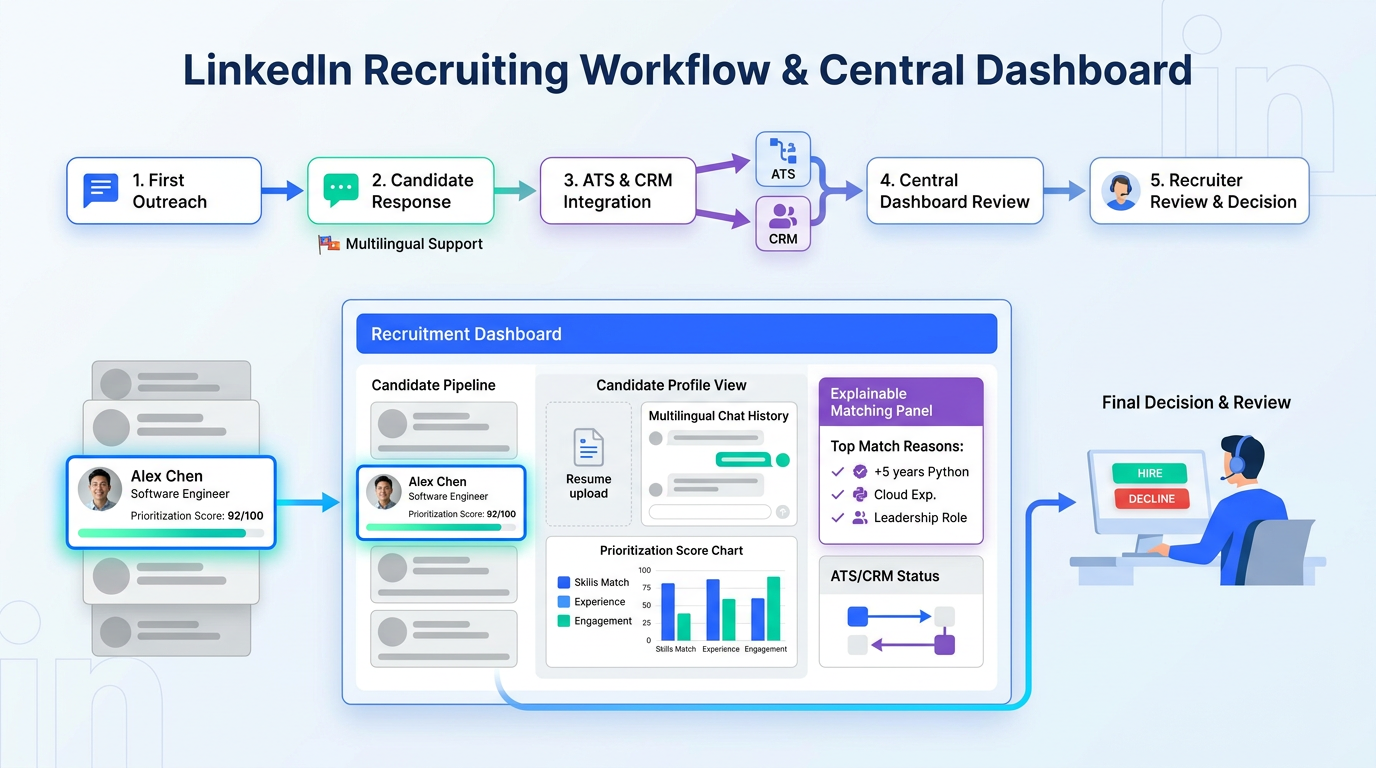
When free-agent candidates go silent after slow follow-up, this article helps recruiting leaders judge ai talent management software that preserves momentum.
That matters because strong candidates rarely behave like captive applicants anymore. They compare opportunities quickly, reply after hours, disappear when follow-up is slow, and expect recruiters to understand not only the role but also the team, growth path, and compensation logic. For agency owners, that creates delivery pressure and margin risk. For solo recruiters, it means missed conversations and too much manual chasing. For in-house talent teams, it can damage hiring manager confidence and employer reputation long before an offer is ready.
In that gap between candidate freedom and recruiter capacity, tools like StrategyBrain AI Recruiter can help with the repetitive front end of outreach. I have found its value is most obvious when candidate replies come in late, across time zones, or in different languages: it can continue LinkedIn conversations, answer common role questions, and collect resumes and contact details so the recruiter is not rebuilding momentum from scratch the next morning. The recruiter still owns final resume review, qualification judgment, and the decision on who moves forward.
A useful way to frame this is the old idea that top employees act more like free agents than long-term fixtures. Think about a controller, senior accountant, or engineering lead who can stay put, leave this quarter, or simply test the market for leverage. The hiring team cannot assume stability. A recruiter has to contact the person, explain the opportunity, respond to compensation questions, and keep the conversation warm while also tracking who is genuinely open to a move.
That is where many recruiting workflows start to fail in practice. One missed LinkedIn reply, one vague answer about progression, or one delayed follow-up can turn a live prospect into a silent loss. The lesson is not only about retention strategy; it is also about how modern ai-powered talent acquisition should support sourcing, engagement, and prioritization. When you evaluate ai talent management software, a talent intelligence platform, or a broader talent platform, the real question is whether the system helps recruiters compete for candidates who always have the option to say no.
Table of Contents
- Why AI hiring starts with a free-agent talent market
- What AI talent management software should actually help recruiters do
- Talent platform vs talent intelligence platform
- How AI improves the workflow from outreach to prioritization
- What recruiters can learn from compensation, social fit, and growth signals
- Why skills-based matching beats keyword search
- Why ATS, CRM, and LinkedIn workflow integration matter
- What responsible AI hiring governance looks like
- How to evaluate vendors without getting distracted by hype
- Common buying mistakes in AI-powered talent acquisition
- FAQ
Why AI hiring starts with a free-agent talent market
Experienced recruiters already know the market truth behind the phrase: employees are free agents. Even when someone is not formally interviewing, they may still be assessing compensation, flexibility, team quality, and career progression. In other words, recruiting is not just about finding people. It is about winning attention before another option becomes more convincing.
That is why ai-powered talent acquisition should not be reduced to automation theater. In a free-agent market, the practical value of AI is that it helps recruiters maintain coverage across many live conversations at once. It supports faster replies, clearer prioritization, and better use of candidate data without forcing every meaningful interaction into a manual queue.
The reference point from traditional retention advice still applies here. Employers try to keep strong performers by addressing three big areas: money, social belonging, and growth. Recruiters feel the same factors from the outside. Candidates ask whether the pay is competitive, whether the team seems worth joining, and whether the move leads somewhere better. Good software should help recruiters keep those signals organized and actionable.
Practical takeaway: if your team loses candidates because responses are slow, ownership is unclear, or recruiters cannot tell who is truly movable, your issue is not just sourcing volume. It is workflow design in a free-agent market.
What AI talent management software should actually help recruiters do
The label ai talent management software covers too much unless you tie it back to daily recruiting work. In practice, useful systems help answer four operating questions: Who is worth contacting? Who is showing intent? Why are they a fit? What should happen next?
For most recruiting teams, the software should support:
- Find: search internal, external, and previously engaged talent pools
- Engage: start and continue candidate conversations without losing context
- Interpret: turn resumes, profiles, and messaging signals into recruiter-usable insight
- Prioritize: rank where limited recruiter time should go next
- Document: push activity back into the governed workflow
I have seen the biggest gains when teams stop asking whether the system looks intelligent in a demo and start asking whether it removes repetitive friction in the real sequence of work. With AI Recruiter, for example, the immediate advantage is not that it replaces recruiter judgment. It helps keep candidate conversations alive on LinkedIn, gathers resumes and contact details from interested people, and reduces the need for recruiters to manually babysit every first-touch exchange. That is especially useful for teams running high outbound volume or cross-border hiring.
Practical advice: ask every vendor to show the handoff from outreach to recruiter review. If the system can generate activity but not a clean decision point, adoption usually fades.
Talent platform vs talent intelligence platform
These terms overlap, but they do not solve the same problem.
| Category | Primary role | Typical value for recruiters |
|---|---|---|
| Talent platform | Broad environment for recruiting or workforce activity | Workflow coordination, collaboration, pipeline tracking, centralized records |
| Talent intelligence platform | Focused layer for data enrichment, market insight, matching, and decision support | Better search, skills normalization, market mapping, candidate prioritization |
A broad talent platform often handles requisitions, stages, approvals, and visibility across teams. A talent intelligence platform goes deeper on understanding the market and the people in it. It is usually more valuable when your bottleneck is relevance, not administration.
That distinction matters in free-agent recruiting. If your team can already move candidates through a process but struggles to identify who is persuadable, who has adjacent skills, or who may leave for stronger growth upside, a pure workflow layer will not fix the problem. You need deeper intelligence and better communication support.
Practical advice: define whether your next purchase is meant to expand system coverage or improve talent judgment. Too many buying cycles confuse the two.
How AI improves the workflow from outreach to prioritization
The best way to evaluate ai-powered talent acquisition is by following the recruiter workflow rather than the feature sheet.
1. Outreach that does not stall after business hours
Many candidate conversations begin when recruiters are busy elsewhere or offline. That is why after-hours response capacity matters more than vendors often admit. A tool that can continue initial LinkedIn outreach, answer basic role questions, and capture resume intent can reduce the drop-off that happens between first response and real follow-up.
From my own use perspective, this is where StrategyBrain AI Recruiter feels practical rather than flashy. It keeps early-stage messaging moving, including multilingual communication, so recruiters can return to a warmer conversation instead of a cold lead. But the recruiter still decides whether the candidate’s background actually matches the role.
2. Screening that separates interest from fit
AI can help identify whether someone is responsive, curious, and willing to share details. That is useful, but it is not the same as final qualification. Recruiters still need to read the resume, assess chronology, and evaluate whether the role requirements are truly met.
Practical advice: avoid systems that blur willingness to engage with actual fit. Those are different signals, and strong recruiters treat them differently.
3. Matching that explains itself
Good matching should combine skills, relevant experience, and role context. Just as important, it should show why someone is being surfaced. Black-box rankings are hard to defend to hiring managers and even harder to trust when the role is difficult.
4. Prioritization that reflects candidate leverage
In a free-agent market, not every prospect deserves the same follow-up sequence. Some candidates need quick compensation clarity. Others need reassurance about progression or team quality. Better systems help recruiters prioritize not just by fit score, but by likelihood of movement and urgency of response.
Key insight: The strongest AI recruiting workflow does not simply automate outreach. It helps recruiters act faster on candidates who have the most options.
What recruiters can learn from compensation, social fit, and growth signals
The retention logic in the reference material is surprisingly useful for talent acquisition. Employers hold on to people by getting three things right: financial value, social connection, and progression. Recruiters can use the same frame when evaluating candidate engagement and software support.
Financial signals
Compensation still shapes candidate behavior. Good recruiting systems should help capture and organize pay expectations, bonus questions, and willingness-to-move thresholds without leaving those details scattered across inboxes and chat threads.
Social signals
Candidates also judge whether they can imagine belonging in the team. Recruiters need tools that preserve conversation context so outreach does not feel robotic or disconnected from the real environment the candidate would join.
Growth signals
Top performers often care as much about progression as they do about stability. That means recruiters need to understand whether the role offers a bigger mandate, stronger leadership exposure, or future mobility. A system that only tracks stage changes misses that nuance.
Practical advice: during demos, test whether the software can capture the reasons a candidate may accept, hesitate, or leave. If it only stores generic notes, it will not help much in a competitive search.
Why skills-based matching beats keyword search
Keyword search still misses too many relevant people. Titles vary across employers, strong candidates describe their work differently, and adjacent experience often matters more than exact wording.
That is why a capable talent intelligence platform should normalize skills, connect related experience, and surface candidates whose backgrounds map to the work even when the profile language does not match the job description line by line.
This is especially important in a free-agent market because recruiters do not have unlimited shots. If your search logic keeps serving only obvious profiles, you burn time competing in the same crowded pool. Better matching expands the field and improves the quality of first outreach.
Practical advice: ask vendors to run a hard role from your own desk and show adjacent-skill matches, not just exact-title wins.
Why ATS, CRM, and LinkedIn workflow integration matter
Integration is where many promising tools become either operationally useful or quietly abandoned. Recruiters need candidate data, conversation history, and next-step actions to move across LinkedIn, CRM, and ATS environments without duplicate entry.
If your team does heavy outbound work, LinkedIn conversation flow is part of the real recruiting system whether buyers like to admit it or not. That is why software that supports that front-end work can matter, provided the handoff back into the formal process is clean. A recruiter should not have to manually reconstruct who replied, who shared a resume, and who asked for compensation details.
I would evaluate this closely with any tool, including AI Recruiter conversation workflows. The useful question is not whether an integration exists in theory. It is whether the recruiter can move from message to review to submission without retyping the same candidate history.
Practical advice: ask what syncs, what does not, and what the recruiter still has to do manually after an interested candidate responds.
What responsible AI hiring governance looks like
Trust matters more when AI is involved in messaging, matching, and prioritization. Recruiters and talent leaders need to know how recommendations are generated and what remains under human control.
Responsible governance should include:
- Explainability: why a candidate was surfaced or prioritized
- Human review: clear recruiter ownership over final qualification and progression
- Data discipline: secure handling of resumes, contact details, and conversation records
- Compliance awareness: documented process and privacy controls
This is one reason many teams prefer AI to support the front end of recruiting rather than act as a final gatekeeper. With outreach automation and intent capture, the system helps scale effort while the recruiter keeps control over judgment.
How to evaluate vendors without getting distracted by hype
Use the buying process to test operating fit, not marketing language.
- Start with a real free-agent scenario. Use a role where candidates have options and reply unpredictably.
- Separate engagement automation from qualification. Know whether the tool supports outreach, matching, or both.
- Test difficult searches. Easy roles make weak systems look fine.
- Review LinkedIn and CRM handoffs. Early-stage communication is often where momentum is won or lost.
- Inspect multilingual and after-hours support. This matters for global and agency hiring more than many buyers expect.
- Confirm recruiter usability. If the workflow adds clicks or parallel tracking, adoption will drop.
- Check governance and privacy controls. Make sure human review stays central.
When I assess tools in this category, I care less about whether the vendor claims to replace recruiter work and more about whether it protects recruiter momentum. That is the practical standard that separates a useful talent platform from one that simply creates more software to supervise.
Common buying mistakes in AI-powered talent acquisition
- Assuming candidate availability is stable. In reality, strong talent behaves like a free agent.
- Confusing willingness to engage with qualification.
- Buying broad platform claims when the real need is deeper intelligence.
- Relying on keyword search for roles that need adjacent-skill judgment.
- Treating LinkedIn messaging as separate from the core recruiting workflow.
- Ignoring after-hours response gaps.
- Accepting black-box scoring without recruiter explainability.
One more mistake is expecting any system to solve persuasion on its own. AI can help capture attention, maintain responsiveness, and surface the right people. It cannot replace the recruiter’s role in understanding motives, pressure-testing fit, and managing stakeholder trust.
FAQ
What is AI-powered talent acquisition?
AI-powered talent acquisition uses AI tools to help recruiting teams find, engage, match, and prioritize candidates. It works best when it supports recruiter judgment rather than replacing it.
What is AI talent management software?
Ai talent management software is software that helps organize and improve talent-related decisions such as sourcing, engagement, screening support, matching, and prioritization. In recruiting, its value depends on how well it fits the real workflow.
What is the difference between a talent platform and a talent intelligence platform?
A talent platform is a broader system for managing recruiting or workforce activity. A talent intelligence platform is more specialized in data enrichment, skills understanding, market insight, and decision support.
Why does the free-agent idea matter in recruiting?
Because strong candidates do not wait around for slow processes. They compare opportunities constantly, which means recruiters need better timing, better context, and stronger prioritization.
Can AI help with LinkedIn recruiting without replacing recruiters?
Yes. AI can handle repetitive first-touch messaging, after-hours replies, multilingual communication, and resume collection while recruiters retain control over qualification and next-step decisions.
What should I ask before buying AI recruiting software?
Ask how the tool supports real recruiter workflow, how it handles integration, whether it explains its recommendations, and where human review remains essential.
Conclusion
The strongest lens for evaluating ai talent management software is simple: does it help recruiters compete in a market where candidates act like free agents? If the answer is yes, the software should improve speed, preserve context, support better matching, and make prioritization more realistic.
Whether you are considering a talent intelligence platform, a broader talent platform, or a LinkedIn-focused engagement layer, keep the buying decision grounded in recruiter workflow. The right system is not the one with the loudest AI claim. It is the one that helps your team keep conversations alive, evaluate fit with more confidence, and move faster without sacrificing judgment.