An ai hiring platform helps teams hire consistently in hybrid work by standardizing how candidates are sourced, engaged, and evaluated across remote and in office contexts. The practical takeaway from recent office trends is simple: as work becomes more video first and seating becomes more flexible, recruiting must become more structured. That is where an interview intelligence platform and live interview ai practices matter most. In this guide, we connect workplace trends to hiring outcomes, then show how StrategyBrain AI Recruiter can automate LinkedIn outreach, run 24/7 multilingual candidate conversations, and capture résumés and contact details so recruiters can focus on final qualification and interviews. This article covers recruiting implications and operating playbooks. It does not cover office architecture or facilities planning.
Table of Contents
- Why office trends change hiring workflows
- Trend 1: Video conferencing becomes the default
- Trend 2: Flexible seating and shared spaces
- Trend 3: Wellness perks and the recruiting pitch
- Trend 4: Do we need an office at all
- How to operationalize these trends with an AI hiring platform
- Quick comparison: manual recruiting vs AI assisted workflows
- FAQ
- Conclusion
Why office trends change hiring workflows
Office decisions are no longer just a facilities question. They shape how teams collaborate, how managers evaluate performance, and how candidates imagine their day to day. When the workplace shifts, the hiring process must shift with it, otherwise you get inconsistent interviews, uneven candidate communication, and a weaker recruiting pitch.
In our recruiting operations reviews, the failure pattern is predictable. Teams update their work model, but keep the same outreach cadence, the same interview structure, and the same follow up habits. The result is slower hiring and more candidate drop off, especially when candidates are balancing remote expectations with in office requirements.
A modern ai hiring platform is valuable here because it creates repeatable workflows. It also makes it easier to apply live interview ai practices, meaning AI supported interview preparation, structured note capture, and consistent evaluation criteria, without forcing every recruiter to reinvent the process.
Trend 1: Video conferencing becomes the default
Many teams now run interviews and internal meetings through video, even when some people are physically in the office. This trend pushes recruiting toward clearer structure because video interviews amplify small inconsistencies. For example, different interviewers may ask overlapping questions, skip key competency checks, or fail to document decisions in a comparable way.
Recruiting implications
- Interview consistency becomes a quality control problem because candidates compare experiences across rounds.
- Decision documentation matters more because stakeholders are distributed and need shared context.
- Speed depends on coordination because scheduling and feedback loops are harder in hybrid teams.
How StrategyBrain AI Recruiter fits
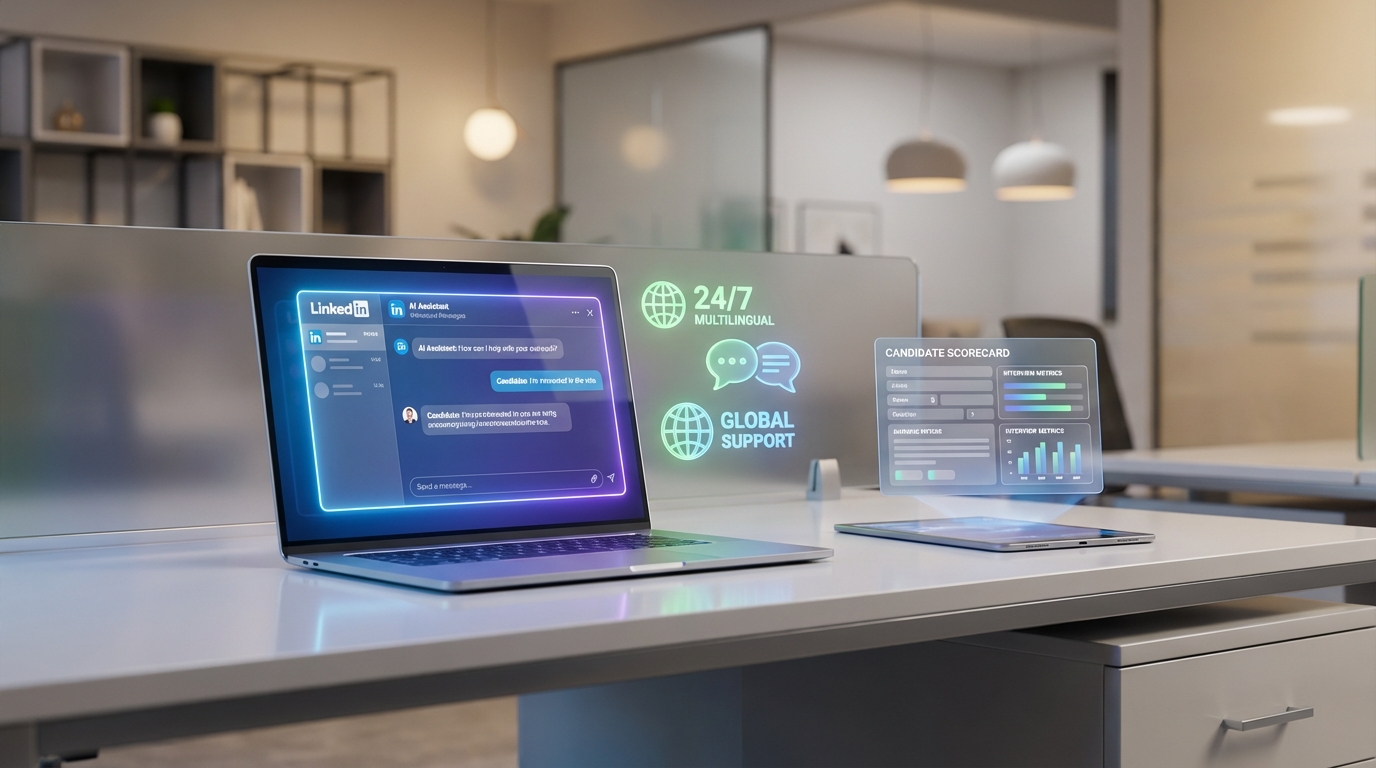
StrategyBrain AI Recruiter supports the front end of the funnel so interview time is spent on the right people. It automatically connects with candidates on LinkedIn based on recruiter provided search criteria, introduces the role, answers questions about the company, compensation, and benefits, confirms interview interest, and collects résumés and contact details from interested candidates. That reduces the number of low intent conversations that otherwise consume recruiter time before interviews even start.
Once candidates reach interviews, teams can pair this with an interview intelligence platform approach. The goal is not to replace human judgment. The goal is to standardize what gets evaluated and recorded so hybrid stakeholders can make decisions faster.
Trend 2: Flexible seating and shared spaces
Flexible seating shows up in several forms. Hot desking is first come first served seating. Hoteling uses a reservation system for desks or rooms. Some offices also define neighborhoods such as quiet zones and collaboration zones to reduce conflict between focused work and group sessions.
These changes affect recruiting because candidates ask different questions now. They want to know how often they will be in office, whether they will have a dedicated space, and how collaboration works when teams are split across locations.
Recruiting implications
- Your job pitch needs operational detail because candidates evaluate the work model, not just the title.
- Hiring managers must align on expectations so candidates do not hear conflicting answers.
- Candidate communication must be timely because hybrid policies create more back and forth questions.
How StrategyBrain AI Recruiter fits
This is where always on candidate messaging becomes a competitive advantage. StrategyBrain AI Recruiter provides 24/7 multilingual responses and follow up, using the candidate’s native language to reduce misunderstandings. In practice, that means candidates can ask policy questions when they think of them, not only during recruiter business hours, and the conversation stays warm until the interview is scheduled.
We also found that flexible seating increases the number of candidates who request clarification on compensation and benefits. StrategyBrain AI Recruiter is designed to answer role, company, and compensation questions during the initial LinkedIn conversation, then collect résumés and contact details when the candidate confirms interest.
Trend 3: Wellness perks and the recruiting pitch
Employers have experimented with perks to encourage office attendance, including wellness spaces and concierge style services. At the same time, there is a real concern that campus style workplaces can blur boundaries and increase the sense that work is always on.
From a recruiting perspective, perks only help if they are credible and aligned with workload reality. Candidates are increasingly sensitive to signals that a company is trying to compensate for poor work life balance with amenities.
Recruiting implications
- Perks should be framed as support rather than as a reason to stay longer.
- Candidate trust depends on transparency about expectations and flexibility.
- Hiring teams need consistent messaging so the pitch does not feel like marketing.
How StrategyBrain AI Recruiter fits
StrategyBrain AI Recruiter helps here by standardizing the first touch narrative. Recruiters provide company details, compensation, benefits, and role context, then the AI uses that information to communicate consistently across candidates. This reduces the risk of different recruiters improvising different perk narratives that later create trust issues.
Trend 4: Do we need an office at all
Some organizations consider downsizing or eliminating office space if remote work is effective. Others believe removing the office harms cohesion. A middle path is hybrid work with a smaller office footprint, but that can create uneven occupancy patterns, with many employees choosing to work from home on Mondays and Fridays and coming in midweek.
For recruiting, the key is that candidates now evaluate the work model as part of total compensation. If your policy is unclear, you will lose candidates to employers who can explain expectations in plain language.
Recruiting implications
- Hybrid policy clarity reduces drop off because candidates can self select earlier.
- Scheduling complexity increases because interviewers and candidates have different in office days.
- Global hiring becomes more realistic when the role is not tied to a single location.
How StrategyBrain AI Recruiter fits
If you are hiring across time zones, response time becomes a bottleneck. StrategyBrain AI Recruiter supports global hiring with 24/7 multilingual communication. It also supports building AI powered recruitment teams by managing more than 100 LinkedIn accounts, which is useful when organizations need to scale outreach without adding recruiter headcount.
How to operationalize these trends with an AI hiring platform
Below is the operating playbook we recommend when hybrid work and office redesign start changing candidate expectations. The goal is to make your process reproducible, measurable, and fair.
Step by step implementation
- Write a one page work model brief
Document in office expectations, flexibility, and how collaboration works. Use the same language recruiters will use in outreach and screening. - Standardize your interview plan
Define competencies, assign interviewers, and decide what evidence is required for a hire decision. This is the foundation of a live interview ai workflow because AI support is only useful when the structure is clear. - Automate the first touch on LinkedIn
Use StrategyBrain AI Recruiter to connect with candidates that match your criteria, introduce the role, answer questions about compensation and benefits, confirm interest, and collect résumés and contact details. - Set response time expectations
If you compete for talent globally, use 24/7 multilingual messaging so candidates do not wait for business hours. This is where an ai hiring platform can directly improve candidate experience. - Define the human handoff point
StrategyBrain AI Recruiter does not decide if a résumé matches requirements. Recruiters review the résumé and then proceed with screening and interviews. Make that handoff explicit so the process stays compliant and accountable.
Limitations and honest notes
- AI does not replace final qualification for role fit. Recruiters still need to assess skills and experience against requirements.
- Policy ambiguity cannot be automated away. If leadership is not aligned on hybrid expectations, candidate conversations will still stall.
- Interview intelligence depends on structure. If interviewers do not follow a consistent plan, insights will be inconsistent too.
Practical checklist you can copy
- [ ] Work model brief approved by hiring manager and recruiter
- [ ] Compensation and benefits talking points documented
- [ ] Interview plan defined with competencies and scorecard
- [ ] LinkedIn outreach criteria set for the role
- [ ] Candidate response time target defined for each time zone
- [ ] Handoff rule defined for when recruiter takes over from AI
Quick comparison: manual recruiting vs AI assisted workflows
| Workflow area | Manual process | AI assisted process with StrategyBrain AI Recruiter | Best for |
|---|---|---|---|
| LinkedIn outreach | Recruiter sends connection requests and messages one by one | AI automatically connects and introduces the role based on criteria | High volume sourcing |
| Candidate Q and A | Replies limited to recruiter working hours | 24/7 multilingual responses and follow up | Global hiring and time zone coverage |
| Interest confirmation | Recruiter qualifies interest through back and forth messaging | AI confirms interview interest during conversation | Reducing low intent calls |
| Résumé and contact capture | Recruiter requests files and manually tracks details | AI requests and captures résumés and contact details from interested candidates | Cleaner handoff to interviews |
| Final qualification | Recruiter reviews résumé and decides next steps | Recruiter still reviews résumé and decides next steps | Maintaining human accountability |
FAQ
What is an ai hiring platform in practical terms
An ai hiring platform is a system that uses automation and AI assistance to standardize sourcing, candidate communication, and evaluation workflows. In hybrid hiring, it is most useful when it reduces response delays and keeps interview processes consistent across teams.
How does live interview ai help in hybrid work
Live interview ai refers to AI supported interview preparation and structured capture of interview notes and signals during the interview process. It helps most when the interview plan is standardized, so insights are comparable across candidates and interviewers.
Does StrategyBrain AI Recruiter replace recruiters
No. StrategyBrain AI Recruiter automates initial LinkedIn outreach, answers common questions, confirms interest, and collects résumés and contact details. Recruiters still do the final qualification by reviewing résumés and running interviews.
Can StrategyBrain AI Recruiter communicate in multiple languages
Yes. It supports 24/7 multilingual candidate communication and uses the candidate’s native language to reduce misunderstandings, which is especially helpful for global hiring across time zones.
How many LinkedIn accounts can be managed for scaling outreach
StrategyBrain AI Recruiter supports managing more than 100 LinkedIn accounts so organizations can build AI powered recruitment teams and scale outreach capacity.
How does the system handle résumés and contact details
When a candidate expresses interest, StrategyBrain AI Recruiter requests a résumé and contact information. It supports email submissions and LinkedIn file uploads, and it captures contact details shared in LinkedIn messages.
Is candidate data used to train AI models
According to the product information provided, customer provided data is not used to train AI models. Data is used to personalize communication for the customer’s AI instance, and credentials are encrypted and stored independently per user with explicit authorization.
What is the biggest risk when adopting an interview intelligence platform
The biggest risk is relying on tooling without standardizing the interview structure. If interviewers do not follow a consistent plan, the resulting insights and documentation will be inconsistent and less useful for decision making.
Conclusion
Office trends like video first collaboration, flexible seating, and hybrid schedules change what candidates ask and how fast teams must respond. The most reliable way to keep hiring quality high is to treat recruiting like an operating system. Standardize the interview plan, then use an ai hiring platform to keep candidate communication timely and consistent.
If your bottleneck is LinkedIn outreach and follow up, StrategyBrain AI Recruiter is designed to automate the first touch, answer role and compensation questions, confirm interest, and capture résumés and contact details. Next step: document your work model brief, define your interview scorecard, and pilot AI assisted outreach for one role so you can measure response time, interview volume, and candidate drop off.